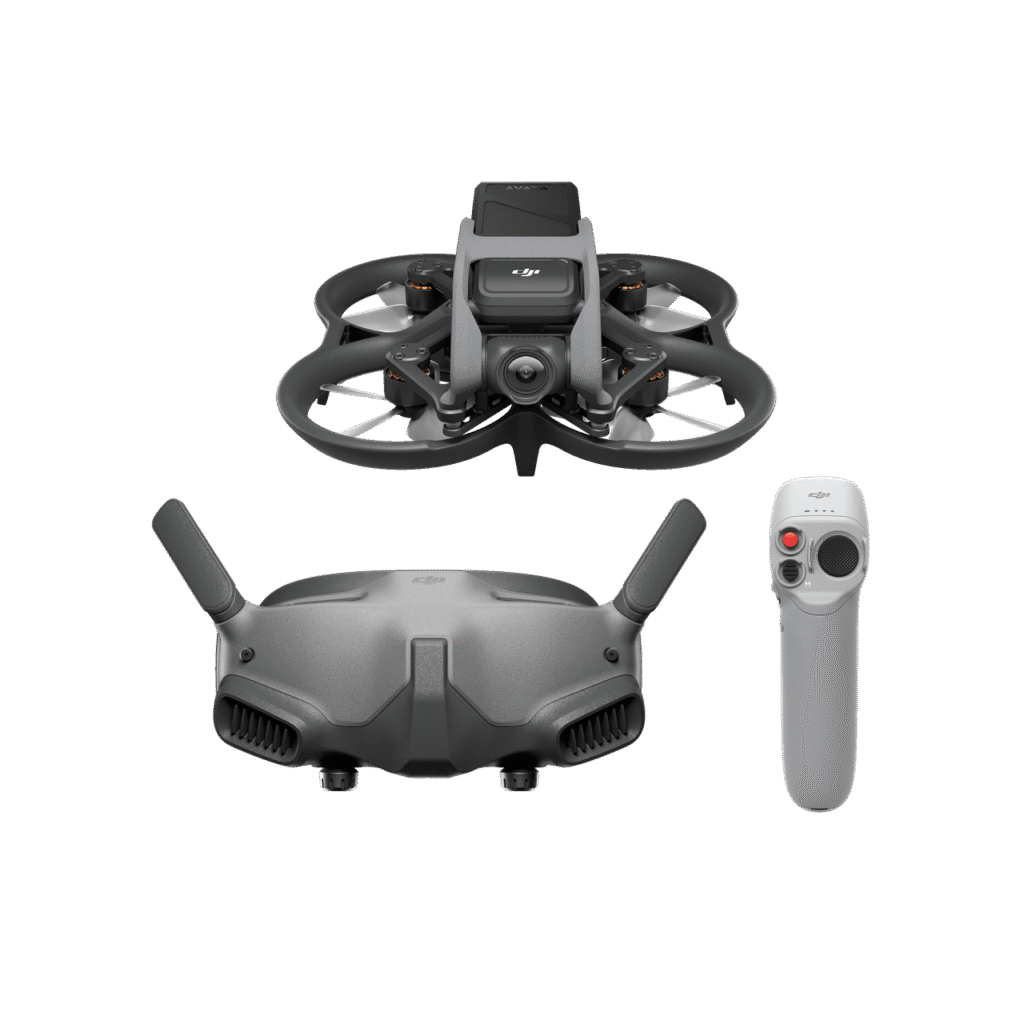
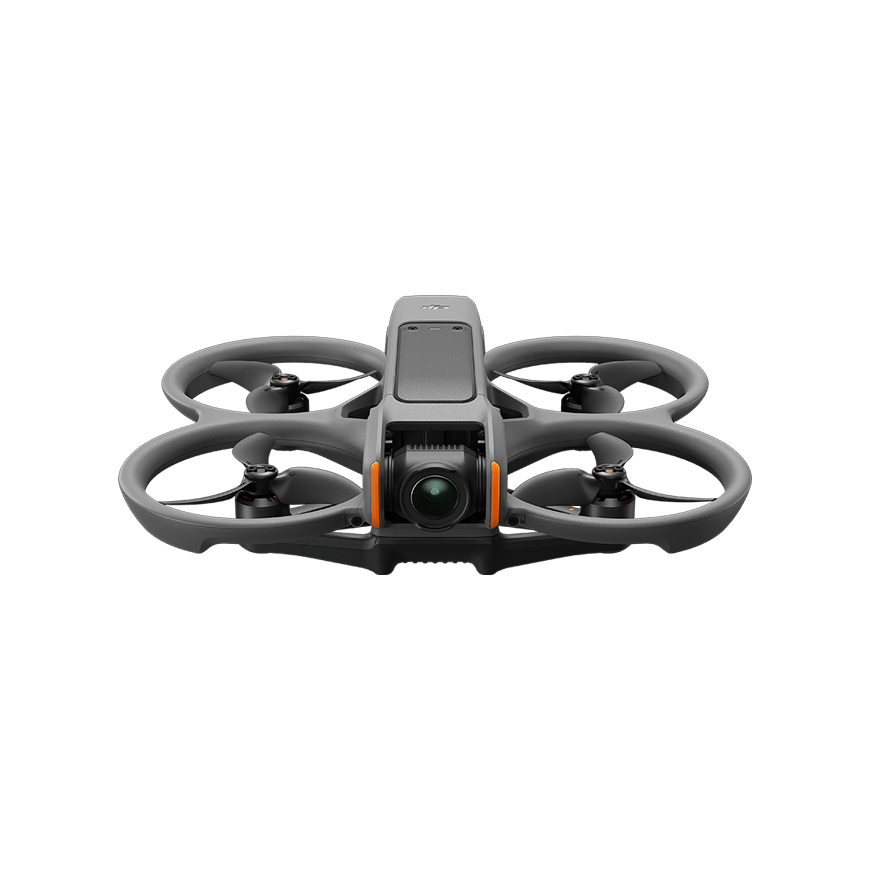
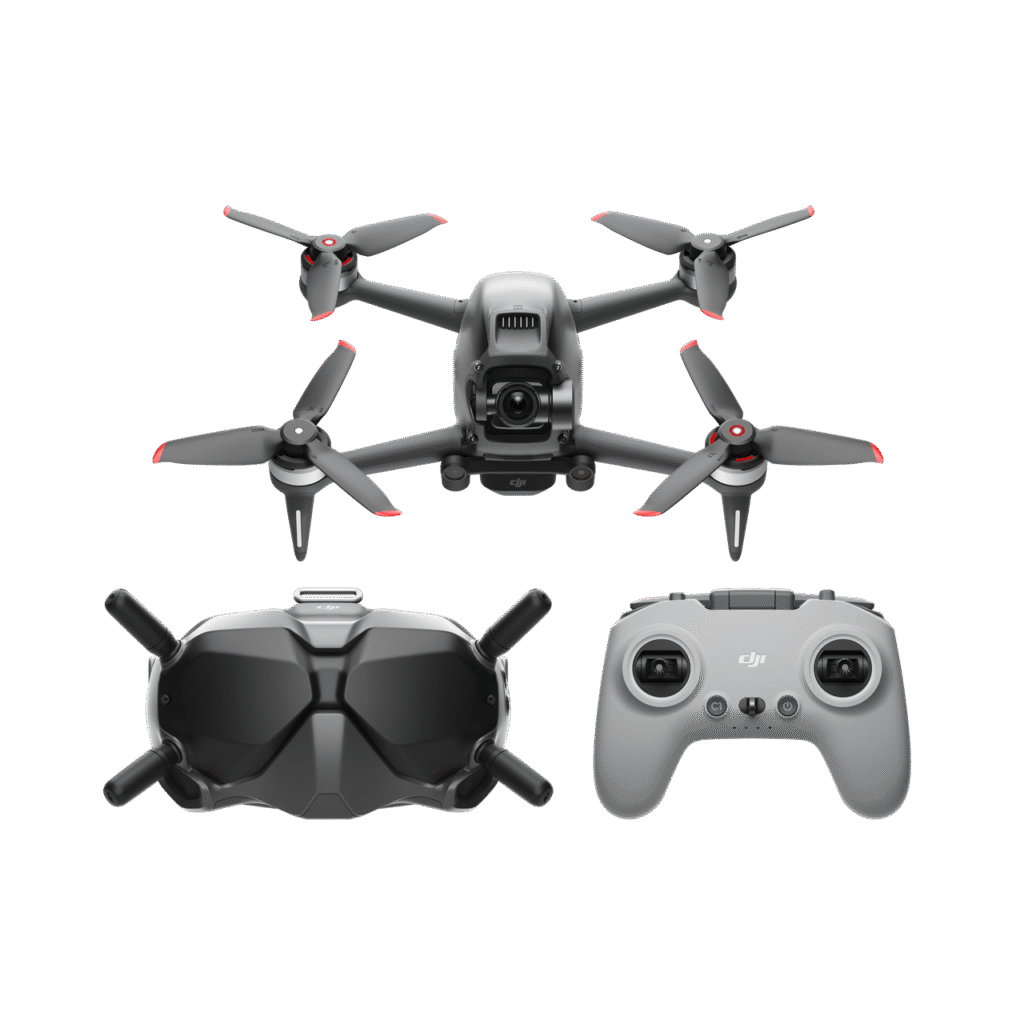
Two guarded cinewhoops and one speed machine
The Avata and Avata 2 use compact cinewhoop-style bodies with integrated propeller guards, so they suit close-proximity flying and routes near structures. The DJI FPV Drone is a larger, faster platform with exposed propellers, built for acceleration and open space. That split decides more than any single spec: pick the airframe for where you fly, then compare cameras.
The Avata 2 has the best camera, the Avata the highest bitrate
The Avata 2's 1/1.3-inch sensor is larger than the original Avata's 1/1.7-inch and the FPV Drone's 1/2.3-inch. A bigger sensor doesn't guarantee a better image every time, but it gives the Avata 2 the clearest on-paper edge in low light and dynamic range.
It also records 4K at up to 100fps, so you get high-resolution slow motion without dropping to 2.7K or 1080p. The original Avata does 4K up to 60fps and 120fps at 2.7K; the FPV Drone reaches 120fps only at 1080p.
Bitrate runs the other way: 150 Mbps on the Avata, 130 on the Avata 2 and 120 on the FPV Drone. Bitrate alone doesn't decide image quality, but it helps with fast motion and fine texture. For color work, the Avata 2 offers D-Log M; the other two offer D-Cinelike. None of the three shoots RAW stills, so all three are video tools first.
Speed: the FPV Drone is in a different class
DJI rates the FPV Drone at 39 m/s in Manual mode, against 27 m/s for both Avatas. The Avata 2 is further capped at 19 m/s in Manual mode in EU regions. The guards that make the Avatas safer near gates and structures also add drag compared with exposed propellers.
Those top speeds are Manual-mode figures, not beginner settings. Manual FPV flight removes stabilization help and needs training, open space and careful setup.
Flight time and battery energy
Rated flight times are about 23 minutes for the Avata 2, 20 for the FPV Drone and 18 for the original Avata. Don't compare mAh figures without voltage: the FPV Drone has the lowest mAh but the most energy at 44.4 Wh, against 35.71 Wh for the Avata and 31.7 Wh for the Avata 2. The bigger aircraft simply burns more power. Hard acceleration, wind, cold and a sensible return reserve all cut real flight time well below these maximums, so budget for a multi-battery kit.
None of them avoids obstacles for you
The Avata uses downward vision and time-of-flight sensors, mainly for positioning. The Avata 2 adds backward visual positioning but still has nothing facing forward to protect you entering a gap at speed. The FPV Drone has forward and downward sensing in Normal mode, which can slow the aircraft but won't brake and steer around an obstacle, and those functions are restricted in Sport and Manual modes.
Thin branches, wires, reflective surfaces, low-contrast walls and poor light all trip up vision systems. Guards can soften some low-speed contact, but they don't replace walking the route and keeping speed in check.
Weight, size and storage
The Avata 2 weighs 377 g and the original Avata 410 g. The FPV Drone weighs 795 g and has a much bigger footprint with propellers fitted, which means more momentum in a collision and less room for tight routes. All three are over 250 g, so in the US each must be registered with the FAA; in the EU operators register with their national aviation authority. See the registration-by-weight guide for details.
The Avata 2 has 46 GB of internal storage, more than double the Avata's 20 GB. The FPV Drone has none, so a microSD card is mandatory; carry a spare, because high-frame-rate 4K fills cards fast.
Range and goggles
The Avata 2 has the longest published link: 13 km (FCC) and 10 km (CE, SRRC, MIC). The original Avata lists 10 km FCC, 2 km CE and 6 km SRRC; the FPV Drone 10 km FCC and 6 km CE, SRRC and MIC. These are open-field radio maximums, not flight distances, and they don't override visual-line-of-sight rules.
Goggles and controllers don't carry over cleanly. The Avata was designed around DJI Goggles 2 or FPV Goggles V2, while the Avata 2 launched with Goggles 3 and newer controls. Check DJI's current compatibility list before reusing accessories. If you are weighing DJI's newer 360-degree model, see the Avata 360 vs Avata 2 comparison.