DJI Agras T60 vs DJI Agras T70P
For a new high-volume operation, buy the T70P. It carries 70 L of liquid instead of 50 L, sprays 30 L/min as standard (40 with four nozzles), spreads up to 400 kg/min of compound fertilizer against roughly 190 kg/min on the T60, and adds a…
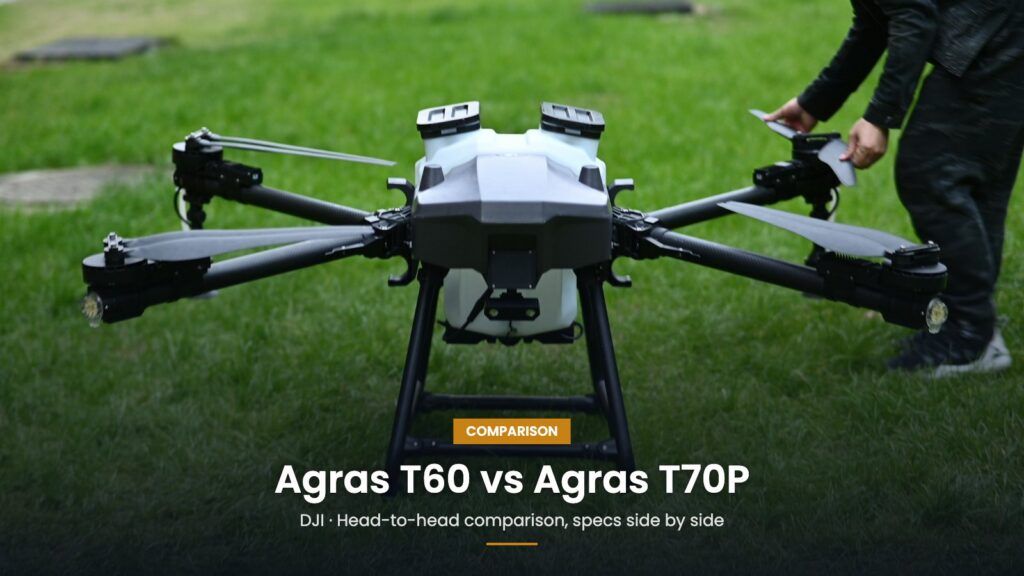
DJI Agras T60
N/A

DJI Agras T70P
N/A
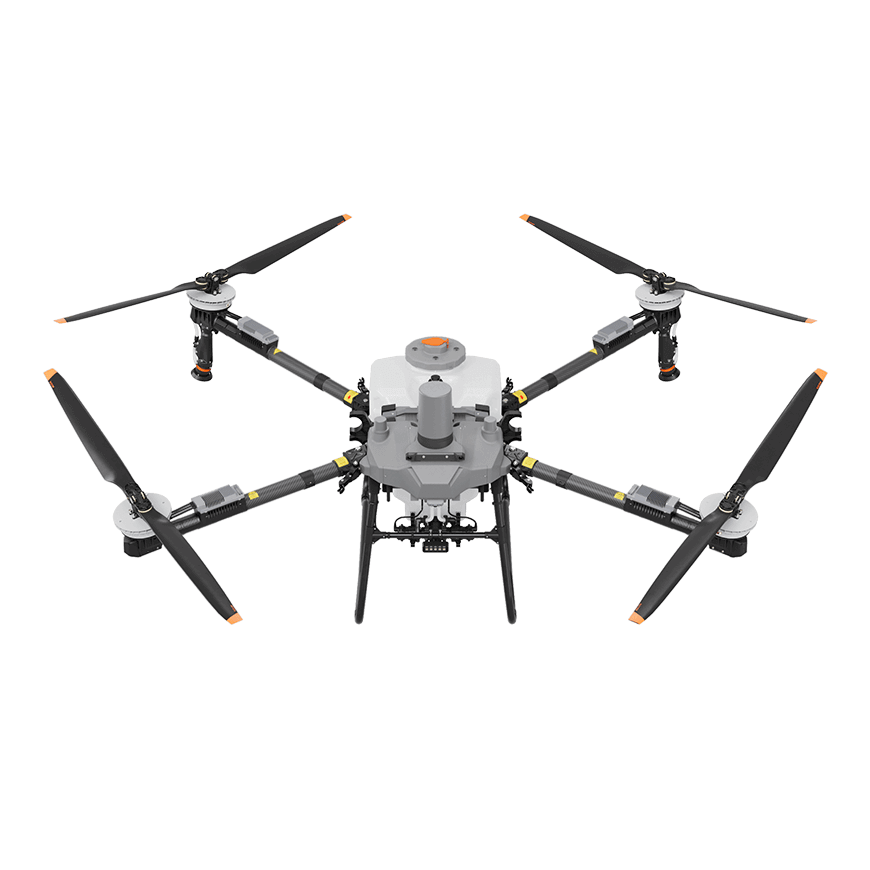
Technical Specifications
Last updated: Oct 2026| Feature | DJI Agras T60 | DJI Agras T70P |
|---|---|---|
| Weight | Approx. 61 kg with DB2100 battery | 52 kg with DB1580 battery; 56 kg with DB2160 battery |
| Dimensions | 2870×3295×900 mm unfolded; 1100×900×900 mm folded | 3200×3520×960 mm unfolded; 1160×900×960 mm folded |
| Volume | Approx. 891000 cm³ folded bounding-box volume | Approx. 1002000 cm³ folded bounding-box volume |
| Max Speed | Up to 13.8 m/s within the documented safe obstacle-avoidance operating envelope | 20 m/s maximum operation speed (manufacturer-stated) |
| Max Flight Distance | 2 km configurable flight radius | 2 km configurable flight radius |
| Sensor Size | Safety System 3.0 with front and rear phased-array radar and trinocular vision | Safety System 3.0 with millimeter-wave radar and Tri-Eye Visionary Intelligence |
| Megapixels | N/A – agricultural FPV and safety vision system | N/A – agricultural FPV and safety vision system |
| Max ISO | N/A | N/A |
| Flight Time | Mission endurance varies significantly with payload and operating conditions | Mission endurance varies according to battery configuration, payload and field conditions |
| Max Resolution | Low-light full-color FPV monitoring camera; not intended for cinematography | Agricultural FPV and AR-enhanced operational display; not intended for cinematography |
| Movie Bitrate | N/A | N/A |
| Field of View | Front radar 360° horizontal; rear radar 360° vertical; trinocular vision coverage | Front radar 360° horizontal; rear radar 360° vertical; Tri-Eye vision 90° horizontal and 180° vertical |
| Transmission Range | 2 km configurable operating radius with O4 transmission | 2 km configurable operating radius; compatible relay can extend communication coverage |
| Wind Resistance | <6 m/s | <6 m/s |
| Obstacle Avoidance | Safety System 3.0 with phased-array radar, vision sensing and intelligent obstacle bypassing | Safety System 3.0 with millimeter-wave radar, Tri-Eye vision, obstacle avoidance and AR-enhanced display |
| Battery Power | DB2100 Intelligent Flight Battery, 40000 mAh, 52.22 V | DB1580 30000 mAh or DB2160 41000 mAh, both 52 V |
| Charge Time | Approx. 10–12 minutes from 15% to 95% with D12500iE; 12–15 minutes with C10000P under stated conditions | Approx. 7–8 minutes DB1580 or 8–9 minutes DB2160 from 30% to 95% with supported fast-charging equipment |
| Internal Storage | N/A | N/A |
| GPS | Yes, RTK/GNSS positioning | Yes, RTK/GNSS positioning |
| Obstacle Detection | Yes | Yes |
| Return to Home | Yes | Yes |
| Removable Battery | Yes | Yes |
| Shoots RAW | Not applicable | Not applicable |
| HDR Mode | Not applicable | Not applicable |
| Weather Sealed | No aircraft IP rating confirmed in the compared specification set | No aircraft IP rating listed on the compared official specification page |
| Best For | Large farms and contractors focused on spraying and spreading | High-throughput operations that want spraying, spreading and lifting from one aircraft |
| Standard Spray Tank | 50 L | 70 L |
| Maximum Spray Tank Configuration | 60 L with fruit-tree kit | 70 L |
| Spraying Payload | 50 kg standard | 70 kg |
| Standard Spray Flow | 18 L/min with 2 nozzles | 30 L/min with 2 nozzles |
| Maximum Spray Flow | 28 L/min with 4 nozzles | 40 L/min with 4 nozzles |
| Effective Spray Width | 4–11 m | 4–11 m |
| Spreading Tank Volume | 80 L | 100 L |
| Spreading Payload | 60 kg | 70 kg |
| Maximum Spreading Discharge | Approx. 190 kg/min | 400 kg/min |
| Effective Spreading Width | 3–8 m | 3–10 m |
| Lifting Capacity | No dedicated lifting system listed | 65 kg |
| Battery Capacity | DB2100: 40000 mAh | DB1580: 30000 mAh; DB2160: 41000 mAh |
| Fast Charging | 10–12 min generator; 12–15 min charger | 7–8 min DB1580; 8–9 min DB2160 |
| Propeller Size | 56 inches | 62 inches |
| Maximum Configurable Flight Radius | 2 km | 2 km |
| Obstacle Detection Range | Up to 60 m | Up to 60 m |
| Safe Obstacle-Avoidance Speed | Up to 13.8 m/s | Up to 13.8 m/s |
| Operating Temperature | 0°C to 40°C | 0°C to 40°C |
T60 vs T70P in numbers
- Spray tank: 50 L (60 L fruit-tree kit) vs 70 L
- Spray flow: 18 L/min (28 with four nozzles) vs 30 L/min (40 with four)
- Spreading: 80 L box, 60 kg, about 190 kg/min vs 100 L tank, 70 kg, 400 kg/min
- Lifting: not listed vs 65 kg
- Folded size: about 1100×900×900 mm vs 1160×900×960 mm
Spraying: 70 L and 30 L/min on the T70P
The T60 carries 50 L as standard and is rated at 18 L/min with two nozzles. Its four-nozzle fruit-tree configuration raises flow to 28 L/min and the tank to 60 L, with optional pressure centrifugal sprinklers for orchards. The T70P moves to 70 L and 30 L/min with two nozzles, or 40 L/min with four. That extra flow only helps when your application rate and field conditions allow faster work.
Spreading is where the gap is widest
The T60's spreader uses an 80 L box with a 60 kg load and discharges about 3.1 kg/s (roughly 190 kg/min), with an effective width of 3 to 8 m depending on material. The T70P uses a 100 L tank with a 70 kg load and DJI states up to 400 kg/min for compound fertilizer, with width up to 10 m in the stated test setup. For fertilizer and seeding contractors this is the most important line in the spec sheet.
Only the T70P lists a lifting system
The T70P supports a dedicated lifting kit rated for 65 kg, with a 10 m standard cable and a recommended length of 10 to 15 m. The T60 spec set used here lists no equivalent, so the T70P can also handle short material transport.
Batteries and charging
The T60 uses the DB2100 (40000 mAh, 52.22 V), documented at about 10 to 12 minutes to charge with the D12500iE generator or 12 to 15 minutes with the C10000P charger. The T70P takes either the DB1580 (30000 mAh) or DB2160 (41000 mAh), rated at about 7 to 8 and 8 to 9 minutes from 30% to 95% on supported hardware. These figures assume specific charge levels, temperatures and input power; field charging can take longer.
Obstacle sensing, speed and RTK
Both support RTK/GNSS positioning for repeatable routes, and both combine radar with vision for terrain following and obstacle bypassing. The T60 pairs front and rear active phased-array radar with a trinocular vision system; the T70P uses millimeter-wave radar and Tri-Eye Visionary Intelligence with AR-enhanced obstacle awareness. DJI's documentation lists sensing up to 60 m and safe obstacle-avoidance speed up to 13.8 m/s under supported conditions. Neither is collision-proof: rain, fog, poor light and thin wires reduce detection.
DJI markets the T70P with a 20 m/s maximum operation speed. I couldn't confirm a comparable figure for the T60 in the current material, so it isn't compared here.
Transport and real-world throughput
The T70P folds slightly larger than the T60, though it can weigh less with the DB1580 battery. In practice batteries, chargers, generators and mixing gear shape daily logistics more than a few centimeters of airframe. Recommended payload also changes with altitude, temperature and task, so follow the DJI Agriculture system's loading guidance rather than sea-level maximums, and don't expect a bigger tank to raise hectares per hour by the same percentage.
Which fits your operation
- Existing T60 fleet that keeps up with the work: stay with the T60
- High-volume spraying contractor: T70P
- Large fertilizer or seeding jobs: T70P
- Work that needs lifting: T70P
- Fleet standardized on DB2100 batteries and T60 chargers: T60
Before buying in the US, read our explainer on US rules affecting spray drones, and check regional price, dealer bundle and warranty, which this comparison does not cover.
DJI Agras T60
Strengths
- 50 L spray tank, 60 L with the fruit-tree configuration
- 18 L/min standard flow, 28 L/min with four nozzles
- 60 kg spreading payload with an 80 L box
- Safety System 3.0 with terrain following and obstacle bypassing
- Slightly smaller when folded
Drawbacks
- Smaller spray tank and lower flow than the T70P
- Spreading discharge less than half the T70P's maximum
- No dedicated lifting system listed
- Older DB2100 battery with slower published charging
DJI Agras T70P
Strengths
- 70 L spray tank with a 70 kg operating payload
- 30 L/min standard flow, 40 L/min with four nozzles
- Up to 400 kg/min compound-fertilizer discharge from a 100 L tank
- Dedicated lifting system rated for 65 kg
- Two battery options with faster published charging
- 20 m/s stated maximum operation speed
Drawbacks
- Larger airframe and heavier transport logistics
- Payload depends on battery choice and conditions
- Full performance needs optional nozzle, spreading, lifting or relay hardware
- Extra capacity may not pay off on smaller farms
Is the T70P worth it over the T60?
For a new high-volume operation, buy the T70P. It carries 70 L of liquid instead of 50 L, sprays 30 L/min as standard (40 with four nozzles), spreads up to 400 kg/min of compound fertilizer against roughly 190 kg/min on the T60, and adds a 65 kg lifting system.
The T60 is still a capable heavy-duty drone: 50 L spray tank (60 L in the fruit-tree configuration), 60 kg spreading payload and Safety System 3.0. If your current T60 fleet already keeps up with your acreage and your batteries and chargers are built around it, there is no urgent reason to replace it.
My read: the T70P's biggest gain is in spreading and lifting, not spraying. Contractors who do a lot of fertilizer or seed work will feel the difference most.
Context and limitations
This comparison helps buyers choose between DJI Agras T60 and DJI Agras T70P by translating the specification table into camera, flight, safety, workflow and value decisions. Recommendations are matched to user needs rather than based on a single headline number.
Limitations
The Friday Brief
One email a week on what changed in drones
FCC and FAA rule changes, DJI leaks checked against filings, and the week’s new comparisons. Every Friday, nothing else.
Free. Unsubscribe in one click. Sent with Kit; see our privacy policy.
Follow us on Google too: add Drone Ranker as a preferred source →

Alihan Demirdaş is the founder and editor of Drone Ranker. A software developer by profession, he researches drones the way he reads code: from the primary documents. Every review, comparison and news story on the site is written by him from manufacturer specification sheets, FCC and EU certification filings, aviation-authority rules and dated press releases, with the source linked. Unless a page is labelled hands-on, the analysis is documentary; when an aircraft is in his hands, the page says so and carries his own photographs and flight notes. He covers consumer, professional and agricultural drones and is based in Türkiye.