Which Spray Drones Can US Farmers Still Buy? Check the FCC Date, Not the Flag

If you farm in the United States and you were planning to buy a spray drone this winter, the question you will hear most is which brands are banned. It is the wrong question, and answering it the wrong way can cost a season.
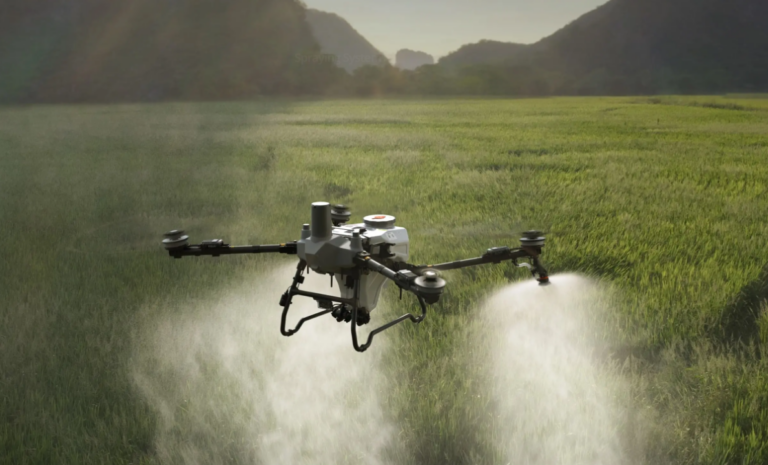
The agricultural drone ban that started on 22 December 2025 does not name a country or a logo. It names a date. A spray drone whose FCC authorization was granted before that date can still be imported, sold and flown. A model that was not authorized by then cannot get authorized now, whether it is built in Shenzhen, São Paulo or Seoul. That is why a DJI Agras T55 is still on American dealer shelves and why a farmer who switched to a Brazilian brand to “get away from China” may have bought into the same problem.
Below is the model-by-model picture as of October 2026, what happens to the aircraft already in your shed, and the one rule taking effect on 13 October that makes “just buy American” less simple than it sounds.
Table of Contents
Checking one aircraft? Every model in the table below is also in our US drone ban checker, alongside DJI’s consumer drones.
The short answer
- Still buyable new, for now: spray drones whose FCC equipment authorization was granted before 22 December 2025. That includes the DJI Agras T55, T100, T50 and T40 families, and the XAG P150 Max, which XAG says is FCC-approved.
- Not coming: any foreign-built model that missed the cut-off. It cannot receive a new FCC authorization unless it qualifies for an exemption.
- Could change by early 2027: a pending FCC proposal would stop imports and marketing of foreign spray drones, and a second one names XAG directly. Neither would affect drones you already own.
- Already in your fleet: nothing changes. The rule is prospective. Your aircraft stays legal to fly, and covered manufacturers may keep pushing firmware updates through at least 1 January 2027.
- US-built alternatives: Hylio, Revolution Drones and others are scaling, but several still source motors, radar or batteries abroad, which is exactly where the 2026 rules bite next.
Why the date matters more than the brand
On 22 December 2025 the FCC added “UAS and UAS critical components produced in a foreign country” to its Covered List. It was the first time the list took in a whole product category rather than named companies. DJI and Autel were also named individually, but for a spray drone buyer the category entry is the one that matters, because it reaches every foreign manufacturer at once.
The Covered List works through equipment authorization. Anything that transmits needs an FCC grant before it can be marketed in the US, and a covered device cannot get a new one. Grants issued before the listing are not revoked. So the useful test for any spray drone is two lookups: its FCC ID, and the date that ID was granted.
We set out the general version of this argument in our explainer on which drones are banned in the US. Agriculture is where it has the sharpest edge, because, by DJI’s own estimate, roughly four out of five spray drones flying on American farms in 2024 were DJI aircraft.
Model by model: what the FCC records show
The table uses the FCC IDs printed in equipment filings. DJI’s IDs carry a four-digit suffix that appears to track the filing period, consistent with the T100 (suffix 2411) and T55 (suffix 2510) grants both pre-dating the listing. Where we could not confirm a grant date ourselves, the table says so.
| Model | FCC ID | Granted before 22 Dec 2025? | Status for a US buyer |
|---|---|---|---|
| DJI Agras T55 | SS3-T55A2510 | Yes, granted 19 Dec 2025 | Legal to sell. Listed by US ag dealers. |
| DJI Agras T100 | SS3-T100A2411 | Yes | Legal to sell. Listed by US ag dealers; no DJI US list price. |
| DJI Agras T70P | SS3-T702412 (filed as Agras T70 / T70P) | Filing period indicates yes; grant date not independently checked | Authorization exists under the T70 ID |
| DJI Agras T25P | SS3-T60A2404 (filed as Agras T60 / T25P) | Filing period indicates yes; grant date not independently checked | Authorization exists under the T60 ID |
| DJI Agras T50 / T25 | SS3-T50A2303 | Yes | Legal to sell |
| DJI Agras T40 / T20P | SS3-T40A2112 | Yes | Legal to sell |
| XAG P150 Max | Not published by XAG | XAG states it is FCC-approved for US operations | Launched in the US on 4 Feb 2026; dealer network has changed, and XAG is named in a pending FCC proposal (see below) |
| XAG P200 | None found | Not confirmed | No US launch announced. Treat as unavailable until an FCC ID appears. |
Two rows deserve a second look. The T70P and T25P launched globally in late 2025, and coverage of DJI’s US position has focused on the T55 and T100 grants while leaving these two out. The FCC records fill the gap: both names sit on authorizations DJI filed under its existing T70 and T60 IDs. That matters to a buyer because a dealer quoting either aircraft is not necessarily selling something the FCC will not allow. We have not been able to confirm the date each model name was added to those IDs, so if you are spending tractor money, ask the dealer for the FCC ID and look up the grant history yourself.
The XAG P200 is the opposite case. It is a strong aircraft on paper (we break down the spec sheet in our XAG P200 review), but XAG’s US announcement in February covered the P150 Max only, and we found no US authorization for the P200. Unless one turns up, it is not a model a US farm can buy new.
The XAG wrinkle: approved, but the dealer network moved
XAG introduced the P150 Max to American growers on 4 February 2026 at the Spray Drone End User Conference in Kansas City, with a 176 lb maximum payload, a 21.1 gallon RevoSpray 5 tank and a quoted 50 to 60 acres an hour of typical spraying. The press release described the aircraft as FCC-approved for US operations.
Regulation was not the only thing that changed after that. On 27 July 2026, Raptor Dynamic, one of the largest US ag drone distributors, ended new XAG sales. Its dealer notice cited reliability and support problems during the P150’s first season and “shifting FCC regulations”, and pointed dealers who wanted to keep selling XAG to AirStrike as the authorized hand-off partner. Raptor said it will keep supporting XAG aircraft already in the field.
The P150 season created real challenges for both dealers and customers, and we saw a lack of alignment in how those issues were handled.
Raptor Dynamic dealer notice, 27 July 2026
For a buyer, the practical point is that “legal to sell” and “easy to get serviced” are separate questions. Before committing to any imported platform for the 2027 season, ask who holds parts inventory in your state and who will do warranty work.
Why “non-Chinese” does not mean “not covered”
This is the mistake we see most in farm coverage. Several operators have told reporters they moved to Brazilian-made spray drones to stay clear of the ban. One Farm Progress report described a Brazilian brand as unaffected.
The text of the listing does not support that reading. The category entry covers drones and critical components “produced in a foreign country”, not produced in China. A spray drone built in Brazil is foreign-produced. If its FCC authorization was granted before 22 December 2025 it is in the same position as a T55: fine. If it was not, it is in the same position as any new Chinese model: it needs an exemption or it cannot be authorized.
Revolution Drones, the North Carolina company founded by record-holding grower Russell Hedrick, is a useful illustration. It started out partnering with Brazil’s GTEEX and planning Brazilian manufacturing. After the December decision, the company told AgFunder News that “everything is now moving to the US”, with electronics, plastics, harnesses and tanks sourced domestically. It also said its motors and radar still came from China and its batteries from Chinese suppliers, and that it planned to use the FCC’s exemption process to source motors from South America.
The airframe moving to Kansas or North Carolina did not by itself settle the parts question. That is the next section.
13 October: why US assembly may not be enough
A separate FCC order, the component rule in ET Docket 21-232, takes effect on 13 October 2026. It closes what had been a gap: a device that contains a “logic-bearing” component made by a company on the Covered List cannot receive a new authorization if the device would have been barred had that company made all of it.
Logic-bearing is defined broadly: anything that produces timing signals above 9,000 pulses a second using digital techniques, or that uses radio frequency energy to process data. On a spray drone that means the flight controller, the radio link, the radar module and any vision or camera board. Bare motors, frames, tanks, wiring and plain battery cells are outside the definition.
Practitioner analysis reads this rule as reaching the companies named on the list, DJI and Autel among them, rather than every foreign factory. If that reading holds, a US-assembled spray drone with a DJI-made board inside cannot get a new authorization after 13 October, even if most of its value is American. Applications already pending on that date are grandfathered unless they are later amended to add or swap a logic-bearing part.
For the domestic manufacturers, the exposure therefore depends on exactly which electronics they source and from whom. That is not something most of them publish, so we cannot tell you which US-built models are fully clear. What a buyer can do is ask the question directly: who makes the flight controller and the radar, and is the aircraft’s FCC authorization already granted?
Two pending FCC proposals could still change this list
Everything above describes the rules in force today. Two proposals the FCC opened in July 2026 would go further and reach products that were authorized before the cut-off.
- “Military-grade” drones, PS Docket 26-189 (DA 26-758). The FCC proposes ending imports and marketing of foreign-produced covered drones with certain capabilities. The list explicitly includes aerosol drones capable of dispensing “economic poison”, which describes agricultural spray drones, alongside thermal, LiDAR, docking-station, swarming and 55 lb-plus aircraft. Published in the Federal Register on 3 August 2026, it would take effect about 180 days later, around 30 January 2027, if adopted. Comments closed on 2 September. Products on the Blue UAS list, Buy American “domestic end products” and conditionally approved equipment are excluded.
- Nine named companies, PS Docket 26-184 (DA 26-742). Released on 17 July 2026, this notice proposes stopping imports and marketing of equipment from nine companies, and XAG (Guangzhou Xaircraft) is one of them. If adopted, sales would have to stop 30 days after the final order is published.
Under both proposals the FCC says owners could keep using equipment they have already bought. Neither has been adopted yet. For a farm planning a 2027 purchase, the practical reading is that today’s “legal to sell” list for DJI Agras and XAG aircraft may not survive the winter, so timing and parts supply matter more than they did a year ago.
What happens to the spray drone you already own
- Flying it: legal. The Covered List restricts new authorizations, not operation of equipment that was lawfully authorized.
- Firmware: in January 2026 the FCC clarified that previously authorized drones from covered manufacturers may continue to receive software and firmware updates through at least 1 January 2027. What happens after that date has not been decided.
- Batteries and spare parts: parts for an already-authorized aircraft are not new equipment authorizations, but dealers quoted by Farm Progress expect replacement parts to get more expensive. Budget for that rather than assuming 2025 pricing.
- Resale: an authorized aircraft keeps its FCC ID. From 1 June 2027, online marketplaces must verify an FCC ID on third-party listings, and used devices are exempt, so a private resale is not affected by that rule.
The market is already moving
The numbers AgFunder News cited in January show the shape of it. Drone-treated acreage in the US rose 58.7% in 2025 to 16.4 million acres, while new spray drone sales fell 59%, from 8,950 units in 2024 to 3,711 in 2025, and the average price per treated acre dropped from $21 to $13. More acres are being sprayed by fewer new aircraft, which is what you would expect when operators stretch fleets they already own.
On the supply side, Hylio in Texas told AgFunder it was producing about 2,500 aircraft a year and targeting more than 5,000. Ceres Air in Vermont, Agri Spray Drones in Missouri and Exedy Drones in Michigan are building or planning US production. Exedy, a subsidiary of a Japanese automotive parts group, has said every aircraft it releases will carry more US content “until we have a 100% US drone”, which is an honest admission that the first ones will not.
The dates that decide the next 15 months
| Date | What happens | Who it hits |
|---|---|---|
| 22 Dec 2025 | Foreign-produced UAS and critical components added to the Covered List | Any spray drone not authorized by then |
| 13 Oct 2026 | Component rule in force: no new authorizations for devices with covered-company logic boards | US-assembled aircraft using DJI or Autel electronics |
| 1 Jan 2027 | Firmware assurance for covered manufacturers runs “through at least” this date | Every covered fleet’s update path |
| ~30 Jan 2027 | Proposed: imports and marketing of foreign “military-grade” drones, including spray drones, would stop (PS Docket 26-189), if adopted | DJI Agras, XAG and other imported sprayers |
| 1 Mar 2027 | Marketplaces holding stock must show a valid FCC ID | Retail spray drone listings |
| 1 Jun 2027 | Third-party marketplace listings must carry a verified FCC ID | Online resellers (used devices exempt) |
| 1 Jan 2028 | Blue UAS and Buy American “domestic end product” exemptions end (extended from 1 January 2027 on 21 July 2026) | Exempted imports |
We will update this page on 13 October and again when the FCC decides what follows 1 January 2027. If you run a farm operation and are pricing a 2027 aircraft, our DJI Agras T55 review, the Agras T55 vs T50 comparison and the Agras T60 vs T70P comparison cover the spec side.
Frequently asked questions
Is there an agricultural drone ban in the US?
Not on flying. The agricultural drone ban is a ban on new FCC authorizations for foreign-produced drones and critical components, in force since 22 December 2025. Spray drones authorized before that date can still be sold and flown.
Can US farmers still buy a DJI Agras drone?
Yes for now, for models authorized before 22 December 2025. The Agras T55 was granted on 19 December 2025 and the T100 earlier; US ag dealers list both. A DJI model authorized after the cut-off would not be available.
Can I still buy a DJI Agras T100 in the US?
Yes. Its FCC ID, SS3-T100A2411, pre-dates the Covered List. DJI has not published a US list price, so pricing comes from dealers.
Is the DJI Agras T70P banned in the US?
The T70P appears on the FCC authorization DJI filed under its Agras T70 ID (SS3-T702412), so it is not automatically barred. We have not independently verified when the T70P name was added, so confirm the grant history before buying.
Is the XAG P150 Max legal in the US?
XAG says the P150 Max is FCC-approved for US operations and launched it in the US on 4 February 2026. XAG is, however, one of nine companies named in a pending FCC proposal (PS Docket 26-184) that would stop imports and marketing of its equipment if adopted. Distribution changed in July 2026, when Raptor Dynamic stopped new XAG sales and handed XAG dealers to AirStrike.
Can I buy an XAG P200 in the US?
We found no US FCC authorization for the XAG P200 and no US launch. Treat it as unavailable for new purchase unless an FCC ID is published.
Are Brazilian or other non-Chinese spray drones exempt?
No. The Covered List entry covers drones produced in any foreign country. A non-Chinese import is only clear if its FCC authorization was granted before 22 December 2025 or it qualifies for an exemption.
Will my existing spray drone stop working?
No. The rules are prospective. Previously authorized aircraft stay legal to operate, and the FCC has said covered manufacturers may keep issuing firmware updates through at least 1 January 2027.
Are US-made spray drones safe from the 2026 rules?
Not automatically. From 13 October 2026, a device containing a logic-bearing component made by a covered company such as DJI cannot get a new authorization. A US-built drone is clear if its electronics come from uncovered suppliers or its authorization was already granted.
How do I check whether a spray drone is FCC authorized?
Find the FCC ID on the aircraft label or in the manual, then look it up in the FCC equipment authorization database. The grant date is the field that matters.
Correction, 2 October 2026: an earlier version of this article said the Blue UAS and Buy American exemptions end on 1 January 2027. The FCC extended them to 1 January 2028 on 21 July 2026. We have also added the two pending FCC proposals that affect spray drones.
Sources
- FCC fact sheet, 21 July 2026 (exemptions extended; military-grade proposal)
- FCC, DA 26-742 (nine named companies, 17 July 2026)
- FCC, DA 25-1086 (Covered List addition, 22 December 2025)
- XAG press release, 4 February 2026
- DroneXL on the Agras T55 and T100 FCC grants
- Raptor Dynamic dealer notice, 27 July 2026
- AgFunder News on US spray drone localization
- AgFunder News on Revolution Drones and Exedy
- Farm Progress on expected shortages
Sources
Primary references used for factual claims in this article.
Continue Reading
All News