Which Drones Are Banned in the US? It Is Not a Brand List

The most common reaction to the US drone rules of 2026 is to go looking for a different badge on the airframe. If DJI is out, buy Autel. If Autel is out, buy Potensic. If Potensic is out, buy HOVERAir. It is a reasonable instinct and it does not work, because the rule that changed in December 2025 is not a list of companies. It is a rule about where a drone was built.
Working out which drones are banned in the US therefore starts in the wrong place if it starts with a brand. The question that decides it is narrower and stranger: does this exact model already hold an FCC equipment authorization, and when was it granted?
Table of Contents
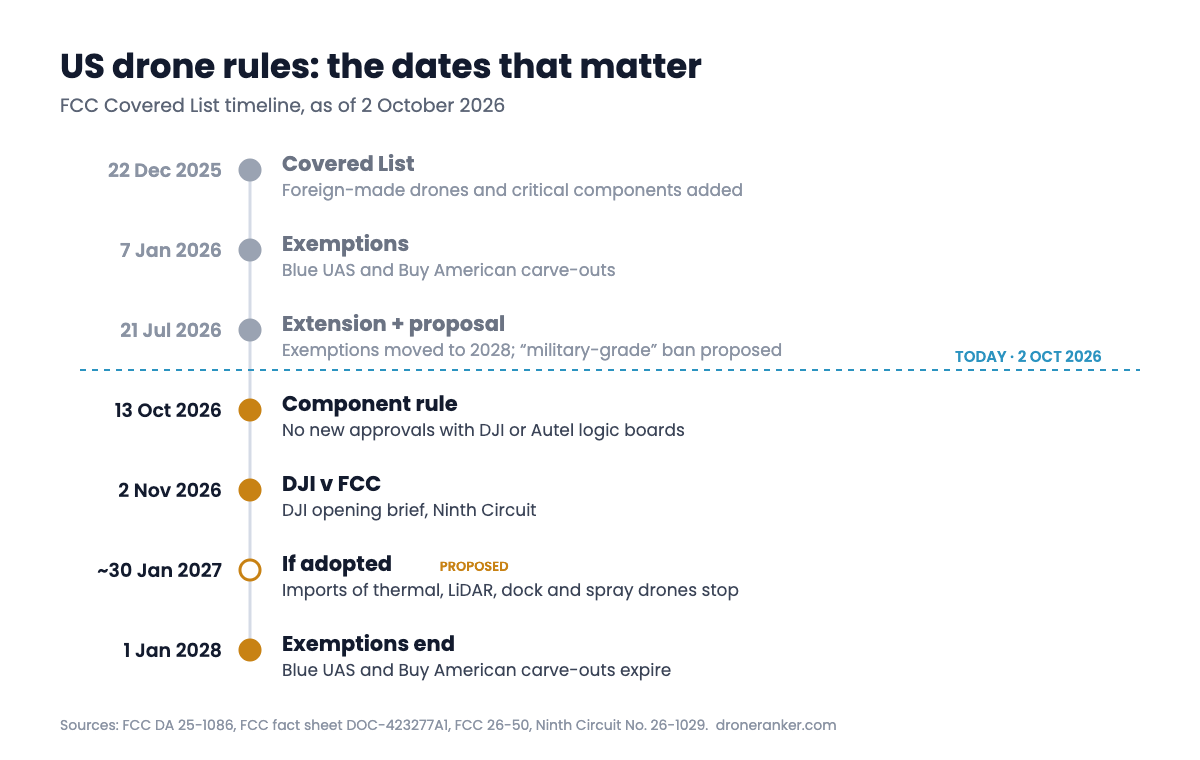
Correction, 2 October 2026: earlier versions of this page gave 1 January 2027 as the end of the Blue UAS and Buy American exemptions. The FCC extended both to 1 January 2028 on 21 July 2026, and the dates below are corrected. The same FCC action proposed ending imports of foreign “military-grade” drones, and a separate notice named nine companies, including XAG and Skyrover maker WaveGo Tech. Our US drone ban checker flags the models affected.
Check a specific model: our US drone ban checker applies the date test below to 19 drones and accessories, or to any FCC grant date you enter.
Update, 2 October 2026: The same date test decides the farm market, where DJI aircraft made up roughly four in five US spray drones. We went model by model through DJI Agras, XAG and the US-built alternatives in which spray drones US farmers can still buy.
Update, 22 September 2026: one route above narrows on 13 October. A separate FCC order, effective that day, blocks a new equipment authorization for any device containing logic-bearing hardware made by a company named on the Covered List — so a drone designed and assembled in the United States fails if a DJI or Autel board is inside it. That is the one place the list does work as a brand list, and we set it out in the FCC component rule explained.
Update, 1 October 2026. The next DJI enterprise aircraft is already in the Chinese registry: the Matrice 5TD filing lists its weights, and under these rules it has no route to a US buyer.
What the December 2025 listing actually did
On 22 December 2025 the FCC issued Public Notice DA 25-1086 and added to its Covered List all unmanned aircraft systems and UAS critical components produced in foreign countries. Not a set of manufacturers. A category.
That was the first time an entire product category had been added to the list rather than named companies, and it is the detail that breaks the brand-swap strategy. “Critical components” is drawn widely too: flight controllers, communications systems, data transmission devices, ground control stations, and associated software, regardless of the size of the aircraft they sit in.
Two companies were then named on top of the category listing — DJI and Autel Robotics — along with their subsidiaries, affiliates, partners, and entities operating under technology-sharing arrangements with them. So those two carry both problems at once: they are foreign producers, and they are named.
What it does not do
This is where most coverage goes wrong in the other direction, so it is worth being exact. The listing blocks new equipment authorizations. It does not reach backwards.
- The FCC stated plainly that the update “does not prohibit the import, sale, or use of any existing device models the FCC previously authorized.”
- Retailers can keep selling models that already hold an authorization, including foreign-made ones.
- Owners can keep flying anything they lawfully bought. Nothing already in your bag was grounded.
So the market did not empty on 22 December. It stopped being restocked. Everything foreign-made that is legitimately on sale in the United States today is either inventory of a model authorized before that date, or it falls under one of the exemptions below.
One caveat belongs here rather than in a footnote: the FCC has separate legal authority to revoke existing authorizations, and in July 2026 it proposed doing something close to that. We covered that proceeding in the public comment round on the drone ban. Nothing has been ordered yet.
It is also worth keeping the two halves of US drone law apart. This listing is about equipment: what may be authorized and sold. What an aircraft is allowed to do once it is flying sits under a separate patchwork, and that one has its own unresolved fights — see the ten state statutes that Amazon’s delivery drones run into every time they release a parcel in mid-air.
The three ways a drone can legally be new on a US shelf today
Rather than asking whether a brand is banned, check which of these a specific model sits in.
- 1. It was authorized before the cutoff. An FCC equipment authorization granted on or before 22 December 2025 still stands. The model can be imported and sold, and you can buy and fly it. This is the route almost all foreign-made consumer stock is travelling on right now.
- 2. It is on the Blue UAS Cleared List. Models on the Defense Contract Management Agency’s cleared list were exempted when the listing was modified on 7 January 2026 — originally until 1 January 2027, since extended to 1 January 2028. No DJI or Autel product was included in that relief.
- 3. Its critical components qualify as domestic end products. Components meeting Buy American standards were exempted on the same date and under the same deadline, now extended to 1 January 2028.
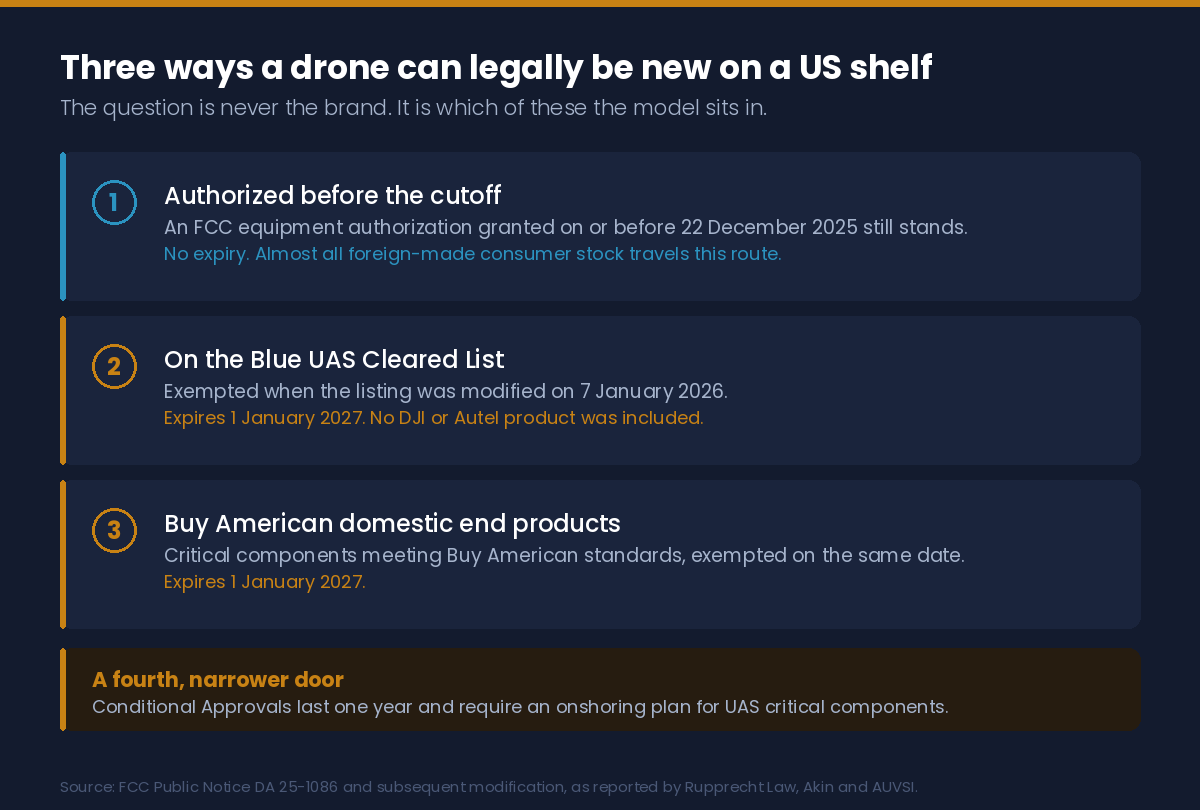
There is a fourth, narrower door: Conditional Approvals, which run for one year and require the applicant to develop an onshoring plan for manufacturing its UAS critical components. That is a supply-chain commitment, not a paperwork exercise, and it is not a route a consumer brand walks down quickly.
Notice what routes 2 and 3 have in common. Both expire on the same day.
Why the brand-by-brand question keeps giving the wrong answer
Take the substitutions people actually make when they decide DJI is off the table.
Autel is the swap most often suggested, and it is the worst one available: Autel Robotics is named in the notice alongside DJI, so it carries the company-level listing as well as the category one.
Smaller Chinese brands are frequently recommended as the sensible budget answer. They are not named individually, which is exactly why people assume they are fine, but they are foreign producers and the category listing reaches them all the same. This site has already followed two of those stories in detail: the HOVERAir VERSA and what happened to its US preorders, and whether the Skyrover S1 can still be bought or flown. Neither is DJI. Both ran into the same wall.
Allied manufacturers are the uncomfortable case. The listing is written around where a drone is produced, not around which government produces it, so European and other allied makers were caught in the drafting as well. AUVSI, the industry association, argued against exactly that scope, warning that “expanding the scope beyond identified PRC risks raises concerns for American and allied industry.” The Blue UAS and Buy American carve-outs are the mechanism intended to protect trusted suppliers — and both of them run out at the start of 2027.
The practical consequence for a buyer is simple. A recommendation that says “get this instead of a DJI” is a statement about the aircraft, not about whether you can buy it next year. Our own Potensic ATOM 3 review is a good example: the case for the aircraft stands on its specifications, and its availability in the United States rests on an authorization granted before the cutoff, not on the badge.
How to check a specific drone before you buy it
- Find the FCC ID. Any drone lawfully authorized for the US carries one, printed on the airframe or in the manual and listed on the product page. No FCC ID is the answer to the question.
- Check the grant date, not the launch date. A model announced in 2026 can still hold a grant issued in 2025. That timing is the whole ballgame, and it is why a controller cleared on 19 December 2025 sits in a completely different position from the aircraft it pairs with.
- Treat a listing with no FCC ID and a very good price as grey-market. It may be perfectly functional hardware. It is also a unit with no US support channel, and typically a regional rather than an American warranty.
- Remember tariffs are a separate layer. They change the price, not the legality. We went through that separately in the 2026 US tariff price analysis.
The dates that decide what happens next
Almost nothing about this is settled, and the open items have dates attached. These are the ones worth keeping.
- 21 January 2026 — DJI filed a petition for reconsideration with the FCC. Autel filed two applications for review to the full Commission, challenging both the listing and the treatment of prior authorizations.
- 11 May 2026 — replies filed; the administrative record closed. Decisions from the full Commission are still pending.
- 28 May 2026 — the FCC’s motion to dismiss DJI’s Ninth Circuit petition (No. 26-1029) was denied. The appeal is held in abeyance pending the agency’s own decision.
- 31 August and 2 September 2026 — comment periods closed on the two July proposals that would reach previously authorized equipment, covered in the LiDAR and “military grade” update. No order has issued.
- 2 November 2026 — DJI’s opening brief is due in the Ninth Circuit, with the Commission’s answering brief a month later.
- 1 January 2028 — the Blue UAS and Buy American exemptions expire together.
A separate case is running in the D.C. Circuit over DJI’s designation as a Chinese military company under Section 1260H, which is a different statute with different consequences and is often folded into the same headline. It is not the same proceeding.
So what do you actually buy
For a hobbyist today, the honest answer is that the shelf is still reasonably full and the constraint is time rather than choice. Foreign-made models authorized before the cutoff are legal to buy and fly, and that covers most of what is in stock. What you are buying into is a catalogue that is not being refreshed, which shows up as thinning inventory and drifting prices rather than an empty store — the pattern we traced through DJI’s own line in what is left of DJI in the US.
For anyone who needs a supply chain rather than a drone — a public safety agency, a survey firm, a contractor with a procurement officer — the calculation is different, and it is already visibly changing what gets flown. Boston’s drone-as-first-responder programme runs on BRINC hardware, a US manufacturer, which is why a crash there was a story about procurement as much as about a drone.
What nobody can honestly tell you is what is on sale in eighteen months. That depends on the Commission’s pending decisions, on the Ninth Circuit, and on whether the two exemptions, already extended once to 1 January 2028, are extended again. Anyone offering a confident answer about 2027 is guessing.
Frequently asked questions
Which drones are banned in the US right now?
No specific drone you already own is banned. What is blocked is new FCC equipment authorization for any unmanned aircraft system or critical component produced in a foreign country, which stops new foreign-made models entering the market. Models authorized on or before 22 December 2025 can still be imported, sold, bought and flown.
Is Autel banned in the US as well as DJI?
Autel Robotics is named in the December 2025 public notice alongside DJI, together with subsidiaries, affiliates, partners and entities under technology-sharing arrangements. It is therefore covered twice over: as a named company and as a foreign producer.
Are cheaper Chinese brands like Potensic or HOVERAir a way around the rule?
No. They are not named individually, but the listing covers foreign-made UAS as a category, so it reaches them too. Individual models remain sellable only where they already hold a pre-cutoff authorization.
Can I still legally fly the drone I already own?
Yes. The FCC confirmed that consumers can continue to use any drone they lawfully purchased or acquired. The Covered List governs equipment authorization, not personal use, and normal FAA rules still apply to how you fly.
Can shops still sell foreign-made drones?
Yes, where the model already holds an FCC authorization. Retailers were not required to pull previously authorized stock, which is why foreign-made drones remain widely on sale months after the listing.
Does the rule only apply to Chinese drones?
No, and this is the part most often misreported. It applies to UAS and critical components produced in any foreign country. Allied manufacturers are caught by the wording and are covered instead by the Blue UAS and Buy American exemptions, which now expire on 1 January 2028.
What is the Blue UAS Cleared List?
A Defense Contract Management Agency list of cleared unmanned aircraft. Models on it were exempted from the Covered List restriction when the listing was modified on 7 January 2026, with that exemption originally running until 1 January 2027 and extended on 21 July 2026 to 1 January 2028. No DJI or Autel product was included.
How do I tell whether a drone is authorized before I buy it?
Look for the FCC ID on the airframe, in the manual or on the product listing, and check the grant date rather than the launch date. A model released in 2026 can still hold a 2025 grant, and a listing with no FCC ID at all is the clearest warning sign.
Could drones already approved be banned later?
It has been proposed. Two FCC public notices issued in July 2026 sought comment on limiting or prohibiting the import and marketing of previously authorized equipment. Both comment periods closed in late summer and no order had issued as of 21 September 2026.
When will this be resolved?
There is no fixed end date. The nearest scheduled milestones are DJI’s Ninth Circuit opening brief on 2 November 2026 and the FCC’s pending “military-grade” import proposal (around 30 January 2027 if adopted) and the expiry of the two exemptions on 1 January 2028, with decisions from the full Commission on the DJI and Autel challenges pending since the record closed in May 2026.
Sources
- FCC, Public Notice DA 25-1086 (22 December 2025)
- Iowa State CALT — Foreign-made UAS stay on the Covered List as DJI and Autel challenges proceed
- Akin — FCC adds all foreign-made UAS and critical components to the Covered List
- Rupprecht Law — FCC drones Covered List FAQs
- AUVSI — Covered List FAQs for industry and international partners
Sources
Primary references used for factual claims in this article.
Continue Reading
All News