Boston’s New Police Drone Crashed Into a Car Six Days Into the Pilot

A Boston police drone crash destroyed the rear end of a parked car in Brighton on 3 September 2026 — six days after the department announced the Drone as First Responder pilot that put the aircraft in the air.
The drone was a BRINC Responder, a 7.7 lb (roughly 3,493 g) airframe with a stated 42-minute endurance. It came down on a Mazda 3 at around 1:30 p.m., smashing the rear windshield and destroying the trunk. The police incident report noted that the aircraft itself arrived in pieces. Nobody was hurt.
Neither the Boston Police Department nor BRINC has said what caused it. That is the part worth following, because a DFR programme is designed to fly over streets and rooftops in a dense city, and this is the first visible stress test of Boston’s.
The Boston Police Drone Crash: What Happened in Brighton
The crash happened at 11 Hatherly Road in Brighton, a residential street. The car’s owner, reported as a 42-year-old Brighton resident, was not in the vehicle. Damage was confined to the Mazda: rear windshield and trunk.
The procurement shift behind this story got harder on the supply side too: from 13 October, a US-built public safety drone cannot be newly authorized if a covered company made the boards inside it. The component rule, explained.
It was first reported by DroneXL and covered locally by Hoodline. The Boston Police Patrolmen’s Association, which has opposed the programme, publicised it on its own channels; association president Larry Calderone has described the technology as “invasive surveillance” and said the union is “against robots doing police work.”
That framing is a labour dispute as much as a safety one, and it is worth separating from the engineering question. A union objecting to drones replacing officers is a different argument from an aircraft failing over a residential street. Only the second one is a drone story.
Six Days, Not Six Months
The department announced the pilot on 28 August 2026, run with Motorola Solutions and BRINC. The setup is standard for modern DFR: weatherproof docking stations, aircraft marked with department insignia, sirens and emergency lights, launching within seconds of a 911 call or a ShotSpotter activation.
Commissioner Michael Cox framed the value in terms of speed, saying that putting eyes on a scene “in as little as a minute” lets dispatch send the right resources and lets officers approach safely. The department also published privacy constraints: cameras point at the horizon in transit and only tilt down once the aircraft is over the incident, with programme statistics to be posted publicly.
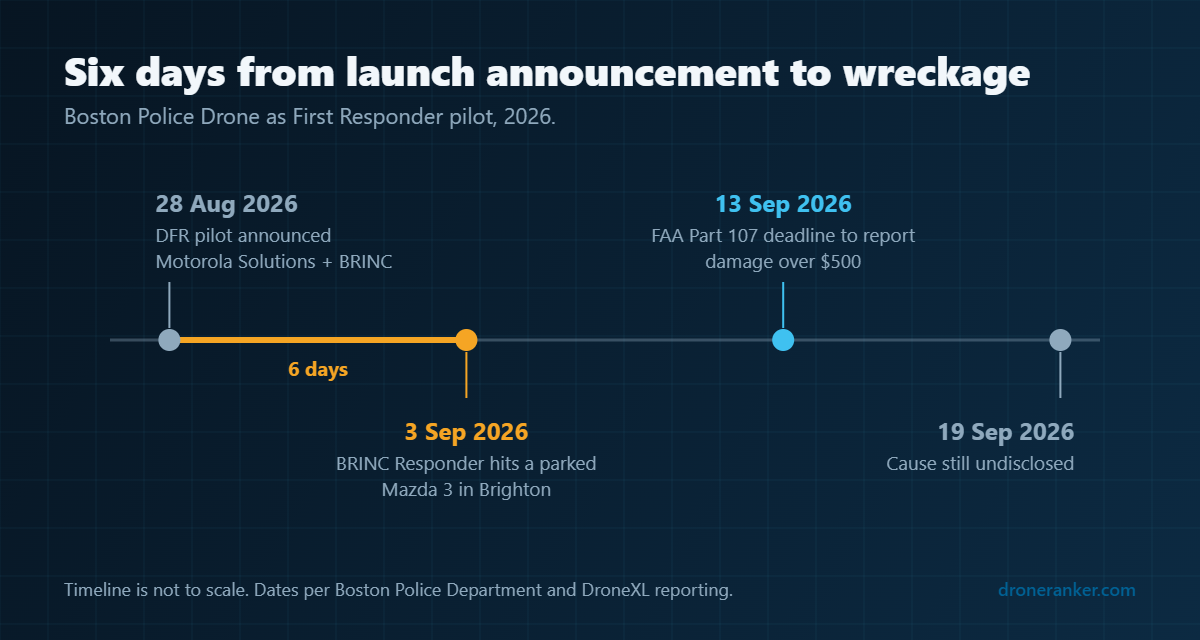
Six days is a short interval, and it matters for a reason that has nothing to do with blame. Early failures in a pilot are the cheapest failures a programme will ever have: small scale, high scrutiny, no entrenched process yet. What a department does with one is the actual signal.
How a DFR Programme Actually Works
Drone as First Responder is a specific operating model, not a general term for police drones, and the distinction is what makes the Boston police drone crash worth reading closely.
In a conventional deployment, an officer drives to a scene, gets out, unpacks an aircraft and launches it. In DFR, the aircraft lives in a weatherproof dock on a rooftop and launches on the call itself — a 911 dispatch or an acoustic gunshot detection — with the intent that it reaches the address before any patrol car does. Live video goes back to dispatch and to responding officers while they are still in transit.
Two things follow from that design. The first is that the flights are routinely beyond the pilot’s visual line of sight, which under US rules requires an FAA waiver; the dock model does not exist without one. The FAA has been streamlining that approval path for public safety agencies, which is a large part of why DFR has spread as quickly as it has.
The second is that the aircraft is over streets, cars and pedestrians on essentially every flight. A hobby pilot is told to avoid flying over uninvolved people. A DFR aircraft is dispatched to where the people are. That is the trade the model makes, and it is why an airframe failure in this context reads differently than the same failure in a park.
Why Boston Is Flying a BRINC and Not a DJI
Boston has not stated why it selected BRINC, and it would be wrong to assume. But the backdrop is not in dispute: US public safety procurement has been moving steadily away from Chinese-made airframes, and the regulatory pressure we have been tracking — the 2026 FCC proposals affecting previously approved DJI models and the comment record on the proposed drone rule — is the reason.
BRINC is a US manufacturer, which removes a procurement question that a DJI purchase would raise for a municipal department. The same pressure is reshaping the consumer side: the leaked DJI Neo 3 has a controller with a pre-cutoff FCC authorization and an airframe with none, and tariffs have already moved DJI pricing.
So this crash sits at an interesting junction. The policy conversation has largely been about which drones agencies are allowed to buy. It has been much quieter about how the replacements perform once they are flying over people.
Why This Boston Police Drone Crash Is a Different Risk Class
This is where the specifications matter more than the politics. A DFR airframe is not a hobby drone, and the weight difference is not marginal.
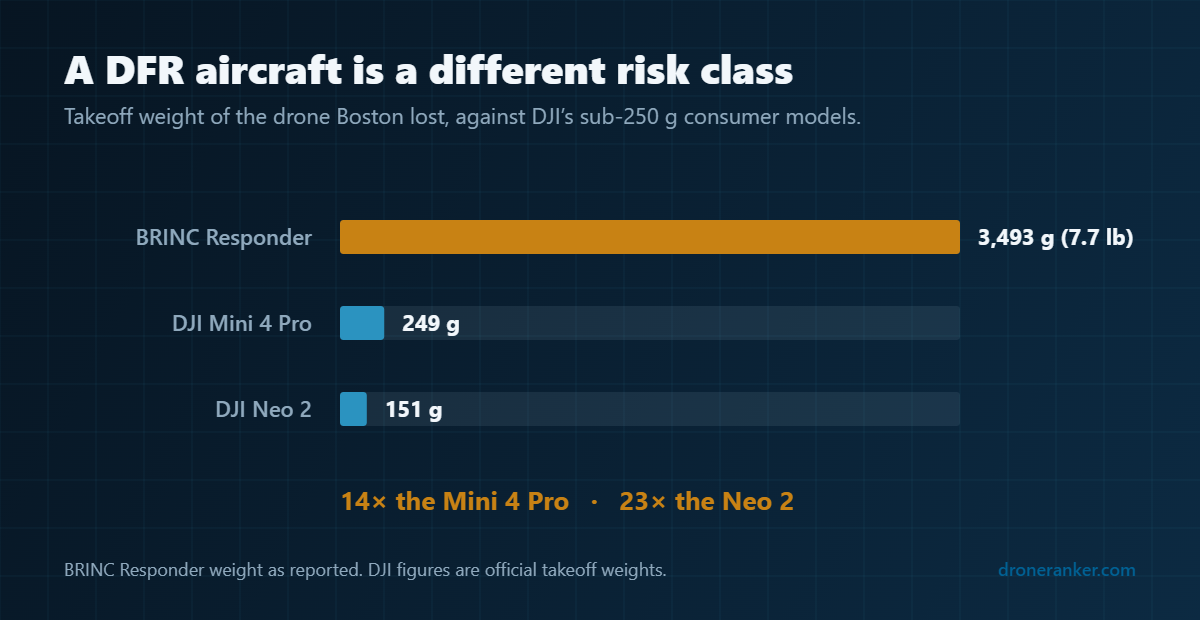
The BRINC Responder is about 14 times the takeoff weight of a DJI Mini 4 Pro and 23 times a DJI Neo 2. The sub-250 g threshold that governs so much consumer drone regulation exists precisely because kinetic energy at impact scales with mass. A 151 g aircraft coming down on a car is a scratch. A 3,493 g aircraft coming down on a car destroyed a trunk.
And unlike a consumer drone, a DFR aircraft is not incidentally over populated ground. It is over populated ground by design — that is the entire product. The consumer weight classes were written for people who are told to avoid flying over others; DFR inverts that assumption and has to earn its reliability a different way.
What the FAA Rules Require
Under Part 107, an operator must report an accident to the FAA within 10 days when it causes at least $500 of damage to property other than the aircraft, or serious injury. A smashed rear windshield and a destroyed trunk clears $500 without argument, which put the reporting deadline around 13 September 2026.
Whether that report was filed has not been confirmed publicly. FAA accident reports are not published in real time, so absence of news is not evidence either way. It is simply an open item.
What We Still Do Not Know
- The cause. Neither BPD nor BRINC has said whether this was a hardware failure, a power issue, a link loss, a software fault or an operator error. These have very different implications for a fleet.
- Whether the aircraft was under active control. DFR flights are supervised by certified pilots, but the failure mode determines whether supervision was even relevant.
- Whether the programme paused. No suspension has been announced.
- How many aircraft are in the pilot, and what area they cover. The announcement did not specify.
Bottom Line
One crash six days into a pilot is not evidence that DFR is unsafe, and treating it that way would be as lazy as ignoring it. Pilots exist to surface exactly this kind of thing.
Boston is not the only place where routine drone flights are running ahead of the rules written for them. Amazon’s delivery drones release parcels in mid-air at about thirteen feet, in states whose statutes say that is an offence, and nobody has tested it in court either.
What makes it worth watching is the combination: a heavier airframe than most people picture when they hear “police drone,” flying over a dense city by design, on a platform selected in part because the regulatory environment pushed agencies off the incumbent. The interesting question is not whether a drone fell. It is what the cause turns out to be, and whether it gets published. This page is updated if it is.
Frequently Asked Questions
What drone crashed in Boston?
A BRINC Responder operated by the Boston Police Department as part of its Drone as First Responder pilot. It weighs about 7.7 lb and has a stated 42-minute flight time.
When did the Boston police drone crash happen?
Around 1:30 p.m. on 3 September 2026, on Hatherly Road in Brighton — six days after the pilot programme was announced on 28 August.
Was anyone hurt?
No injuries were reported. The damage was to a parked Mazda 3: rear windshield and trunk. The drone was destroyed.
What caused the crash?
Not disclosed. Neither the Boston Police Department nor BRINC has published a cause.
Does the FAA have to be told?
Yes. Part 107 requires reporting within 10 days for accidents causing $500 or more in damage to other property, which this clears. Public confirmation that a report was filed is not available.
Why is Boston using BRINC instead of DJI?
Boston has not said. The wider context is that FCC Covered List restrictions and related proposals have pushed US public safety agencies toward domestic manufacturers, and BRINC is US-based.
Sources
Primary references used for factual claims in this article.
Continue Reading
All News