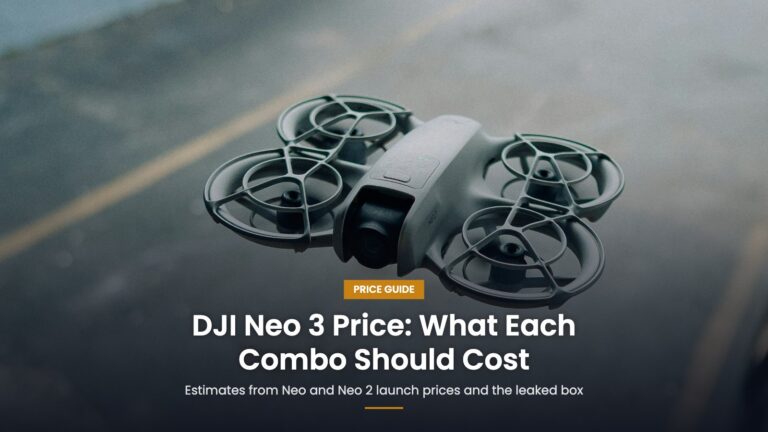
DJI Neo 2: 151 g, 4K/100 and LiDAR, but Watch the Storage


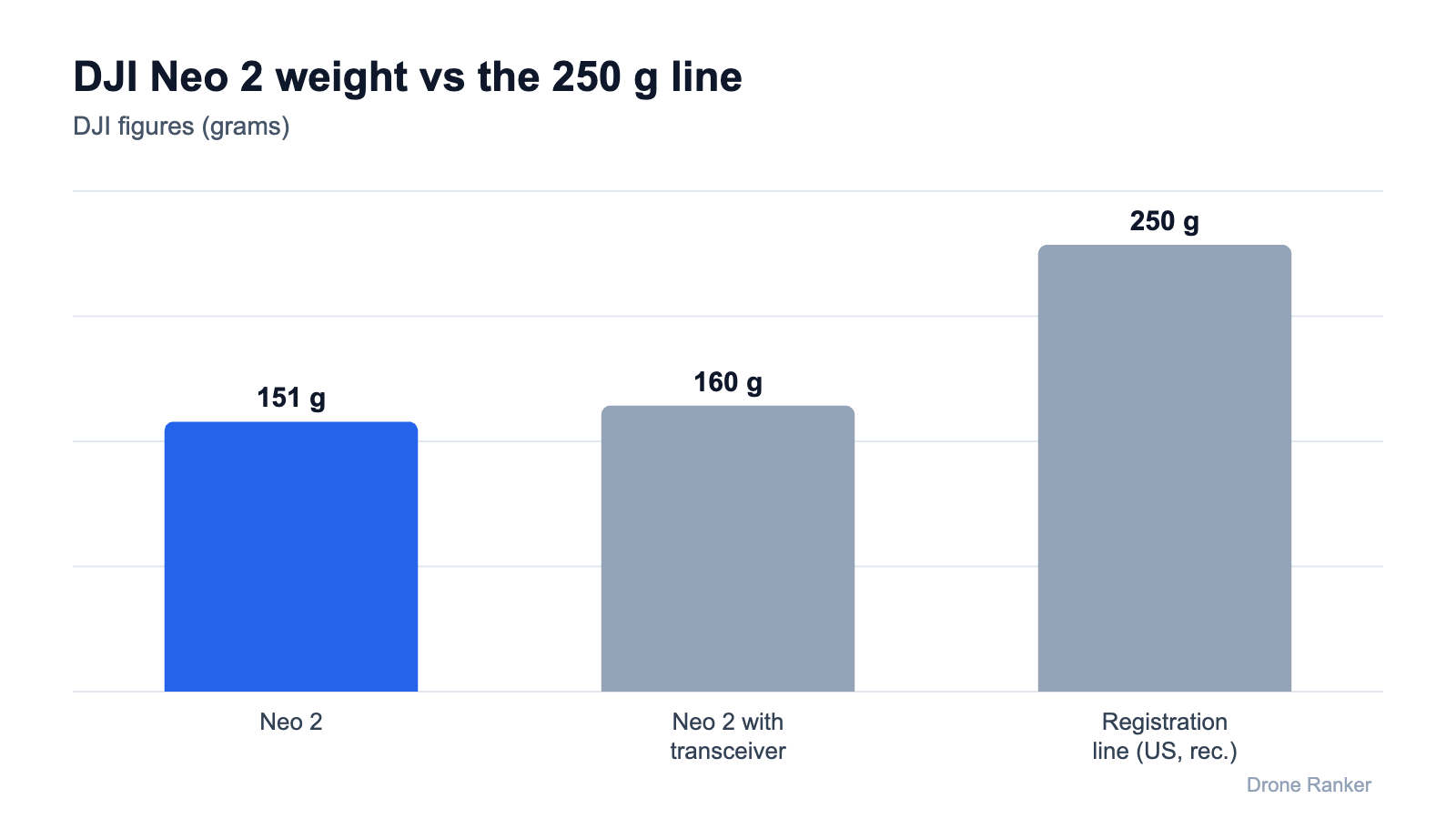
The DJI Neo 2 weighs 151 g on DJI’s spec sheet, or 160 g with the clip-on Digital Transceiver, and packs 4K at 100fps, a 2-axis gimbal and a forward LiDAR sensor into that weight. It sits well under the 250 g line that triggers registration in many places and in the EU’s C0 class. DJI notes the actual weight can vary slightly between production batches.
It launched in November 2025 outside China. DJI did not launch it in the US, so US listings, including on Amazon, come from third-party sellers rather than DJI. This analysis is based on DJI’s published figures and owner reports; we have not flown it.
The Neo 2 suits beginners and social creators who want a palm-sized follow-me drone. If you want scenic stills or a 3-axis gimbal, skip it. Its 1/2-inch, 12 MP sensor is the same size as the original Neo’s.
Table of Contents
Size, weight and storage
With propeller guards fitted and no transceiver, it measures 147×171×41 mm. With the transceiver attached for O4 video transmission, that becomes 167×171×54 mm. Either way it fits in a jacket pocket.
Storage is the catch owners raise most. There is 49 GB built in, which is generous for a drone this size, but no microSD slot. At 4K/100fps and 80 Mbps that fills fast, so plan to offload footage often on long shooting days.
DJI Neo 2 camera and gimbal
The 1/2-inch CMOS sensor sits behind a 16.5 mm-equivalent lens with a 119.8° field of view and an f/2.2 aperture. That is smaller than the 1/1.3-inch sensors in heavier sub-250 g drones such as the Mini 3 Pro.
Photo ISO runs 100–3200 in Auto and up to 12800 in Burst and Manual; video ISO is 100–12800 in both modes. Video shutter speeds run from 1/8000s to 1/30s, and stills go down to 1/10s, which leaves a little room for long exposures while the drone hovers.
Video options:
- 4K (4:3) up to 60fps
- 4K (16:9) up to 100fps, only when using motion control or a remote controller
- 2.7K vertical (9:16) up to 60fps, for Reels, TikTok and Shorts without cropping
The gimbal is 2-axis mechanical (tilt and roll) with an angular vibration range of ±0.01°. RockSteady EIS is supported, but the on/off switch for stabilization only appears with DJI Goggles. With it off, footage can be stabilized later in Gyroflow, which FPV freestyle pilots tend to prefer.
Flight time, speed and battery
DJI quotes about 19 minutes of flight (17 with guards) and 18 minutes of hover (16.5 with guards). Those figures come from a wind tunnel at sea level, flying forward at a steady 4 m/s until the battery runs out. Wind, tracking, aggressive flying and the O4 transceiver all cut into that, and owner reports on forums say the same.
| Mode | Max ascent | Max descent | Max horizontal |
|---|---|---|---|
| Cine | 0.5 m/s | 0.5 m/s | Not listed |
| Normal | 3 m/s | 3 m/s | 8 m/s |
| Sport | 5 m/s | 3 m/s | 12 m/s (also when tracking) |
The 1,606 mAh (11.5 Wh) Li-ion battery takes about 70 minutes to charge from empty inside the aircraft at 15W. The Two-Way Charging Hub with a 65W charger does three batteries in about 68 minutes. Operating temperature is -10° to 40° C (14° to 104° F). Each battery manages at least 20 palm takeoffs and landings, which is what makes the automated Circle, Rocket and Dronie shots practical for vloggers who don’t want to pull out a controller.
Obstacle sensing and forward LiDAR
The original Neo had no obstacle sensing. The Neo 2 has omnidirectional monocular vision, downward infrared sensing and a forward-facing LiDAR. Forward, backward and sideways detection reaches 15 m at speeds up to 8 m/s; up and down also reach 15 m but only at up to 3 m/s.
The LiDAR measures 0.3–8 m with a 60° horizontal and vertical field of view. DJI’s spec requires surface reflectivity above 10%. Analysts expect it to help most with close-range avoidance in low light, where cameras alone struggle.
Wi-Fi, O4 and goggles
Out of the box the Neo 2 uses Wi-Fi, good for about 500 m in open, unobstructed space under FCC rules. Attach the Digital Transceiver and it switches to DJI’s O4 system, rated for 10 km (FCC) or 6 km (CE/SRRC/MIC) without obstructions or interference. In practice the 7 km maximum flight distance caps it. Under FCC standards, expect about 1.5–3 km with strong urban interference and 3–6 km in suburbs.
Latency with O4:
- DJI RC-N3: about 120 ms, up to 1080p/60fps live view
- DJI Goggles N3: as low as 54 ms at 1080p/60fps
- DJI Goggles 3: as low as 50 ms at 1080p/100fps
That split is the real buying decision. Anyone who wants long range and low latency has to buy the transceiver plus a compatible controller or goggles, which raises the total cost. For pilots who want the FPV side, I think it is worth it; for palm-launch selfie use, Wi-Fi is enough.
Neo 2 vs Mini 3, Mini 3 Pro and Avata 2
The Mini 3 Pro’s 1/1.3-inch sensor should give better dynamic range and low-light results, and both Mini 3 models have a 3-axis gimbal instead of the Neo 2’s 2-axis gimbal plus EIS and Gyroflow. For aerial photography the Mini is still the better tool.
The Neo 2 wins on size and FPV. At 151 g it is far lighter than the 249 g Mini 3 Pro, and it works with DJI Goggles and the RC Motion 3 controller, which the Mini 3 series cannot. Its omnidirectional sensing with forward LiDAR beats the standard Mini 3, which has none, and goes further than the Mini 3 Pro’s tri-directional sensing.
Its closest relative is really the Avata 2. Like the Avata, it supports goggles, RockSteady and motion control, but without the bulkier dedicated FPV airframe, which makes it a more accessible, pocketable way to try immersive flying. See Neo 2 vs Avata 2 for the details, plus Neo 2 vs the original Neo and Neo 2 vs Flip.
Specs at a glance
| Specification | Detail |
|---|---|
| Takeoff weight | 151 g (without transceiver) / 160 g (with transceiver) |
| Dimensions (with guards) | 147×171×41 mm / 167×171×54 mm (with transceiver) |
| Image sensor | 1/2-inch CMOS, 12 MP |
| Max video | 4K (16:9) at 100fps / 2.7K vertical (9:16) at 60fps |
| Gimbal | 2-axis mechanical (tilt, roll) |
| Max flight time | About 19 min (17 min with guards) |
| Max speed (Sport) | 12 m/s |
| Max transmission (O4, FCC) | 10 km (unobstructed, no interference) |
| Sensing | Omnidirectional vision, forward LiDAR, downward IR |
| Storage | 49 GB internal, no microSD |
| Battery | 1,606 mAh / 11.5 Wh |
Full figures are on DJI’s spec page, and current pricing is on the DJI Neo 2 Amazon listing.
Should you wait for the Neo 3?
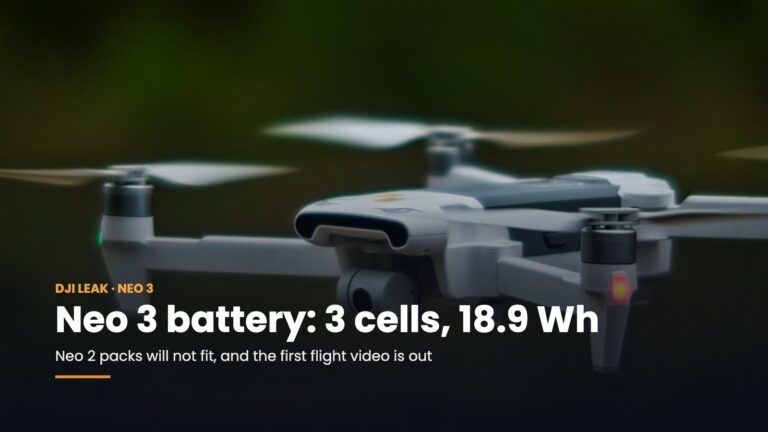
DJI has not replaced the Neo 2, but the Neo 3 has leaked: a 1/1.1-inch sensor, 192.7 g and an RC Mini controller with a screen. Retail packaging has surfaced too (see our Neo 3 leak report). The leaked box lists nine items and no Digital Transceiver, while the RC Mini is included, so the clip-on module may not carry over. We cover that in DJI Neo 3 vs Neo 2.
The Neo 3 is not announced, has no price and no FCC authorization, and its batteries will not fit the Neo 2. I’d only wait if you are outside the US and in no hurry. Track progress on the Neo 3 release date tracker.
The Friday Brief
One email a week on what changed in drones
FCC and FAA rule changes, DJI leaks checked against filings, and the week’s new comparisons. Every Friday, nothing else.
Free. Unsubscribe in one click. Sent with Kit; see our privacy policy.
Follow us on Google too: add Drone Ranker as a preferred source →
Continue Reading
All News