DJI Ban 2026 Update: FCC Could Block Air 3S, Mini 5 Pro, Neo 2 & More

The FCC is considering a rule that could stop the future import and sale of some foreign-made drones already approved for the US market, and its definition is broad enough to reach consumer DJI models like the Air 3S, Mini 5 Pro and Neo 2. Those drones have not become illegal to own or fly. Nothing has been adopted, and the FCC has not named any individual model.
For the current status of specific drones, see our US drone ban checker, updated as authorizations change. For the commercial picture, including which DJI products can no longer enter the US and which one DJI is simply choosing not to sell there, see our September 2026 breakdown of what DJI you can still buy in the US. Results of the comment period are in our report on the public comments.
A second front opened alongside this proceeding: from 13 October the FCC will refuse new authorizations to any device carrying logic-bearing hardware from a listed company. Our explainer covers what that means for US manufacturers.
Update, 22 October 2026: comments on the FCC proposal closed on 2 September, and as of 21 October the FCC bureaus had not adopted it. Farm groups are now pressing for an exemption for spray drones; see what the spray drone coalition is asking the FCC for.
Table of Contents
What the FCC proposed
On 21 July 2026, the FCC’s Public Safety and Homeland Security Bureau and Office of Engineering and Technology released DA 26-758, a public notice under PS Docket No. 26-189. It covers foreign-produced drones and critical components that are already on the Covered List, were previously authorized for the US market, and meet a proposed definition of a “military-grade” UAS or UAS critical component.
“Previously authorized” is the key phrase. Until now, covered products had trouble getting new equipment authorization, but products already authorized could generally keep being imported and sold. This proceeding asks whether those already-authorized products should be restricted too. That is why it reaches drones already on US shelves, not just unreleased ones.
What counts as “military-grade”
Much more than the label suggests. Under the proposal, a foreign-produced drone or related equipment could qualify through any of these:
- takeoff weight of 55 pounds or more;
- the ability to dispense certain substances covered by FAA agricultural rules;
- thermal imaging sensors;
- LiDAR sensors;
- drone docking stations;
- systems specially designed to incorporate certain defense articles;
- certain coordinated or autonomous swarm capabilities.
LiDAR is the item that pulls in consumer drones. In current DJI models it is a safety feature: forward-facing LiDAR helps with obstacle sensing and Return-to-Home in low light, where vision cameras struggle. The same technology supports 3D terrain mapping, autonomous navigation and reconnaissance, which is how the FCC frames it.
In my view, that is the weakest part of the proposal. Calling a pocket camera drone “military-grade” because it has a sensor meant to stop it hitting a tree at dusk stretches the term past usefulness, and the comment record is where that argument gets made.
Which DJI drones could be affected
The notice has no list naming the Air 3S, Mini 5 Pro, Neo 2 or any other consumer model. It defines categories of technology. Read against DJI’s published specifications, these products intersect with them:
| DJI product | Relevant capability | Why it’s relevant |
|---|---|---|
| DJI Air 3S | Forward-facing LiDAR | LiDAR is specifically included in the proposed definition |
| DJI Mini 5 Pro | Forward-facing LiDAR | Could potentially meet the LiDAR criterion |
| DJI Neo 2 | Forward-facing LiDAR | Could potentially meet the LiDAR criterion |
| DJI thermal enterprise drones | Thermal imaging | Thermal sensors are specifically listed |
| DJI Agras drones | Agricultural dispensing | Certain dispensing capabilities are included |
| DJI Dock systems | Automated docking | UAS docking stations are explicitly included |
The table shows overlap, not bans. DJI officially lists a forward-facing LiDAR sensor in the Air 3S sensing system, which makes it the clearest consumer example. DJI also confirms forward LiDAR on the Mini 5 Pro, and the Neo 2’s specs describe omnidirectional vision supplemented by forward LiDAR. Whether a final rule would actually be applied to any of them is uncertain.
The enterprise and farm side may feel this harder. Spraying drones, thermal drones for public safety, inspection fleets and Drone-in-a-Box operations with DJI Dock all fit the categories more obviously. DJI argues these are widely used for farming, emergency response and infrastructure inspection, not military work, and that the definition captures civilian products.
Can you keep flying a DJI drone you own?
Yes. The FCC says that even if the import and marketing restriction is adopted, continued use or operation of previously purchased affected equipment would remain authorized. The issue is future importation, marketing and availability, not disabling drones people already own. Normal FAA rules still apply.
Could the Air 3S or Mini 5 Pro stop being sold?
Possibly. If the FCC adopts the proposal and decides a specific previously authorized product falls within it, importing and marketing that product could be restricted. That would hit new inventory, distributors, retailers and possibly some covered replacement components. DJI has warned that previously cleared products could become unavailable to buy.
It would not be immediate. The proposal would give affected parties 180 days after a final prohibition is published in the Federal Register to stop importing and marketing, and the FCC asked for input on stock already imported, held for sale, in transit, or covered by existing distribution agreements. No 180-day clock is running now; a final rule has to come first.
The timeline
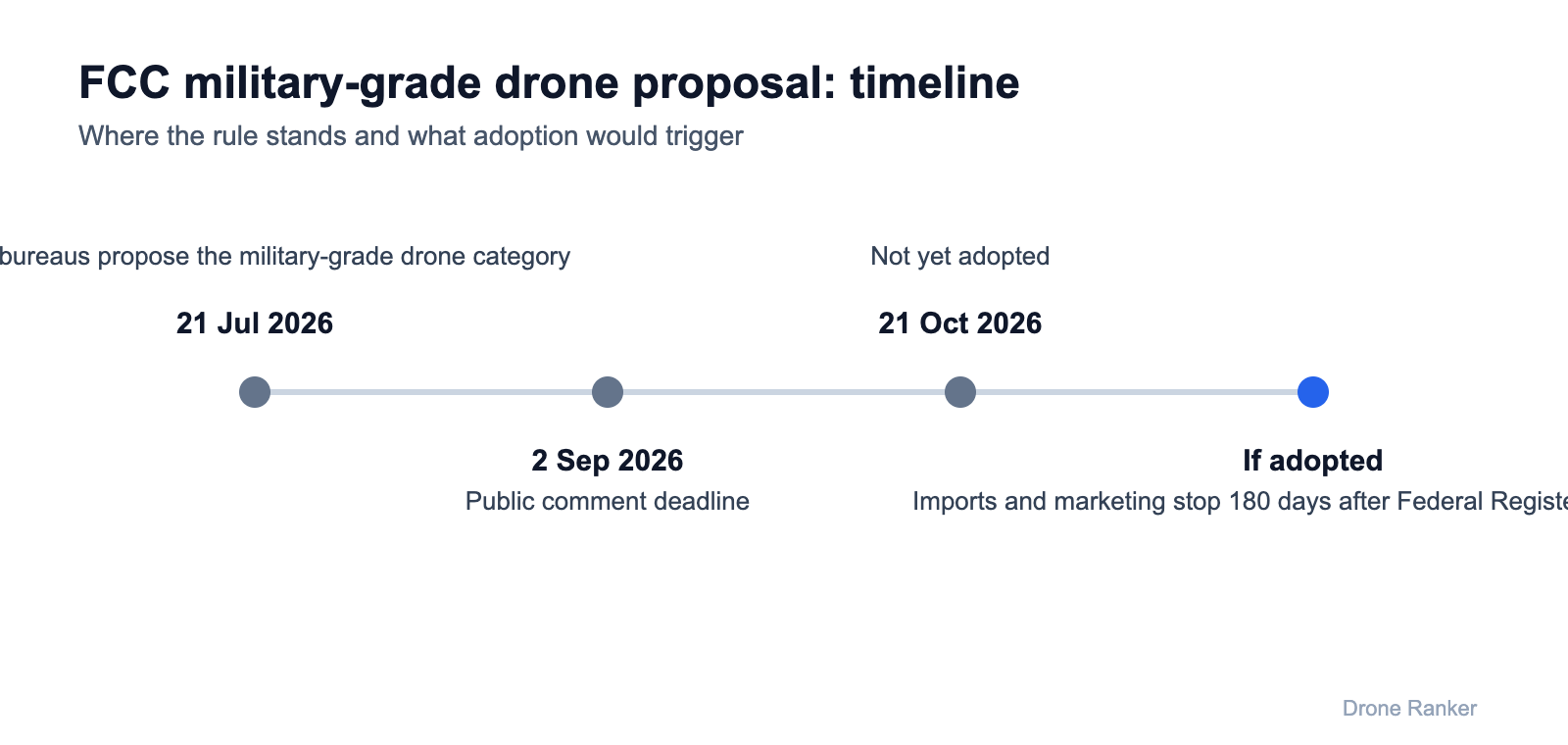
- 21 July 2026: FCC releases the public notice.
- 3 August 2026: notice published in the Federal Register.
- 2 September 2026: public-comment deadline. This is not a date when DJI drones stop working or leave stores.
- Then: FCC review and possible action. Only if a final prohibition is adopted would the 180-day period start.
There is no confirmed date on which the Air 3S, Mini 5 Pro, Neo 2 or any other named model will stop being sold. After the comments, the FCC could adopt the proposal largely as written, narrow the definition, add exemptions, change the timeline, drop some technologies or categories, or take another approach.
Future models are a separate question
Unreleased drones like the Air 4 and Mini 6 Pro face a different hurdle: whether they can get the authorization needed to enter the US market at all. We covered that in our DJI Air 4 and Mini 6 Pro US availability analysis, and our DJI Mini 6 Pro release date and rumors tracker follows the next Mini. This proceeding adds the second question, whether some already-authorized products could lose import and marketing rights because of their capabilities.
Should you avoid buying DJI right now?
For a recreational buyer, the risk is supply, not legality. If you want an Air 3S or another LiDAR model, I wouldn’t hold off purely because of this notice; there is no announcement that any of them has been individually prohibited. Professional buyers should think harder, because long-term access to aircraft, replacement units and components weighs much more in a fleet, and enterprise products sit more squarely in the proposed categories.
DJI drones still sold in the US
DJI Mini 4 Pro (RC-N2)
Under 249 g, omnidirectional sensing without LiDAR, still in DJI’s US line-up.
DJI Neo 2
151 g, 4K/60 and omnidirectional sensing. The current Neo you can buy in the US.
DJI Air 3S (RC-N3)
1-inch main camera plus a 70 mm tele, up to 45 min. One of the models the FCC LiDAR proposal could reach.
As an Amazon Associate, Drone Ranker earns from qualifying purchases. We do not quote prices because Amazon’s change by the hour.
Drone Ranker will update this article if the FCC publishes a decision, changes the proposed scope, or identifies specific drone categories affected by a final action.
Last updated 11 August 2026. References to individual DJI models describe how their published specifications could intersect with the FCC’s proposed categories; they do not mean the FCC has designated those models for prohibition.
The Friday Brief
One email a week on what changed in drones
FCC and FAA rule changes, DJI leaks checked against filings, and the week’s new comparisons. Every Friday, nothing else.
Free. Unsubscribe in one click. Sent with Kit; see our privacy policy.
Follow us on Google too: add Drone Ranker as a preferred source →
Continue Reading
All News