DJI Neo 3 Gets a 1/1.1-Inch Square Sensor: What the Retail Box Panel Confirms

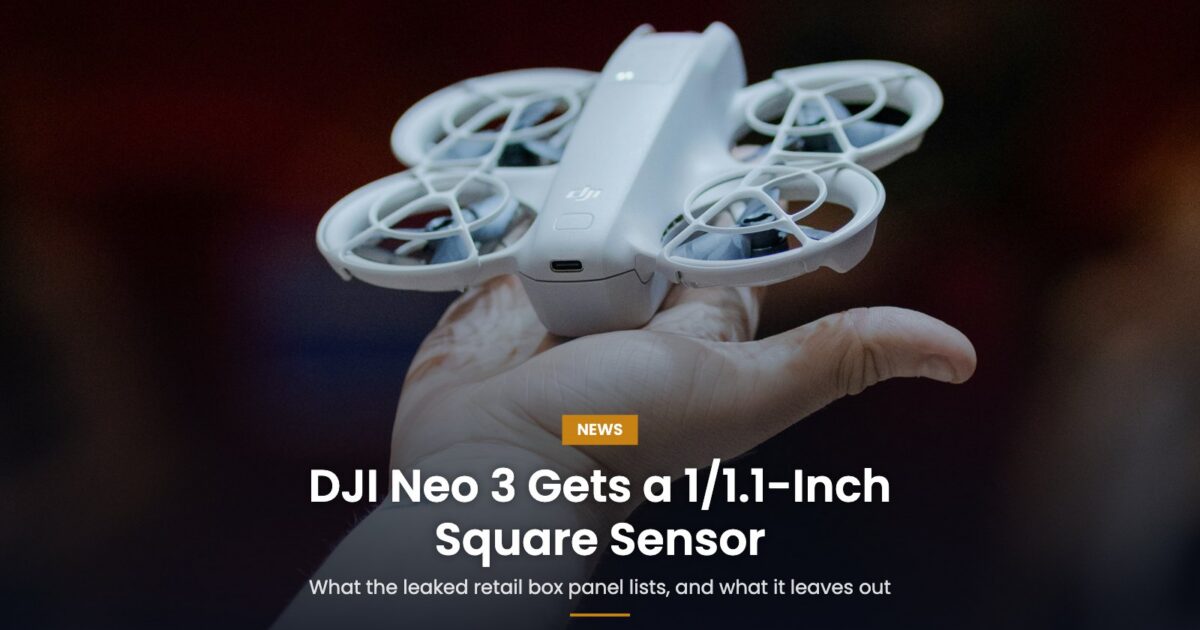
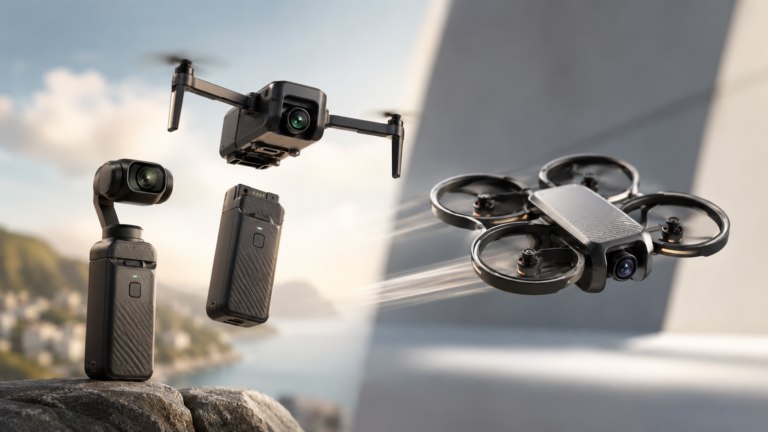
DJI has still not announced the Neo 3, but its retail box has now described the camera. A feature panel from the packaging, posted by leaker Igor Bogdanov on 1 October 2026, lists a 1/1.1-inch square sensor, 2x lossless zoom, high-speed ActiveTrack, omnidirectional obstacle sensing and an updated SelfieShot mode. If the panel is accurate, the DJI Neo 3 specs move the smallest DJI drone onto the same sensor DJI put in its Osmo Action 6 action camera.
That is a much bigger change than anything earlier leaks pointed to. It also explains part of the 42 grams the Neo 3 gained in China’s drone registry, which we tried to break down in our weight analysis before the panel appeared. Below: what the box says, what it leaves out, and which of our earlier assumptions now need correcting.
Table of Contents
DJI Neo 3 specs: what the retail panel lists
The panel is marketing copy, not a spec sheet. It names features, not numbers, and DJI has not confirmed any of it. Here is the split between what is printed and what is not.
| Feature | On the Neo 3 box panel | Status |
|---|---|---|
| Image sensor | 1/1.1-inch square sensor, “true vertical shooting” | Printed on box |
| Zoom | 2x lossless zoom, portrait mode | Printed on box |
| Tracking | High-speed ActiveTrack, automatic camera movements | Printed on box |
| Obstacle sensing | Omnidirectional obstacle sensing | Printed on box |
| Selfie modes | Next-generation SelfieShot (reported as SelfieShot 2.0) | Printed on box |
| Take-off and control | Palm take-off and landing, gesture control | Printed on box |
| Controller | DJI RC Mini with built-in screen (Fly More Combo) | Printed on box |
| Take-off weight | — | 192.7 g in China’s drone registry |
| Megapixels, aperture | — | Not stated |
| Video resolution, frame rates, 10-bit | — | Not stated |
| Flight time, battery | — | Not stated |
| Price, launch date | — | Not stated |
The source has a good record on DJI packaging. Bogdanov’s earlier Neo 3 box images, posted in mid-September, showed the RC Mini bundle, and a separate registry entry later confirmed the model code DEN326 and a production date of 21 September 2026. That does not make every line of this panel correct, but it is not an anonymous render either.
From 1/2-inch to 1/1.1-inch: how big a jump is that?
The Neo and Neo 2 both use a 12 MP 1/2-inch sensor with an f/2.2 lens. A 1/1.1-inch square sensor is a different class of hardware. Inch-type sensor names are approximate, so treat the area figures below as estimates, but the order of magnitude is clear.
| Camera | Sensor | Shape | Approx. area | Resolution |
|---|---|---|---|---|
| DJI Neo 2 (Nov 2025) | 1/2-inch | 4:3 | ~28 mm² | 12 MP, f/2.2 |
| DJI Flip (Jan 2025) | 1/1.3-inch | 4:3 | ~70 mm² | 48 MP |
| DJI Osmo Action 6 (Nov 2025) | 1/1.1-inch | Square | ~100 mm² | ~38 MP, f/2.0–4.0 |
| DJI Neo 3 (leaked panel) | 1/1.1-inch | Square | ~100 mm² if the same sensor | Not stated |
On those estimates the Neo 3 sensor has roughly three to four times the light-gathering area of the Neo 2’s, and about 40% more than the 249 g DJI Flip, which launched at €439, nearly twice the Neo 2’s price. In practice that would mean cleaner low-light footage and more room to crop, which is what makes the 2x lossless zoom claim plausible: zoom by cropping into a sensor with more pixels than the output needs.
What we cannot say is whether the Neo 3 inherits the rest of the Osmo Action 6 camera. The Action 6’s headline feature is a variable f/2.0–4.0 aperture. A tiny drone has much less room for a lens assembly, and the panel does not mention aperture at all. Sharing a sensor does not mean sharing a lens, so assume a fixed aperture until DJI says otherwise.
Why the square shape matters more than the size
“True vertical shooting” is the line on the panel most Neo owners will care about. The Neo 2 has no rotating gimbal axis for portrait video. Its vertical mode crops the 4:3 frame, and tops out at 2.7K.
A square sensor removes the trade-off. The camera can read a 9:16 window from the same sensor area it uses for a 16:9 window, so vertical clips do not have to give up resolution or field of view. That is how the Osmo Action 6 handles portrait video, and it is the reason DJI chose a square sensor for a camera aimed at social video. For a drone sold mostly as a selfie and vlogging tool, that matters more than the raw size jump.
The panel does not say what resolution vertical video records at. A 4K vertical mode would be the obvious claim to make, and its absence from the box copy is a reason not to assume it.
One headline that is not new: obstacle sensing
Some coverage of the leak describes omnidirectional obstacle sensing as a first for the Neo line. It is not. DJI’s Neo 2 already lists an omnidirectional monocular vision system plus a forward-facing LiDAR sensor. The Neo 3 panel uses the same feature name and gives no detail on the hardware behind it.
The earlier box images did show a new dome-shaped sensor on top of the Neo 3 body that the Neo 2 does not have. If that is an upward-facing sensor, the Neo 3’s coverage could be more complete than the Neo 2’s. That is a reasonable reading of a picture, not something the panel states.
The 42 grams, revisited
When the registry put the Neo 3 at 192.7 g, we argued the fair comparison was the 160 g Neo 2 with its clip-on Digital Transceiver, not the 151 g bare aircraft, because the Neo 3 box has no transceiver and appears to have the radio built in. That leaves about 33 g to explain. Here is how the new panel changes our list of candidates.
| Candidate | What we said on 2 Oct | After the panel |
|---|---|---|
| Built-in O4 radio | Likely (no transceiver in the box) | Unchanged. Already counted in the 160 g comparison. |
| Larger battery | Most likely main cause | Still possible, but no longer the only big item. No capacity figure yet. |
| Bigger camera module | Not listed | Now a strong candidate. A 1/1.1-inch sensor needs a larger lens and gimbal than a 1/2-inch one. |
| More obstacle sensing | Possible | Weaker. The Neo 2 already had omnidirectional sensing. A new top sensor would add little. |
| Stiffer frame, bigger motors | Possible | Unchanged. Would follow from the heavier camera and battery. |
The honest update: we left the camera off our list because nothing leaked at the time suggested a new sensor. It now looks like one of the two main reasons the Neo 3 is heavier, alongside whatever DJI has done to the battery. The flight time question stays open until DJI publishes a number.
What is still unknown
- Video specs. Resolution, frame rates, bitrate and whether 10-bit D-Log M is available. The Neo 2 records 4K at up to 100 fps in slow motion; the Action 6 sensor supports 4K/120 in the camera.
- Lens and aperture. Fixed or variable, and the field of view.
- Flight time. The heavier airframe makes any number a guess.
- Price. A bigger sensor and a screened controller in the combo both push it up. We look at the likely range in our DJI Neo 3 price guide.
- Launch date. Retail packaging and a 21 September production date point to October or November 2026, but DJI has published nothing.
Will the Neo 3 be sold in the US?
Not through normal channels, on current rules. Since DJI was added to the FCC Covered List on 22 December 2025, new DJI equipment cannot receive the FCC authorization it needs to be marketed in the US, and no authorization for the Neo 3 aircraft has appeared.
The controller is the odd exception. The DJI RC Mini bundled with the Neo 3 holds FCC authorization SS3-TKMI2507, granted on 19 December 2025, three days before the cut-off. So the remote in the box is cleared for the US market and the drone it flies is not. Our US drone ban checker lists the Neo 3 as not authorized, and the wider rules are explained in which drones are banned in the US.
Frequently asked questions
What sensor does the DJI Neo 3 have?
According to its leaked retail box, a 1/1.1-inch square sensor. DJI has not confirmed it. The Neo 2 uses a 12 MP 1/2-inch sensor.
Is the Neo 3 sensor the same as the Osmo Action 6?
The format matches: the Osmo Action 6 also uses a 1/1.1-inch square sensor. Nothing confirms it is the identical part, and the Action 6’s variable aperture is not mentioned on the Neo 3 box.
Does the DJI Neo 3 have obstacle avoidance?
The box lists omnidirectional obstacle sensing. The Neo 2 already had omnidirectional vision sensing and a forward LiDAR, so this is a continuation rather than a first.
Can the DJI Neo 3 shoot vertical video?
The box claims “true vertical shooting”, which a square sensor makes possible without cropping away resolution. The vertical video resolution is not stated.
How much does the DJI Neo 3 weigh?
192.7 g according to China’s civil drone registry, which keeps it under the 250 g threshold.
When will the DJI Neo 3 be released?
DJI has not announced a date. Leaked retail packaging and a 21 September 2026 production date point to October or November 2026.
Can I buy the DJI Neo 3 in the US?
Not through official channels. The aircraft has no FCC authorization, and new DJI equipment cannot get one while DJI is on the Covered List.
Sources
- Notebookcheck: DJI Neo 3 rears its head with major camera upgrade revealed (2 October 2026)
- TheNewCamera: DJI Neo 3 promises a bigger sensor (2 October 2026)
- Heliguy: DJI Neo 2 improvements and specifications
- Camera Jabber: DJI Osmo Action 6 specifications
- Notebookcheck: Neo 3 registry entry (192.7 g, DEN326)
Continue Reading
All News