DJI Avata 2: The Easiest Way Into Goggle FPV, and Its Limits

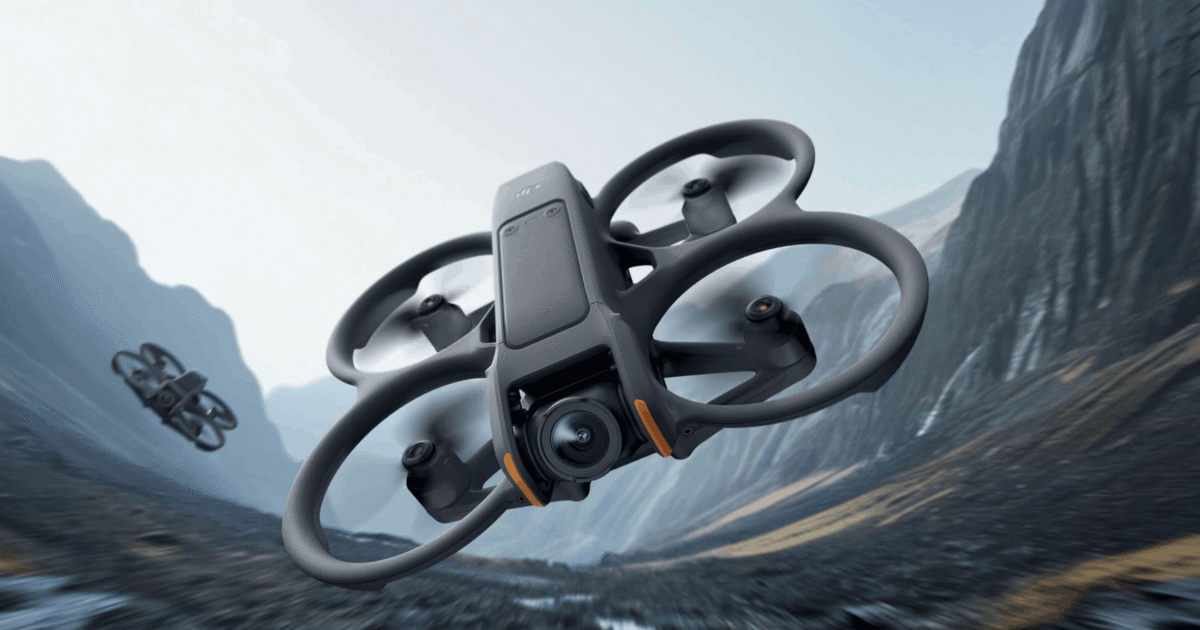
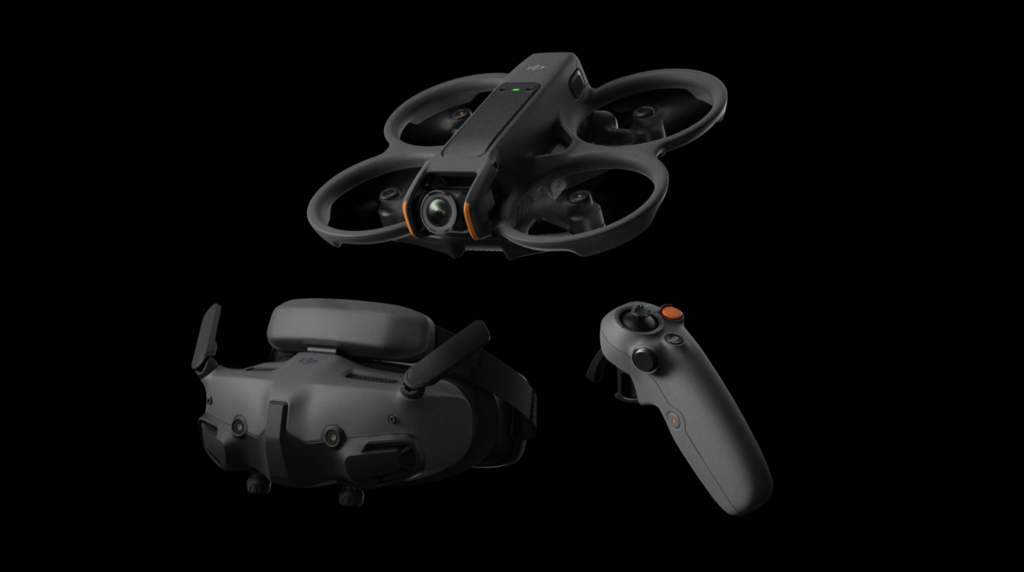
The DJI Avata 2 is a 377 g ready-to-fly FPV drone with enclosed propellers, a 1/1.3-inch camera and DJI’s O4 transmission, sold in the US as a $999 Fly More Combo with Goggles 3, the RC Motion 3 controller and one battery. It launched in April 2024 and is still sold there. This analysis is based on DJI’s published specifications; we have not flown it.
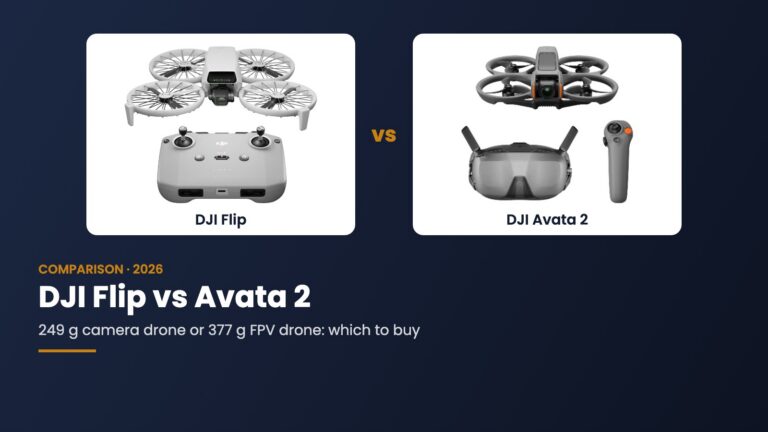
It is the easiest way into goggle-based FPV without building a drone, and a poor choice if you mainly want steady travel footage or photos. For that, a gimbal drone fits better. Our DJI Flip vs Avata 2 guide, new on 14 October, covers that choice in detail, and side-by-side spec tables compare the Avata 2 with the Flip, the Avata 360 and the Neo 2.
Table of Contents
Design, weight and rules
The Avata 2 keeps the cinewhoop layout: a compact body with built-in propeller guards, which makes flying indoors or near obstacles less nerve-racking than with open props. DJI lists it at 185×212×64 mm and about 377 g.
That weight puts it over the US 250 g line, so it must be registered with the FAA and broadcast Remote ID, even for recreational flying. FAA rules also require visual line of sight, which means that in the US someone has to stand next to you as a visual observer while you fly through the goggles. In the EU it carries a C1 class rating, which is less restrictive than heavier classes.
Speed modes and controls
There are three speed modes. Normal caps horizontal speed at 8 m/s (about 28.8 km/h) for smooth shots and beginners. Sport doubles that to 16 m/s (about 57.6 km/h). Manual reaches 27 m/s (about 97.2 km/h), restricted to 19 m/s in the EU, and requires the DJI FPV Remote Controller 3, with the dual-stick layout manual pilots expect.
With the RC Motion 3, Easy ACRO performs flips, rolls and 180-degree drifts from a single joystick movement. That is DJI’s shortcut to acrobatic footage without learning full Manual mode, and for most buyers it is the feature that makes this drone make sense.
DJI Avata 2 flight time and range
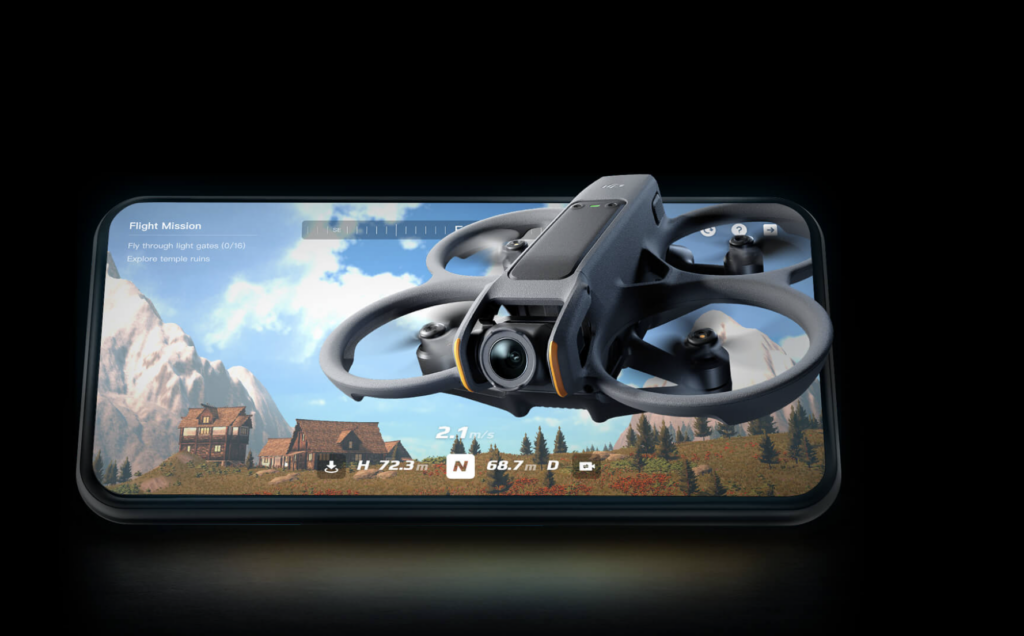
DJI lists about 23 minutes of flight, measured flying forward at a constant 21.6 km/h with no wind, and about 21 minutes hovering. Aggressive Sport or Manual flying, or wind, will cut that.
Transmission range is rated at 13 km under FCC rules and 10 km under CE, in open, interference-free conditions. DJI’s own breakdown is more useful:
| Environment | Interference | Max distance (FCC) |
|---|---|---|
| Urban | Strong | 1.5–4 km |
| Suburban | Medium | 4–10 km |
| Suburb/seaside | Low | 10–13 km |
| Obstructed by buildings | Low | 0–0.5 km |
| Obstructed by trees | Low | 0.5–3 km |
For positioning it uses GPS, Galileo and BeiDou, with ±1.5 m horizontal hover accuracy outdoors and ±0.3 m when the downward vision system takes over indoors or with weak GPS. DJI rates wind resistance at 10.7 m/s (Level 5) and the operating range at -10° to 40° C (14° to 104° F).
DJI Avata 2 camera
The sensor is 1/1.3-inch, the same size as in the Mini 3 Pro and Mini 4 Pro, and up from the original Avata’s 1/1.7-inch. It shoots 12 MP JPEG stills through a fixed f/2.8 lens with a 155° field of view and focus from 0.6 m to infinity. ISO runs from 100 to 25600.
Video options:
- 4K (16:9): up to 100fps
- 4K (4:3): up to 60fps
- 2.7K (16:9): up to 120fps
- 1080p (16:9): up to 120fps
Maximum bitrate is 130 Mbps, and there is 10-bit D-Log M for grading. The 4K/100 and 2.7K/120 modes are the ones slow-motion fans will use.
Stabilization is mostly electronic. The camera sits on a single-axis gimbal that tilts from -85° to 80°, and RockSteady 3.0+ and HorizonSteady handle the rest: RockSteady smooths turbulence and sharp moves, HorizonSteady keeps the horizon level as the drone rolls. You can turn EIS off, in which case the drone records gyroscope data so footage can be stabilized later in software like Gyroflow, which experienced FPV pilots tend to prefer.
Goggles 3 and O4
O4 sends a 1080p live view to DJI Goggles 3 at up to 100fps, with latency as low as 24 ms and up to 60 Mbps bitrate, using a 2T4R antenna design (two transmitters, four receivers). Goggles 3 add Real View PiP, which uses outward-facing cameras to show your surroundings without taking the goggles off.
Sensing, storage and batteries
There is no forward obstacle avoidance. The Avata 2 has downward and backward binocular vision sensors plus a downward ToF sensor, which help with low-altitude stability and with obstacles behind or below, for example when flying backward. DJI quotes a measurement range up to 20 m on well-lit, diffuse surfaces. In front, the ducted propellers are your protection.
It has 46 GB of internal storage, takes microSD cards up to 512 GB, and offers Wi-Fi downloads up to 30 MB/s.
The 2150 mAh battery charges from 0 to 100% in about 45 minutes on the 65W charging hub, or about 88 minutes in the drone on a 30W charger. The hub also does “power accumulation”: it moves leftover charge from several partly used batteries into the fullest one, which can get you one more flight in the field.
Who should buy it
- First-time FPV pilots who want goggles, motion control and one-tap flips in a ready-to-fly package. This is who it suits best.
- Creators after dynamic, immersive footage, with the 1/1.3-inch sensor, 10-bit D-Log M and 4K/100 to back it up.
- Experienced FPV pilots who want a grab-and-go option alongside a custom rig. It is not built to compete with 5-inch racing quads on speed or repairability.
Skip it if you want level travel video or high-resolution photos; 12 MP stills and a single-axis gimbal aren’t built for that.
Check the Latest DJI Avata 2 Fly Smart Combo Price
Compare today's price, available bundles, and verified customer reviews before making your purchase.
Check Price on Amazon →Disclosure: As an Amazon Associate, we earn from qualifying purchases at no additional cost to you.
The Friday Brief
One email a week on what changed in drones
FCC and FAA rule changes, DJI leaks checked against filings, and the week’s new comparisons. Every Friday, nothing else.
Free. Unsubscribe in one click. Sent with Kit; see our privacy policy.
Follow us on Google too: add Drone Ranker as a preferred source →
Continue Reading
All News