DJI Air 3S: Two Cameras, LiDAR and Who Actually Needs Them

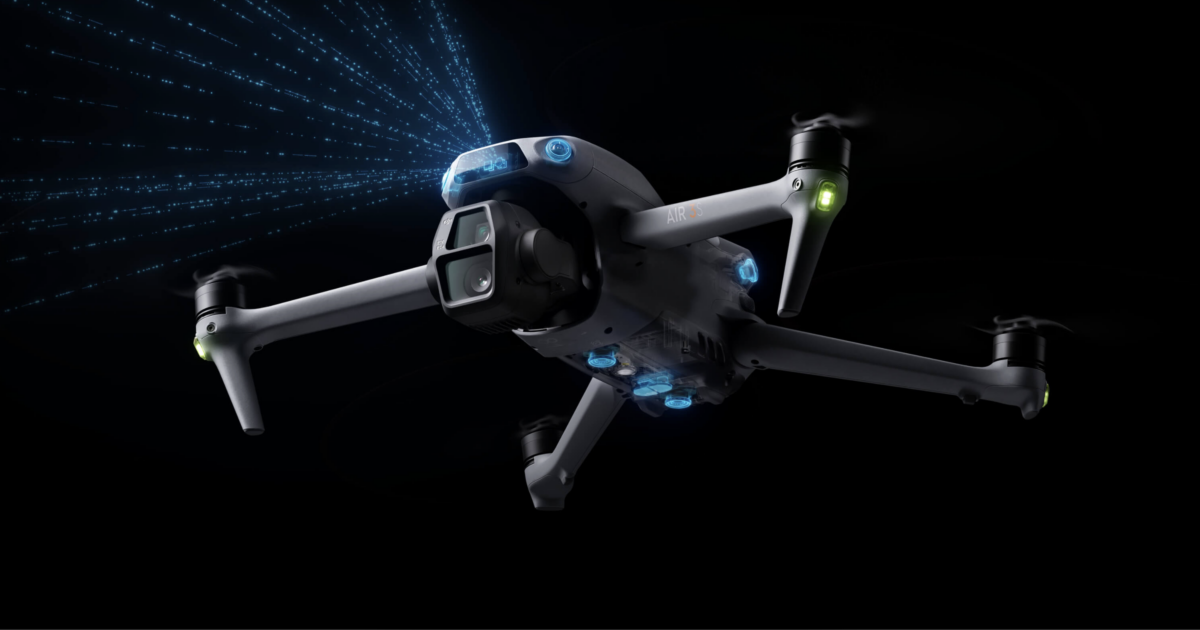
The DJI Air 3S is a 724 g dual-camera drone: a 1-inch, 50 MP wide camera plus a 70 mm medium telephoto, forward LiDAR on top of omnidirectional vision sensing, and a claimed 45 minutes of flight. It launched in October 2024 at $1,099 with the RC-N3 controller and is still sold in the US. This is a specification-based analysis of DJI’s published figures; we have not flown it.
It suits travel and scenery shooters who want two focal lengths in one drone. It doesn’t suit beginners hoping to skip FAA registration: at 724 g it must be registered and broadcast Remote ID. Its forward LiDAR also puts it in scope of the FCC’s pending “military-grade” proposal; see what that proposal would mean.
Comparing options? See DJI Mini 3 vs Mini 5 Pro vs Air 3S, Mini 4 Pro vs Air 3S, Mini 5 Pro vs Air 3S, or the Air 4 rumors. Current pricing is on DJI’s product page.
Table of Contents
Size, weight and class
Folded without propellers, the Air 3S measures 214.19×100.63×89.17 mm; unfolded, 266.11×325.47×106.00 mm. That fits a normal camera bag or a small drone backpack.
At 724 g it carries a C1 class label in the EU (the class covers 250 to 900 g), which lets you fly closer to uninvolved people than a heavier C2 drone, though you still keep a safe distance. Outside the EU, sub-250 g exemptions don’t apply, so expect to register it in most places, including for recreational flying in the US.
The two cameras
| Feature | Wide-angle camera | Medium tele camera |
|---|---|---|
| Sensor | 1-inch CMOS | 1/1.3-inch CMOS |
| Effective pixels | 50 MP | 48 MP |
| Aperture | f/1.8 | f/2.8 |
| Focal length (equiv.) | 24 mm | 70 mm |
| Field of view | 84° | 35° |
| Focus range | 0.5 m to ∞ | 3 m to ∞ |
The pairing is the main reason to buy this drone. The 24 mm wide covers big scenes; the 70 mm lets you frame a subject tightly without flying close to it. The 1-inch main sensor and f/1.8 lens are the bigger upgrade for low light and dynamic range.
Video
Both cameras record 4K (3840×2160) at up to 120fps, and 1080p goes up to 240fps for slow motion. There is also 2.7K vertical shooting at 1512×2688 for social platforms. Bitrate tops out at 130 Mbps with H.265; H.264 is supported, but 4K and slow motion require H.265. D-Log M and HLG record 10-bit 4:2:0 in 4K, which gives far more grading room than the 8-bit Normal profile.
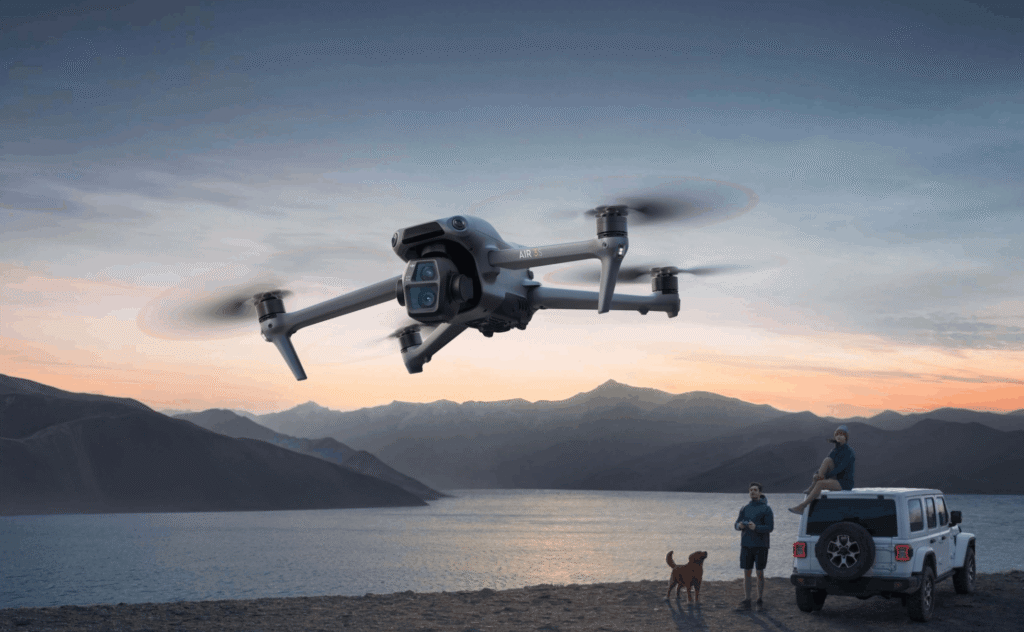
Photo settings
Both cameras shoot at 12 MP or full resolution (50 MP wide, 48 MP tele), in JPEG or DNG RAW. Burst runs from 3 to 7 frames, and there is AEB and timed shooting from 2 to 60 seconds. ISO is 100–12800 for Normal video, 100–3200 in D-Log M or HLG, up to 6400 for 12 MP photos and 3200 at full resolution.
The wide camera’s shutter runs from 1/8000 s to 2 s, with simulated long exposures from 2.5 to 8 s; the tele reaches 1/16000 s for 12 MP photos. Digital zoom runs 1x to 2.9x on the wide and 3x to 9x on the tele. Image quality drops as you zoom, but the extra reach can help for checking distant structures.
Flight time and performance
DJI claims 45 minutes of flight and 41 minutes of hover. The 45 minutes was measured in a wind tunnel at sea level, flying forward at a constant 32.4 kph with obstacle avoidance set to Brake and the camera in Photo mode. Wind, aggressive flying and the reserve you keep for Return to Home all cut into that; plan for roughly 15–20% less.
| Spec | DJI figure |
|---|---|
| Max ascent / descent | 10 m/s / 10 m/s |
| Max horizontal speed | 21 m/s (Sport, no wind); 27 m/s with a 6 m/s tailwind; 19 m/s in the EU |
| Max wind resistance | 12 m/s |
| Max pitch angle | 36° |
| Max takeoff altitude | 6,000 m |
| Operating temperature | -10° to 40° C (14° to 104° F) |
| Hover accuracy (vision) | ±0.1 m vertical, ±0.3 m horizontal |
Obstacle sensing and LiDAR
The Air 3S combines an omnidirectional binocular vision system with a forward-facing LiDAR module and a downward infrared sensor. Forward vision detects obstacles up to 200 m away and is effective at flight speeds up to 15 m/s. Forward, backward, lateral and upward vision measure from 0.5 to 18 m (lateral to 30 m), and downward vision from 0.3 to 14 m.
LiDAR is the interesting part. Camera-based sensing struggles in low light, while LiDAR measures distance with laser pulses regardless of ambient light. DJI lists a nighttime range of 0.5 to 25 m for objects with more than 10% reflectivity, so on paper the Air 3S keeps some forward obstacle detection at dusk or dawn. The vision sensors still need textured surfaces and light above 1 lux, and the infrared sensor measures only 0.3 to 8 m, so featureless ground and water at night remain a real risk. Treat the LiDAR as a backup, not permission to fly blind.
Transmission and controllers
DJI’s O4 system uses the 2.4, 5.1 and 5.8 GHz bands and switches to the clearest channel. The maximum range is 20 km under FCC rules and 10 km under CE, unobstructed and without interference, with latency as low as about 120 ms and a 1080p/30 or 1080p/60 live view. DJI’s own real-world estimates:
- Strong interference (urban): about 1.5–4 km
- Medium interference (suburban): about 4–10 km
- Low interference (open suburb or seaside): about 10–20 km
- Blocked by buildings: about 0–0.5 km
- Blocked by trees: about 0.5–3 km
It works with the DJI RC-N3 and DJI RC 2. The RC-N3 uses your phone as the screen (up to 180×86×10 mm) and runs about 3.5 hours, or 1.5 hours if it is also charging the phone.
Beyond O4, the drone has Wi-Fi (802.11 a/b/g/n/ac on 2.4 and 5.8 GHz) for downloads at up to 30 MB/s in lab conditions, and Bluetooth 5.2 for pairing. For positioning it uses GPS, Galileo and BeiDou together, which helps with satellite lock and Return to Home accuracy.
Battery, charging and storage
The Intelligent Flight Battery is a 4,276 mAh Li-ion 4S pack: 14.6 V nominal, 62.5 Wh, about 247 g. With the DJI 100W USB-C adapter and the charging hub, one battery charges in about 60 minutes; with the DJI 65W portable charger, about 80. The hub charges three batteries in sequence, starting with the one that has the most charge left.
There is 42 GB of internal storage, which saves you if you forget a card but fills quickly at 4K/120. DJI’s recommended microSD cards include the Lexar 1066x and Kingston Canvas GO! Plus (V30 U3 A2 microSDXC, 64 to 512 GB).
Gimbal
The three-axis mechanical gimbal (tilt, roll, pan) has an angular vibration range of ±0.0037°. Its mechanical range is -135° to 70° tilt, -50° to 50° roll and -27° to 27° pan; from the controller you get -90° to 60° tilt at up to 100°/s.
Air 3S vs Air 3
Set the Air 3S against the Air 3 and the two upgrades that count are the 1-inch main sensor and the forward LiDAR. Flight time and range are essentially unchanged, and internal storage grows from 8 GB to 42 GB. The Air 3S costs more than the older model; whether that premium is worth it depends on how much you shoot in low light.
| Feature | DJI Air 3S | DJI Air 3 |
|---|---|---|
| Main camera sensor | 1-inch CMOS | 1/1.3-inch CMOS |
| Tele camera sensor | 1/1.3-inch CMOS | 1/1.3-inch CMOS |
| Obstacle sensing | Omnidirectional + LiDAR | Omnidirectional |
| Max flight time | Up to 45 minutes | Up to 46 minutes |
| Internal storage | 42 GB | 8 GB |
| Max range | 20 km (O4) | 20 km (O4) |
For the full breakdown, see DJI Air 3S vs Air 3.
Who should buy it
On paper the Air 3S is one of the most complete portable drones for enthusiasts: two useful focal lengths, 4K/120, 10-bit D-Log M, a 20 km O4 link and LiDAR addressing low-light obstacle detection, in a body that still fits a small bag. If you shoot travel or scenery seriously and don’t mind registering a 724 g drone, it is the one I’d pick at this size. If you mostly want something light and unregulated, a sub-250 g Mini is the smarter buy.
For US buyers, the Air 3S was authorized before the December 2025 Covered List decision and remains on sale. The pending FCC proposal on LiDAR-equipped foreign drones could stop new sales if adopted, so if you want one, I wouldn’t count on it staying available indefinitely. DJI has not announced an Air 4; it has appeared in a Chinese flight-filing app but has no FCC authorization, so it is not expected in the US. Pricing is on DJI’s store.
The Friday Brief
One email a week on what changed in drones
FCC and FAA rule changes, DJI leaks checked against filings, and the week’s new comparisons. Every Friday, nothing else.
Free. Unsubscribe in one click. Sent with Kit; see our privacy policy.
Follow us on Google too: add Drone Ranker as a preferred source →
Continue Reading
All News