DJI Air 4 vs Mini 6 Pro: Which Upcoming DJI Drone Should You Wait For?

As of 22 October 2026, neither the DJI Air 4 nor the Mini 6 Pro has been announced by DJI. There is no official spec sheet for either, and DJI has not confirmed a camera, battery, weight, transmission system, price or launch date. So this is not a spec comparison. It is a question of which kind of drone to wait for, and for most buyers the answer comes down to drone class, not rumored megapixels.
The evidence behind the two is also uneven. A July report said the Air 4 had appeared in a Chinese certification database, following an earlier report of a suspected Air 4 in a Chinese flight application. The certification listing revealed no specifications. The Mini 6 Pro attracts plenty of rumors, but DJI’s consumer pages show no Mini 6 Pro product or spec sheet, and I found no comparable filing.
Table of Contents
What is actually known
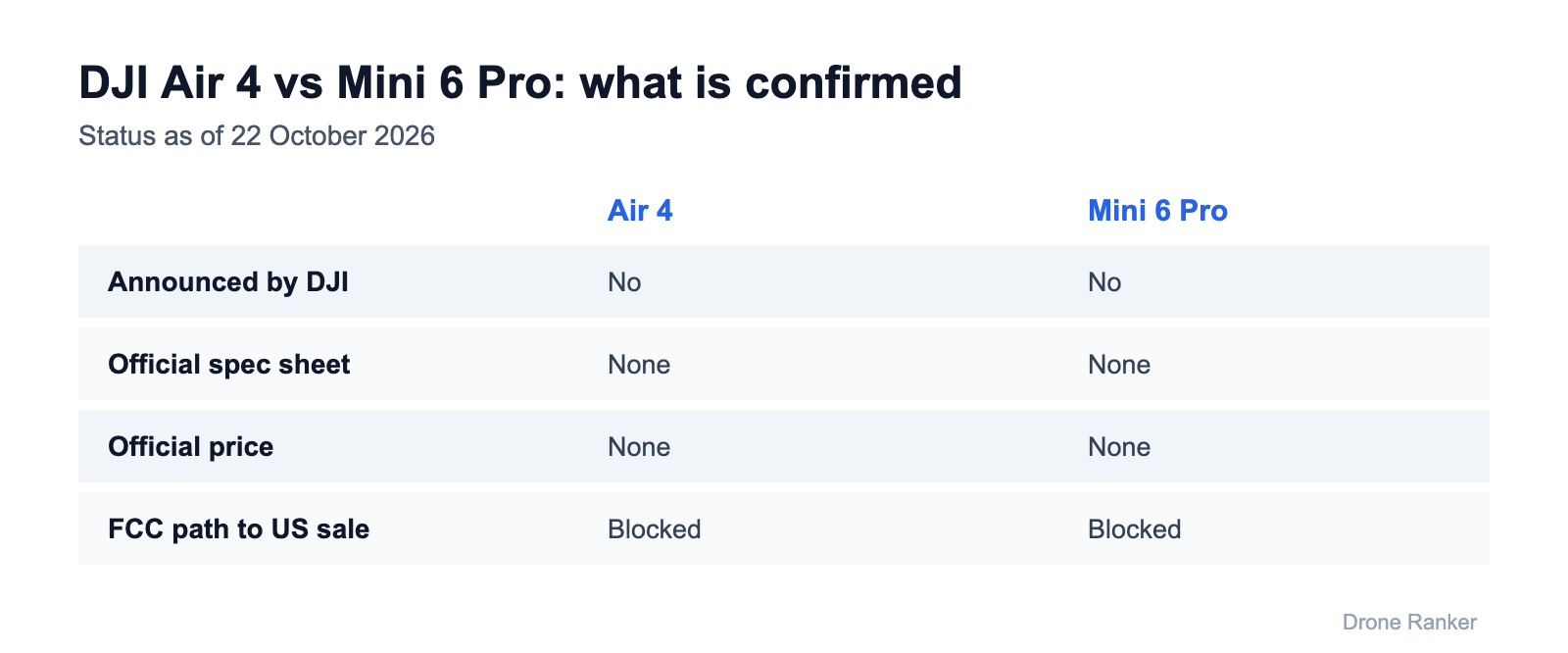
| DJI Air 4 | DJI Mini 6 Pro | |
|---|---|---|
| Officially announced | No | No |
| Official DJI product page | Not found in sources checked | Not found in sources checked |
| Reported certification activity | Yes | No comparable filing verified |
| Weight, cameras, video, sensing, LiDAR, transmission, flight time, storage | Unknown | Unknown |
| Price and release date | Unknown | Unknown |
| US availability | Uncertain | Uncertain |
Claims that the Air 4 will have a particular dual-camera setup, that the Mini 6 Pro will shoot 6K, or that either will have a certain battery life or transmission generation are not confirmed specs. Certification activity suggests a product is moving through development or regulatory review. It says nothing about a retail date, final specs or regional availability.
On evidence alone, the Air 4 looks closer to being real. That does not make it the better drone.
A better Mini or a smaller Mavic?
DJI’s current lineup shows how the two families differ. The Mini 5 Pro puts a 1-inch 50 MP sensor into an airframe with a nominal takeoff weight around the 250 g threshold, plus 4K/120 slow motion and 42 GB of internal storage. The Air 3S is a 724 g aircraft with two cameras: a 24mm-equivalent 1-inch 50 MP wide camera and a 70mm-equivalent 1/1.3-inch medium tele. DJI rates it for up to 45 minutes of flight and 12 m/s wind resistance, and it pairs omnidirectional sensing with forward LiDAR for low-light obstacle awareness.
So the Mini asks how much camera DJI can fit into the smallest practical aircraft, and the Air asks how much capability it can offer without going all the way to a Mavic. Start with how you fly, not with whose rumored numbers are bigger.
The Mini’s case: you actually carry it
A Mini is easier to take hiking, carry on a plane, fit into a small camera bag and bring along when you are not sure you will fly. That is the whole product, and a drone with better specs is no use if it stayed at home when the shot appeared. For the Mini 6 Pro to justify itself, DJI has to improve on the Mini 5 Pro without making it bigger, which is hard now that the Mini already has a 1-inch sensor. Likely areas are processing, dynamic range, sensor readout, noise, HDR and high-frame-rate modes, but those are possibilities, not features.
Treat 6K on a Mini with particular care. Higher resolution means more processing, heat, file size, storage bandwidth and power draw, all harder to manage in a tiny airframe. Even if it arrives, the useful questions are frame rate, bitrate, crop and how long it records before heat limits it.
The Air’s case: a second focal length and more margin
The Air series has room. The Air 3S uses it for a second camera, and a 70mm view gives background compression, tighter architecture shots, layered mountain compositions and vehicle tracking from a safer distance. If the Air 4 keeps that approach, camera versatility could be the main reason to pick it. DJI has not confirmed two cameras on the Air 4, though; a dual setup would only make sense given the Air 3S.
A bigger airframe also fits larger motors, propellers and batteries without chasing the Mini’s weight target. For a casual traveler that may not matter. For someone who flies along coasts, in mountains or in strong wind, it can matter a lot.
Battery, sensing and transmission: wait for real numbers
Battery size affects takeoff weight, charging time, cost, bag size and regulatory class, so “45 minutes beats 35” is not the whole comparison. Three small Mini batteries can be easier on a hike than a heavier Air kit. Neither drone has confirmed LiDAR or a confirmed transmission system. With DJI’s current links already very capable, stability, interference resistance, latency and live-view quality would matter more than another jump in advertised range.
Beginners, professionals and existing owners
Beginners: probably the Mini 6 Pro, if DJI keeps the Mini’s accessibility. Smaller drones are less intimidating and easier to take on holiday. The counterargument is that a larger Air can feel more confident in wind, and if you expect to move into serious aerial filmmaking quickly, waiting for the Air 4 could save buying twice.
Professional work: the Air 4 is the more interesting one to watch, because the Air format leaves room for multiple cameras, sustained performance and endurance. A Mini can still be a good commercial tool, but if your work depends on aerial footage, the Air platform deserves serious consideration.
Mini 3 Pro, Mini 4 Pro and Mini 5 Pro owners: you already have a drone, so waiting for a Mini 6 Pro costs little. Wait until DJI shows what it improves.
Air 3 and Air 3S owners: the Air 3S already has a 1-inch main camera, a medium tele, omnidirectional sensing with LiDAR and strong flight performance. Don’t upgrade on a rumor.
US buyers have a separate problem
The FCC added broad categories of foreign-produced drones and critical components to its Covered List in late 2025, which affects new equipment authorizations; later notices added exemptions for some categories. In July 2026 the FCC also opened a proceeding on foreign-made “military-grade” drones and some previously authorized equipment. A global DJI launch would not guarantee simple US availability, so be skeptical of any article giving a US release date for either model. Our DJI release tracker follows the evidence for both.
Should you wait at all?
If you need a drone for a trip next month, a paid job, a wedding or a specific season, don’t wait for either. The Air 3S already offers dual cameras, a 1-inch main sensor and a 45-minute rated flight time, and the Mini 5 Pro brings a 1-inch sensor to a much smaller body. Missing six months of shooting for an unannounced product can cost more than buying the “older” drone.
If you can wait, my advice is: watch the Mini 6 Pro if portability comes first, and the Air 4 if you want the most versatile camera short of a Mavic. Either way, decide on DJI’s published specs, not on someone else’s imaginary spec sheet.
Written August 13, 2026. Air 4 and Mini 6 Pro specs stay marked unknown until reliable documentation exists.
The Friday Brief
One email a week on what changed in drones
FCC and FAA rule changes, DJI leaks checked against filings, and the week’s new comparisons. Every Friday, nothing else.
Free. Unsubscribe in one click. Sent with Kit; see our privacy policy.
Follow us on Google too: add Drone Ranker as a preferred source →
Continue Reading
All News