DJI Mini 6 Pro vs Mini 4 Pro: Is It Worth Waiting for DJI’s Next Mini?

If you need a drone now, buy the DJI Mini 4 Pro, or another Mini that is actually on sale. If you already own a capable drone, wait for the Mini 6 Pro to become real before deciding anything. As of August 11, 2026, DJI has not announced the Mini 6 Pro, published specifications, opened a product page or confirmed a launch date. Most of what circulates online comes from social-media speculation, concept videos, forum threads and second-hand rumor reporting, not primary documents.
The Mini 4 Pro is the opposite: DJI documents every spec. So this comparison will not invent a Mini 6 Pro spec sheet. The useful question is how much better a Mini 6 Pro would need to be to make waiting worthwhile.
What is confirmed, side by side
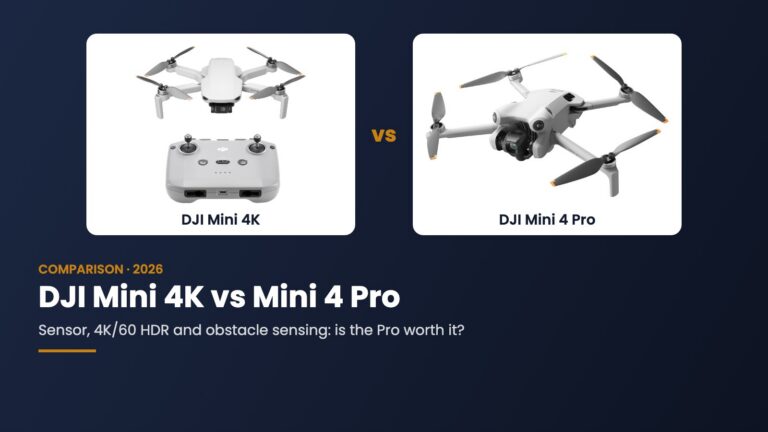
| Feature | DJI Mini 4 Pro | DJI Mini 6 Pro |
|---|---|---|
| Product status | Official / available | Not officially announced |
| Standard takeoff weight | Under 249 g | Unknown |
| Camera sensor | 1/1.3-inch CMOS, 48 MP | Unknown |
| Lens | 24mm equivalent, f/1.7 | Unknown |
| Normal 4K video | Up to 4K/60fps HDR | Unknown |
| Slow motion | Up to 4K/100fps | Unknown |
| Vertical capture | True Vertical Shooting | Unknown |
| Color profiles | 10-bit D-Log M / HLG | Unknown |
| Obstacle sensing | Omnidirectional | Unknown |
| Tracking | ActiveTrack 360° | Unknown |
| Transmission | DJI O4, up to 20 km FCC | Unknown |
| Flight time | 34 min standard; up to 45 min with Plus battery | Unknown |
| Release date | September 2023 | Not announced |
| Price | Current retail product | Not announced |
An almost empty Mini 6 Pro column is not a gap in the comparison. It is the accurate picture today.
The camera bar a Mini 6 Pro has to clear
The Mini 4 Pro pairs a 48 MP 1/1.3-inch sensor with a 24mm-equivalent f/1.7 lens on a three-axis gimbal. It records 4K at 24, 25, 30, 48, 50 and 60fps, 4K/100fps slow motion, and 10-bit D-Log M and HLG, at a maximum bitrate of 150 Mbps. Its gimbal physically rotates the camera for true vertical video instead of cropping a horizontal frame, which is useful for anyone publishing Reels or Shorts. A successor would need to keep that at minimum.
For travel video, YouTube and general aerial photos, that is a lot in a sub-249 g aircraft. “Better image quality” is not enough of a promise. A real upgrade would have to show up as more dynamic range, faster sensor readout, better low light, higher bitrates, stronger HDR, more usable high frame rates, or better lens and aperture control.
The 6K, LiDAR and 60-minute rumors
Some rumor discussions mention 6K recording, a variable aperture and a newer sensor. None of that is confirmed by DJI, and a feature repeated across rumor sites is still a rumor. Could DJI fit 6K into a future Mini? Certainly. Has any verified source shown the Mini 6 Pro does? No. Claims of continuous 6K/60fps deserve extra skepticism, because heat, data rate and power draw all get harder in an aircraft built around a very low takeoff weight.
Resolution alone does not decide camera quality either. A clean, high-dynamic-range 4K image with good color and controlled rolling shutter can be more useful than a poorly tuned 6K one. If DJI does announce 6K, the numbers to look for are sensor size, readout speed, bitrate, codec, dynamic range, frame rates, crop and thermal limits.
LiDAR comes up because DJI has put LiDAR-based sensing in newer aircraft, but current rumor analysis treats Mini 6 Pro LiDAR claims as speculation. The same goes for an O5 or upgraded transmission system.
The 60-minute flight time circulating online is the least believable of all. It is not supported by any DJI documentation and has been criticized as implausible for a sub-250 g aircraft. Wait for the battery spec, not the rumor.
Weight may say more than resolution
The Mini 4 Pro weighs under 249 g in its standard configuration; the Intelligent Flight Battery Plus takes it over 249 g. Depending on the country and type of flying, staying under 250 g can change which rules apply, so it is more than a marketing number.
Keeping a new Mini under that line while adding a faster processor, better sensing, a bigger camera, more battery, extra cooling and possibly new radio hardware is hard. That is why I think the Mini 6 Pro’s weight will tell us more about DJI’s priorities than its resolution. No weight or regulatory class has been published.
Sensing, transmission and battery
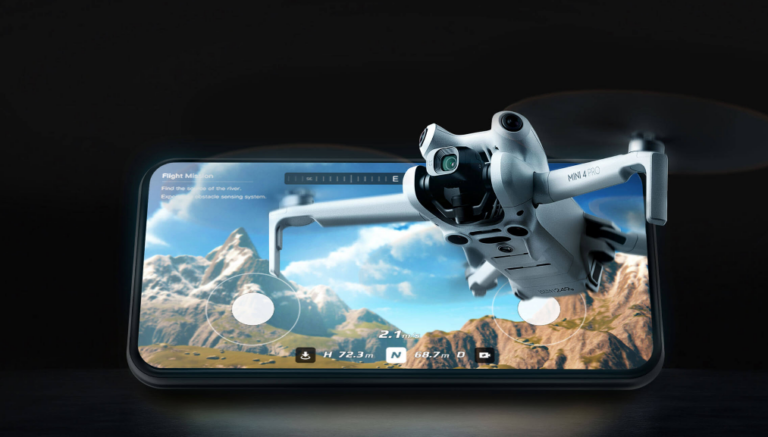
The Mini 4 Pro brought omnidirectional obstacle sensing to the Mini line, using vision sensors around the body plus a downward 3D infrared system. That supports ActiveTrack 360° and obstacle-aware automated flight. A successor could improve low-light sensing, detection range, processing speed or automated-flight reliability, but the jump will be smaller than the one the Mini 4 Pro made.
O4 transmission is rated up to 20 km under FCC rules and 10 km under CE, in unobstructed, interference-free testing, with up to a 1080p/60fps live feed. Those are technical maximums, not permission to fly beyond visual line of sight. For most owners, range is not what would justify an upgrade; connection resilience, interference handling, latency and efficiency would.
Battery life is where a Mini 6 Pro could make waiting worthwhile. DJI rates the Mini 4 Pro at 34 minutes on the standard battery and up to 45 minutes with the Plus battery, which is not sold in every region. Real flights are shorter once you keep a reserve for returning and landing, and wind, temperature and flying style all cut endurance. A sub-249 g Mini that flies noticeably longer would be felt on every flight.
Why not compare with the Mini 5 Pro?
DJI has already released the Mini 5 Pro, with a 1-inch CMOS camera and nightscape omnidirectional obstacle sensing, so the Mini 4 Pro is no longer the newest Mini. It stays relevant because of price and ownership: discounted stock, used buyers, creators who don’t need the newest camera, and existing owners deciding whether to skip a generation. If the price gap to the Mini 5 Pro is small, the newer drone deserves a look. If you are choosing between the newest Mini and the next one, see our Mini 5 Pro vs Mini 6 Pro comparison.
If you already own a Mini 4 Pro or Mini 3 Pro
I would not sell a Mini 4 Pro because of Mini 6 Pro rumors. It already has a strong camera, 10-bit recording, 4K/60 HDR, slow motion, vertical shooting, omnidirectional sensing, ActiveTrack, O4 and a sub-249 g standard weight. For an upgrade to make financial sense, the Mini 6 Pro should solve a problem you actually have, whether that is low light, battery life, tracking or dynamic range. “Two generations newer” is not a reason to spend money. Mini 4 Pro owners gain the most from waiting, and Mini 5 Pro owners even more so.
A Mini 3 Pro owner could see real gains in obstacle sensing, tracking, transmission, video features and automated flight by moving up a generation. If you need that upgrade now, buy a drone whose specs you can verify. If your Mini 3 Pro still does what you need, wait. The best buying position is one where you don’t need the rumored product to arrive.
The case for buying now
The Mini 4 Pro’s biggest advantage is that you can buy it. You know exactly which camera, battery system, controllers, sensing and recording modes you get, and how it fits your local rules. If you need a drone for a trip next month, a wedding, a paid job or this summer, waiting for a product with no launch date has its own cost: months you aren’t flying.
It suits a first serious drone buyer who wants something compact before stepping up to Air or Mavic hardware, a traveler who values the sub-249 g weight and folding design, and a creator who shoots mostly vertical. A strong discount is probably the best reason of all in 2026: a mature previous-generation drone can be better value than chasing each launch.
US buyers have an extra question. The rules around foreign-made drones have changed a lot, and the FCC is considering further restrictions on some previously authorized foreign drone equipment. Even if DJI launches a Mini 6 Pro globally, US availability is a separate question from whether it is any good, so be careful with any article that names an American launch date. There is no verified launch date anywhere yet. We follow it in Air 4 and Mini 6 Pro US availability.
My call
Need a drone now? Buy from today’s Mini lineup. Already own a capable Mini? Wait for DJI to show the product, then compare camera, battery, weight, sensing and price with real numbers. What I would not do is put a real project on hold because a rumor site promised 6K video or a 60-minute battery that DJI has never announced.
Buy now instead of waiting
DJI Mini 4 Pro (RC-N2)
Under 249 g, omnidirectional sensing without LiDAR, still in DJI’s US line-up.
As an Amazon Associate, Drone Ranker earns from qualifying purchases. We do not quote prices because Amazon’s change by the hour.
Last updated: August 12, 2026. Mini 6 Pro entries marked unknown will be updated only when reliable primary-source information appears.
The Friday Brief
One email a week on what changed in drones
FCC and FAA rule changes, DJI leaks checked against filings, and the week’s new comparisons. Every Friday, nothing else.
Free. Unsubscribe in one click. Sent with Kit; see our privacy policy.
Follow us on Google too: add Drone Ranker as a preferred source →
Continue Reading
All News