DJI Air 4 Rumors: Release Date, Specs, Leaks and What Is Confirmed

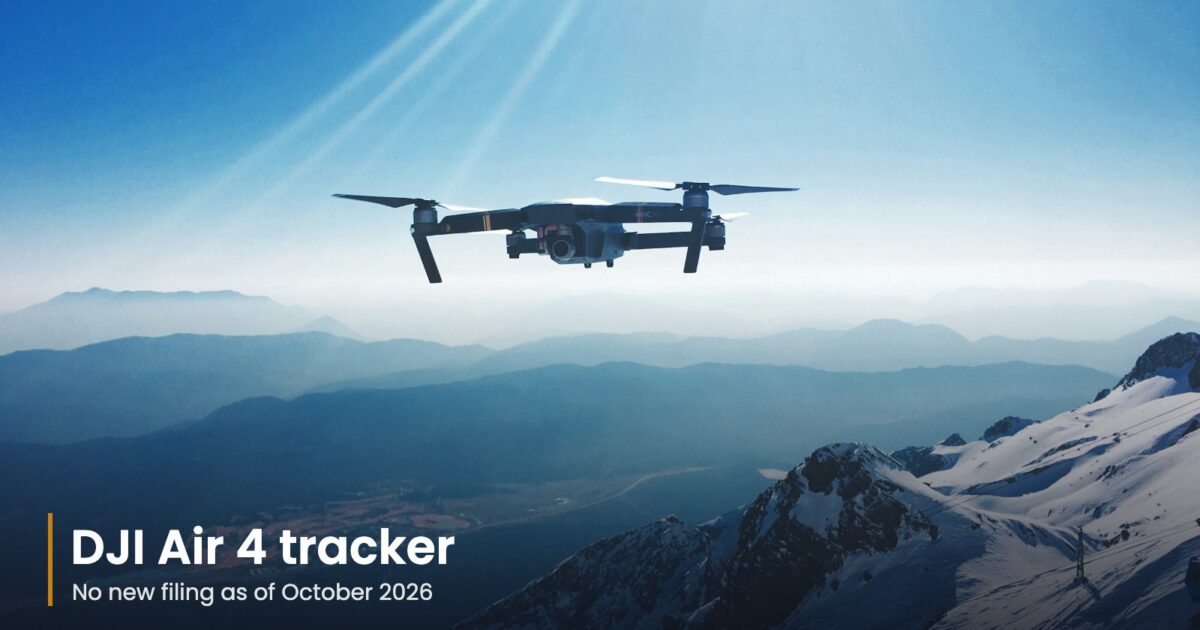
Nothing about the DJI Air 4 is confirmed. As of 27 October 2026, DJI has not announced it, and there has been no new certification, retail listing, packaging leak or official teaser since September 1. The strongest Air 4-specific evidence is still a May 11 entry in a Chinese flight-filing app, shared by leaker Igor Bogdanov alongside early documents he obtained in May 2026.
The DJI release tracker shows where the Air 4 sits against the Neo 3, Mini 6 Pro and Matrice 5TD on the path from rumor to launch.
Table of Contents
Latest check: 27 October 2026
The launch window is slipping. The trackers that follow DJI most closely have gone quiet too: DroneXL’s Air 4 guide was last revised on September 7 and DJI Rumors’ Air 4 page on August 21. For recent DJI launches, a Chinese radio certificate has typically appeared one to three months before release, and packaging leaks two to six weeks before.
With neither visible, the September to November 2026 window that earlier estimates pointed to now looks unlikely. Trackers have moved to “late 2026 or early 2027”, and DJI’s fall slot appears to belong to the Neo 3, whose registry entry already shows a September 21 production date and whose retail packaging leaked on September 15, 2026. The leak trackers’ attention has also shifted to the enterprise Matrice 5.
A correction on July’s “certification”. The only radio certificate that surfaced in China in July was for a DJI device coded N610BS, with an N610BS-BD variant. DroneXL, which reported it, said plainly that nobody outside DJI knows what it is. Some coverage at the time, including our own report on the Chinese certification listing, linked it to the Air 4 more firmly than the evidence allows.
A lull is not a cancellation. DJI has gone months between a filing and a launch before, and the Air series has never followed a fixed annual cycle. Since July, though, there has been no teaser, creator embargo or regional product page.
What the leaked prototype images show
Shortly after Bogdanov’s documents, images reportedly taken from a Chinese flight app began circulating, and they look consistent with an active development program rather than a concept. Several people who analyzed them describe noticeably thicker arms than the Air 3S, which usually means room for larger motors, better cooling or more internal parts, plus a stiffer frame. They also point to what look like top-mounted sensors, which would widen obstacle sensing.
Treat all of it with care. Prototype hardware often changes a lot before production, and what appears in a leaked photo may not be what ships.
Rumored specs, and why they conflict
There are two incompatible spec stories, and neither comes with a named source:
- a sub-250 g aircraft with a 1/1.3-inch camera and O4+;
- a heavier sub-500 g design with two 1-inch cameras and O5.
One explanation in circulation is that DJI is preparing two models. I’m not treating either as confirmed.
The dual 1-inch idea gets the most attention. The Air 3S pairs a 1-inch main camera with a smaller 70 mm telephoto sensor, so matching the second camera to the first would help low-light work and dynamic range, and would narrow the gap to DJI’s Mavic line.
A sub-250 g Air would be a regulatory play: in the EU, the UK and several Asian markets, drones under 250 g get simpler registration and fewer operating restrictions. It would also be hard to build. The Air 3S weighs about 730 g, and some commentators expect a lighter version would have to drop the second camera or use a smaller battery.
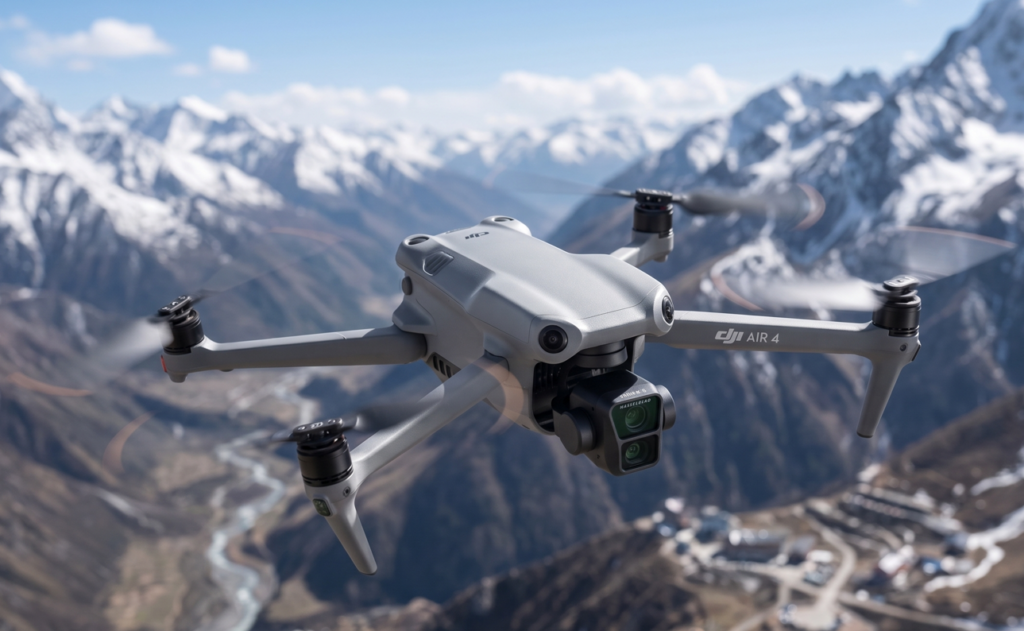
Transmission and sensing are the least surprising parts. The Air 3S already uses O4, which DJI rates at up to 20 km on existing models in ideal conditions, with real-world range usually lower. Commentary about a next-generation APAS suggests smoother routing around obstacles; some Air 3S owners report that its avoidance can be overly cautious and stop unnecessarily around complex shapes.
What is N610BS?
N610BS and N610BS-BD appeared in China’s CMIIT (Ministry of Industry and Information Technology) records in mid-2026. The filing was handled differently from DJI’s recent consumer drones, categorized more like a higher-level or professional model, and the BD variant got its own certificate number (2026-7820). The “N” prefix also matches none of DJI’s established series:
| Series | Prefix | Example model | Category |
|---|---|---|---|
| Matrice | M | M4T | Enterprise |
| Lito | DG | DGN12C | Entry-level consumer |
| Air | CZ | CZ3SCL | Mid-range consumer |
| Mini | MT | MT4MFVD | Lightweight consumer |
| Neo | DF | DF1A0424 | Ultra-light consumer |
| Avata | QF | QF3W4K | FPV consumer |
| N610BS | N | N610BS | Unknown |
It could be a new category, a prosumer drone above the Air line, an enterprise model, or a specialized variant of an existing product. Some observers think it is a companion or higher-tier model launched alongside the Air 4. All of that is speculation until DJI files more. If DJI is preparing two new aircraft in close succession, it may stagger the announcements to avoid competing with itself.
Price
Current estimates put the Air 4 at $800 to $1,200+, depending on configuration. That fits the series’ history: the Air 3 launched at $999 for the standard combo, and the Air 3S has stayed in a similar bracket. Dual 1-inch cameras, more sensing hardware and a more complex frame would push toward the top of that range. Where DJI has no official sales, gray-market importers usually add significant markups and offer limited warranty support.
The US problem
There is no Air 4 FCC filing, and in the US the situation is simple: a new DJI aircraft cannot get FCC authorization while DJI is on the Covered List. Even after a global launch, American buyers would be left waiting, buying gray-market, or choosing something else. Gray-market units typically lack a full manufacturer warranty, and firmware support and after-sales service can be patchy.
Should you wait for it?
My view: if you need an Air-class drone now, buy the Air 3S. It has a 1-inch main camera, a 70 mm medium telephoto, O4 and omnidirectional sensing, and waiting for the Air 4 comes with no confirmed payoff date.
- Upgrading from an Air 2S or older: a dual 1-inch Air 4 would be a bigger jump, so waiting is more defensible, if you will be able to buy one.
- Flying where sub-250 g rules make a real difference: a light Air 4 would be attractive, but it is only a rumor.
- In the US: don’t plan around an Air 4 at all.
Signs a launch is close
- A Chinese radio certificate clearly tied to the aircraft, and new CMIIT or CE filings.
- Packaging leaks, which have tended to come two to six weeks before release.
- DJI creator activity. DJI usually briefs select YouTubers and photographers ahead of launches, so a burst of teasers from trusted partners is a strong signal.
- Air 3S discounts, which can mean stock being cleared for a successor.
DJI has not published an Air 4 product page. Check any release and regional availability against the official DJI camera drone catalog. This page is updated when a new filing, retailer listing or official DJI signal appears.
The Friday Brief
One email a week on what changed in drones
FCC and FAA rule changes, DJI leaks checked against filings, and the week’s new comparisons. Every Friday, nothing else.
Free. Unsubscribe in one click. Sent with Kit; see our privacy policy.
Follow us on Google too: add Drone Ranker as a preferred source →
Continue Reading
All News