DJI Air 4 vs Mini 5 Pro: Should You Wait for Air 4 or Buy Now?

If portability matters to you, buy the DJI Mini 5 Pro now. Wait for the Air 4 only if you want something the Mini platform cannot easily deliver, such as a dedicated telephoto camera or a larger, more wind-capable aircraft, and you don’t need a drone soon.
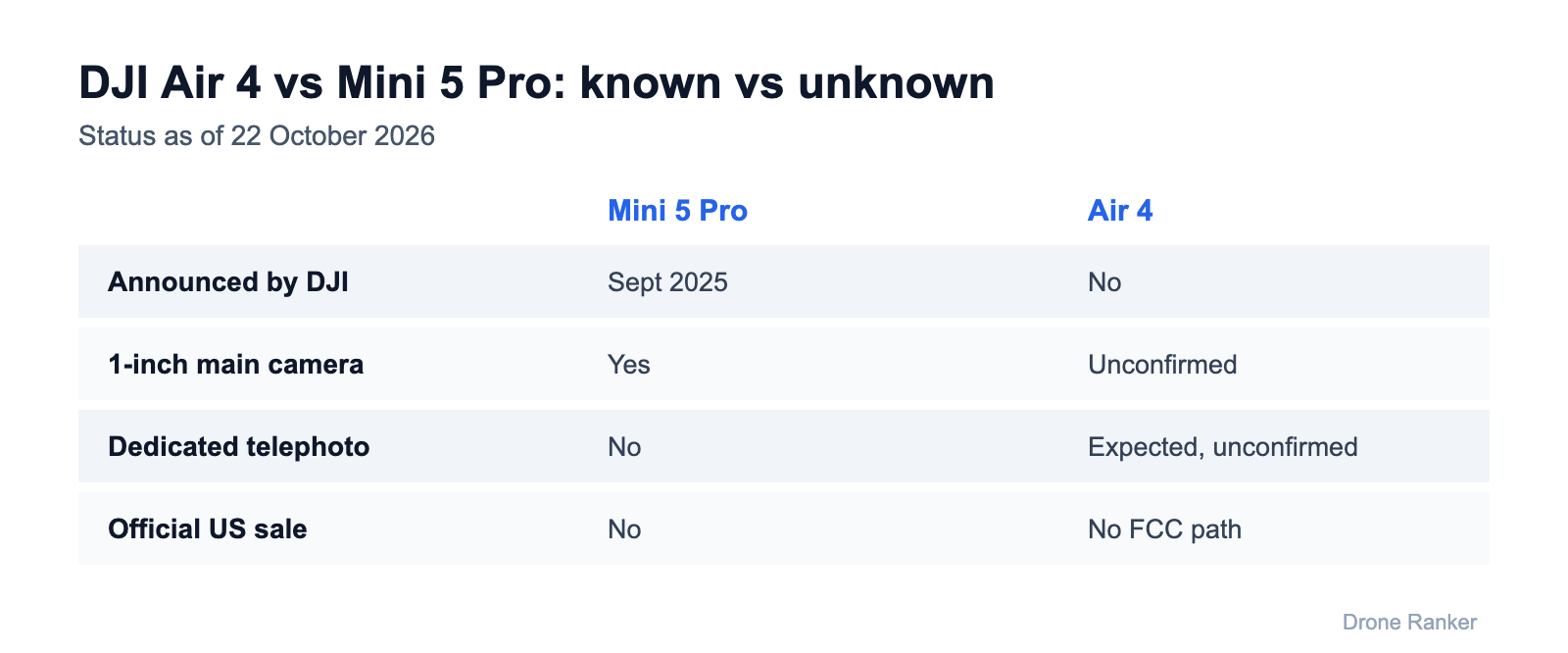
The catch with this comparison is that DJI has not announced the Air 4. Reports say the next Air model has appeared in a Chinese certification database, but that listing revealed no camera, battery, weight, price or release date. So this is not a spec-by-spec comparison. It is a look at what the Air 4 would have to offer to make waiting better than buying a Mini 5 Pro today.
Table of Contents
What the Mini 5 Pro already offers
| Spec | DJI Mini 5 Pro (DJI figures) |
|---|---|
| Takeoff weight | 249.9 g nominal, standard configuration |
| Folded size | 157 × 95 × 68 mm |
| Camera | 1-inch CMOS, 50 MP, 24 mm equiv., f/1.8 |
| Video | 4K/60 HDR, 4K/120 slow motion, 130 Mbps, 10-bit Normal / HLG / D-Log M |
| Telephoto | 48 mm 2x Med-Tele crop mode, no separate tele camera |
| Obstacle sensing | Omnidirectional vision + forward LiDAR + downward infrared |
| Transmission | O4+, up to 20 km (FCC), 10 km (CE/SRRC/MIC), 1080p/60 live view |
| Max flight time | 36 min standard battery, 52 min Battery Plus |
| Typical flight time | 21 min standard, 33 min Plus |
| Top speed | 18 m/s standard battery, 19 m/s Plus |
| Wind resistance | 12 m/s |
| Storage | 42 GB internal |
There is no official Air 4 spec sheet to set beside it. Any exact Air 4 number you see presented as fact, flight time included, should be ignored until DJI publishes one.
The Mini already has the big sensor
For years DJI’s lineup was simple. A Mini gave you portability, an Air gave you more camera and flight capability, and a Mavic moved further toward high-end imaging. The Mini 5 Pro breaks that by putting a 1-inch CMOS sensor in the Mini line. So the Air 4 cannot justify itself with “it has a big main camera.” The Mini already does.
To be clearly the better imaging platform, the Air 4 would need to pull ahead somewhere else: a more versatile multi-camera system, a stronger telephoto, faster sensor readout, better low-light quality, better heat management for long recording, higher-end codecs or bitrates, or more dynamic range. None of that is confirmed.
A second camera is the best reason to wait
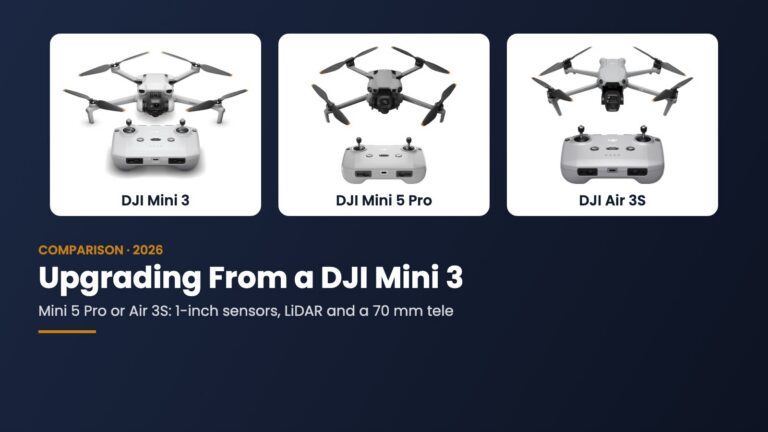
The current Air 3S uses two cameras, a 1-inch wide and a 70 mm-equivalent medium tele, and weighs 724 g. That does not prove the Air 4 will follow the same design, but it shows why someone would still pick an Air over the Mini 5 Pro.
A dedicated tele camera changes how you shoot: compressed mountain scenes, stronger parallax, tighter subject isolation, distant architecture and tracking from farther away, all without moving the drone close to the subject. The Mini 5 Pro’s 48 mm mode is a 2x crop, which DJI itself describes as a Med-Tele mode rather than a separate camera. If the Air 4 keeps the Air family’s multi-camera approach, that is the strongest case for waiting.
Flight performance and battery
The Mini 5 Pro’s 18–19 m/s top speed and 12 m/s wind rating are plenty for travel and casual creator use. The Air 3S shows what DJI can do with a bigger platform: up to 45 minutes of flight and higher top speeds under specified conditions, with the same 12 m/s wind rating. Those figures cannot be assigned to the Air 4, but a larger airframe leaves room for stronger motors, bigger propellers and batteries, steadier flight in gusts and more thermal headroom. For mountains, coastlines, vehicle tracking and professional location work, that can count for more than one more camera spec.
On battery, I like that DJI publishes both maximum and typical figures for the Mini 5 Pro, because the gap (36 versus 21 minutes on the standard pack, under DJI’s mixed-flight, 4K/60 test) shows why maximum endurance claims should never be read as usable flight time. The Plus battery also adds weight and can change the aircraft’s regulatory class. An Air 4 with strong endurance on its standard battery, without that weight trade-off, would be a real benefit.
Sensing, transmission and storage
The Mini 5 Pro has already closed much of the gap here. DJI says its forward LiDAR enables omnidirectional sensing at night down to specified low-light conditions and supports next-generation Smart RTH. The Air 3S brought forward LiDAR to the Air family too, so the question for the Air 4 is not whether it has LiDAR but whether its sensing does meaningfully more than the Mini’s.
The same applies to transmission. The O4+ range figures are measured maximums, not permission to fly beyond visual line of sight, and for most people headline range is already past the point where a bigger number changes anything. Better interference resistance, lower latency and steadier links in difficult radio environments would matter more.
The 42 GB of internal storage sounds dull until you forget your microSD card. With Off-State QuickTransfer and Wi-Fi 6 transfers at DJI’s claimed 100 MB/s under supported conditions, it is genuinely useful on a trip. An Air 4 should at least match it.
The Mini’s real advantage is size
The Air 4 may beat the Mini 5 Pro in several technical categories. It cannot beat it at being a Mini. DJI notes that actual weight varies slightly and that battery choice affects classification: in the EU the normal Fly More configuration is C0-certified, the Fly More Combo Plus is C1, and fitting the larger Plus battery to a C0 aircraft takes it past the C0 weight limit.
The Mini’s appeal has always been about less friction. A drone that folds to 157 × 95 × 68 mm comes on trips almost automatically. A bigger aircraft makes you think twice about carrying it, its larger batteries, the charging hub, spare propellers, ND filters, the controller and a bigger case. A drone that comes along more often because it is small can be worth more than a better one that stays home.
Who should buy, who should wait
Buy the Mini 5 Pro now if you:
- travel or hike and want a 1-inch camera in a very compact folding aircraft;
- are buying your first premium drone and want strong imaging, tracking and obstacle sensing without moving to a heavier Air or Mavic;
- make vertical social content, where the 225° gimbal roll and vertical capture help;
- have a trip, job or project coming up. The Air 4 has no launch date, and missing months of shooting for an unannounced product makes little sense.
Wait for the Air 4 if you:
- own an Air 3S, unless you urgently need something smaller;
- need a dedicated telephoto camera, which the Mini 5 Pro cannot fully replicate;
- regularly fly in high wind or demanding locations;
- already own a capable drone that still does the job. If you have a Mini 5 Pro, base any upgrade on confirmed Air 4 specs, not rumors.
US buyers have a second question
The FCC is considering further restrictions on importing and marketing some previously authorized foreign-produced drones, and future DJI products face their own US availability problems. The proceeding is a proposal, not a shutdown of existing DJI drones. But a global Air 4 announcement would not answer whether you can officially buy one in the US. That is covered in our DJI Air 4 and Mini 6 Pro US availability analysis. For US buyers, waiting means two unknowns: what the drone will be, and how it will reach the US market.
A rumor cycle can make an excellent product feel obsolete because of a certification listing that says nothing about specs. The Mini 5 Pro is a real, documented drone that already does more than most people need. Don’t put off real projects for a spec sheet that does not exist yet. If you already have a capable drone and want the next serious Air, wait for DJI to show the Air 4 before spending anything.
Last updated: August 13, 2026. Air 4 details stay marked as unknown until DJI publishes official specifications.
The Friday Brief
One email a week on what changed in drones
FCC and FAA rule changes, DJI leaks checked against filings, and the week’s new comparisons. Every Friday, nothing else.
Free. Unsubscribe in one click. Sent with Kit; see our privacy policy.
Follow us on Google too: add Drone Ranker as a preferred source →
Continue Reading
All News