DJI Mini 5 Pro: A 1-Inch Camera Under 250 g, and Where It Falls Short

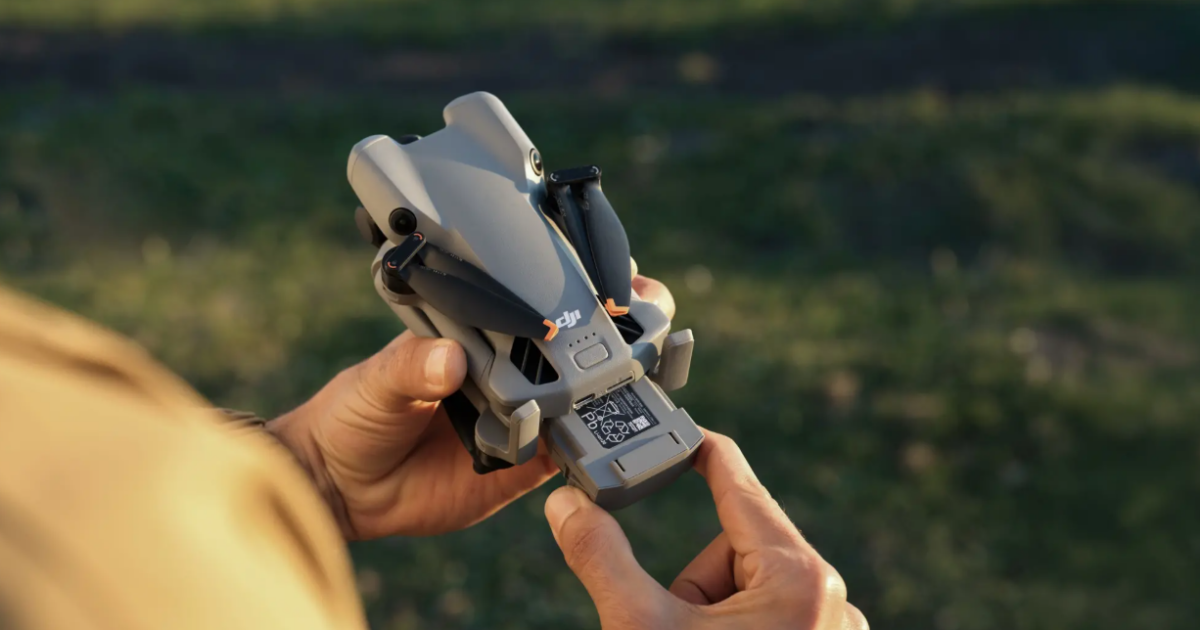
The DJI Mini 5 Pro is the best camera DJI has fitted under 250 g: a 1-inch, 50 MP sensor, 4K/120, 10-bit D-Log M and a gimbal that rolls 225°. It launched on 17 September 2025 from £679 for the drone and £869 for the Fly More Combo with the RC-N3, everywhere except the US. DJI said it “will not be available officially in the United States”. Amazon US listings come from retailers, not DJI, so check who is selling it and what warranty applies.
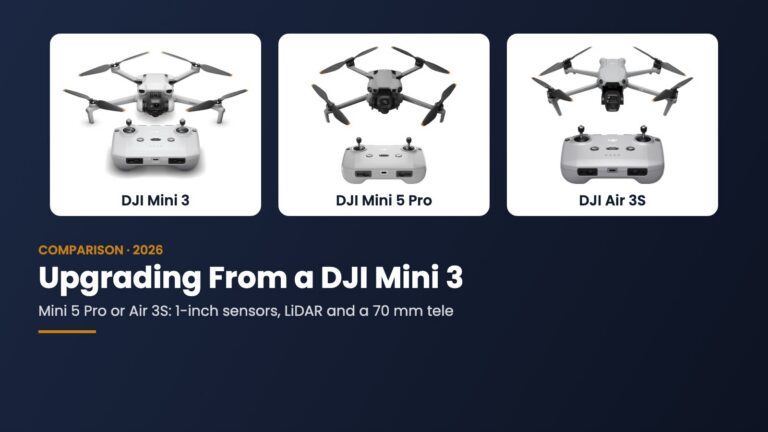
This analysis works from DJI’s published spec sheet and statements; we have not flown it. For comparisons, see Mini 5 Pro vs Mini 4 Pro, Mini 5 Pro vs Flip, Mini 5 Pro vs Mavic 3 Pro and the three-way Mini 3 vs Mini 5 Pro vs Air 3S.
Table of Contents
Is it really under 250 g?
DJI lists a takeoff weight of 249.9 g and notes batch variation of about ±4 g. DroneXL reports production units at 252–253 g. That matters: in the US, a drone at 250 g or more must be registered with the FAA, and the sub-250 g line is what spares many recreational pilots elsewhere from registration and exams.
In the EU it is sold as a C0 drone, the class with the widest access for casual flying. The Intelligent Flight Battery Plus takes it well over 250 g and is not sold in Europe. Whichever battery you use, check local rules on registration and exams before flying.
Size and flight performance
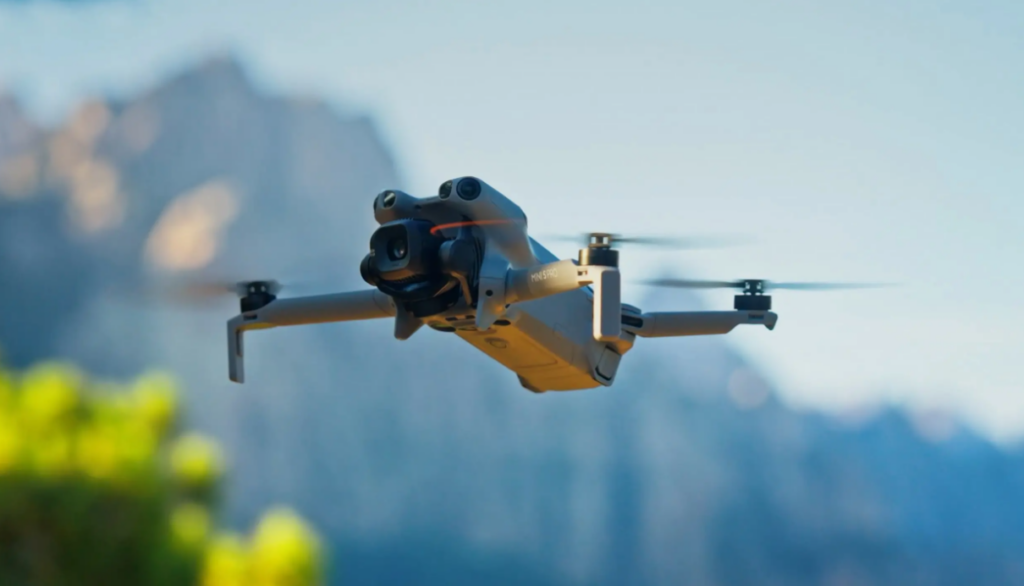
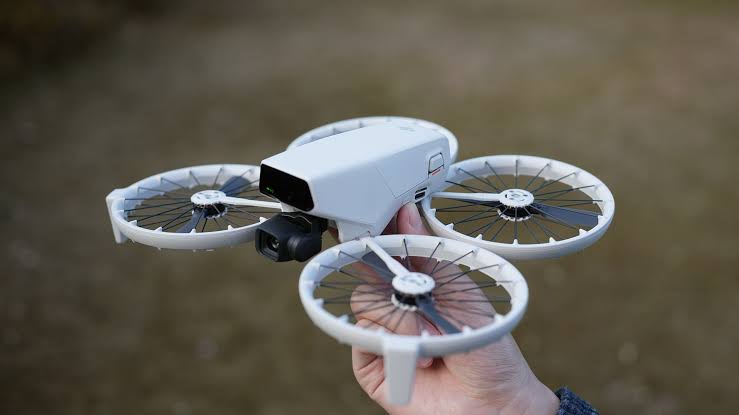
Folded without propellers it measures 157×95×68 mm; unfolded with propellers, 304×380×91 mm. It fits a small camera bag or a jacket pocket.
There are three flight modes: Sport, Normal and Cinematic. In Sport mode, maximum ascent is 10 m/s, and descent is 8 m/s with the Battery Plus or 6 m/s with the standard battery. Top horizontal speed is 19 m/s with the Plus battery and 18 m/s with the standard one, limited to 15 m/s while tracking. DJI measures these in a wind tunnel simulating windless conditions at sea level, after a vertical climb to 1.5 m, so real speeds will vary with wind, altitude and firmware. It is rated for winds up to 12 m/s, with a 38° maximum pitch angle.
Maximum takeoff altitude is 6000 m with the standard battery, 4500 m with the Plus, and 2000 m with the Quick-Release 360° Propeller Guard fitted.
DJI Mini 5 Pro: standard battery or Battery Plus
| Specification | Intelligent Flight Battery | Intelligent Flight Battery Plus |
|---|---|---|
| Capacity | 2788 mAh | 4680 mAh |
| Weight | approx. 71.2 g | approx. 117 g |
| Nominal voltage | 7 V | 7.16 V |
| Energy | 19.52 Wh | 33.51 Wh |
| Max flight time | 36 minutes | 52 minutes |
| Typical flight time | 21 minutes | 33 minutes |
The gap between maximum and typical flight time is large, and the typical figure is the one to plan with. The maximum comes from a wind tunnel, flying forward at a constant 21.6 km/h (standard) or 25.2 km/h (Plus) until the battery is empty. The typical test is closer to a real flight: take off, climb to 120 m, fly 1 km at 15 m/s, record 4K/60fps while moving the gimbal, and hover until the return-to-home reminder.
Maximum flight distance is 21 km on the standard battery and 32 km on the Plus, at a constant 39.6 km/h in a wind tunnel. Wind, interference and line-of-sight rules will keep real distances far lower.
Camera: a 1-inch sensor under 250 g
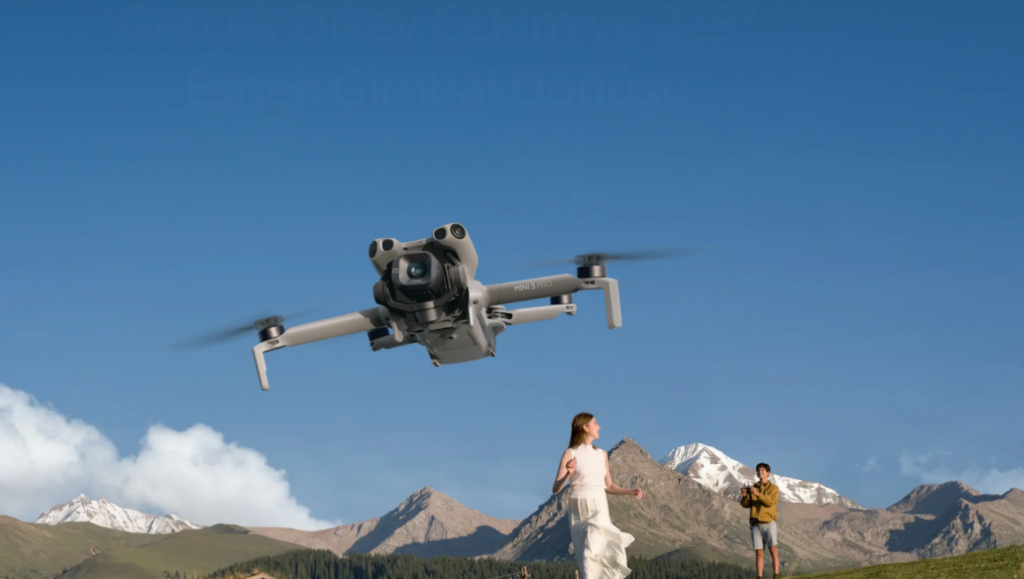
The sensor is a 1-inch CMOS with 50 MP effective, behind a 24 mm-equivalent lens with an 84° field of view, f/1.8 aperture and focus from 0.5 m to infinity. A sensor this size gathers more light than the smaller chips in most ultra-light drones, which should mean better dynamic range and less noise in low light.
ISO ranges depend on mode. Video runs 100–12800 in Normal, 100–3200 in D-Log M and HLG, and 100–6400 in slow motion. Stills run 100–6400 at 12 MP and 100–3200 at 50 MP. Shutter speeds go from 1/8000 s to 2 s, with a simulated long exposure of 2.5–8 s at 12 MP. Maximum image size is 8192×6144, and stills modes include single shot (12 and 50 MP), burst, AEB and timed, in JPEG or DNG RAW.
Video and bitrates
It records H.264 and H.265. 4K (3840×2160) is available at 24, 25, 30, 48, 50, 60 and 120 fps, and Full HD at up to 240 fps; the 120 and 240 fps modes play back as slow motion. Slow motion and 4K use H.265 only.
Maximum bitrate is 130 Mbps. One detail affects storage and editing: 4K/120fps D-Log M is encoded at 120fps and 130 Mbps, but the file plays at 30fps. The clip therefore runs four times longer than the recording, and the file’s bitrate reads as roughly a quarter of the original.
Normal FHD is 8-bit 4:2:0 in H.264, or 10-bit 4:2:0 in H.265 along with Normal 4K. HLG and D-Log M are 10-bit 4:2:0 in H.265. Digital zoom is 1–3x for 12 MP photos and 4K video, and 1–4x for FHD.
The 3-axis gimbal has a mechanical range of -135° to 80° tilt, -230° to 95° roll and -25° to 25° pan. The controllable range is -90° to 55° tilt and -180° to 45° roll, with a maximum tilt speed of 100°/s and angular vibration of ±0.005°.
Obstacle sensing
The Mini 5 Pro uses omnidirectional binocular vision, a forward-facing LiDAR and an infrared sensor underneath. DJI’s figures for the vision system:
- Forward: measurement 0.5–18 m, detection 0.5–200 m, effective sensing speed ≤ 15 m/s, FOV 90° horizontal, 72° vertical.
- Backward: measurement 0.5–18 m, ≤ 14 m/s, FOV 90° horizontal, 72° vertical.
- Lateral: measurement 0.5–12 m, ≤ 14 m/s, FOV 90° horizontal, 72° vertical.
- Upward: measurement 0.5–18 m, ≤ 6 m/s, FOV 72° front/back, 90° left/right.
- Downward: measurement 0.3–14 m, ≤ 6 m/s, FOV 106° front/back, 90° left/right.
The cameras need textured surfaces and light above 1 lux, and the downward sensor needs diffuse reflectivity above 20%. When light runs out, the infrared sensors take over: the forward LiDAR measures 0.5–25 m at night (reflectivity above 10%) with a 60° field of view in each axis, and the downward infrared sensor covers 0.3–8 m. On paper, that means obstacle sensing that keeps working after dark.
O4+ transmission
O4+ uses the 2.400–2.4835 GHz, 5.170–5.250 GHz and 5.725–5.850 GHz bands, depending on region, with transmit power under 33 dBm EIRP on 2.4 and 5.8 GHz under FCC rules. Maximum range in open, interference-free conditions is 20 km (FCC) and 10 km (CE, SRRC, MIC).
DJI’s own real-world figures are more useful: 1.5–4 km in cities with strong interference, 4–10 km in suburbs with medium interference, 10–20 km in low-interference suburbs or by the sea, 0–0.7 km when blocked by buildings and 0.7–4.5 km through trees. Live view is 1080p/30fps or 1080p/60fps with latency as low as about 120 ms, over four antennas in a 2T4R layout.
Controller, storage and charging
The DJI RC-N3 controller weighs about 320 g and runs for up to 3.5 hours without charging your phone, or 1.5 hours while charging it. It takes phones up to 180×86×10 mm and charges in about 2 hours with a 5V/2A charger. It supports Lightning, USB-C and Micro-USB phones, though Micro-USB needs a separately sold cable.
The drone has 42 GB of internal storage, handy if you forget a microSD card, and uses exFAT. DJI’s recommended cards are mostly from the Lexar Silver Plus and Kingston Canvas Go! Plus lines, 64 GB to 1 TB, all A2 V30.
The charging hub takes USB-C input (5–15 V, max 4.3 A) and charges standard batteries two at a time in parallel, Plus batteries three in sequence. With the DJI 65W Portable Charger, one standard battery takes about 46 minutes in the hub or 69 minutes in the drone, and three take about 115 minutes. One Plus battery takes 56 minutes, three take 193 minutes, all measured at 25°C.
The drone also has Wi-Fi 6 (802.11 a/b/g/n/ac/ax on 2.4 and 5.8 GHz) with downloads of up to 100 MB/s in lab conditions, and Bluetooth 5.4.
Who should buy it
Travelers and creators who want the best possible image from a sub-250 g drone should buy it. The 1-inch sensor, 4K/120, 10-bit color and LiDAR-assisted sensing in a 249.9 g body add up to the most complete Mini DJI has made. Europeans should note that they are limited to the standard battery, and the C0 status depends on it.
US buyers who want official support should skip it and look at our Mini 4 Pro analysis instead. You can check the product page for current pricing. And if you are holding out for a Mini 6 Pro, there was no announcement or regulatory filing as of 12 October 2026; our Mini 6 Pro tracker thinks 2027 is more likely than 2026.
The Friday Brief
One email a week on what changed in drones
FCC and FAA rule changes, DJI leaks checked against filings, and the week’s new comparisons. Every Friday, nothing else.
Free. Unsubscribe in one click. Sent with Kit; see our privacy policy.
Follow us on Google too: add Drone Ranker as a preferred source →
Continue Reading
All News