Upgrading From a DJI Mini 3: Mini 5 Pro or Air 3S?

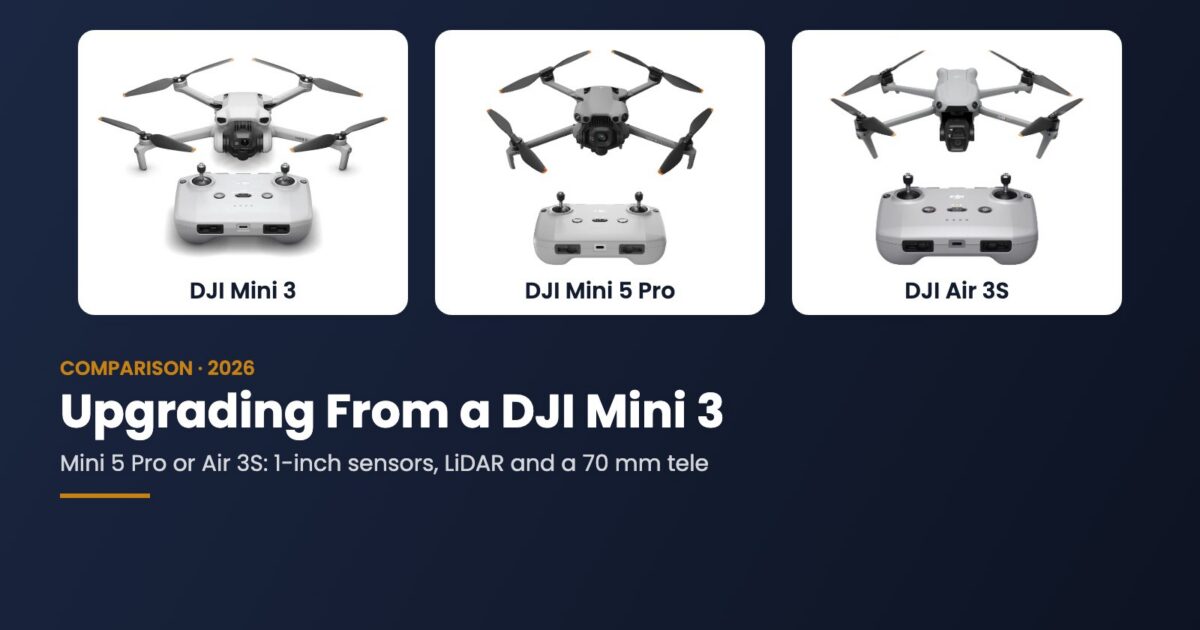
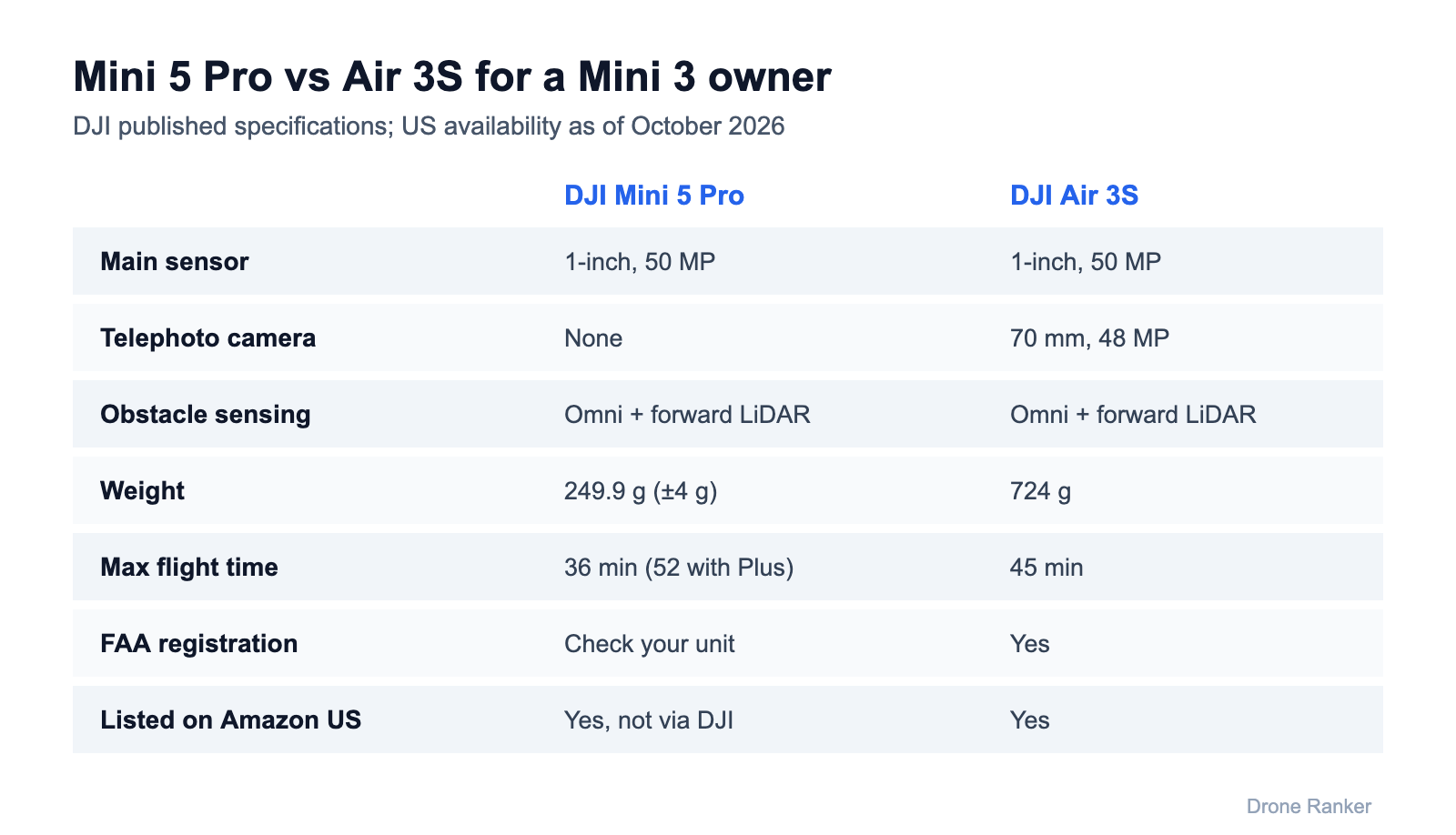
If you own a DJI Mini 3, the upgrade question is Mini 5 Pro vs Air 3S. Both have a 1-inch main sensor, both add the obstacle sensing the Mini 3 never had, and both shoot 4K/120. The real difference is weight and lenses: the Mini 5 Pro stays at about 249.9 g with one camera, while the 724 g Air 3S adds a 70 mm telephoto and must be registered in the US.
| DJI Mini 3 | DJI Mini 5 Pro | DJI Air 3S | |
|---|---|---|---|
| Launched | December 2022 | September 2025 | October 2024 |
| Weight | under 249 g | 249.9 g (±4 g) | 724 g |
| Main sensor | 1/1.3-inch, 48 MP (12 MP native) | 1-inch, 50 MP, f/1.8 | 1-inch, 50 MP, f/1.8 |
| Second camera | None | None | 70 mm, 1/1.3-inch, 48 MP |
| Max video | 4K/30 HDR | 4K/60 HDR, 4K/120 | 4K/60 HDR, 4K/120 |
| 10-bit color | No | D-Log M, HLG | D-Log M, HLG |
| Obstacle sensing | Downward only | Omnidirectional + forward LiDAR | Omnidirectional + forward LiDAR |
| Transmission | O2, 10 km (FCC) | O4, 20 km (FCC) | O4, 20 km (FCC) |
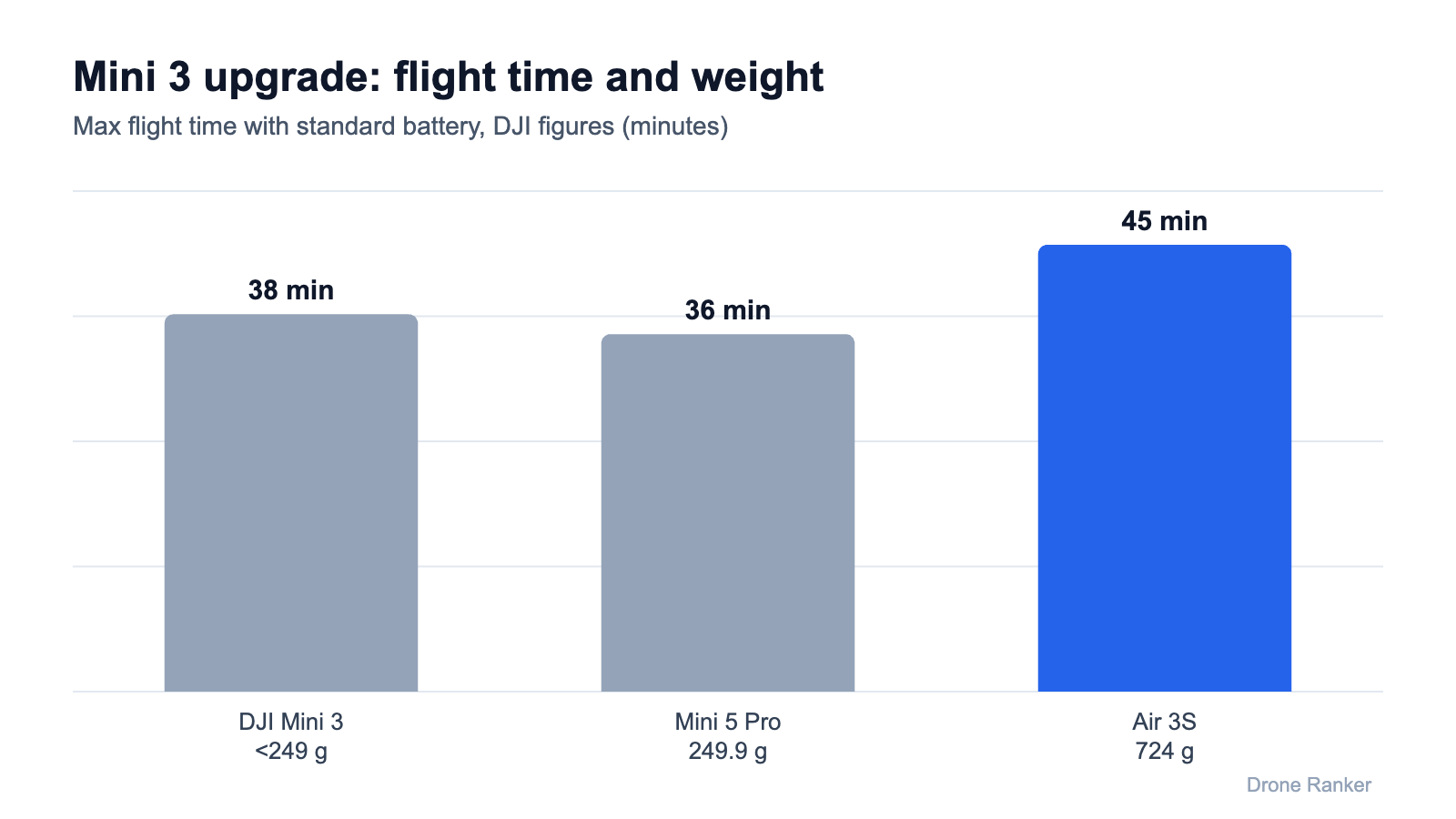
| Max flight time | 38 min (51 with Plus) | 36 min (52 with Plus) | 45 min |
| Wind resistance | 10.7 m/s | 12 m/s | 12 m/s |
| FAA registration (recreational) | No (standard battery) | Check: units can reach 250 g or more | Yes |
| Listed on Amazon US | Yes | Yes, not via DJI | Yes |
Table of Contents
What both upgrades fix over the Mini 3
Either drone changes the same three things. The sensor grows from 1/1.3-inch to 1-inch, which shows most at dusk and in high-contrast light. Video goes from 4K/30 in 8-bit to 4K/60 HDR and 4K/120 with 10-bit D-Log M and HLG, so footage can actually be graded. And both add omnidirectional obstacle sensing with a forward LiDAR sensor. The Mini 3 only senses downward, for hovering and landing.
Transmission also moves from O2 (720p feed, 10 km FCC) to O4 (1080p feed, 20 km FCC), and both are rated for 12 m/s wind against the Mini 3’s 10.7 m/s.
One thing that does not carry over: your batteries. Mini 3 packs work in a Mini 4 Pro, but not in the Mini 5 Pro, which uses its own 2,788 mAh battery, or in the Air 3S.
Mini 5 Pro: same size, better camera
In the Mini 5 Pro vs Air 3S choice, the Mini 5 Pro is the upgrade that changes nothing about how you carry the drone. It folds to the same pocketable size, its gimbal rolls far enough for true vertical video like the Mini 3’s, and it has 42 GB of internal storage.
The weight is less tidy than the 249.9 g headline. DJI quotes a ±4 g tolerance and DroneXL reports production units at 252–253 g, so I would plan on registering it with the FAA ($5) rather than count on the exemption.
Buying it is the bigger catch. DJI never launched the Mini 5 Pro in the US, so Amazon US listings come from retailers rather than DJI, and its LiDAR puts it in scope of the FCC’s pending proposal on “military-grade” foreign drones. Our explainer on the LiDAR proposal covers what that could mean.
Air 3S: a second lens and longer flights
The Air 3S adds what no Mini has: a 70 mm medium telephoto with its own 48 MP 1/1.3-inch sensor. It lets you compress a scene, shoot from farther away and frame subjects without flying closer. It also flies longer, up to 45 minutes, and is a steadier platform in wind.
The trade-off is size and paperwork. At 724 g it must be registered with the FAA and broadcast Remote ID, recreational flying included, and in the EU it falls under stricter rules than a sub-250 g drone. It also uses LiDAR and is named in DJI’s own comments on the FCC proposal, but unlike the Mini 5 Pro it was authorized and sold in the US.
Mini 5 Pro vs Air 3S: which upgrade should you buy?
For most Mini 3 owners in the US weighing Mini 5 Pro vs Air 3S, I think the Air 3S is the safer pick: it is the one sold normally there, and the telephoto is a genuinely new tool rather than a better version of what you have. The Mini 5 Pro makes more sense if you live where DJI sells it officially and pocket size is the reason you bought a Mini in the first place.
- Mini 5 Pro: you travel light, shoot mostly scenery and social video, and want the smallest drone with a 1-inch sensor.
- Air 3S: you want a telephoto, longer flights and steadier footage in wind, and you don’t mind registering it.
- Mini 4 Pro: a cheaper step if you mainly want obstacle sensing and 4K/60 HDR. It keeps the Mini 3’s 1/1.3-inch sensor size and has omnidirectional vision without LiDAR.
The upgrade options
DJI Mini 5 Pro
1-inch, 50 MP sensor, 4K/120, LiDAR, about 249.9 g. Not sold by DJI in the US; check the seller on Amazon.
DJI Air 3S (RC-N3)
1-inch main camera plus 70 mm tele, up to 45 min, 724 g.
DJI Mini 4 Pro (RC-N2)
The budget upgrade: omnidirectional sensing and 4K/60 HDR under 249 g.
As an Amazon Associate, Drone Ranker earns from qualifying purchases. We do not quote prices because Amazon’s change by the hour.
Full spec tables: Mini 3 vs Mini 5 Pro and Air 3S vs Mini 3. Our Mini 5 Pro and Air 3S spec analyses go deeper.
Product links on this page are Amazon affiliate links; Drone Ranker may earn a commission at no cost to you. We compare drones from manufacturer specifications and filings.
The Friday Brief
One email a week on what changed in drones
FCC and FAA rule changes, DJI leaks checked against filings, and the week’s new comparisons. Every Friday, nothing else.
Free. Unsubscribe in one click. Sent with Kit; see our privacy policy.
Follow us on Google too: add Drone Ranker as a preferred source →
Continue Reading
All News