Drone Remote ID in 2026: Who Needs It, Broadcast Modules, FRIAs, Fines and What Changed

Drone Remote ID is the FAA rule that makes registered drones broadcast their identity and location while flying. Since 16 September 2023 every drone that must be registered has to comply, and since 16 March 2024 the FAA has been able to fine operators who don’t, up to $75,000 per violation. Recreational drones of 250 g or less that are not registered are effectively exempt; Part 107 commercial flights are not, whatever the weight.
This guide covers who needs Remote ID in 2026, the three ways to comply, the best-known broadcast modules, how to register, and what changed this year, including a new FAA tool that lets police look up a drone’s owner.
Quick answer
| Question | Answer |
|---|---|
| Who needs Remote ID? | Every drone that is registered or must be registered with the FAA |
| Sub-250 g recreational drone? | Exempt if flown only for fun and not registered |
| Part 107 (commercial)? | Always required, any weight |
| Ways to comply | Standard Remote ID drone, broadcast module, or fly inside a FRIA |
| Mandatory since | 16 September 2023; enforcement from 16 March 2024 |
| Maximum fine | Up to $75,000 per violation |
| Registration cost | $5, valid 3 years |
What Remote ID is
Remote ID is set out in 14 CFR Part 89. The final rule was published on 15 January 2021, manufacturers had to comply from September 2022 and pilots from 16 September 2023. The FAA then gave operators six more months of discretion, ending on 16 March 2024; after that, it said, operators who do not comply could face fines and suspension or revocation of their pilot certificates.
The FAA often compares Remote ID to a digital licence plate. A Standard Remote ID drone broadcasts, over Wi-Fi and Bluetooth:
- the drone’s ID: its serial number, or in future a session ID
- the drone’s latitude, longitude and altitude
- the drone’s speed
- the control station’s latitude, longitude and altitude
- a time mark
- an emergency status
A broadcast module sends the take-off location instead of the controller’s live position. The FAA says a session ID option that hides the serial number may come later; it is not available yet. The technical standard is ASTM F3411, with the FAA accepting the F3586 means of compliance.
Who needs Remote ID, and the 250 g rule
The trigger is registration, not weight. Remote ID applies to drones that are registered or must be registered.
- Recreational, 250 g or less: no registration required, so no Remote ID, as long as you do not register it voluntarily. You still need the free TRUST certificate.
- Recreational, over 250 g: register ($5 covers all your recreational drones for three years) and use Remote ID.
- Part 107, any weight: federal law requires every drone flown under Part 107 to be registered, so Remote ID is always required, even for a 135 g DJI Neo.
Watch the battery. A DJI Mini 3 is under 249 g with its standard battery, but the larger Plus battery pushes it to about 290 g, which means registration and Remote ID apply. We cover weight edge cases in our best mini drones guide.
Three ways to comply
1. Fly a Standard Remote ID drone
Most camera drones sold since 2022, including current DJI models, have Remote ID built in. You only need to register the drone and enter its Remote ID serial number. Check the FAA’s Declaration of Compliance list if you are unsure; only manufacturers can file these declarations.
2. Add a broadcast module
Older drones, kit-built FPV quads and some budget drones need a bolt-on broadcast module. The pilot must keep the drone in visual line of sight for the whole flight. Recreational flyers can move one module between drones if each drone’s registration lists the module’s serial number; Part 107 pilots register each module separately. The FAA’s proposed Part 108 rule would let commercial pilots share modules too, but it is not final.
| Module | Weight | Power | Price (DroneXL test) |
|---|---|---|---|
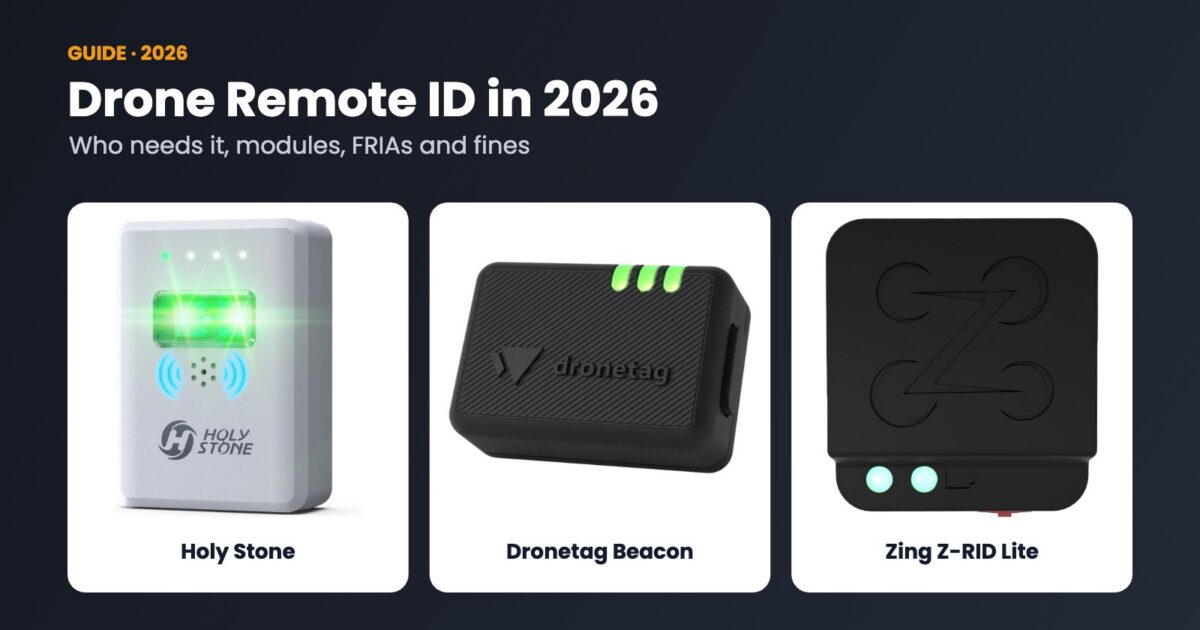
| Dronetag Beacon | 16 g | Battery, 6–18 h | $229 |
| BlueMark DB120 | 24 g | Battery, about 3 h | $140 |
| Pierce Aerospace B1 | 30 g | Battery, about 6 h | $264 |
| Dronetag Mini | 32 g | Battery, 8–14 h | $327 |
| Dronetag BS | 1.5 g | Drone power (FPV) | $89 |
| Flite Test EZID | 10 g | Drone power (FPV) | $109 |
Budget modules from Holy Stone, Ruko, Potensic and Zing are also sold on Amazon; check that the specific model appears in the FAA’s Declaration of Compliance list before you buy. Prices in the table come from DroneXL’s module test, last updated in February 2025, and will have moved.
3. Fly inside a FRIA
An FAA-Recognized Identification Area is a site where drones without Remote ID may fly within visual line of sight. Only FAA-recognised community-based organisations, such as model aircraft clubs, and educational institutions can apply. Approvals last 48 months. Find them on the FAA’s FRIA map. Drones that do have Remote ID must still broadcast inside a FRIA.
How to register and add your Remote ID serial
- Go to FAADroneZone and choose recreational (Exception for Limited Recreational Operations) or Part 107.
- Pay $5. Recreational registration covers your whole fleet for three years; Part 107 registration is per drone.
- Add the device, answer “Yes” to the Remote ID question and choose Standard Remote ID drone or broadcast module.
- Enter the Remote ID serial number from the drone or module.
- Mark your registration number on the outside of the drone.
A registration cannot be switched between recreational and Part 107. Recreational pilots must also pass the free TRUST test.
Fines and enforcement
The FAA Reauthorization Act of 2024 raised the maximum civil penalty for drone violations to $75,000 per violation. In August 2024 the FAA proposed $341,413 in penalties against 27 operators, several for unregistered drones. Its 2025 summary, published in February 2026, listed fines from $1,771 to $36,770 across 18 operations and certificate actions against eight remote pilots. We have not found a published FAA case brought specifically for a Remote ID violation, but missing registration and Remote ID usually appear alongside other violations such as flying near airports.
Who can see your Remote ID data
Anyone with a phone can see the broadcast. Dronetag’s free Drone Scanner app reads Remote ID on Android and, over Bluetooth only, on iOS. The public sees the serial number and flight data, not your name. Linking a serial to an owner requires FAA records.
That link got easier for police in 2026. The FAA’s DiSCVR tool, launched in March, lets federal, state, local, tribal and territorial law enforcement query a Remote ID serial or registration number and see the registered owner’s name, address and phone number, plus any airspace authorisations, sUAS News and DroneLife reported. It does not detect drones itself.
Privacy objections went to court early. In Brennan and RaceDayQuads v. FAA, decided on 29 July 2022, the D.C. Circuit rejected a facial Fourth Amendment challenge, finding no reasonable expectation of privacy in where a drone flies outdoors, while leaving room for narrower challenges later.
What changed in 2025 and 2026
- DiSCVR gave police owner lookups from Remote ID serials (March 2026).
- FCC parts rules. In December 2025 the FCC put foreign-made drone critical components, including data transmission devices, on its Covered List, with exemptions for Blue UAS parts and products with at least 65% US content extended to 1 January 2028. It is unclear whether a general-purpose Bluetooth or Wi-Fi Remote ID module counts. Oregon’s Zing Drone Solutions, maker of the Z-RID Lite, signed an agreement on 5 October 2026 to test Korean radio boards, DroneXL reported.
- Part 108. The proposed beyond-line-of-sight rule, still unsigned, would have Part 108 drones broadcast Remote ID; see our Part 108 tracker.
- Network Remote ID. Congress told the FAA in 2024 to review alternatives such as network-based Remote ID; no outcome has been announced.
Remote ID also underpins counter-drone enforcement; see who can legally take down a drone.
Remote ID broadcast modules on Amazon
Holy Stone Remote ID Module
Budget broadcast module with strobe and buzzer; check FAA DOC listing.
Ruko R111S Remote ID Module
Module with GPS tracker and beeper.
Dronetag Beacon Gen 2
16 g module from the maker of Drone Scanner.
Zing Z-RID Lite
US-designed broadcast module from Oregon’s Zing Drone Solutions.
As an Amazon Associate, Drone Ranker earns from qualifying purchases. We do not quote prices because Amazon’s change by the hour.
Frequently asked questions
Do I need Remote ID for a drone under 250 g?
Not if you fly it only recreationally and have not registered it. If you fly it under Part 107, you need Remote ID.
When did Remote ID become mandatory?
Pilots had to comply from 16 September 2023, and the FAA’s enforcement discretion ended on 16 March 2024.
What does Remote ID broadcast?
The drone’s serial number or session ID, its location, altitude and speed, the control station’s location (or take-off point for modules), a time mark and an emergency status.
What is the fine for flying without Remote ID?
Up to $75,000 per violation, plus possible suspension or revocation of a Part 107 certificate.
Can I use one Remote ID module on several drones?
Recreational flyers can, if each drone’s registration lists the module’s serial. Part 107 pilots must register each module separately.
What is a FRIA?
An FAA-Recognized Identification Area run by a community-based organisation or school, where drones without Remote ID may fly within line of sight.
Can the public see my name through Remote ID?
No. Apps show the broadcast data. Only the FAA and police, through the DiSCVR tool, can link a serial number to the owner.
How do I add a Remote ID serial to my FAA registration?
In FAADroneZone, add the device, answer yes to the Remote ID question, choose the device type and enter the serial number.
Cover: product images via Amazon.
Product links on this page are Amazon affiliate links. If you buy through them, Drone Ranker may earn a commission at no cost to you. We compare drones from manufacturer specifications and filings, not hands-on flight tests.
Sources
- FAA: Remote Identification of Drones
- FAA: Ends discretionary enforcement policy for Remote ID (15 March 2024)
- 14 CFR 89.305: Minimum message elements (Cornell LII)
- FAA: How to register your drone
- FAA: $341,413 in proposed civil penalties (23 August 2024)
- FAA: DiSCVR tool for law enforcement
- DroneLife: FAA’s DiSCVR system (17 March 2026)
- DroneXL: Remote ID module test (updated February 2025)
- DroneXL: Zing tests Korean radios as FCC bars foreign parts (6 October 2026)
- Wiley: D.C. Circuit upholds Remote ID rule (2022)
- Federal Register: FRIA information collection (10 June 2025)
Sources
Primary references used for factual claims in this article.
The Friday Brief
One email a week on what changed in drones
FCC and FAA rule changes, DJI leaks checked against filings, and the week’s new comparisons. Every Friday, nothing else.
Free. Unsubscribe in one click. Sent with Kit; see our privacy policy.
Follow us on Google too: add Drone Ranker as a preferred source →
Continue Reading
All News