Who Can Take Down a Drone in the US? Counter-Drone Laws in 2026 for Police, the FBI and Homeowners

In the US, almost nobody may legally take down a drone. Federal law treats drones as aircraft, so shooting, netting, jamming or hacking one is a crime for homeowners, businesses and most police. Only certain federal agencies and, since a 2025 law, a small number of FBI-certified state and local officers may disable a drone, and only against a credible threat.
That answer has changed more in the past year than in the previous decade. The SAFER SKIES Act, signed in December 2025, gave local police a path to counter-drone authority; the FBI is doubling its training school after seizing more than 700 drones at the World Cup; and the Pentagon has just picked lasers and a microwave weapon for US bases. This explainer sets out who can do what in October 2026. It is general information, not legal advice.
Quick answer
| Who | Can they take down a drone? |
|---|---|
| Homeowners and businesses | No. Shooting or damaging a drone can be a federal crime; jamming is illegal |
| Stadiums and event organisers | No mitigation; they can detect and call authorities |
| Ordinary local police | No, unless an officer holds FBI mitigation certification under SAFER SKIES |
| FBI-certified state and local officers | Yes, against a credible threat, with approved RF equipment and notices to the FBI and FAA |
| DHS and DOJ (incl. FBI) | Yes, under 6 U.S.C. 124n, for covered facilities and events |
| Department of Defense | Yes, protecting covered facilities and assets (10 U.S.C. 130i) |
| Department of Energy | Yes, at covered nuclear facilities (50 U.S.C. 2661) |
Why a drone is legally an aircraft
The starting point is 18 U.S.C. 32, which makes it a federal crime to willfully set fire to, damage, destroy, disable or wreck any aircraft in US special aircraft jurisdiction, with up to 20 years in prison. The FAA said in 2016 that this covers drones. Other federal laws get in the way of electronic countermeasures: the Wiretap Act, the Pen/Trap statute and the Computer Fraud and Abuse Act all make intercepting or taking over a drone’s control link a problem, the Congressional Research Service noted in July 2026. And 47 U.S.C. 333 bars anyone from wilfully interfering with licensed or authorised radio communications, which is why jamming is off the table for private parties.
Federal agencies: who already had authority
Before 2025, Congress had given counter-drone powers to four departments only. The Preventing Emerging Threats Act of 2018 created 6 U.S.C. 124n, which lets DHS and DOJ act against a credible drone threat to covered facilities or assets notwithstanding the aircraft, wiretap and computer-fraud laws. The Defense Department has its own authority under 10 U.S.C. 130i, and the Energy Department under 50 U.S.C. 2661. Federal authority under 124n now runs until 30 September 2031.
What the SAFER SKIES Act changed for local police
The SAFER SKIES Act passed as Title LXXXVI of the Fiscal Year 2026 National Defense Authorization Act and was signed on 18 December 2025. It adds a new section to 124n that lets state, local, tribal and territorial law enforcement and corrections agencies mitigate credible drone threats to people, facilities, large gatherings, critical infrastructure and prisons. The catch is in the conditions:
- Officers must complete Attorney General-approved training and certification.
- Agencies must use equipment from a federal approved list. As of late summer 2026 only radio-frequency systems were approved, 21 of them, and physical interception such as nets was not, the Law Enforcement Drone Association reported.
- The FBI must get notice at least 30 days ahead, an operations plan must be filed at least 7 days ahead, air traffic control must be told within 5 minutes of activation, and a report is due within 48 hours.
- The power cannot be used solely to disrupt activity protected by the First Amendment, and contractors cannot use it.
- State and local authority expires on 31 December 2031.
DOJ and DHS published an interim final rule on 1 July 2026, and the FCC issued a companion ruling the next day giving certified agencies a narrow shield from the anti-jamming law, law firm Davis Wright Tremaine noted. Training comes in two tiers: a free online course of about 90 minutes for detection and warning, and a two-week resident course at the FBI’s National Counter-UAS Training Center for mitigation. Tier 1 officers cannot take Tier 2 actions, even in an emergency. As of 1 July 2026, only 61 officers in about 46 agencies held mitigation certification, according to the CRS.
The FBI school and 700 World Cup seizures
The FBI’s National Counter-UAS Training Center at Redstone Arsenal in Huntsville, Alabama, was created by executive order in June 2025 and ran its first class of 12 officers in October 2025. During the World Cup, from 11 June to 19 July 2026, authorities took more than 700 drones out of the sky across the 11 US host cities under nearly 250 flight restrictions; FedScoop reported about 1,700 detections and more than 400 mitigation actions. None of the seized drones carried explosives, Associate Attorney General Stanley Woodward said when he toured the centre on 1 October. He said it will more than double capacity in its second year, with 250 more graduates planned next fiscal year.
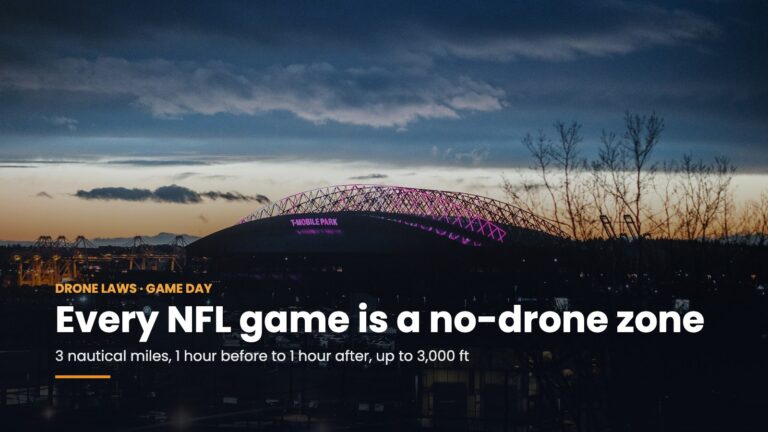
The FAA has kept up the warnings. On 3 October it reminded fans that every NFL regular-season and post-season game is a No Drone Zone covering 3 nautical miles around the stadium up to 3,000 feet, from an hour before kickoff to an hour after the game, with fines of up to $100,000. We cover those limits in our NFL stadium drone rules guide.
The military: lasers and a microwave at US bases
On 5–6 October 2026 the Army-led Joint Interagency Task Force 401 picked four directed-energy systems for a 365-day pilot at US bases: AeroVironment’s palletised high-energy laser, the Kord/KBR Firefly laser, Boeing’s Compact Laser Weapon System and Epirus’s Leonidas high-power microwave. Host bases are Fort Huachuca, Arizona; Fort Bliss, Texas; Naval Base Kitsap, Washington; Grand Forks Air Force Base, North Dakota; and Whiteman Air Force Base, Missouri. The task force director, Brig. Gen. Matt Ross, was sceptical of vendors’ cheapest per-shot cost claims, Defense News reported.
On the southern border, Joint Task Force-Southern Border detected at least 378 drones between 22 August and 22 September 2026; 75 were turned back, 15 drew an engagement and one was captured, DroneXL reported.
Recent cases that show the limits
Laredo: a police threat with no flight restriction
When fire broke out at a Laredo, Texas, hotel early on 7 October, the police chief warned that officers would “take them down” if drones flew over the scene. As of that evening the FAA showed no temporary flight restriction over Laredo, and the city did not say whether any officer held FBI mitigation certification. Cities can request a disaster TFR under 14 CFR 91.137, which is the lawful way to keep drones away. Uncoordinated mitigation can bring civil fines of up to $100,000 per violation, DroneXL noted.
Dallas: federal charges for airport flights
A 24-year-old Dallas man faces a four-count federal indictment and up to eight years in prison over alleged drone flights into the Love Field runway area and restricted airspace at DFW in June 2025, prosecutors announced on 8 October. He is presumed innocent. The case shows how airport incursions are handled: by investigation and prosecution, not by shooting the drone down.
Can I shoot down a drone over my house?
No. The best-known case, Kentucky’s “drone slayer” in 2015, ended with a local judge dismissing a state criminal mischief charge and a federal suit thrown out on jurisdiction, but no court ruled that homeowners may shoot drones, DroneLife reported. Federal aircraft law still applies, and firing a gun in a neighbourhood can break local discharge and reckless-endangerment laws. A falling drone can also hurt someone. Throwing objects, using nets or buying a jammer carries the same risks, and jammers are illegal to sell or use in the US.
What you can do instead:
- Record the drone: video, time, direction and where the pilot appears to be.
- If you can see the pilot, a calm conversation often resolves it.
- Report suspicious or dangerous flights to local police; for security threats, use the FBI tip line.
- Check your state’s privacy, trespass and harassment laws, which vary widely.
Police can identify many drones through Remote ID. Since 2026 the FAA’s DiSCVR tool lets law enforcement look up the registered owner behind a Remote ID serial number; see our Remote ID guide.
Flying legally: Remote ID modules
Holy Stone Remote ID Module
FAA-compliant broadcast module for drones without built-in Remote ID.
Dronetag Beacon Gen 2
Small 16 g broadcast module with long battery life.
As an Amazon Associate, Drone Ranker earns from qualifying purchases. We do not quote prices because Amazon’s change by the hour.
Frequently asked questions
Can I shoot down a drone over my house?
No. Drones count as aircraft under 18 U.S.C. 32, which carries up to 20 years in prison, and local firearm laws also apply. Record the drone and call police instead.
Can police take down drones?
Since the SAFER SKIES Act of December 2025 and the July 2026 rule, yes, but only FBI-certified officers using approved radio-frequency equipment against a credible threat, with notices to the FBI and FAA. Only 61 officers were certified as of July 2026.
Who has federal counter-drone authority?
DHS and DOJ under 6 U.S.C. 124n, the Defense Department under 10 U.S.C. 130i and the Energy Department under 50 U.S.C. 2661.
Is drone jamming legal?
Not for private citizens or businesses; 47 U.S.C. 333 bars interference with radio communications. Only authorised federal agencies and certified state and local agencies may use approved systems.
When does counter-drone authority expire?
Federal authority under 124n runs to 30 September 2031 and state and local authority to 31 December 2031.
Can you fly a drone near an NFL game?
No. Each game is a No Drone Zone for 3 nautical miles and 3,000 feet, from an hour before kickoff to an hour after, with fines of up to $100,000.
What should I do about a drone over my yard?
Document it, try talking to the pilot if visible, and report dangerous or suspicious flights to local police or the FBI. Do not interfere with the aircraft.
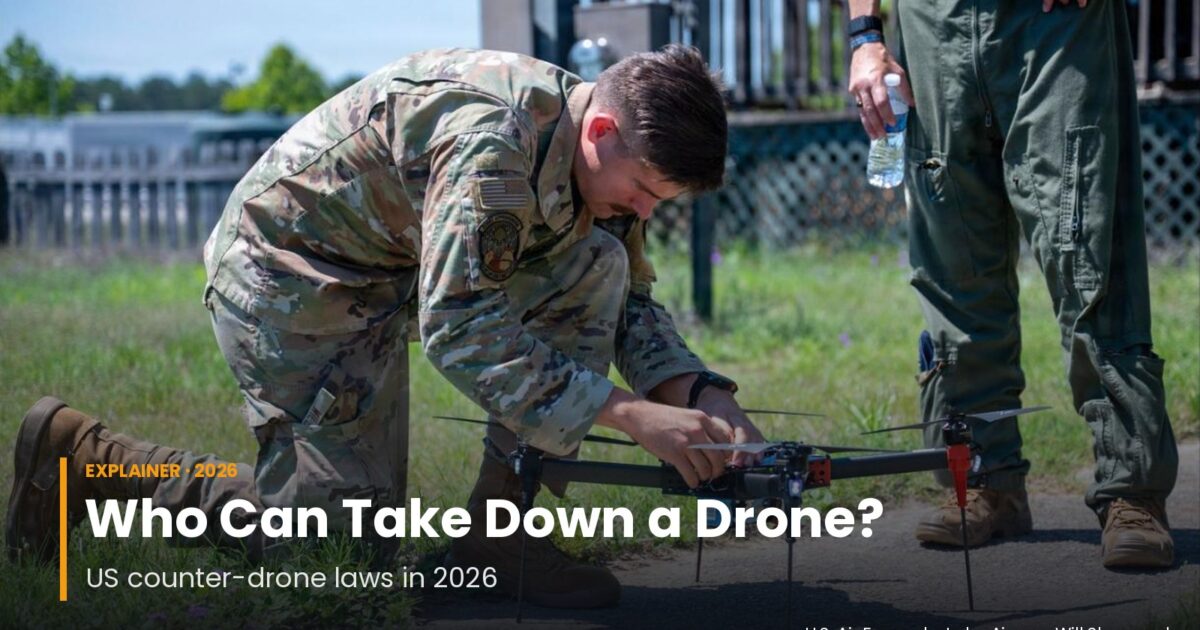
Cover photo: An airman prepares a drone to be targeted by counter-drone systems at Shaw Air Force Base, South Carolina, June 2026. U.S. Air Force photo by Airman Will Sherwood.
Product links on this page are Amazon affiliate links. If you buy through them, Drone Ranker may earn a commission at no cost to you. We compare drones from manufacturer specifications and filings, not hands-on flight tests.
Sources
- 18 U.S.C. 32: Destruction of aircraft (Cornell LII)
- 6 U.S.C. 124n: Protection of certain facilities and assets from unmanned aircraft (Cornell LII)
- Congressional Research Service IF13279 on counter-UAS authority (29 July 2026)
- LEDA: SAFER SKIES Act authority for local agencies (29 September 2026)
- Davis Wright Tremaine: SAFER SKIES counter-drone framework (July 2026)
- DroneXL: FBI drone school to double capacity after 700 World Cup seizures (5 October 2026)
- DroneXL: FAA warns NFL drone pilots (5 October 2026)
- Defense News: Pentagon names 4 directed-energy weapons for US bases (6 October 2026)
- DroneXL: Laredo police vow to take down drones (7 October 2026)
- DroneXL: Dallas drone pilot indicted (9 October 2026)
- DroneXL: 378 border drone incursions in 30 days (6 October 2026)
- DroneLife: Kentucky drone slayer case dismissed (22 March 2017)
Sources
Primary references used for factual claims in this article.
The Friday Brief
One email a week on what changed in drones
FCC and FAA rule changes, DJI leaks checked against filings, and the week’s new comparisons. Every Friday, nothing else.
Free. Unsubscribe in one click. Sent with Kit; see our privacy policy.
Follow us on Google too: add Drone Ranker as a preferred source →
Continue Reading
All News