DJI Agras T55 vs DJI Agras T50
For a new high-throughput operation, buy the DJI Agras T55. It carries 50 L instead of 40 L, its standard spray flow jumps from 16 L/min to 40 L/min, and it spreads up to 400 kg/min of compound fertilizer against 108 kg/min on the T50.…
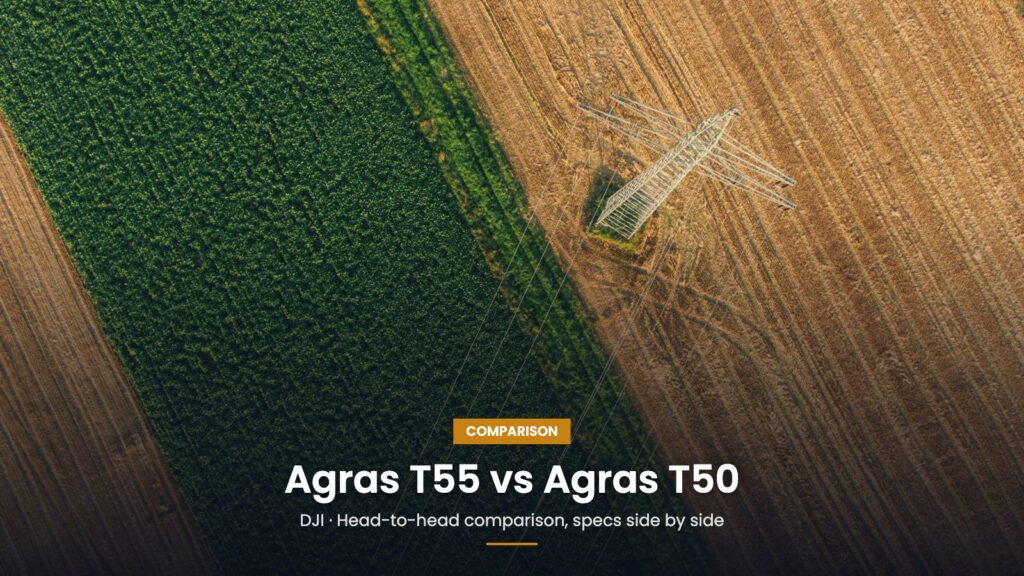
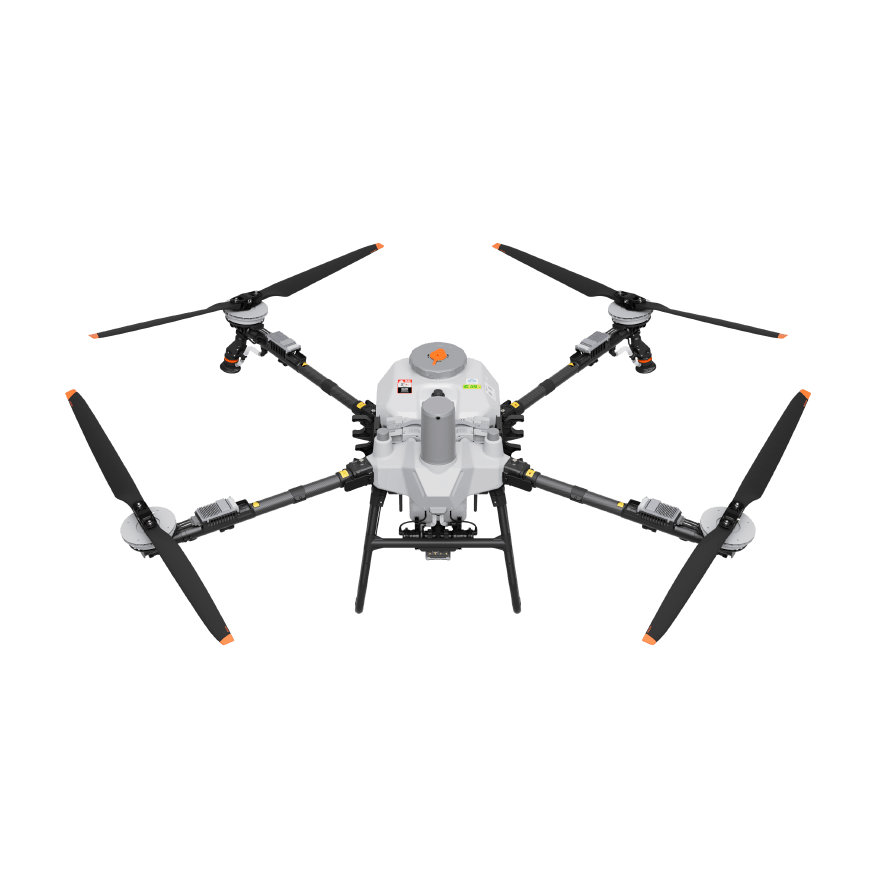
DJI Agras T55
TBD
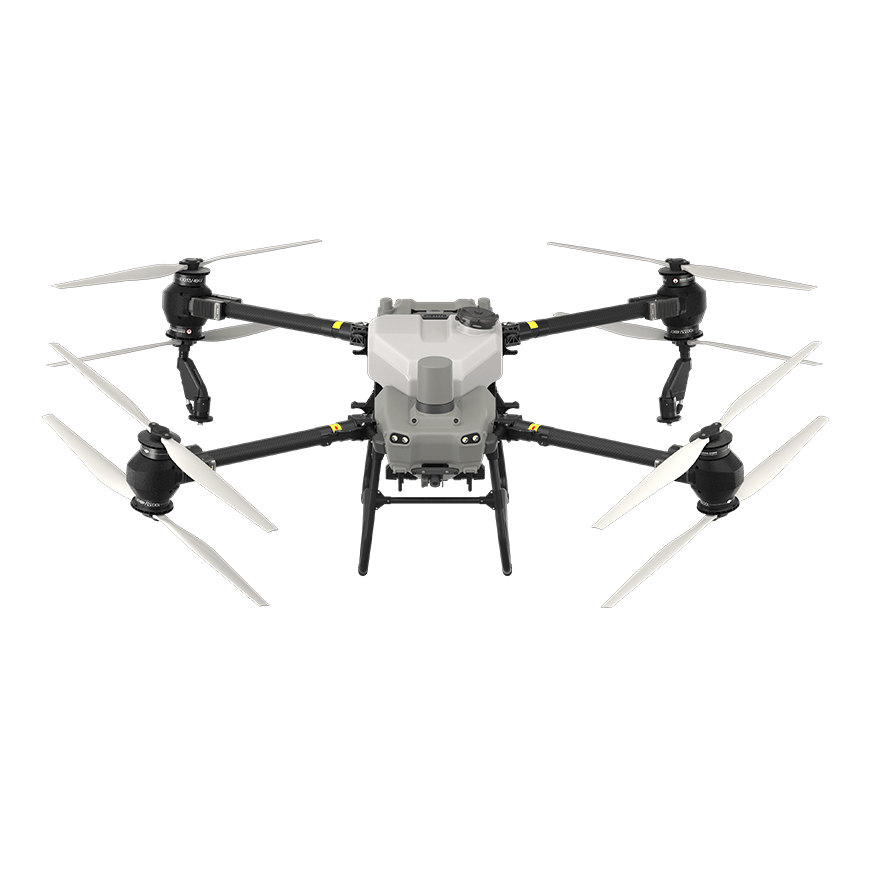
DJI Agras T50
TBD
Technical Specifications
Last updated: Oct 2026| Feature | DJI Agras T55 | DJI Agras T50 |
|---|---|---|
| Weight | 45 kg with DB1050 battery; 48.4 kg with DB1580 battery | 39.9 kg excluding battery; 52 kg including DB1560 battery |
| Dimensions | 1120×896×934 mm folded; 3190×3570×934 mm unfolded with propellers | 1115×750×900 mm folded; 2800×3085×820 mm unfolded with propellers |
| Volume | Approx. 937,288 cm³ folded bounding-box volume | Approx. 752,625 cm³ folded bounding-box volume |
| Max Speed | Up to 13.8 m/s within the documented safe obstacle-bypass operating envelope | Obstacle sensing and terrain-follow operating conditions specify horizontal speed up to 10 m/s |
| Max Flight Distance | 2 km maximum configurable flight radius | 2 km maximum configurable flight radius |
| Sensor Size | Safety system with millimeter-wave radar, tri-vision sensing and FPV camera | Front and rear phased-array radar with binocular vision |
| Megapixels | N/A – agricultural vision and safety system | N/A – agricultural vision and safety system |
| Max ISO | N/A | N/A |
| Flight Time | Not published as a single universal value; endurance depends on battery, payload and operating conditions | Not published as a single universal value; endurance depends on payload and operating conditions |
| Max Resolution | Agricultural FPV monitoring camera; not intended as a cinematography platform | Agricultural FPV monitoring system; not intended as a cinematography platform |
| Movie Bitrate | N/A | N/A |
| Field of View | Tri-vision: 360° horizontal and 180° vertical; front radar: 360° horizontal | Binocular vision: 90° horizontal and 106° vertical; radar provides multidirectional sensing |
| Transmission Range | 2 km configurable aircraft radius; optional relay: 8 km FCC / 4 km CE, MIC and KCC | Remote controller / relay: up to 7 km FCC, 5 km SRRC and 4 km CE/MIC |
| Wind Resistance | 6 m/s | 6 m/s |
| Obstacle Avoidance | 60 m sensing range with radar and tri-vision; obstacle bypassing up to 13.8 m/s under supported conditions | 1–50 m multidirectional radar sensing with binocular vision; effective sensing speed up to 10 m/s |
| Battery Power | DB1050: 20,000 mAh, 52.5 V; DB1580: 30,000 mAh, 52 V | DB1560: 30,000 mAh, 52.22 V |
| Charge Time | DB1050: approximately 8–9 minutes from 30% to 95% with D8000iE or C7000 under stated conditions | DB1560: approximately 9–12 minutes for a full charge with D12000iE or C10000 under stated conditions |
| Internal Storage | N/A | N/A |
| GPS | Yes, RTK/GNSS positioning | Yes, RTK/GNSS positioning |
| Obstacle Detection | Yes | Yes |
| Return to Home | Yes | Yes |
| Removable Battery | Yes | Yes |
| Shoots RAW | Not applicable | Not applicable |
| HDR Mode | Not applicable | Not applicable |
| Weather Sealed | No aircraft IP rating used in this comparison | No aircraft IP rating used in this comparison |
| Best For | Contractors and large farms that need more throughput, or lifting as well as spraying | Operations where 40 L liquid and 50 kg granular loads are enough |
| Spray Tank Volume | 50 L | 40 L |
| Spraying Payload | 50 kg | 40 kg |
| Standard Spray Flow | 40 L/min with 2 nozzles | 16 L/min with 2 sprinklers |
| Maximum Spray Flow | 50 L/min with optional 4-nozzle mist setup | 24 L/min with optional 4 sprinklers |
| Effective Spray Width | 4–11 m | 4–11 m |
| Spreading Tank Volume | 80 L | 75 L |
| Spreading Payload | 55 kg | 50 kg |
| Maximum Spreading Discharge | 400 kg/min for compound fertilizer | 108 kg/min |
| Spreading Width | 3–10 m | Up to 8 m |
| Lifting System | DL100, 40 kg operating payload | No dedicated lifting system listed |
| Terrain Following | Radar-based terrain following confirmed; DJI's current global T55 page does not state a directly comparable maximum slope | Up to 50° slope in mapping-free operation |
| RTK Hovering Accuracy | ±10 cm horizontal, ±10 cm vertical | ±10 cm horizontal, ±10 cm vertical |
| RTK Base Station | Supports D-RTK 3 AG; Network RTK calibration 0.8 cm + 1 ppm horizontal and 1.5 cm + 1 ppm vertical | Aircraft supports RTK/GNSS; standard aircraft hover accuracy ±10 cm |
| Official Field Operation Rate | No directly comparable ha/h figure published on the current global DJI T55 page | Up to 21 ha/h under DJI's specified field-operation test |
| Official Orchard Operation Rate | No directly comparable global figure published | Up to 4 ha/h under DJI's specified test |
| Official Spreading Throughput | 400 kg/min maximum compound-fertilizer discharge | 108 kg/min maximum discharge; DJI also publishes 1,500 kg/h field spreading operation |
| Obstacle Sensing Range | Up to 60 m | Up to 50 m radar; 29 m binocular vision |
| Safe Obstacle Bypass / Sensing Speed | Up to 13.8 m/s | Up to 10 m/s |
| Configurable Flight Radius | 2 km | 2 km |
| Relay Range | 8 km FCC; 4 km CE/MIC/KCC | 7 km FCC; 4 km CE/MIC |
| Standard Flight Battery | DB1050: 20,000 mAh, 8.3 kg | DB1560: 30,000 mAh, approx. 12.1 kg |
| Optional Higher-Capacity Battery | DB1580: 30,000 mAh, 11.7 kg | No second aircraft battery option listed on current T50 specs |
| Generator / Charger Power | D8000iE: 6.5 kW; C7000: 7 kW three-phase | D12000iE: 9 kW charge output; C10000: 9 kW |
| Published Fast-Charge Time | DB1050: 8–9 min from 30% to 95% | DB1560: 9–12 min for full charge |
This comparison uses DJI Agriculture's product pages and specifications. Capacity, flow, field-rate, sensing and charging figures are DJI's, measured under its stated conditions. DJI also notes that payload limits can fall with altitude, so sea-level capacities are not universal.
Pump flow is the biggest gap
The T55 delivers 40 L/min with its standard two nozzles and up to 50 L/min with the optional four-nozzle mist kit. The T50 gives 16 L/min with two sprinklers and 24 L/min with four. The T55 also carries 50 L (50 kg) against 40 L (40 kg), 25% more liquid by tank volume.
That does not mean the T55 covers twice the hectares. Area per hour depends on liters per hectare, speed, swath width, turns, refill time and battery swaps. At high application rates pump flow limits you; at low rates the bottleneck moves to batteries, refills and field shape. Multiplying the T50's 21 ha/h by the flow increase would be misleading.
What DJI publishes for field rates
For the T50, DJI lists up to 21 ha/h in field operations, up to 4 ha/h in orchards and 1,500 kg of granules per hour for spreading, all under test conditions rather than as farm-wide daily averages. DJI's global T55 pages give no comparable figure.
Spreading: 55 kg and 400 kg/min against 50 kg and 108 kg/min
The T55 uses the DS80L system: 80 L volume, 55 kg payload, up to 400 kg/min of compound fertilizer and a 3–10 m effective width depending on material. The T50 carries 50 kg in a 75 L tank at up to 108 kg/min. Refill logistics and flight cycles will cap real output well below either maximum discharge rate.
Terrain following and RTK
The T50's spec is explicit: slopes up to 50° in mapping-free operation, altitude detection from 1 to 50 m and a stabilization range of 1.5 to 30 m. DJI's T55 FAQ confirms radar-based terrain following, including falling back to radar when vision sensors are dirty or at night, with possibly reduced performance. DJI gives no maximum slope for the T55, so none is assumed here.
Both list ±10 cm horizontal and vertical hover accuracy with RTK. The T55 works with the newer D-RTK 3 AG base station, which lists Network RTK calibration accuracy of 0.8 cm + 1 ppm horizontal and 1.5 cm + 1 ppm vertical, L-BAND support and a 15 km FCC / 8 km CE-JP broadcast range.
Obstacle sensing
The T55's safety system measures out to 60 m and bypasses obstacles at up to 13.8 m/s. Its tri-vision system covers 360° horizontally and 180° vertically, backed by radar. The T50 uses 360° phased-array radar from 1 to 50 m and binocular vision to 29 m, with obstacle sensing rated for horizontal speeds up to 10 m/s. Both depend on light, weather and the obstacle itself.
Batteries and charging favor the T50
The T55's standard battery is the lighter DB1050 (20 Ah), with the DB1580 (30 Ah) as an option. DJI lists 8–9 minutes from 30% to 95% for the DB1050 on the D8000iE generator (6.5 kW) or C7000 (up to 7 kW on three-phase input).
The T50 uses the 30 Ah DB1560. Its D12000iE generator and C10000 supply provide up to 9 kW and fully charge the battery in about 9–12 minutes. Raw charging power stays with the T50, even though the T55's smaller battery has a shorter published partial charge.
Lifting is new on the T55
The optional DL100 lifting system carries a 40 kg operating payload on a 10 m standard cable. The T50 has no equivalent, so if you move materials as well as spray, the T55 is the only choice here.
When a T50 owner should upgrade
Upgrade if your crew keeps stopping to refill, can't hold a high-volume application rate at 16–24 L/min, needs more spreading throughput or wants lifting. If the T50 already covers your hectares in the available window, a bigger aircraft won't pay back unless the extra capacity turns into saved labor or more treated area. See also our Agras T55 specs analysis and the status of spray drones in the US.
DJI Agras T55
Strengths
- 50 L spray tank, 50 kg operating payload
- 40 L/min standard flow, up to 50 L/min with four nozzles
- 55 kg spreading payload and up to 400 kg/min discharge
- DL100 lifting system for 40 kg loads
- 60 m sensing range, obstacle bypass up to 13.8 m/s
- Choice of 20 Ah or 30 Ah battery
Drawbacks
- No DJI-published hectares-per-hour figure
- Larger folded size than the T50
- C7000 and D8000iE charge at lower maximum output than the T50's 9 kW setup
- Peak figures depend on nozzles, payload and conditions
DJI Agras T50
Strengths
- DJI-published field rate of up to 21 ha/h
- Terrain following on slopes up to 50° without mapping
- ±10 cm RTK hover accuracy
- Up to 9 kW charging with D12000iE or C10000
- Smaller folded airframe
- 40 L spray tank and 50 kg spreading payload
Drawbacks
- 16 L/min standard flow, 24 L/min with four nozzles
- 10 L less spray capacity than the T55
- Spreading discharge up to 108 kg/min
- No dedicated lifting system
Buy the T55 for a new fleet; keep a T50 that already keeps up
For a new high-throughput operation, buy the DJI Agras T55. It carries 50 L instead of 40 L, its standard spray flow jumps from 16 L/min to 40 L/min, and it spreads up to 400 kg/min of compound fertilizer against 108 kg/min on the T50. It also adds a 40 kg lifting system.
If you already run a T50 fleet that finishes the day's work inside the spray window, I would not upgrade. The T50 has a DJI-published field rate of up to 21 hectares per hour, terrain following on slopes up to 50°, ±10 cm RTK hover accuracy and a 9 kW charging setup.
DJI does not publish a comparable hectares-per-hour figure for the T55, so this page does not claim it beats the T50's 21 ha/h. Its advantage is capacity and flow headroom, which only pays off when refills or pump flow are your bottleneck.
Context and limitations
This comparison helps buyers choose between DJI Agras T55 and DJI Agras T50 by translating the specification table into camera, flight, safety, workflow and value decisions. Recommendations are matched to user needs rather than based on a single headline number.
Limitations
The Friday Brief
One email a week on what changed in drones
FCC and FAA rule changes, DJI leaks checked against filings, and the week’s new comparisons. Every Friday, nothing else.
Free. Unsubscribe in one click. Sent with Kit; see our privacy policy.
Follow us on Google too: add Drone Ranker as a preferred source →

Alihan Demirdaş is the founder and editor of Drone Ranker. A software developer by profession, he researches drones the way he reads code: from the primary documents. Every review, comparison and news story on the site is written by him from manufacturer specification sheets, FCC and EU certification filings, aviation-authority rules and dated press releases, with the source linked. Unless a page is labelled hands-on, the analysis is documentary; when an aircraft is in his hands, the page says so and carries his own photographs and flight notes. He covers consumer, professional and agricultural drones and is based in Türkiye.