How to Start a Drone Business in 2026: Part 107, Insurance, Niches, Pricing and the DJI Problem

To start a drone business in the US in 2026 you need an FAA Part 107 remote pilot certificate (about $175 for the test), a registered drone with Remote ID ($5), liability insurance most clients will ask for (roughly $600–$1,200 a year for $1 million of cover), and a niche that pays. The new complication is equipment: the FCC has blocked new foreign-made drones, US-made alternatives often cost two to three times as much, and the Part 107 test itself changes on 26 October.
This guide walks through the legal steps, setup costs, what each niche pays and how to choose equipment now that DJI’s US future is uncertain. Rates are published ranges from training companies and insurers, not guarantees.
Quick answer
| Step | What it costs | Time |
|---|---|---|
| Part 107 knowledge test | About $175 at an FAA-approved centre | Study 2–4 weeks; test 2 hours |
| Remote pilot certificate | Free (IACRA, TSA vetting) | Temporary certificate after vetting |
| Drone registration | $5 per drone, 3 years | Minutes, online |
| Liability insurance | About $600–$1,200/yr for $1M (BWI), or monthly plans | Same day |
| Business licence/permits | About $50–$500 depending on state | Varies |
| Recurrent training | Free online course every 24 months | A few hours |
Step 1: get your Part 107 certificate
Anyone who flies a drone for pay, even once, needs a Part 107 remote pilot certificate. You must be at least 16, able to read, speak, write and understand English, and physically and mentally fit to fly. The FAA’s process:
- Create an IACRA profile to get an FAA Tracking Number (FTN).
- Schedule the Unmanned Aircraft General – Small (UAG) knowledge test at an FAA-approved testing centre and bring government photo ID.
- Pass the test: 60 scored questions plus 5 unscored, 120 minutes, 70% to pass. A retake costs the fee again after 14 days.
- Complete FAA Form 8710-13 in IACRA using the 17-digit exam ID; results can take up to 48 hours to appear.
- Pass TSA security vetting, then print your temporary certificate. The permanent card arrives by mail.
The test gets harder on 26 October 2026. The FAA is adding image-based sectional chart questions that are not in the printed testing supplement, and some may require on-screen measuring tools, DroneXL reported. In 2025, 73,914 people took the test with an 82.96% pass rate. Details are in our Part 107 test changes guide. You must take a free online recurrent course every 24 calendar months to stay current.
Step 2: register, Remote ID and the rules that matter
- Registration. Every drone flown under Part 107 must be registered on FAADroneZone, $5 each for three years, whatever its weight.
- Remote ID. Required on every Part 107 flight; built in on most modern drones, or added with a module. See our Remote ID guide.
- Airspace. Near airports you need authorisation, usually in minutes through LAANC apps. Requests can be filed up to 90 days ahead.
- Night flying. Allowed without a waiver if you have passed the current test or recurrent training and your drone has anti-collision lights visible for 3 statute miles.
- Flying over people. Allowed under four categories based on the drone; over open-air crowds, Remote ID is required.
- Waivers. For beyond-line-of-sight work and other exceptions, apply for a waiver; the FAA aims to decide within 90 days.
Routine beyond-visual-line-of-sight flying will depend on the FAA’s Part 108 rule, which has sat at the White House since 10 July and remains unsigned; the FAA said it hopes to publish by the end of 2026. Track it in our Part 108 tracker.
Step 3: set up the business
Most solo operators form an LLC to separate business and personal liability; filing fees vary by state. Budget about $50–$500 for local business licences and permits. Check your state’s drone laws too, since some limit flights over critical infrastructure or require permits in parks.
Insurance is not required by the FAA, but real estate brokers, contractors and municipalities usually ask for a certificate of insurance. Published examples:
- BWI: about $300 a year for $500,000 liability, $600–$1,200 for $1 million and $2,000–$5,000 for $5 million.
- SkyWatch.AI: a monthly plan at about $44 including hull cover, or around $466 a year.
- On-demand cover: roughly $5–$15 per hour of flying.
Step 4: pick a niche, and know what it pays
Specialist work pays more per job but needs more equipment and sometimes extra certificates. These ranges come from Drone U’s 2026 service cost guide, Drone Launch Academy and DroneBundle; treat them as a starting point for your local market.
| Niche | Typical rates | Notes |
|---|---|---|
| Real estate photos | $150–$250 photos; $250–$400 with video; $400–$800 luxury | Easiest entry; crowded |
| Roof inspection | $200–$500 per hour; often ~$250 flat for a house | Partner with roofers and insurers |
| Construction progress | $250–$600 per hour | Recurring monthly contracts |
| Mapping and surveying | $5–$20 per acre | Needs mapping software; licensed surveyors sign off |
| Thermal and solar inspection | $300–$700 per hour | Thermal camera required |
| Events | $150–$350 per hour | Watch crowd and venue rules |
| Agricultural spraying | $8–$40 per acre, typically $12–$25 | Needs Part 137, exemption and state licence; startup $45K–$60K |
| Cleaning and painting | Job-based | Rigs cost $45K–$75K; see our cleaning drone guide |
Spraying is the most regulated. Spraying for hire needs a Part 137 agricultural aircraft operator certificate on top of Part 107, usually an exemption that takes four to six months, and a state pesticide applicator licence. A DJI Agras T50 kit runs about $36,000–$37,000. We cover the hardware question in our spray drone ban explainer.
Greg Reverdiau of Pilot Institute, interviewing revenue consultant Amy Wiegand for DroneXL on 13 October, argued that revenue comes from sales and marketing, not hardware. Wiegand’s advice is to run a 30-60-90-day plan around what you control, such as pricing, operations, training and client outreach, and to review your numbers every six months. Wiegand has also warned that new pilots tend to quote below their true costs.
Step 5: choose equipment in the post-DJI market
DJI drones are still the default for most small operators, and existing authorised models remain legal to buy and fly. But the FCC added foreign-made drones to its Covered List in December 2025, so new DJI models cannot come to the US, and since 3 September imported drones with integrated thermal cameras carry a 100% tariff. An FCC proposal would also restrict previously authorised thermal and other “military-grade” foreign drones; see FCC exemptions and proposals.
The price gap is large. NPR reported that a DJI Matrice 400 costs about $10,500 against $21,000 for the US-made Inspired Flight IF800 TOMCAT, and US drones generally run $20,000–$50,000. Skydio’s X10 is about $15,000 on its own. For government clients, or in states with foreign-drone bans such as Florida, you may need NDAA-compliant or Blue UAS equipment regardless of price.
A practical approach for a new business:
- Start real estate and roof work with an authorised compact DJI or similar drone you can afford to replace.
- Buy batteries and spares now; stock of DJI accessories is finite.
- Before bidding on public-sector work, check whether the contract requires NDAA or Blue UAS hardware.
- Price your services to cover equipment replacement at US-made prices, not today’s DJI prices.
How many drone pilots are there?
The FAA reports about 481,760 certificated remote pilots and 837,513 registered drones. MarketsandMarkets estimated the US drone services market at about $6.47 billion in 2024, projected to reach about $18 billion by 2029. Competition in easy niches is high, which is why specialised skills and local relationships matter more than the drone itself.
Pass the Part 107 test
FAA Airman Knowledge Testing Supplement
The official figure book used in the exam; the test adds chart questions on 26 October.
ASA Remote Pilot Test Prep 2027-2028
Popular Part 107 study guide with practice tests.
Bolton Prep Part 107 Study Guide
Full-colour study guide with practice exams.
As an Amazon Associate, Drone Ranker earns from qualifying purchases. We do not quote prices because Amazon’s change by the hour.
Frequently asked questions
Do I need a licence to make money with a drone?
Yes. Any paid flying needs an FAA Part 107 remote pilot certificate, and each drone must be registered for $5.
How much does it cost to get a Part 107 licence?
About $175 for the knowledge test at an FAA-approved centre. The certificate itself and recurrent training are free.
How hard is the Part 107 test?
It has 60 scored questions and a 70% pass mark; the 2025 pass rate was about 83%. From 26 October 2026 it adds image-based chart questions.
Do drone businesses need insurance?
The FAA does not require it, but most clients do. $1 million of liability cover costs roughly $600–$1,200 a year, or about $44 a month on some monthly plans.
What is the most profitable drone niche?
Specialist work such as spraying, thermal and solar inspection, and mapping pays more per job than real estate photos, but needs more equipment and sometimes extra certificates.
Can I still buy DJI drones for my business in 2026?
Yes, models authorised before 22 December 2025 are still sold. New foreign models are blocked, and thermal drone imports carry a 100% tariff.
Can I fly at night commercially?
Yes, without a waiver, if you have passed the current test or recurrent training and your drone has anti-collision lights visible for 3 miles.
Is beyond-line-of-sight flying legal for small businesses?
Only with an FAA waiver. The Part 108 BVLOS rule is still unsigned as of October 2026.
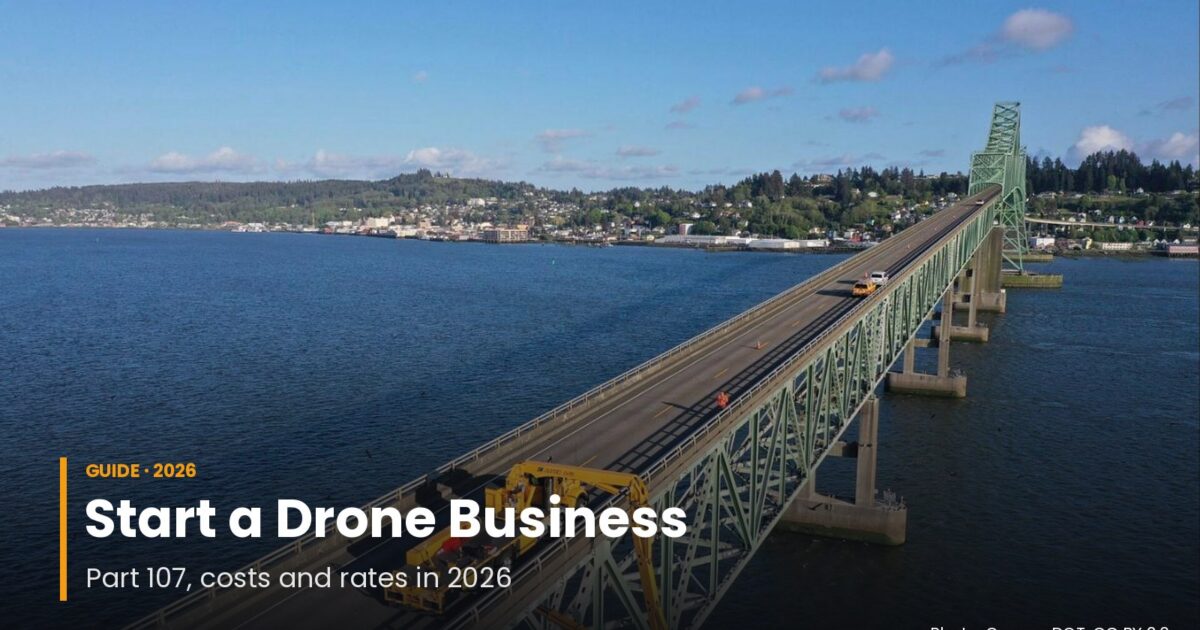
Cover photo: Drone’s-eye view of a bridge inspection on the Astoria-Megler Bridge, Oregon Department of Transportation, CC BY 2.0; cropped, text added.
Product links on this page are Amazon affiliate links. If you buy through them, Drone Ranker may earn a commission at no cost to you. We compare drones from manufacturer specifications and filings, not hands-on flight tests.
Sources
- FAA: Become a certificated remote pilot
- FAA: Operations over people and at night
- FAA: Part 107 waivers
- DroneXL: Part 107 test adds chart questions on 26 October (9 October 2026)
- DroneXL: Greg Reverdiau and Amy Wiegand on a 90-day plan (13 October 2026)
- DroneXL: FAA $12M for test sites as Part 108 sits unsigned (5 October 2026)
- DroneLife: The hard part may come after Part 107 (31 August 2026)
- Drone U: Drone service cost guide (May 2026)
- Drone Launch Academy: Real estate drone photography rates
- BWI: Drone liability insurance cost (December 2025)
- SkyWatch.AI: Monthly drone insurance plan
- DroneBundle: Drone spraying cost per acre (April 2026)
- NPR: Police and the cost of Chinese drone bans (12 October 2026)
- FAA: Drones by the numbers
- MarketsandMarkets: US drone services market
Sources
Primary references used for factual claims in this article.
The Friday Brief
One email a week on what changed in drones
FCC and FAA rule changes, DJI leaks checked against filings, and the week’s new comparisons. Every Friday, nothing else.
Free. Unsubscribe in one click. Sent with Kit; see our privacy policy.
Follow us on Google too: add Drone Ranker as a preferred source →
Continue Reading
All News