Police Drones in 2026: Drone as First Responder Costs, Flock vs Skydio vs BRINC, and the Privacy Fight

Police drones are spreading fast in the US. More than 1,000 agencies received FAA waivers for drone-as-first-responder (DFR) flights between April 2025 and February 2026, and the FAA now approves about 125 more a month. But the DJI drones most departments fly are being squeezed out, US-made replacements cost two to three times as much, and cities from San Francisco to Warwick, Rhode Island, are writing rules on what police drones may record.
This explainer covers what DFR is, what programs cost, how Flock, Skydio, BRINC and Axon compare, and where the privacy fight stands in October 2026.
Quick answer
| Police drones, October 2026 | |
|---|---|
| Agencies flying drones | About 6,000 (Law Enforcement Drone Association); EFF counts about 1,500 with a program |
| DFR waivers | 1,000+ from April 2025 to February 2026; about 125 new approvals a month |
| Share using DJI | 80–90% of agencies, per LEDA |
| DJI vs US price | About $10,500 for a DJI Matrice 400 vs $21,000 for a US-made Inspired Flight IF800 |
| Main DFR vendors | Flock Safety, Skydio (also via Axon), BRINC (with Motorola), Axon |
| Program cost examples | $150K over 3 years (Warwick) to $6.83M over 8 years (Orlando) |
What drone as first responder means
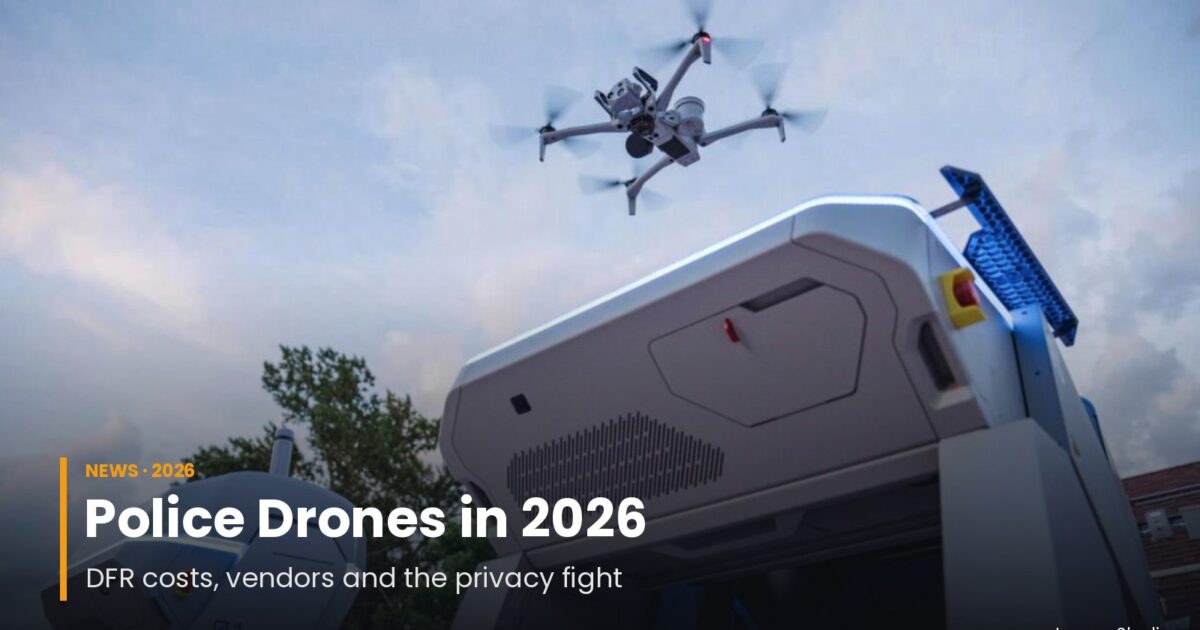
In a DFR program, a drone sits in a dock on a rooftop or police station. When a 911 call or gunshot-detection alert comes in, an operator launches it, often within seconds, and it streams live video to dispatch and responding officers before they arrive. Boston police describe drones launching “within seconds of a 911 call or ShotSpotter activation.” Chula Vista, California, ran the first program in 2018.
The legal basis is not Part 107, the commercial drone rule. Police fly as public aircraft under a streamlined FAA waiver introduced in April 2025 that allows flights beyond the operator’s line of sight. About 87% of agencies choose a shielded tier, flying at or below 200 feet or close to buildings, and about 13% choose a 400-foot tier that requires detect-and-avoid technology, DroneXL reported. Approvals last 48 months and require Remote ID. The FAA’s broader BVLOS rule, Part 108, is still unpublished; see our Part 108 tracker.
What police drone programs cost
| Agency | Vendor | Cost | Notes |
|---|---|---|---|
| Warwick, RI | Flock Safety | $150,000 over 3 years | Awaiting FAA approval for zero-foot grids near T.F. Green Airport |
| Bellingham, WA | Skydio (via public dashboard) | $475,417 state grant through 2028 | 23 flights since 19 August; one incident response |
| League City, TX | BRINC via Motorola | Up to $1.76M over 6 years | Two docks; launch planned December 2026 |
| Orlando, FL | Skydio | $6.83M over 8 years | 11 drones on 9 rooftop docks |
| Lakeland, FL | Axon | $21.98M over 10 years (drones are one part) | Approved 7-0 on 5 October 2026 |
Hardware is where the DJI squeeze shows. NPR reported on 12 October that one Ocean County, New Jersey, sheriff’s deputy kit cost $29,427.99, including a DJI Matrice 300 RTK at $13,699 and an $11,499 thermal camera. A DJI Matrice 400 costs about $10,500, while the US-made Inspired Flight IF800 TOMCAT costs $21,000. Law Enforcement Drone Association president Jon Beal told NPR that US drones typically run $20,000–$50,000 against under $10,000 for a DJI thermal drone.
Why police are replacing DJI
- FCC Covered List. In December 2025 the FCC added foreign-made drones and components, including DJI, to its Covered List, blocking new models. Existing drones may still be flown; see which drones are banned.
- Tariffs. Since 3 September 2026, imported drones with integrated thermal cameras carry a 100% Section 232 tariff, DroneXL reported.
- Proposed “military-grade” rule. The FCC has proposed treating thermal drones as military-grade, which could stop sales of previously authorised models. Comments closed on 2 September; no order had been issued as of 13 October.
- State bans. Agencies in Florida, Texas, Mississippi and Tennessee have ended or scrapped programs because of state limits on foreign drones, NPR reported. Orange County, Florida, replaced 16 DJI drones with 18 Skydio aircraft, and Florida set aside about $25 million to replace more than 500 drones.
The National Sheriffs’ Association has asked for an exemption for state and local law enforcement. DJI says the security concerns are not supported by technical evidence. For the full picture of how much this costs departments, see how DJI scored in DHS’s Blue UAS tests.
Flock vs Skydio vs BRINC vs Axon
Flock Safety (Alpha)
Flock, best known for licence plate cameras, bought drone company Aerodome in October 2024 and unveiled its US-built Alpha drone in October 2025. Flock says Alpha flies at up to 60 mph, swaps batteries in under 90 seconds, uses four cellular modems and can read plates from 2,000 feet. DroneXL reported on 13 October that Flock is valued at $8.4 billion, has about 175 DFR customers and expects drones to be nearly half of future revenue; it also reported that about 270 employees are taking a voluntary buyout. Flock says its drones do not run automated plate scans and deletes drone video after seven days by default. Flock Alpha received an FCC conditional approval in June 2026.
Skydio (X10 and Dock)
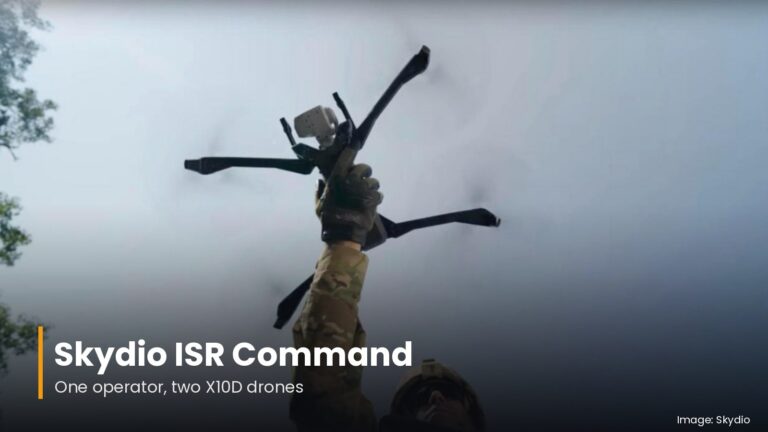
Skydio, the largest US drone maker, sells the X10 and its Dock directly and through Axon. Skydio lists up to 40 minutes of flight in lab conditions, speeds up to 45 mph and a FLIR Boson+ 640×512 thermal camera. Orlando and Bellingham are among its DFR customers. Skydio has also expanded into defence; see what it showed at Ascend 2026.
BRINC (Responder, Guardian)
BRINC raised $75 million in April 2025 alongside a strategic alliance with Motorola Solutions, and a further $125 million in July 2026 led by Motorola. It claims more than 900 agency customers. Boston’s DFR pilot uses BRINC Responder drones; one fell onto a parked car in Brighton on 3 September 2026 without injuring anyone, as we reported in our Boston crash story.
Axon
Axon, the body-camera company, partnered with Skydio in June 2024 for an end-to-end DFR package that also includes its Axon Air software and Dedrone airspace awareness. Its contracts often bundle drones with cameras and software, as Lakeland’s 10-year deal shows.
The privacy fight
San Francisco. The Police Commission was scheduled to vote on 14 October on an amended drone policy after objections from the ACLU and the Public Defender. The draft would let drone pilots clear some calls with no officer on scene, require a warrant to focus on home interiors or enclosed yards, ban general surveillance and keep non-evidentiary footage for 30 days or less. San Francisco logged about 4,000 DFR incidents from March 2024 to August 2026. In July, live feeds from five SFPD Skydio drones were found to have been exposed online for about six months, DroneXL reported. The result of the vote had not been reported when we published.
Warwick. Because the city bans non-fixed licence plate readers, the police chief asked Flock to disable plate reading on its Alpha. Footage is deleted after 30 days unless needed for an investigation, and every launch needs supervisor approval.
Congress. On 2 October Senator Bernie Sanders introduced the Ban Flock Act with Representative Alexandria Ocasio-Cortez and Senator Jeff Merkley. It would bar federal agencies from using automated licence plate readers or accessing local ALPR data, and cut some federal grants to state and local governments that do not ban them, TechCrunch reported. DroneLife notes it covers drone-based readers too.
States. There is no federal drone-privacy statute beyond FAA rules. Ohio’s HB 251, signed in 2026, requires a warrant where an in-person search would need one, with exceptions for emergencies and crime scenes, and bans armed police drones. The ACLU does not oppose police drones outright but wants limits on when they fly, no use for protests and transparency about footage.
What to watch
- The outcome of San Francisco’s drone policy vote.
- Whether the FCC finalises its military-grade proposal for thermal drones.
- Part 108 publication, which the FAA hopes to finish by the end of 2026.
- Whether Congress moves the Ban Flock Act.
Starting a public-safety drone career
FAA Airman Knowledge Testing Supplement
Official figure book for the Part 107 exam; the test adds chart questions on 26 October.
Bolton Prep Part 107 Study Guide
Full-colour Part 107 prep with practice exams.
As an Amazon Associate, Drone Ranker earns from qualifying purchases. We do not quote prices because Amazon’s change by the hour.
Frequently asked questions
What is a drone as first responder program?
Police launch a docked drone to a 911 call so dispatch and officers see live video, often before anyone arrives on scene.
How much does a police drone program cost?
Recent contracts range from about $50,000 a year (Warwick, $150,000 over three years) to about $760,000 a year (Orlando, $6.83 million over eight years). US-made drones cost about $20,000–$50,000 each.
How many police departments use drones?
About 6,000 law enforcement agencies, according to the Law Enforcement Drone Association; EFF counts about 1,500 with a formal program. More than 1,000 received FAA DFR waivers between April 2025 and February 2026.
Do police need a warrant to use a drone?
It depends on the state. Ohio requires one where an in-person search would; there is no federal statute.
Can police drones read licence plates?
Flock’s Alpha can read plates from 2,000 feet, but Flock says it does not run automated scans, and some cities have had the feature disabled.
Why are police replacing DJI drones?
Because of the FCC Covered List, 100% tariffs on thermal drone imports, a proposed FCC rule on thermal drones and state bans on foreign drones.
Who makes police drones in the US?
Skydio, Flock Safety and BRINC are the main US DFR vendors, with Axon and Motorola reselling and integrating them.
Cover image: Skydio X10 and Dock. Image: Skydio.
Product links on this page are Amazon affiliate links. If you buy through them, Drone Ranker may earn a commission at no cost to you. We compare drones from manufacturer specifications and filings, not hands-on flight tests.
Sources
- NPR: US restrictions on Chinese drones are hurting police departments (12 October 2026)
- DroneXL: DJI curbs hit police budgets (13 October 2026)
- DroneXL: Flock bets on police drones as San Francisco weighs limits (13 October 2026)
- DroneXL: FAA DFR waiver list tops 1,000 agencies (7 August 2026)
- DroneXL: Bellingham police pick Skydio for DFR (6 October 2026)
- DroneXL: Warwick police Flock drone (5 October 2026)
- DroneXL: Lakeland’s $22M Axon deal (5 October 2026)
- DroneXL: Orlando Skydio drone program (25 February 2026)
- TechCrunch: Sanders introduces Ban Flock Act (2 October 2026)
- DroneLife: Ban Flock Act targets drone-based plate readers (13 October 2026)
- Boston Police Department: DFR pilot program (28 August 2026)
Sources
Primary references used for factual claims in this article.
The Friday Brief
One email a week on what changed in drones
FCC and FAA rule changes, DJI leaks checked against filings, and the week’s new comparisons. Every Friday, nothing else.
Free. Unsubscribe in one click. Sent with Kit; see our privacy policy.
Follow us on Google too: add Drone Ranker as a preferred source →
Continue Reading
All News