DJI Agras T55: One Airframe for Spraying, Spreading and Lifting

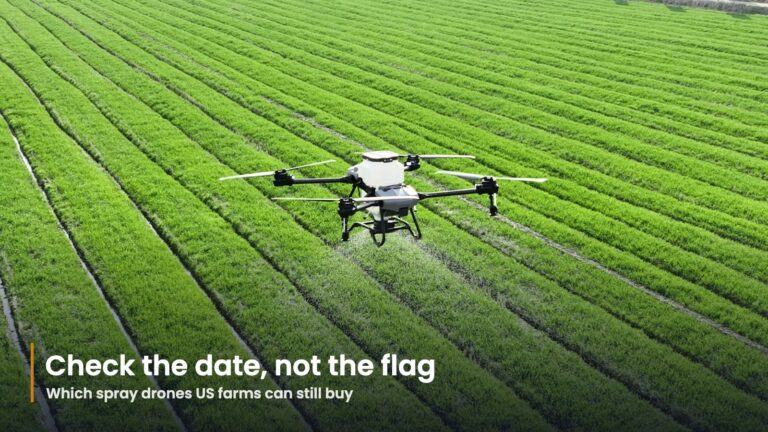
Update, 2 October 2026: The Agras T55’s FCC authorization (SS3-T55A2510) was granted on 19 December 2025, three days before foreign-made drones were added to the FCC Covered List, so it can still be sold in the US. See how the T55 fits among the spray drones US farms can still buy.
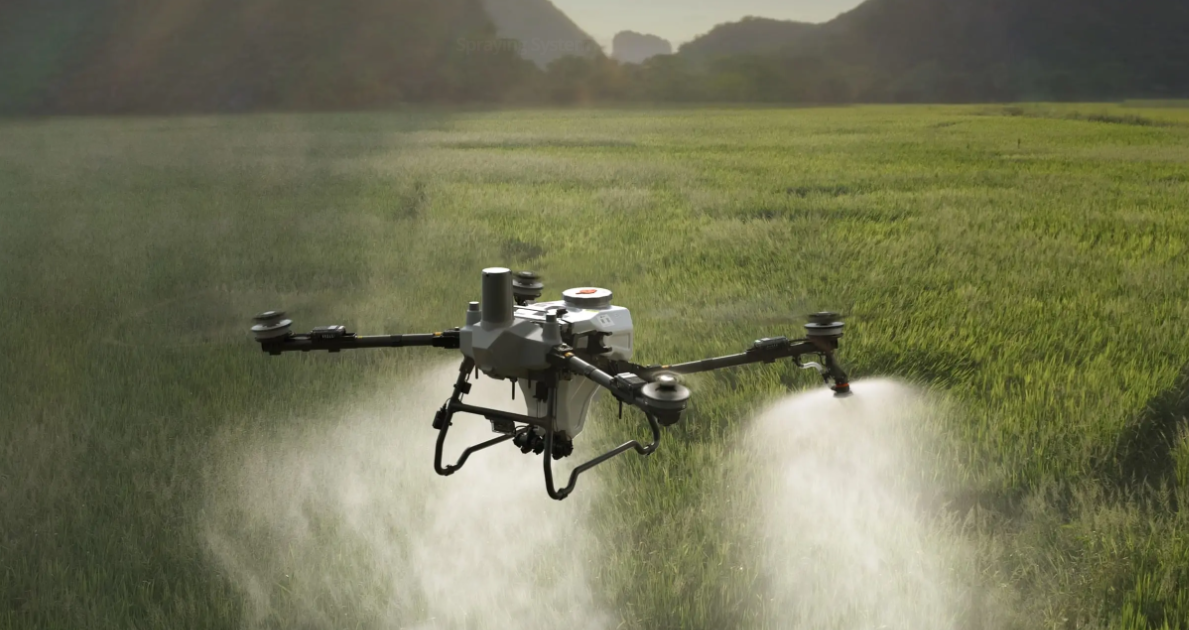
The DJI Agras T55 is a modular farm drone: one airframe that sprays, spreads granules and lifts cargo by swapping systems. It carries a 50 L spray tank, an 80 L spreader with a 55 kg payload, or a 40 kg hoist, and weighs 45 kg in its standard spraying setup. In DJI’s agriculture lineup it sits alongside the T70/T70P series and the larger T100, and DJI pitches it as “light, intuitive, and easy to get started with.”
Everything below comes from DJI’s spec sheet and product page. DJI sells the T55 only in selected countries and regions, through authorized dealers, and does not list a price.
Table of Contents
Weight, size and propulsion
According to the official DJI specifications, the aircraft weighs 45 kg with two nozzles, the 50 L tank and the DB1050 battery, or 48.4 kg with the larger DB1580. DJI has added a new carrying handle for solo transport and loading onto a vehicle, which helps on farms where one operator mixes, refills and flies.
| Configuration | L × W × H |
|---|---|
| Arms and propellers unfolded | 3190 × 3570 × 934 mm |
| Arms unfolded, propellers folded | 1800 × 2170 × 934 mm |
| Arms and propellers folded | 1120 × 896 × 934 mm |
The diagonal wheelbase is 2415 mm. It flies on four pairs of 62-inch carbon fiber composite propellers, driven by motors with 155 × 16 mm stators rated at 55 rpm/V.
Spraying
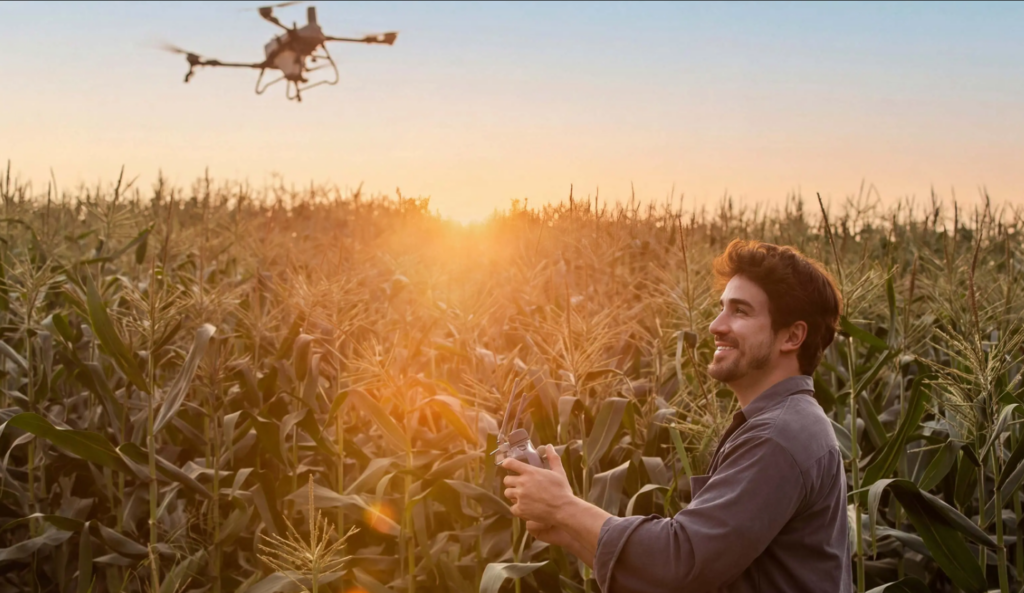
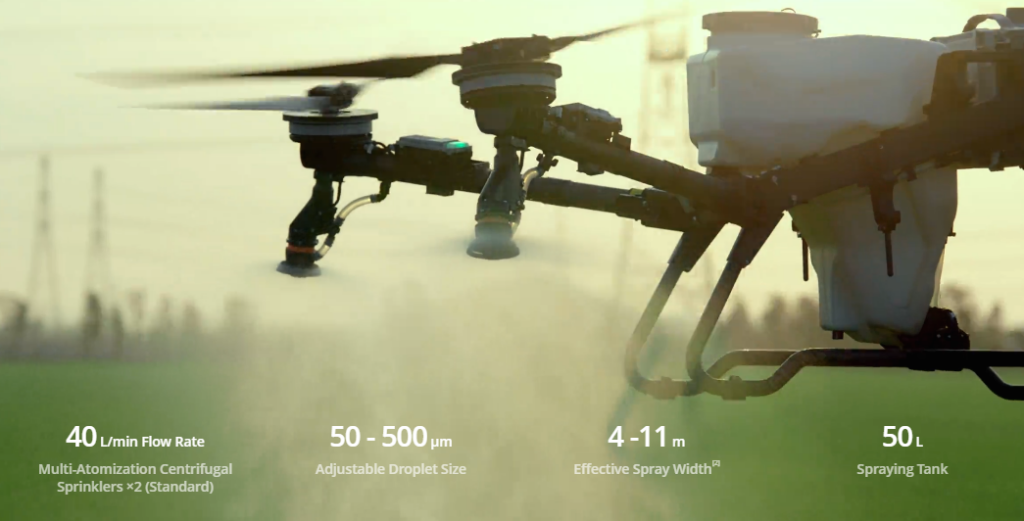
The standard setup uses two LX09050DX centrifugal nozzles spaced 1800 mm apart, with an optional mist nozzle (LX09510DX) and an upgrade to four nozzles. Maximum flow is 40 L/min with two nozzles and 50 L/min with four. The 50 L HDPE tank gives a 50 kg operating payload.
Droplet size adjusts from 50 to 500 μm, from fine mist for fungicide coverage to coarse droplets that reduce herbicide drift. Effective spray width is 4 to 11 m depending on flight parameters and nozzles. DJI calls the centrifugal disc a “new design” that lets the two sprinklers handle most jobs. Two magnetic drive impeller pumps feed it, and a dual-channel electromagnetic flow meter handles dosing.
Spreading with the DS80L
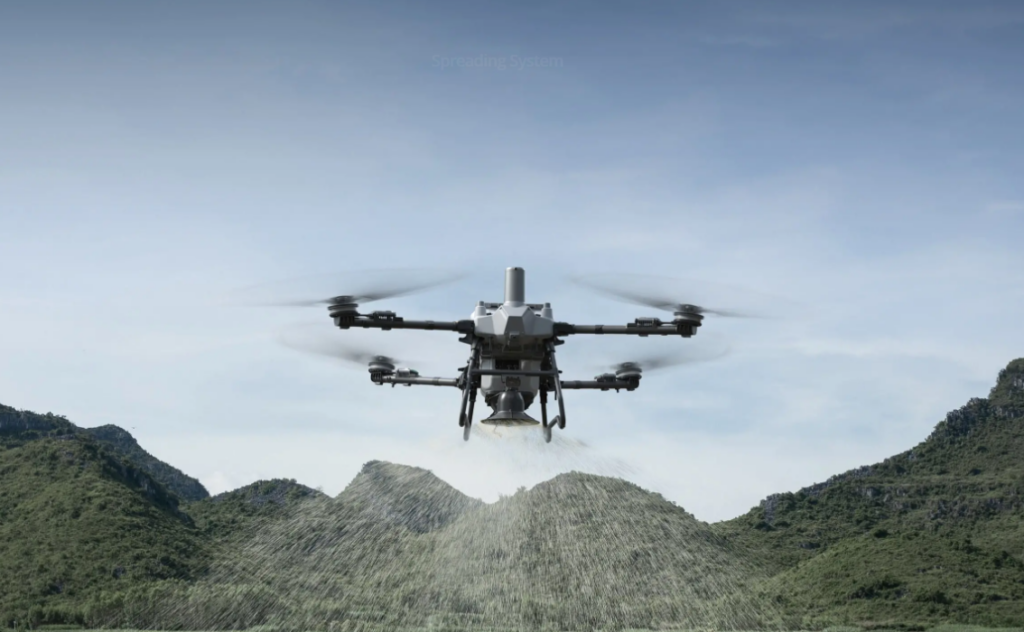
Swap the tank for the DS80L spreading system and the T55 carries 80 L with a maximum operating payload of 55 kg. DJI rates the maximum discharge at 400 kg/min with compound fertilizer, over a 3 to 10 m width. At that rate a full load would empty in roughly 8 seconds, so the figure is about headroom, not normal operation. A centrifugal disc and screw feeder are meant to prevent clogging and leakage.
Five feeder sizes match different materials:
- Extra-large auger (standard): 0.5–10 mm granules: fertilizer, wheat seed, feed
- Medium auger (standard): 4–6 mm granules: rice
- Large auger (optional): 4–10 mm granules: rice, fertilizer
- Small and medium auger (optional): 0.5–2 mm pellets: crayfish and prawn feed
- Small auger (optional): 0.5–4 mm granules: rapeseed, granular herbicides and insecticides
One-click material templates cut preparation time, the system adjusts flow during flight to keep application even, and the controller shows remaining material in real time, so operators know when to refill instead of guessing.
Obstacle sensing
A new millimeter-wave radar produces up to 250,000 points per second, and DJI says upgraded hardware and algorithms keep it reliable in rain and fog. The quad-vision system pairs three top-mounted cameras with a low-light full-color FPV camera (86° horizontal, 155° vertical field of view); the tri-vision cameras cover 360° horizontally and 180° vertically.
- Radar range: 60 m
- Safe obstacle bypass speed: ≤ 13.8 m/s
- Avoidance works from ≥ 1.5 m height and holds 2.5 m from an obstacle after braking
- Detects and bypasses obstacles such as power lines, can find a new path in complex scenes, and saves detected obstacles to the field record for later flights
- AR overlays on the FPV and auxiliary views mark field boundaries, obstacles and breakpoints
DJI’s footnotes matter here. Sensing and avoidance vary with light, rain, fog and the material, position and shape of objects, and the system needs “normal light intensity, rich scene texture features, and no dirt,” which dusty, muddy, dim farm conditions will not always provide. It cannot avoid moving objects, and damage from bottom collisions is not covered by warranty. The radars also draw power: the front unit peaks at 36 W, downward and rear at 3.5 W each.
Accuracy and flight limits
With RTK, hover accuracy is ± 10 cm horizontally and vertically; without it, ± 0.6 m horizontal and ± 0.3 m vertical. The maximum configurable flight radius is 2 km. It operates from 0° to 40°C (32° to 104°F) and in winds up to 6 m/s, which is adequate but will ground operators in windy regions more often than they would like.
The T55 can also follow terrain without aerial mapping, detecting terrain relief on its own. DJI says this lets standard orchards run terrain-following jobs without a pre-flight mapping step, which saves real time where elevation changes.
Batteries and takeoff weight
| DB1050 | DB1580 | |
|---|---|---|
| Weight | 8.3 ± 0.3 kg | 11.7 ± 0.3 kg |
| Capacity | 20,000 mAh | 30,000 mAh |
| Voltage | 52.5 V | 52 V |
| Max takeoff, spraying (2 / 4 nozzles) | 95 / 99 kg | 99 / 103 kg |
| Max takeoff, spreading | 104 kg | 108 kg |
| Max takeoff, hoisting | 84 kg | 89 kg |
The most interesting power feature is the Onboard Battery Heat Sink, an air duct that cools the battery during flight. Paired with a ground air-cooled heat sink, it is meant to allow continuous work without overheating. Forum discussions of earlier DJI ag drones often mention battery heat in summer, so if this works as described it fixes a real problem.
Charging
Both charging options take the DB1050 from 30% to 95% in 8–9 minutes.
- D8000iE inverter generator: gasoline, 20 L tank, 6500 W DC output (42–61.6 V), 500 mL/kWh reference consumption, which DJI says is 15% more efficient than the previous generation. Runs on unleaded RON ≥91, one-button start, 46 ± 0.5 kg, 452 × 566 × 600 mm.
- C7000 smart charger: single-phase 220–240 V or three-phase 380–480 V input, 7000 W on three-phase (2000 W single-phase), 8.5 kg, with over-temperature, over-voltage, under-voltage, short-circuit and fan-stall protection.
Controller, relay and RTK
The T55 ships with the DJI RC Plus 2 AG (model TKPL 2): a 7-inch, 1920 × 1200 touchscreen at 1,400 cd/m², bright enough for direct sun. The internal battery runs 3.8 hours and the external adds 3.2; charging takes about 2 hours powered off, via USB-C at up to 65 W. It uses O4 transmission to 2 km, matching the flight radius, and has physical buttons and dual sticks that work with gloves.
The optional O4 Relay (RL0265) weighs 630 g, has a 6500 mAh battery good for 5 hours, is rated IP55, uses 2.4 and 5.8 GHz, and extends range to 4 km (CE/MIC/KCC) or 8 km (FCC).
The D-RTK 3 AG base station supports GPS (L1/L2/L5), BeiDou (B1I/B2I/B3I/B1C/B2A/B2B), Galileo (E1/E5a/E5b/E6), GLONASS (G1/G2), QZSS (L1CA/L2C/L5) and L-BAND, with IP67 and 7 hours of operation. Network RTK accuracy is 0.8 cm + 1 ppm horizontal and 1.5 cm + 1 ppm vertical (RMS); the PPP satellite service reaches 30 cm horizontal and 40 cm vertical after 20 minutes of convergence.
Lifting with the DL100
The DL100 carries 40 kg on a 10 m cable (10–15 m recommended), useful for orchards, terraced fields and aquaculture sites that ground vehicles struggle to reach. Cargo Obstacle Avoidance slows the drone early based on obstacle positions to keep the cable from snagging, and a lever-action emergency release drops the load in 3 seconds; the cable can be reinstalled. A standard triaxial force sensor weighs the cargo, detects swing and adjusts the drone’s posture to damp it, and the controller can total lifted weight for billing. DJI says cargo avoidance is assistance only, and damage from the load or cable hitting obstacles is not covered by warranty.
How it compares and what it costs
Against the T70 series, the T55 adds the quad-vision safety system, the onboard battery heat sink and improved obstacle bypassing; DJI says some improvements are measured “compared with the T70/T70P agricultural drones and their supporting equipment.” The T100 has a larger frame for bigger tanks and heavier loads and suits very large operations. DJI aims the T55 at small to medium-sized plots.
The official DJI Agras T55 product page is the place to check regional availability; for a price you have to contact a local dealer. Budget for the whole kit, not just the aircraft: batteries, a charger or generator, the spreading and lifting systems, an RTK base and possibly the relay.
My view: the T55’s strongest argument is the modular design, which lets a DJI Agras buyer add spreading or lifting later instead of buying separate drones. For orchards and mixed small-to-medium farms that is a good fit. The 6 m/s wind limit, the 0–40°C range and a safety system that depends on clean sensors and decent light are the trade-offs to plan around, and a dealer demonstration on your own fields is worth more than the spec sheet.
Enterprise drones listed on Amazon US
DJI Matrice 4E
Mapping-focused enterprise drone listed on Amazon US.
DJI Matrice 4TD
Thermal, wide and tele cameras; the dock-ready Matrice 4 variant, with RC Plus 2 Enterprise.
As an Amazon Associate, Drone Ranker earns from qualifying purchases. We do not quote prices because Amazon’s change by the hour.
The Friday Brief
One email a week on what changed in drones
FCC and FAA rule changes, DJI leaks checked against filings, and the week’s new comparisons. Every Friday, nothing else.
Free. Unsubscribe in one click. Sent with Kit; see our privacy policy.
Follow us on Google too: add Drone Ranker as a preferred source →
Continue Reading
All News