DJI Avata 360: Fly Now, Frame Later With 8K 360° FPV

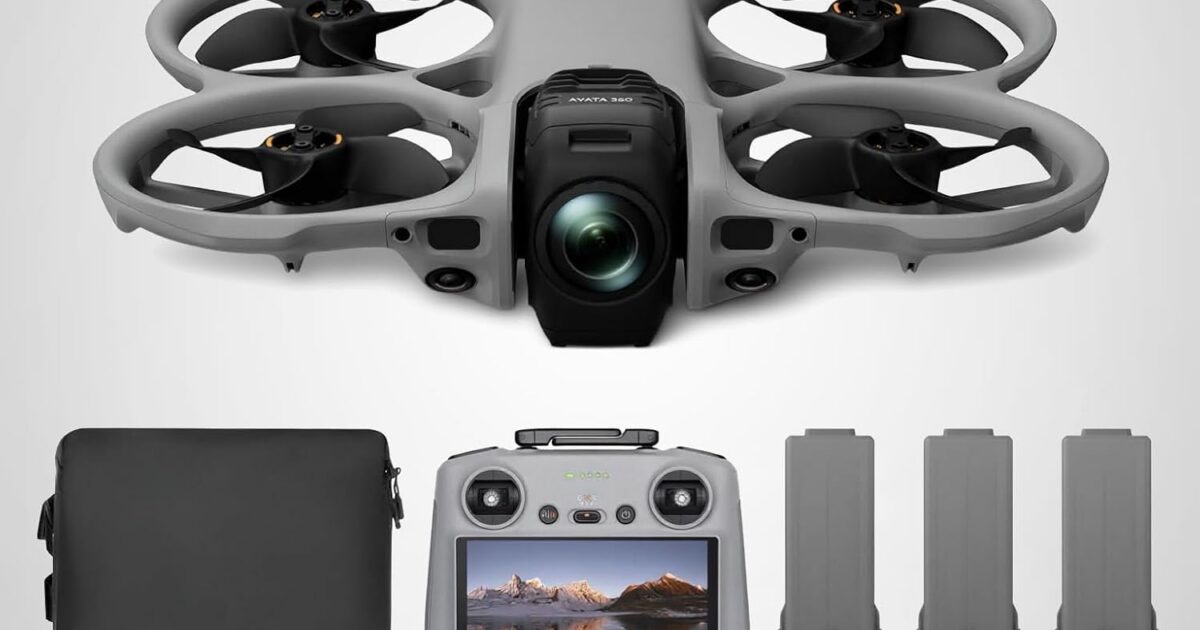
The DJI Avata 360 is an FPV drone with two cameras that record the whole sphere around it, in 8K at up to 60 fps. You fly it like a cinewhoop and choose your framing afterwards, instead of worrying about what is behind or beside you while flying. It weighs 455 g and carries a C1 class label in Europe.
Update (15 October 2026): The A1’s maker is expanding in the US; see how Insta360’s Antigravity is moving into the space DJI left.
Update, 22 October 2026: firmware v01.00.0800 adds waypoint missions, support for the DJI RC Pro 2, zoom during FocusTrack and display orientation switching. It arrived on 20 October with a wider batch of DJI updates; see what that DJI firmware update means for older drones.
Update, 26 October 2026: if you fly with the DJI RC Pro 2, the aircraft update is only half the job. The controller needs its own firmware, V01.00.0900, before it can pair with the Avata 360 and use the new features. DJI’s Avata 360 release notes also warn that the update may reset RTH altitude and maximum flight distance, so write those settings down before you start.
This article is based on DJI’s published specifications. For current prices, see the DJI Avata 360 listing on Amazon.
Table of Contents
Body and obstacle sensing
The design borrows from the DJI Avata 2. At 246 × 199 × 55.5 mm it is compact enough for narrow gaps, tree branches and indoor flying. A 3D ToF (time of flight) sensor and infrared sensors underneath and a LiDAR unit at the front give it obstacle sensing, something traditional FPV drones lack.
In Europe the C1 class applies. Outside Europe, check local rules for a drone of this weight; some countries do not require a pilot license under 500 g, but restricted zones still apply. Our registration rules by weight page covers the main countries.
Cameras: 8K 360° and 120 MP stills
The camera module uses two 1/1.1-inch square CMOS sensors, each 64 MP effective, behind f/1.9 lenses with a 200° field of view.
- 360° mode: up to 8K at 60 fps, suited to VR headsets and interactive video.
- Single-lens mode: 4K at 60 fps (4:3) or 2.7K at 120 fps slow motion, if you want to use it like a conventional FPV drone.
- Photos: JPEG or DNG RAW up to 120 MP (16K) in 360° mode, useful for real estate and virtual aerial tours.
- Color: D-Log M for grading.
Video is saved as .MP4 and as DJI’s own .OSV 360 format. The DJI Fly app or DJI Studio on a computer converts it into standard 360 or reframed files that Premiere Pro, DaVinci Resolve and Final Cut can open. At 180 Mbps for 8K/60, the internal storage fills quickly, so bring a fast V30 microSD card for long shoots.
A virtual gimbal instead of a 3-axis one
The Avata 360 has only a single-axis (tilt) mechanical gimbal. Stabilization comes from a software 360° Virtual Gimbal that keeps the horizon level through ±180° of tilt and roll, even during flips. A drone like the DJI Air 3 uses a mechanical 3-axis gimbal instead.
If you want calm, cinematic scenery, the Air 3 is the better tool. If you want to fly through the action and reframe dynamic shots later, the Avata 360 is the one built for it.
Flight time, speed and wind
The 2700 mAh (38.67 Wh) battery is rated for about 23 minutes of flight and around 22 minutes of hover, against the 4–6 minutes typical of custom FPV builds. Expect less in real use; 18–20 minutes depending on conditions and recording settings is a fairer planning figure. The batteries, like other accessories, are not compatible with the Avata 2.
- Cine mode: 6 m/s
- Normal mode: 16 m/s
- Sport mode: 18 m/s
Wind resistance is listed at 10.7 m/s (Level 5). With its dual-lens body it will likely be pushed around more than a heavier camera drone like the Mavic 3 Pro, though the virtual gimbal is designed to smooth wind-induced shake out of the footage.
O4+ transmission
The Avata 360 uses DJI’s O4+ system with four antennas (2T4R), rated up to 20 km under FCC rules and 10 km under CE in open, interference-free conditions. DJI’s own figures for harder environments are more useful: about 0.7 km in built-up urban areas and up to 4.5 km in dense woodland.
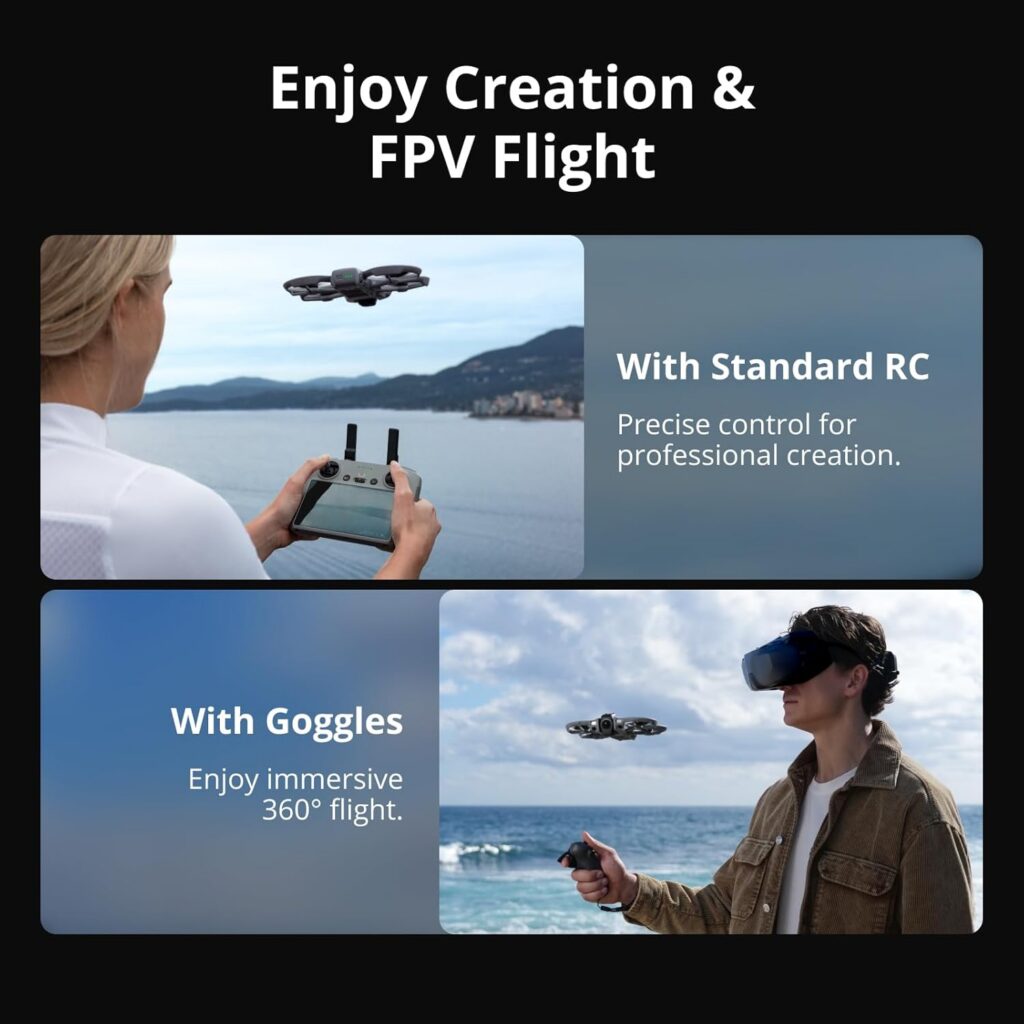
With a conventional controller (RC 2 or RC-N2/N3), video latency is about 130 ms. Paired with DJI Goggles 3 or Goggles N3 and the RC Motion 3, latency drops much lower and the live feed runs at 1080p/100 in single-lens mode.
Storage and charging
Storage figures for the Avata 360 differ between sources (42 GB and 128 GB both appear), so plan on 42 GB, which is still enough to save a shoot if you forget your card. A charging hub on DJI’s 100 W USB-C adapter takes one battery from 10% to 90% in 31 minutes, and all three in about 100 minutes.
Avata 360 vs Avata 2
For Avata 2 owners, the change is the dual-sensor camera that records everything around the drone at once, plus higher resolution and O4+ transmission. The DJI Avata 360 vs Avata 2 comparison goes through it in detail.
| Feature | DJI Avata 360 | DJI Avata 2 |
|---|---|---|
| Cameras | Dual 1/1.1″ CMOS (360°) | Single 1/1.3″ CMOS (155° FOV) |
| Max video | 8K/60 | 4K/60, 2.7K/120 |
| Max photo | 120 MP | |
| Takeoff weight | 455 g | 377 g |
| Transmission | O4+ | O4 |
The Avata 360 makes the most sense for creators who want FPV-style movement and the freedom to frame every angle after the flight. Classic FPV pilots who only need forward-facing footage are better served by the lighter, simpler Avata 2. If the 360 is your pick, you can check the Avata 360 on Amazon.
The Friday Brief
One email a week on what changed in drones
FCC and FAA rule changes, DJI leaks checked against filings, and the week’s new comparisons. Every Friday, nothing else.
Free. Unsubscribe in one click. Sent with Kit; see our privacy policy.
Follow us on Google too: add Drone Ranker as a preferred source →
Continue Reading
All News