DJI Flip: A Prop-Guarded Vlog Drone and Its One Real Weakness

New, 14 October: camera drone or FPV? Our side-by-side of the DJI Flip vs Avata 2 covers camera, goggles, flight time, range and FAA registration.
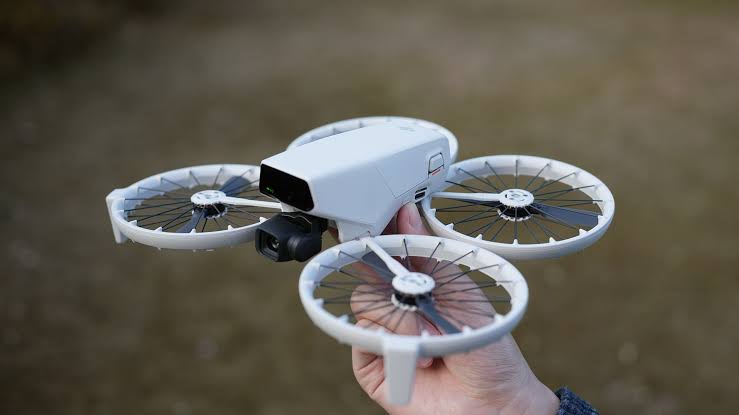
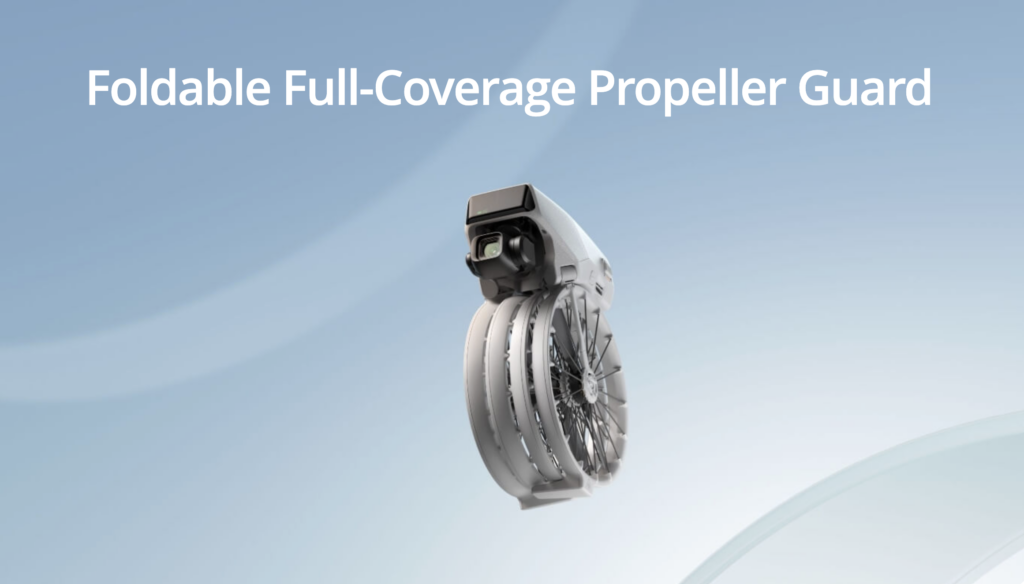
The DJI Flip is a sub-249 g camera drone with full propeller guards, palm takeoff and a 1/1.3-inch sensor on a 3-axis gimbal. It launched in January 2025 at $439 with the RC-N3 controller, and it is still sold in the US because the FCC authorized it before the December 2025 Covered List decision. You can check current pricing here: view the DJI Flip on Amazon.
This is a specification analysis. I compare DJI’s published figures and have not flown the drone. On paper, it is a good fit for vloggers and families. The one real weakness is sensing: it only sees forward, so if you fly fast near trees or obstacles, look elsewhere.
Table of Contents
Size, weight and rules
Folded, the Flip measures 136×62×165 mm (L×W×H); unfolded, 233×280×79 mm. DJI lists the takeoff weight as under 249 g with the Intelligent Flight Battery and a microSD card, noting that actual weight can vary slightly between batches.
That weight is the point. In the US, recreational pilots don’t have to register it, though they still need the TRUST certificate. In the EU, DJI’s spec sheet puts it in the C0 class, which lets pilots in most countries fly without extensive training or exams. Check local rules before you fly anyway.
The camera
The sensor is 1/1.3-inch, much larger than the 1/2.3-inch sensors common in ultra-compact drones and a big one for this weight class. A larger sensor generally gathers more light, which should help dynamic range and low-light results. The lens is a 24 mm-equivalent f/1.7 with an 82.1° field of view, focusing from 1 m to infinity. That wide aperture helps at golden hour and on overcast days.
Stills come at 12 MP or 48 MP (8064×6048), in JPEG or DNG RAW. Modes from the spec sheet:
- Single shot: 12 MP and 48 MP
- Burst: 12 MP, 3, 5 or 7 frames
- AEB: 12 MP, 3, 5 or 7 frames at 2/3 EV step
- Timed: 12 MP, at 2, 3, 5, 7, 10, 15, 20, 30 or 60 s intervals
ISO runs 100–6400 for 12 MP photos and 100–3200 for 48 MP. Shutter speeds go to 1/16000 s at 12 MP.
Video is where the DJI Flip stands out for its size. It records 4K (3840×2160) at up to 100fps, which leaves room for slow motion without dropping resolution, and Full HD up to 100fps. It also offers 4K/60 HDR. Native vertical modes are 2.7K (1512×2688) and FHD (1080×1920) at 24, 25 or 30fps, so social clips don’t need cropping.
Maximum bitrate is 150 Mbps, recorded as MP4 on exFAT (so files can exceed 4 GB). Color modes are Normal and 10-bit D-Log M, with D-Log M limited to ISO 100–1600; it gives a flatter image that keeps more highlight and shadow detail for grading.
Flight performance
There are three modes. Sport and Normal both allow 5 m/s ascent and descent; Cine slows that to 2 m/s up and 1.5 m/s down for smoother moves. Maximum horizontal speed is 12 m/s in Sport mode and while tracking. DJI also lists 16 m/s in Sport with a 4 m/s tailwind, measured in a wind tunnel, so real speeds will vary.
Wind resistance is rated at 10.7 m/s (Level 5). Maximum takeoff altitude is 3000 m; DJI says that at this altitude, in still air, a fully charged Flip can climb 500 m and fly in Sport mode until the battery hits 20%. That makes mountain trips possible, but watch battery drain closely.
Positioning uses GPS, Galileo and BeiDou. Hover accuracy is ±0.1 m vertical and ±0.3 m horizontal with vision positioning, or ±0.5 m vertical and ±1.5 m horizontal on satellites alone. The operating range is -10° to 40° C (14° to 104° F); in sub-zero weather, expect the battery to suffer.
Battery and charging
The DJI Flip uses a 3110 mAh LiNiMnCoO2 lithium-ion battery: 7.16 V nominal, 22.3 Wh, about 83.5 g. DJI’s maximum flight time is 31 minutes, measured in a wind tunnel at a steady 6 m/s at sea level with obstacle avoidance set to Brake and the camera in photo mode. Maximum hover time is 28 minutes. Expect less with tracking and wind.
Charging in the aircraft with a 30 W charger (such as DJI’s 30W USB-C Charger) takes about 70 minutes from 0 to 100%. The Battery Charging Hub is quicker: about 45 minutes for one battery at 48 W. With a 65 W charger, the hub charges two batteries in parallel in about 70 minutes, but only if the charger supplies at least 65 W, 4.3 A at 15 V and supports PD, with a compatible cable; otherwise it charges them one at a time. The hub is rated at 65 W and accepts 5, 9, 12 or 15 V at 4.3 A. Batteries charge between 5° and 40° C (41° to 104° F).
Transmission and connectivity
The Flip uses DJI’s O4 transmission, the latest generation, with live view up to 1080p/60fps on the controller and latency down to about 120 ms depending on environment and phone. It switches automatically between 2.4000–2.4835 GHz, 5.170–5.250 GHz and 5.725–5.850 GHz.
| Standard | Max transmission distance |
|---|---|
| FCC (USA) | 13 km |
| CE (Europe) | 8 km |
| SRRC (China) | 8 km |
| MIC (Japan) | 8 km |
Those are unobstructed, interference-free figures, and in practice the limit is the 14 km maximum flight distance and your battery. DJI’s own interference figures under FCC are more useful: about 1–2.5 km in cities, 2.5–7 km in suburbs and 7–13 km at the seaside or in open suburbs. With buildings in the way, range falls to 0–0.5 km; with trees, 0.5–2 km.
The drone also has Wi-Fi (802.11a/b/g/n/ac on 2.4 and 5.8 GHz, about 50 m in the open) and Bluetooth 5.0 (2.4 GHz, under 10 dBm), mainly for quick file transfers and short-range control.
Obstacle sensing
Forward sensing is a 3D infrared system with a 0.3–8 m range on surfaces above 10% reflectivity and a 60°×60° field of view. Downward, it uses one visual sensor plus an infrared sensor, with the same 0.3–8 m range and 60° field of view, and precise hovering from 0.5 to 10 m. There is nothing to the sides or behind.
Infrared helps in low light where cameras struggle, but it maps obstacles less precisely than the omnidirectional vision systems on bigger DJI drones. The downward sensors also need a patterned surface with diffuse reflectivity above 20% (like concrete) and more than 15 lux of light, so expect a less stable hover over smooth, shiny surfaces or in the dark. The prop guards are a safety net, not a substitute for sensing. If that’s a dealbreaker, compare the Flip vs Mini 4 Pro or Flip vs Mini 5 Pro.
Controller, app and storage
The Flip is flown from a phone or the RC-N3 and RC 2 controllers; it is not an FPV drone and doesn’t work with goggles. The RC-N3 runs up to 3.5 hours, or 1.5 hours while charging your phone, works from -10° to 40° C and holds phones up to 180×86×10 mm. The DJI Fly app needs iOS 13.0 or Android 7.0 or later. Downloads run at up to 10 MB/s over O4 and 30 MB/s over Wi-Fi 5 in lab conditions.
Internal storage is only 2 GB, a few minutes of high-bitrate 4K, so you need a microSD card rated U3 and V30 to keep up with 150 Mbps. DJI recommends the Kingston CANVAS Go! Plus and the Lexar Professional 1066x, both in 64, 128, 256 and 512 GB (U3 A2 V30 microSDXC).
Who it suits
On paper, the Flip packs a lot of camera into a drone that sidesteps most registration rules: a 1/1.3-inch sensor, f/1.7 lens, 4K/100fps, D-Log M, native vertical video and 48 MP RAW. For travel, hiking and everyday content, especially if you film yourself or fly around family, I think it is one of the easiest drones to recommend. Just remember that it only sees forward and down. Check the DJI Flip on Amazon.
The Friday Brief
One email a week on what changed in drones
FCC and FAA rule changes, DJI leaks checked against filings, and the week’s new comparisons. Every Friday, nothing else.
Free. Unsubscribe in one click. Sent with Kit; see our privacy policy.
Follow us on Google too: add Drone Ranker as a preferred source →
Continue Reading
All News