DJI Mavic 4 Pro: Three Cameras for Paid Work, Wrong Drone for Travel

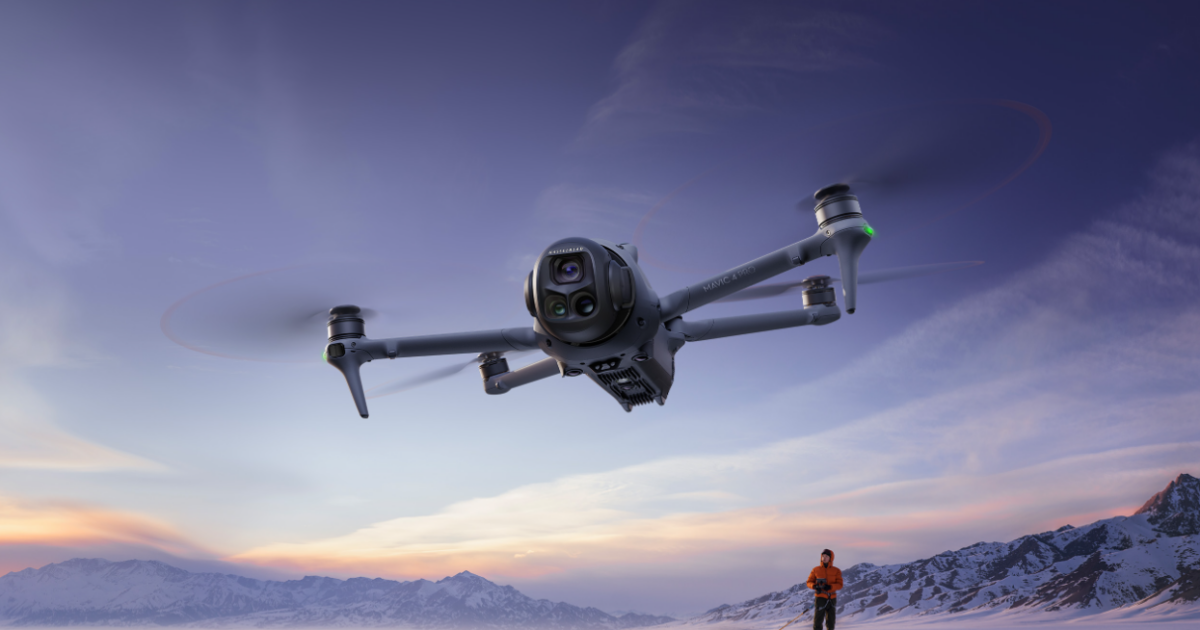
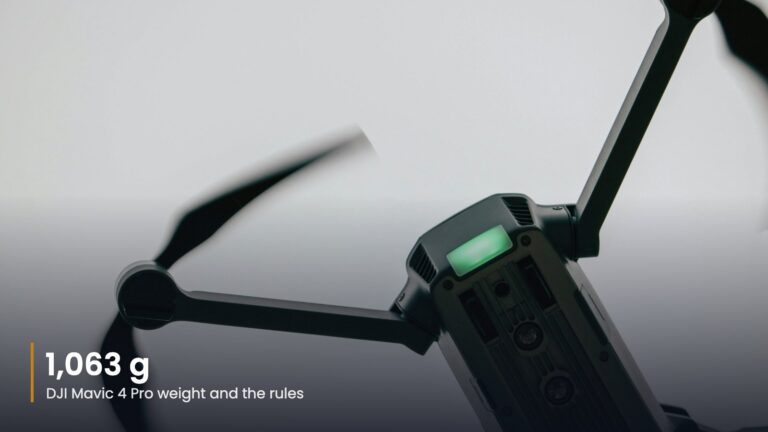
The DJI Mavic 4 Pro is built for people who sell aerial photos and video. It puts three optical focal lengths (28, 70 and 168 mm), a 100 MP 4/3 main camera with a variable aperture, and 6K video into one folding drone. For travelers and hobbyists it is the wrong drone: at 1,063 g it is a C2 aircraft in the EU and needs FAA registration in the US, and a sub-250 g Mini 5 Pro or a C1 Air 3S is far easier to fly legally.
This is a specification analysis, updated October 7, 2026. It compares DJI’s published figures; we have not flown the aircraft.
Table of Contents
DJI Mavic 4 Pro price and availability
DJI launched the Mavic 4 Pro on May 13, 2025. European and UK launch prices:
| Package | EU | UK |
|---|---|---|
| Drone with DJI RC 2 | €2,099 | £1,879 |
| Fly More Combo | €2,699 | £2,459 |
| 512GB Creator Combo | €3,539 | £3,209 |
The Creator Combo adds the 1,200 Mbps ALL-I codecs and 512 GB of internal storage.
DJI did not launch it in the United States, but US retailers began selling it later in 2025, at around $2,700 for the drone alone according to The Drone Girl. It received FCC authorization before the December 2025 Covered List decision, so it can still be sold and flown; the US drone ban checker tracks which DJI models later FCC actions affect. You can check current pricing and availability here.
Size and weight
Folded with propellers, the Mavic 4 Pro measures 257.6×124.8×106.6 mm; unfolded it is 328.7×390.5×135.2 mm. DJI lists the weight at about 1,063 g and notes it can vary slightly between material batches. That puts it in the EU’s C2 class, with specific limits on flying near uninvolved people.
The rated maximum takeoff altitude is 6,000 m, dropping to 3,000 m with DJI’s official propeller guards fitted.
DJI Mavic 4 Pro flight time and speed
DJI rates it at 51 minutes of flight, measured in a wind tunnel flying forward at a constant 32.4 kph until forced landing, and 45 minutes of hover in windless, sea-level conditions. As with any drone, real flights will be shorter, because wind, temperature and hard flying all eat into battery life.
There are three flight modes: Sport, Normal and Cine. In Sport, ascent and descent top out at 10 m/s and horizontal speed at 25 m/s in still air (27 m/s with a 2 m/s tailwind). Tracking limits horizontal speed to 15 m/s. Wind resistance is rated at 12 m/s (about 26 mph), maximum pitch is 35 degrees, and the operating range is -10 °C to 40 °C (14 °F to 104 °F). It uses GPS, Galileo and BeiDou, with hover accuracy down to ±0.1 m vertically and ±0.3 m horizontally when vision positioning is active.
Three cameras, 28 to 168 mm
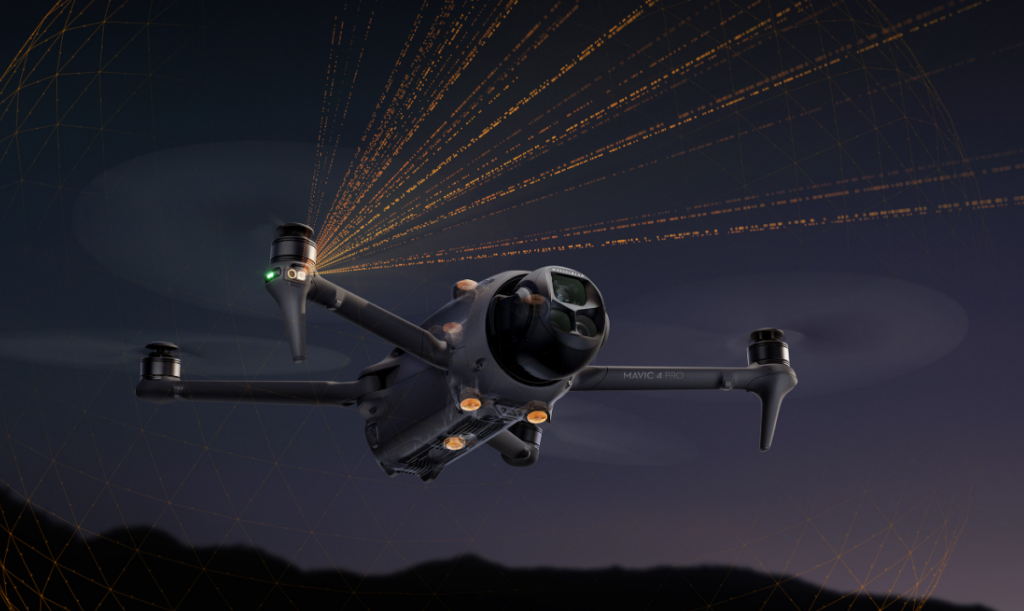
The camera module is the reason to buy this drone. Earlier Mavics paired one main sensor with a secondary telephoto; this one has three high-resolution cameras covering 28 mm to 168 mm equivalent, so compressed backgrounds and tight framing don’t depend on cropping. Digital zoom fills the gaps: 1x to 2.5x on the main camera, 2.5x to 6x on the medium tele, and 6x to 24x on the tele.
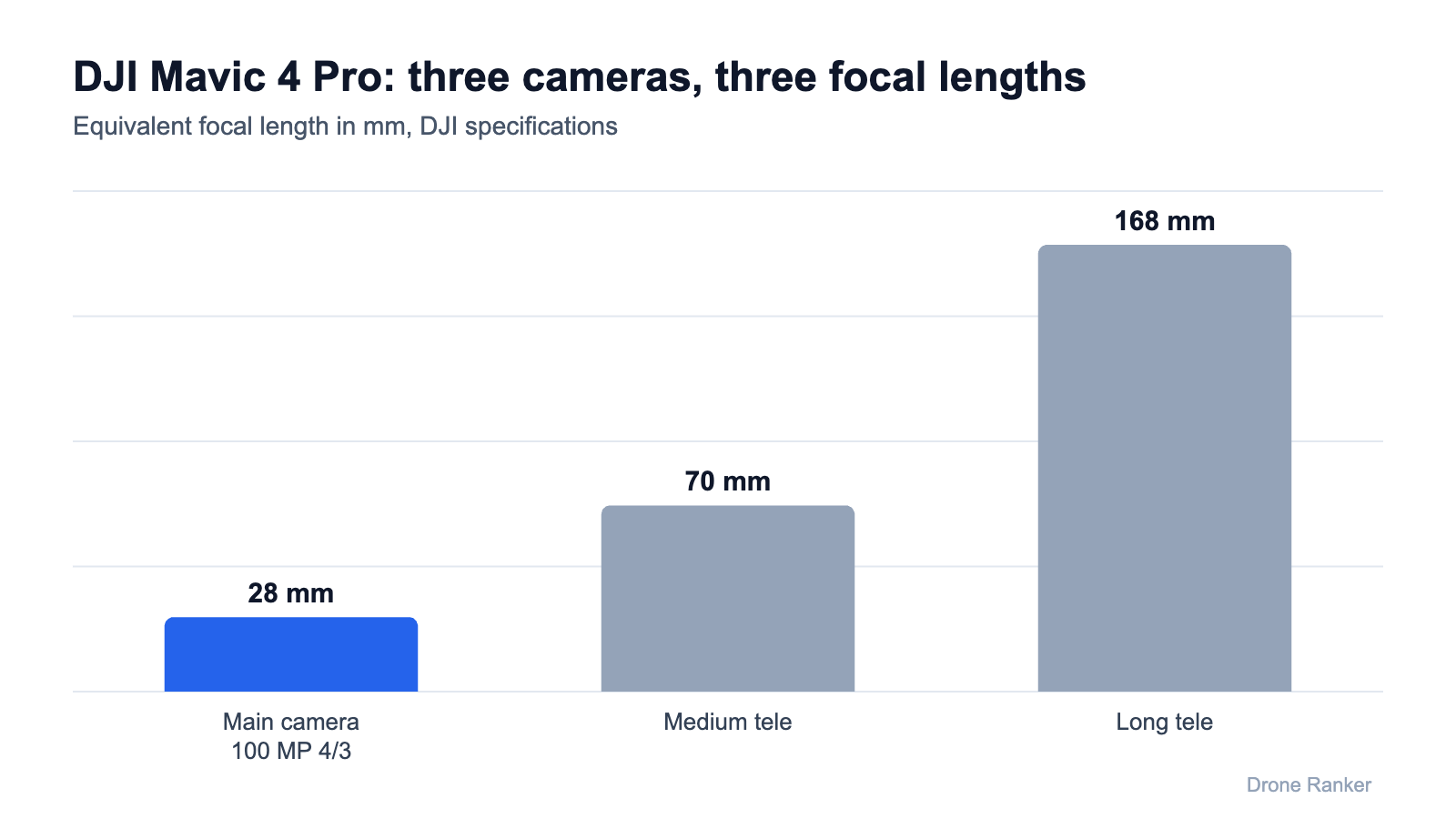
- Hasselblad main camera: 4/3 CMOS, 100 MP effective, 72° field of view (28 mm equivalent), variable aperture f/2.0 to f/11, so you can control depth of field and exposure without leaning only on ND filters.
- Medium tele: 1/1.3-inch CMOS, 48 MP, 70 mm equivalent, f/2.8.
- Tele: 1/1.5-inch CMOS, 50 MP, 168 mm equivalent, f/2.8.
Both tele cameras focus no closer than 3 meters. The main camera shoots 25 MP or 100 MP stills, with 100 MP images at 12288 × 8192. Shutter speeds run from 1/16000 to 16 seconds for 25 MP single shots (over 2 seconds is simulated long exposure) and 1/8000 to 8 seconds at 100 MP. ISO goes up to 12800 for normal video, 6400 in D-Log and HLG, and 3200 for 100 MP photos.
Video and bitrates
The main camera records 6K at 6016×3384 at 24, 25, 30, 48, 50 and 60 fps, plus DCI 4K (4096×2160) and 4K (3840×2160) at up to 120 fps for slow motion.
The standard model records H.265 at up to 180 Mbps or H.264 at 90 Mbps. The Creator Combo unlocks H.264 ALL-I at up to 1,200 Mbps with 10-bit 4:2:2 color on all three cameras. Files are MP4 on exFAT. ALL-I footage at that bitrate fills storage fast, so if you buy the Creator Combo for its codecs, plan for high-capacity storage and quick offloading.
Obstacle sensing
The Mavic 4 Pro uses omnidirectional binocular vision, plus forward-facing LiDAR and a downward infrared sensor.
| Direction | Measurement range | Detection range | Effective sensing speed |
|---|---|---|---|
| Forward | 0.5 – 24 m | 0.5 – 200 m | ≤ 18 m/s |
| Backward | 0.5 – 22 m | 0.5 – 200 m | ≤ 18 m/s |
| Lateral | 0.5 – 21 m | 0.5 – 200 m | ≤ 18 m/s |
| Upward | 0.5 – 18 m | N/A | ≤ 6 m/s |
| Downward | 0.5 – 17 m | N/A | ≤ 6 m/s |
The LiDAR is aimed at night flying, measuring 0.5 to 25 m on surfaces with more than 10% reflectivity. The downward infrared sensor covers 0.3 to 8 m. The 3-axis mechanical gimbal is rated at angular vibration as low as ±0.001° in a windless hover.
O4+ transmission
O4+ runs on 2.4 GHz, 5.1 GHz and 5.8 GHz with a 2T4R antenna setup (two transmitters, four receivers). DJI lists 30 km under FCC rules and 15 km under CE in an unobstructed, interference-free environment, though in practice the limit is the 41 km maximum flight distance and local law. Latency is as low as about 130 ms with the DJI RC 2 or RC Pro 2.
DJI’s own estimates show how much the environment matters:
- Strong interference (urban areas): about 1.5 – 6 km
- Medium interference (suburban): about 6 – 15 km
- Low interference (open suburb or seaside): about 15 – 30 km
- Low interference but obstructed: 0 to 0.7 km behind buildings, 0.7 – 4.5 km behind trees
Downloads run at up to 10 MB/s over O4+, or up to 80 MB/s over Wi-Fi 6 from internal storage.
Battery, charging and storage
The battery is a 6,654 mAh Li-ion 4S pack rated at 95.3 Wh and weighing about 332 g. That is under the 100 Wh limit most airlines allow in carry-on baggage.
With the DJI Mavic 240W Power Adapter and the Charging Hub, one battery charges from 0% to 100% in about 51 minutes, and three charge in sequence in about 90 minutes on 200V-240V input or 110 minutes on 100V-127V. The hub can also charge three in parallel with the 240W adapter. The DJI 100W USB-C adapter takes about 80 minutes per battery.
The standard model has 64 GB of internal storage (about 42 GB usable); the Creator Combo has 512 GB (about 460 GB usable). For microSD, DJI recommends:
- Lexar Silver Plus Series (64GB to 1TB, A2 V30 microSDXC)
- Kingston CANVAS GO! Plus Series (64GB to 512GB, A2 V30 microSDXC)
For 1,200 Mbps ALL-I recording, use an A2 V30 card to avoid dropped frames and corruption.
Who should buy it
- Buy it if you sell aerial photos or video and need optical telephoto, 100 MP stills or 10-bit 4:2:2 ALL-I video, and you are comfortable with C2/A2 rules in Europe.
- Buy it if long flights matter: 51 rated minutes, and the battery still goes in cabin baggage.
- Skip it if you mainly travel or fly for fun. Weight, price and paperwork all point to a smaller drone.
- Skip it if you own a Mavic 3 Pro and rarely use its telephoto cameras. The main gains are the 100 MP sensor, the longer tele and LiDAR-assisted night sensing; see Mavic 3 Pro vs Mavic 4 Pro.
| Mavic 4 Pro | Air 3S | Mini 5 Pro | |
|---|---|---|---|
| Weight | 1,063 g (EU C2) | Under 900 g (EU C1) | Under 250 g (EU C0) |
| Main sensor | 4/3, 100 MP, f/2.0–f/11 | 1-inch | 1-inch, 50 MP, f/1.8 |
| Optical tele | 70 mm and 168 mm | 70 mm | None |
| Rated flight time | 51 min | See review | 36 min (standard battery) |
| Best for | Professional photo and video | Enthusiasts who want a tele lens | Travel and lightweight flying |
More detail: Mavic 4 Pro weight and size, DJI Air 3S review, DJI Mini 5 Pro review and Mavic 3 Pro vs Mavic 3 Pro Cine vs Mavic 4 Pro.
The Friday Brief
One email a week on what changed in drones
FCC and FAA rule changes, DJI leaks checked against filings, and the week’s new comparisons. Every Friday, nothing else.
Free. Unsubscribe in one click. Sent with Kit; see our privacy policy.
Follow us on Google too: add Drone Ranker as a preferred source →
Continue Reading
All News