Will DJI Drone Prices Rise? The 25% US Drone Tariff, Now in Effect

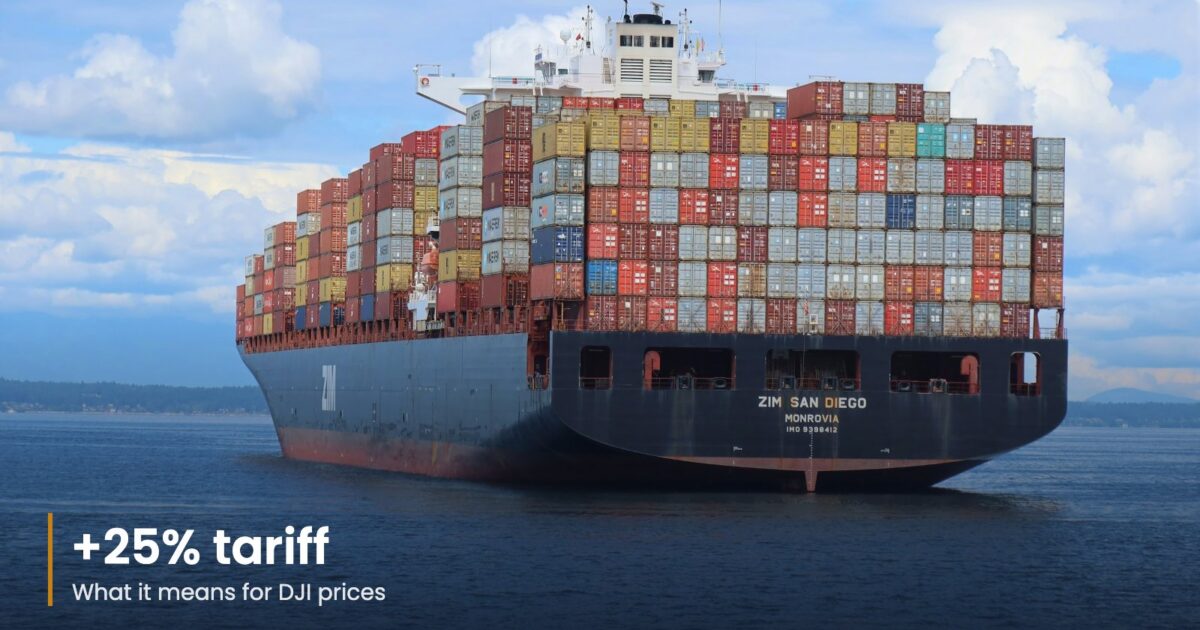
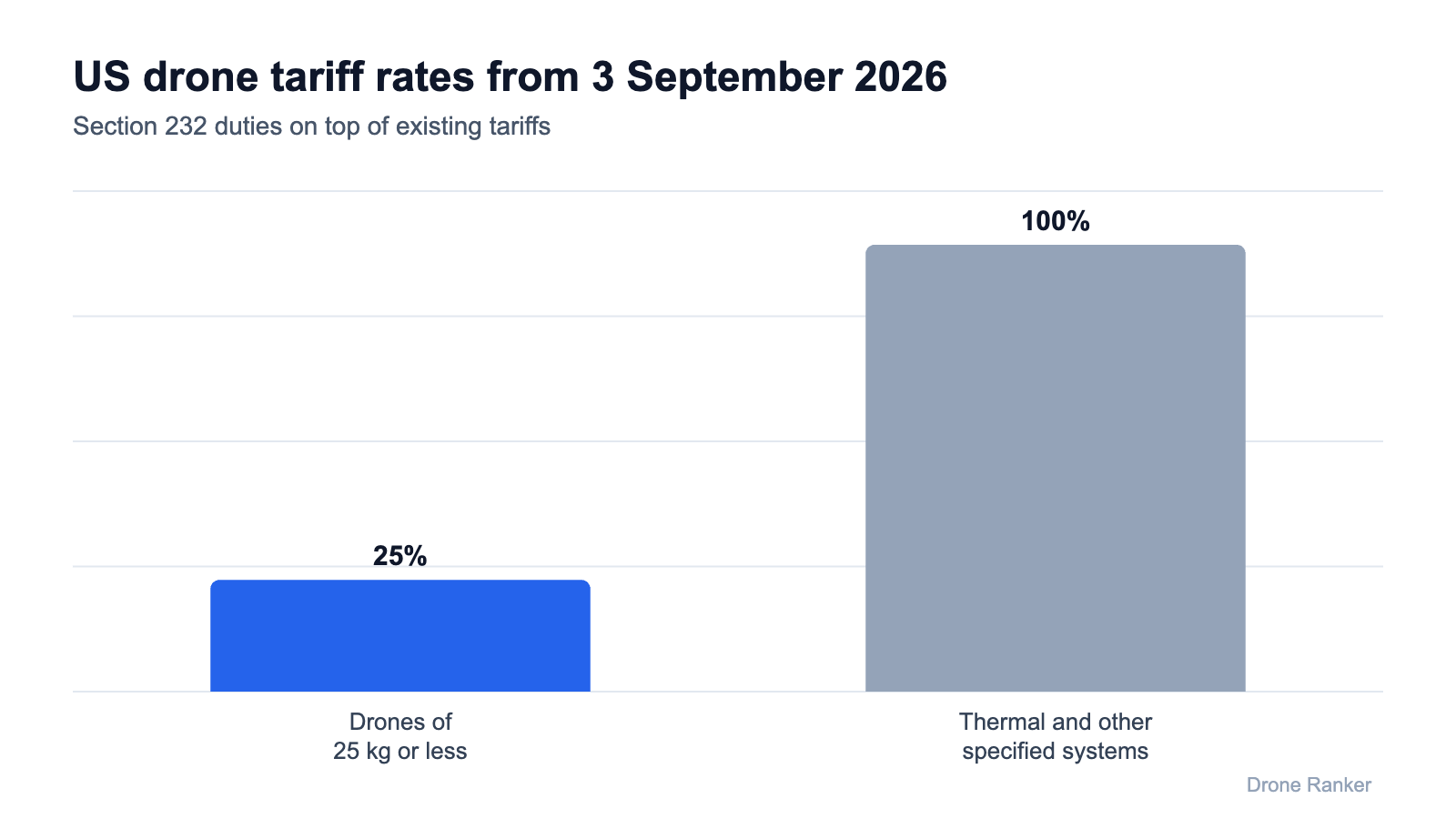
DJI drone prices are now exposed to a new US tariff. On August 13, 2026, the US government announced tariffs on imported drones and drone components. Covered imported drones weighing 25 kg or less face a 25% ad valorem tariff, and some heavier, thermal-equipped and other specified systems face up to 100%. The main drone tariffs take effect at 12:01 a.m. Eastern Time on September 3, 2026.
Update, 22 October 2026: the tariffs took effect on 3 September as scheduled. Drones of 25 kg or less now carry a 25% duty, and thermal and other specified systems up to 100%. Stock imported before that date can still be sold without the new duty, so shelf prices are changing model by model rather than all at once.
That does not mean a DJI Mini on the shelf at Best Buy, Amazon or DJI’s own store becomes 25% more expensive. The tariff is charged on the imported product; it does not set the store price. Manufacturers, importers and retailers can absorb part of the cost, trim margins, change distribution or raise prices by different amounts. What the rule does create is a real chance of higher costs, tighter supply or both for drones entering the US after the start date.
Table of Contents
The three tariff tiers
The action was taken under Section 232 of the Trade Expansion Act, after a Commerce Department investigation into US reliance on imported drones and their components.
| Rate | What it covers | Starts |
|---|---|---|
| 100% | Drones with maximum takeoff weight above 25 kg, drones integrating thermal imagers, covered docking stations and certain critical components | September 3, 2026 |
| 25% | Covered imported drones with maximum takeoff weight of 25 kg or less, unless another provision gives a lower rate | September 3, 2026 |
| 25% | Drone components listed in Annex III | February 9, 2027 |
The 25% tier is the one that touches consumer camera drones. A Mini-series drone of around 250 grams and an Air-series drone well under 1 kg sit far below the 25 kg line. The final treatment of any product still depends on its customs classification, its origin and the details of the proclamation, not on its marketing name.
Why prices did not all move on September 3
The tariff applies to goods entered for consumption or withdrawn from warehouse for consumption from the start date. A drone already imported before then is not the same as a new shipment arriving after it. Retailers may hold weeks of stock bought at the old landed cost, under existing distributor agreements. As that sells through, new shipments arrive with a different cost structure, so the effect is likely to be gradual.
That can produce an odd market for a while. A store that imported plenty of Mini 5 Pro, Air 3S or Mavic stock before the deadline has no reason to reprice on September 3, while another that has already restocked with tariff-affected units may charge noticeably more for the same drone.

Will a $1,000 drone become $1,250?
Not automatically. Take a simplified example: an importer brings in a covered drone with a customs value of $800. The tariff is $800 × 25% = $200. That still does not mean a drone selling at $1,000 must now sell for $1,200. Retail prices also carry the manufacturer’s wholesale price, importer, distributor and retailer margins, freight, warehousing, promotions, currency moves, stock age and competition. A manufacturer could absorb some of the cost, a distributor could cut its margin, a retailer could hold the price but drop discounts. Or the whole cost, and possibly more, could eventually reach the buyer.
For the Mini line, the first signs are more likely to be fewer discounts, less frequent Fly More Combo promotions, patchier retailer stock, changed bundle contents and higher prices on newly imported units, rather than an overnight MSRP change.
It is not a DJI tariff
The proclamation defines categories of imported drones and components; it does not single out a brand. The duty on a given product depends on its classification, capabilities and country of origin. That pulls in Potensic, HOVERAir, Autel and many smaller makers as well.
It also undercuts the reaction many buyers have had to DJI’s US regulatory problems: “I’ll just buy another Chinese drone brand.” A Potensic or HOVERAir drone does not escape an import tariff because it doesn’t say DJI on the shell. The questions that decide it are where the product legally originates, which tariff category applies, whether a lower rate is available and when the stock was imported.
Lower rates for some trade partners
For qualifying products from the European Union, Japan, South Korea, Taiwan, Switzerland and Liechtenstein, the total rate can be capped at 15%. Qualifying UK products get a rate no higher than 10%. These rates are conditional: substantially all critical components and technology must meet origin requirements, and Commerce sets the process for deciding eligibility. Assembling a drone in one of those countries may not be enough on its own, which could eventually shift where companies build and source parts.
Components in 2027, and an onshoring escape hatch
The 25% tariff on Annex III components starts on February 9, 2027. The White House says the delay is meant to give time for more domestic production and supply-chain adjustment. That later date may hit replacement parts, batteries and electronics, repair costs and US-assembled drones that use foreign parts, so the consumer effect could keep developing well after September.
Commerce is also directed to set up an onshoring program. Companies building or expanding US production can submit plans; if approved, they may import certain covered products and supply-chain equipment without the Section 232 duties, in volumes tied to their planned US capacity. The point of the policy is not only to make imports dearer but to give manufacturers a financial reason to build in the United States. Whether the big consumer-drone makers take that route is an open question.
Enterprise and thermal drones take the bigger hit
The 100% tier is where the tariff gets severe: enterprise thermal drones, public-safety aircraft, industrial inspection platforms, some agricultural systems and docking setups. For fleet operators, doubling the duty on a covered system affects replacement aircraft, spares, fleet growth, service contracts and parts supply, not only the first purchase. Consumer buyers are looking at a few hundred dollars; enterprise buyers could face much larger procurement bills.
A tariff is not a ban
The tariff is about the cost of importing a covered product: you can bring it in, but you pay an extra duty. The FCC proceedings are about whether certain foreign-produced equipment can get or keep the authorization needed to be imported and marketed at all. The two can overlap, so US buyers now have to watch both price policy and availability policy. Our DJI ban and FCC 2026 analysis covers the regulatory side.
The Air 3S shows how the two meet. It is far below 25 kg, but its forward-facing LiDAR is relevant to a separate FCC discussion. Future models such as the DJI Air 4 and Mini 6 Pro face both questions: can they get the approvals to reach the US, and if so, what duty applies? We covered the first in our DJI Air 4 and Mini 6 Pro US availability analysis. Even if a new DJI drone clears the regulatory hurdles, its US price could differ substantially from Europe or Asia because of import duties.
DJI drone prices: should you buy now, or wait?
Don’t panic-buy, but watch prices if you were already planning a purchase. Pre-tariff stock is the cheapest you are likely to see; if you were going to buy in the next month anyway, buying before tariff-affected stock reaches retailers could protect you from later price pressure. On the other hand, existing US stock may last past September 3, makers or retailers may absorb some of the cost, products will not all react the same way, and promotions can offset part of a rise.
I would not buy a $1,000 drone you don’t need because someone said everything goes up 25% on September 3. But if you have already settled on a model and find a strong pre-tariff deal, waiting in the hope that the same deal will still be there adds risk for no clear gain.
The used market could go either way. If new drones get pricier, harder to find or less often discounted, used Mini 4 Pro, Mini 5 Pro, Air 3S and Mavic-series aircraft become more attractive and resale prices could firm up. If buyers worry about long-term support or US availability, they may pay less for used DJI hardware. Expect more volatility rather than a simple rise.
There is no basis yet to assume DJI must raise consumer prices before the tariff starts. The proclamation sets duties; it does not order anyone to change an MSRP. Until US retail prices actually move, claims about a specific new DJI price are speculation.
What to watch in the coming weeks
- Official DJI US pricing. Real changes, not rumor screenshots.
- Retailer stock. Models repeatedly going out of stock would point to supply pressure.
- Fly More Combo pricing. Bundles are the easiest place to cut value quietly without touching the headline price.
- September 3. The main effective date for the covered drone tariffs.
- FCC developments. Import cost means little if a future model cannot reach the market at all.
Last updated: August 17, 2026. Retail prices and availability may change as manufacturers, importers and retailers respond to the tariffs.
The Friday Brief
One email a week on what changed in drones
FCC and FAA rule changes, DJI leaks checked against filings, and the week’s new comparisons. Every Friday, nothing else.
Free. Unsubscribe in one click. Sent with Kit; see our privacy policy.
Follow us on Google too: add Drone Ranker as a preferred source →
Continue Reading
All News