Will DJI Fly Stop Working on Android? What Changed on 30 September 2026

Update, 22 October 2026: for DJI Fly Android users, the 30 September enforcement phase has started in Brazil, Indonesia, Singapore and Thailand. Outside those four countries nothing changed on that date, and we have not seen reports of installed copies of DJI Fly being blocked. The wider rollout is still scheduled for 2027.
No. As of August 17, 2026, there is no announced September 30 shutdown of DJI Fly on Android. Google’s new Android developer-verification system does start enforcement on September 30, 2026, but only for users in Brazil, Indonesia, Singapore and Thailand, and Google says it will expand globally in 2027 and beyond. Sideloading is not going away either.
DJI Fly gets caught up in this because of how DJI distributes it. DJI’s own Android instructions tell users to download the APK from DJI’s website and install it manually, and the company still offers the app through its official Download Center. Headlines saying DJI Fly will stop working worldwide on September 30 are misleading.
Table of Contents
What changed for DJI Fly Android users on September 30
Google is introducing Android developer verification. Apps installed on certified Android devices will increasingly need to be tied to a verified developer. Developers who distribute outside Google Play can use Google’s new Android Developer Console to:
- create a developer account;
- verify their identity;
- register their app package names;
- prove ownership with the APK signing key.
Once registered, they can distribute through channels of their choice, including their own websites. The initial participating stores include Google Play and stores run by Samsung, Xiaomi, OPPO, vivo, Honor and Transsion.
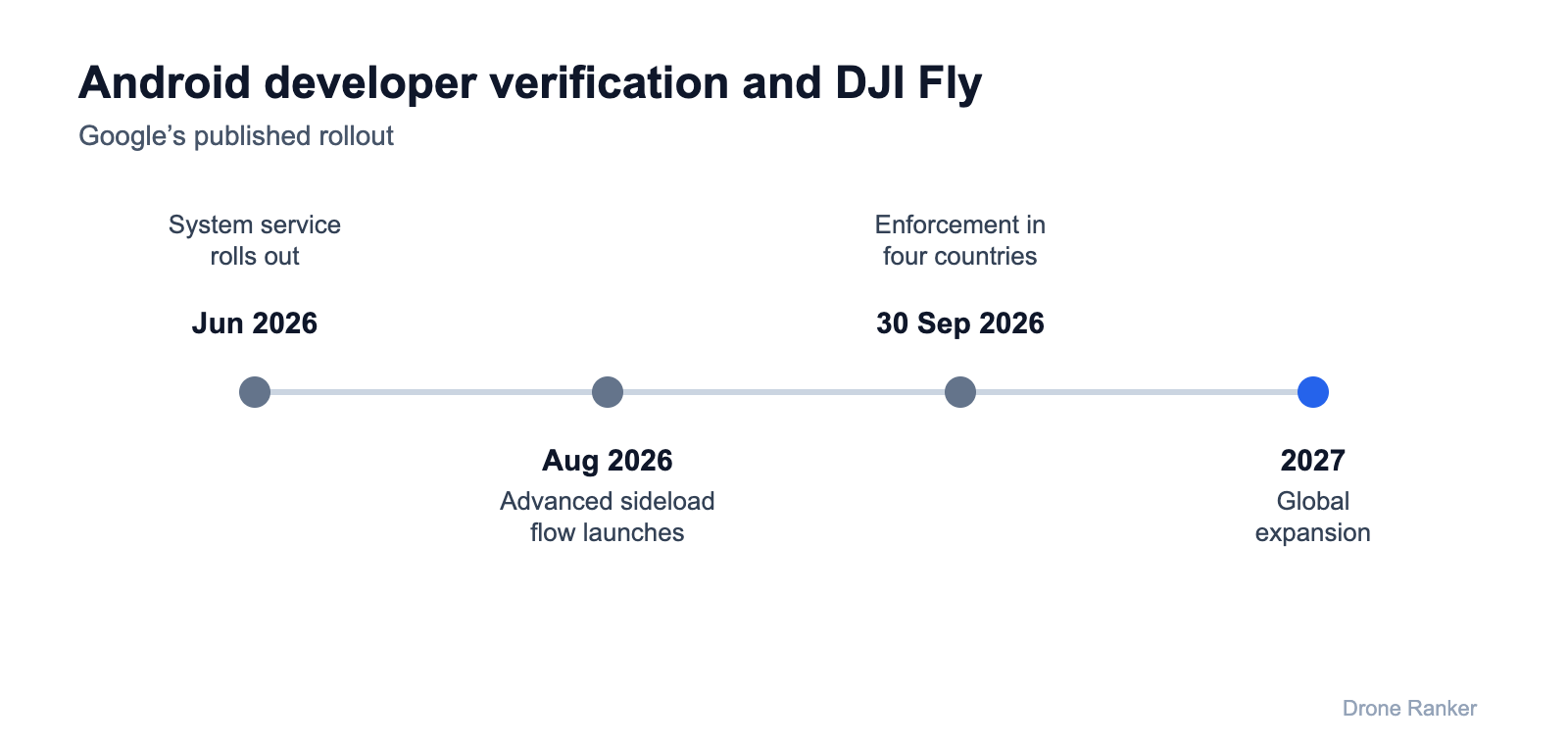
| Date | What changes |
|---|---|
| June 2026 | Google begins rolling out the system service used for developer verification |
| August 2026 | Advanced sideload flow launches globally for power users |
| September 30, 2026 | Initial enforcement in Brazil, Indonesia, Singapore and Thailand |
| 2027 onward | Verification requirements expand globally |
The United States, the UK, the rest of Europe, Canada, Australia, Türkiye and most other markets are not part of the September 30 phase.
Will installed copies stop working?
Nothing published says so. Google’s documentation is about whether apps can be installed and updated on certified devices under the new framework. It does not announce a remote shutdown of apps people already have, it does not say DJI drones will stop connecting to Android phones, and it does not single out DJI Fly. That could change if DJI or Google publishes something new, but it is not in the official sources I reviewed.
Updates are the more realistic concern. Once the system is enforced in a region, developer registration could decide whether DJI Fly updates install smoothly. Google says apps from fully verified developers should install essentially as normal; an unregistered app may need ADB or the advanced flow.
Has DJI registered DJI Fly?
As of August 17, I found no DJI announcement on how it will handle DJI Fly under the new program, so nobody should claim it has registered. Google’s console is built for exactly the way DJI distributes the app, though, and DJI is a large commercial developer, not an anonymous hobbyist. It is too early to assume regular users will ever need a workaround, and the real question for the next few months is simply whether DJI completes verification before the 2027 expansion. If it does, most owners won’t notice. If it doesn’t, installing could take extra steps once verification reaches more regions.
Sideloading is not being banned
This is the biggest misconception. Google’s documentation says plainly: “Your apps can still be sideloaded.” Apps from unverified developers can still be installed through:
- Android Debug Bridge (ADB), whose workflow stays unchanged;
- Google’s new advanced flow, aimed at power users who understand the risks of installing from an unverified developer. It adds extra warnings and safeguards meant to make it harder for scammers to pressure people into installing malicious apps.
Unverified does not mean impossible to install. It may just mean more steps.
This is not part of the DJI ban
Developer verification applies to Android developers broadly and is meant to connect apps with real, verified publishers. It is not a US government action, and Google has not put DJI on a blacklist. The Pentagon blacklist, FCC restrictions, US drone tariffs and Android verification are different issues run by different organizations under different rules. Don’t add this one to the list of things people call a “DJI ban“.
For American owners, September 30 is not the Android deadline to worry about, though the 2027 global expansion is worth following.
DJI RC 2 and iPhone users
Google’s announcement does not say screen controllers such as the DJI RC 2 will stop working on September 30. Its rules cover installing Android apps on certified Android devices, and DJI’s controllers are a different setup from DJI Fly on a phone. Unless DJI publishes a controller-specific notice, there is no reason to treat the date as an RC shutdown.
The change does not apply to iOS at all. If you run DJI Fly on an iPhone, this policy doesn’t affect how you install it.
What to do now
- If DJI Fly works, keep using it. Don’t uninstall a working app because of a viral headline.
- Install or update only from DJI’s official website. DJI’s own troubleshooting advice points Android users there for the latest APK.
- In Brazil, Indonesia, Singapore or Thailand, watch for DJI or Google guidance as September 30 approaches.
The one real risk here is self-inflicted. Confusion around the date is an opening for sites offering a “DJI Fly APK working September 2026” download, and third-party APK mirrors can serve modified or outdated builds, malicious code, broken signatures, fake update pages or bundled extras. If your phone warns you about an APK, first confirm the file really came from DJI. Don’t answer a security warning by fetching the same app from a less trustworthy source.
Last updated August 17, 2026. We will update this article if DJI publishes Android verification guidance or Google changes the rollout.
DJI drones still sold in the US
DJI Mini 4 Pro (RC-N2)
Under 249 g, omnidirectional sensing without LiDAR, still in DJI’s US line-up.
151 g, 4K/60 and omnidirectional sensing. The current Neo you can buy in the US.
DJI Air 3S (RC-N3)
1-inch main camera plus a 70 mm tele, up to 45 min. One of the models the FCC LiDAR proposal could reach.
As an Amazon Associate, Drone Ranker earns from qualifying purchases. We do not quote prices because Amazon’s change by the hour.
The Friday Brief
One email a week on what changed in drones
FCC and FAA rule changes, DJI leaks checked against filings, and the week’s new comparisons. Every Friday, nothing else.
Free. Unsubscribe in one click. Sent with Kit; see our privacy policy.
Follow us on Google too: add Drone Ranker as a preferred source →
Continue Reading
All News