DJI Lito X1: Forward LiDAR at 249 g, but Not for US Buyers

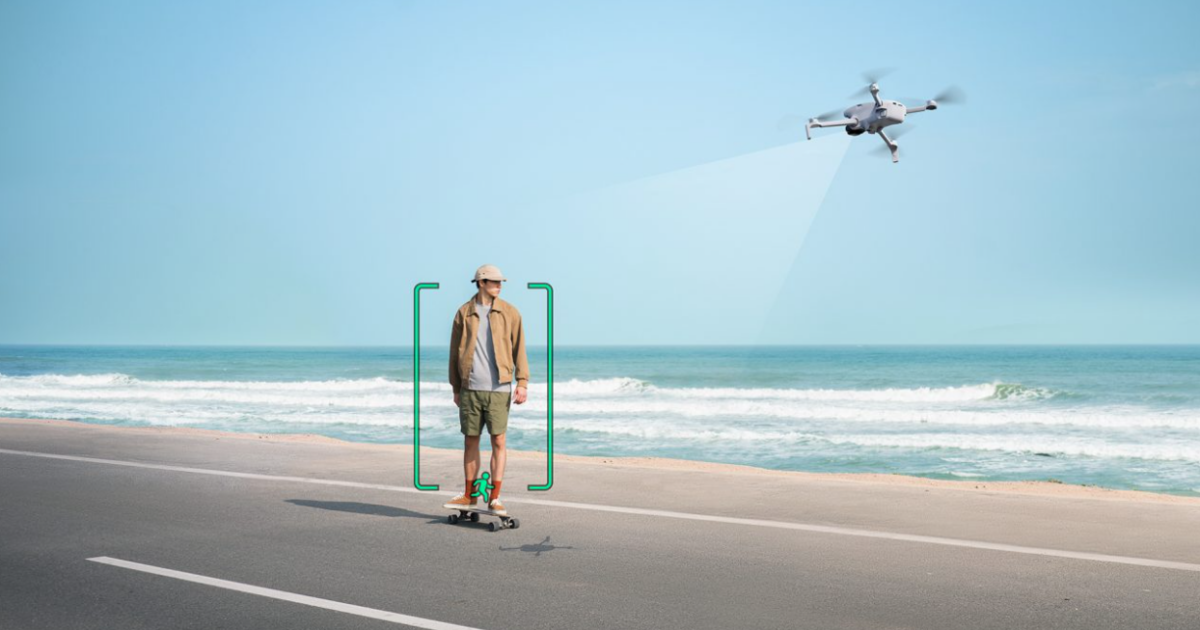
The DJI Lito X1 fits a 1/1.3-inch 48 MP sensor, O4 transmission and forward-facing LiDAR into a drone of about 249 g. That last item is unusual at this weight, and it is the main reason to look at the Lito X1 over an older Mini. DJI launched it on 23 April 2026 outside the United States, from €419; the cheaper Lito 1 starts at €339. There is no US launch.
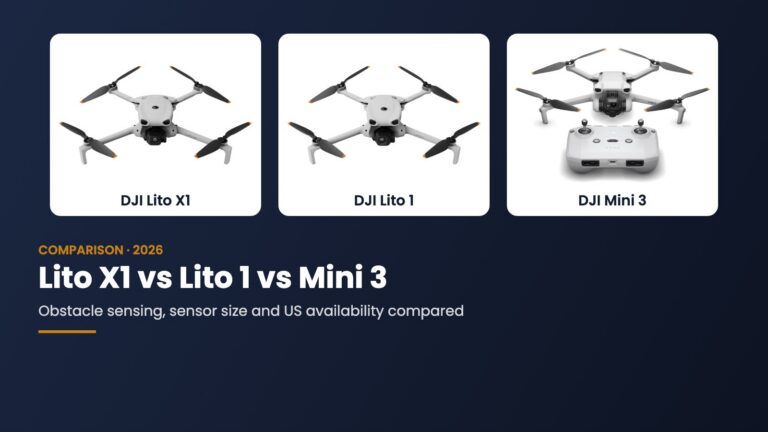
New, 13 October: how the Lito X1, Lito 1 and DJI Mini 3 compare on sensor, obstacle sensing and where you can buy them: Lito X1 vs Lito 1 vs Mini 3.
This analysis is based on DJI’s published specifications and owner reports, not on flight testing.
| Feature | DJI Lito X1 |
|---|---|
| Standard takeoff weight | Approx. 249 g |
| Max takeoff weight | Approx. 340 g |
| Image sensor | 1/1.3-inch CMOS, 48 MP, f/1.7 |
| Max video | 4K at up to 100 fps, 130 Mbps |
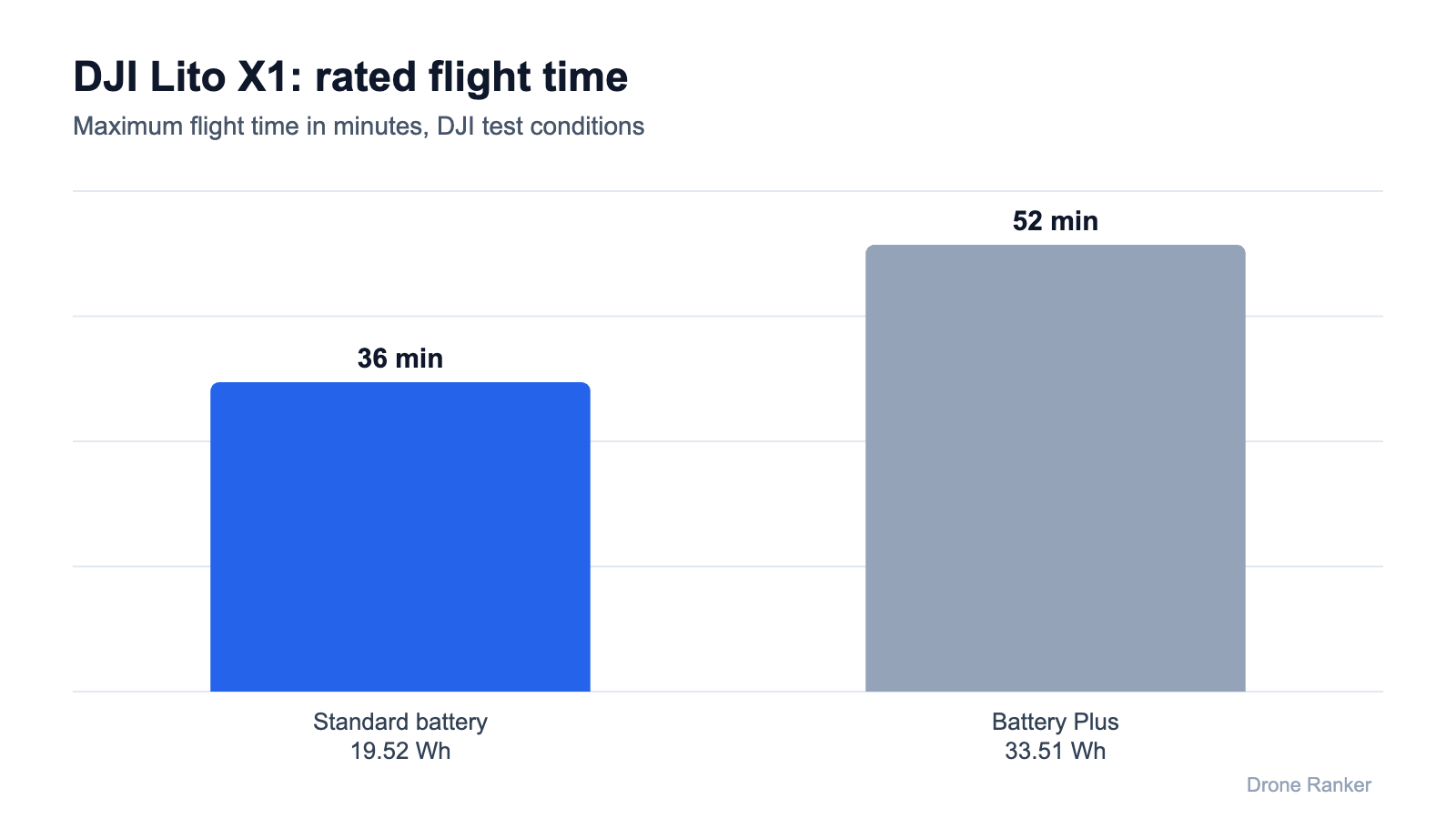
| Max flight time (standard / Plus) | 36 min / 52 min |
| Typical flight time (standard / Plus) | 23 min / 37 min |
| Transmission | O4, up to 1080p/60fps live feed |
| Max range (CE / FCC) | 8 km / 15 km |
| Obstacle sensing | Omnidirectional + forward LiDAR |
| Forward LiDAR range | 0.5-36 m (large obstacles) |
| Internal storage | 42 GB |
| Operating temperature | -10°C to 40°C (14°F to 104°F) |
Table of Contents
Weight and the C0 class
The 249 g standard takeoff weight is clearly aimed at the EU’s C0 class and the lighter categories elsewhere. Add propeller guards, an ND filter, a microSD card and the larger battery and the maximum takeoff weight reaches about 340 g.
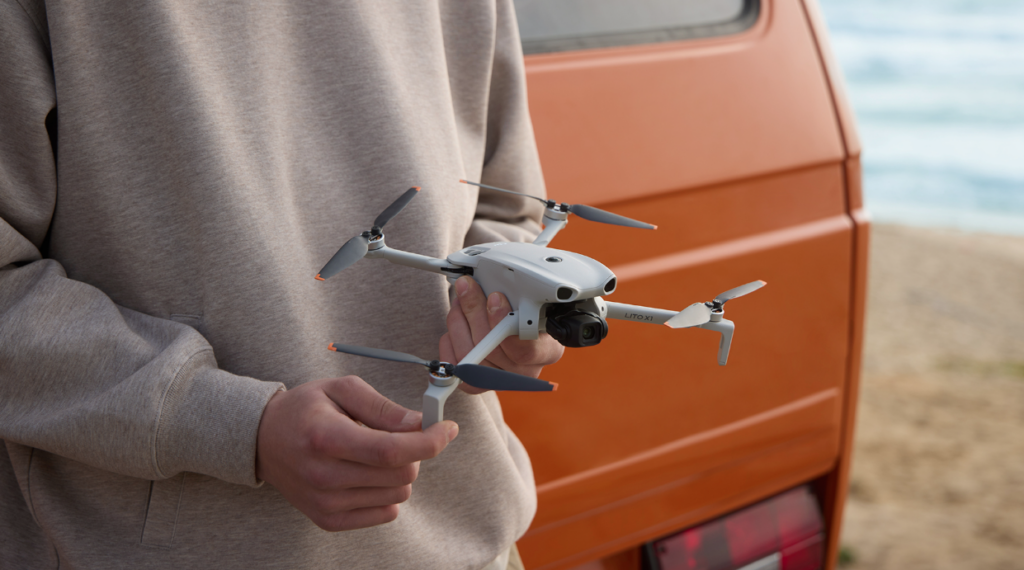
The Lito Series Intelligent Flight Battery Plus takes the drone over 249 g. In the EU and UK, DJI says that battery is approved only for the Lito X1 Fly More Combo Plus (DJI RC 2) aircraft. If you fly under C0 rules, stick to the standard battery. Our guide to EU and UK drone rules covers what the classes allow.
Folded without propellers it measures 144×94×62 mm; unfolded, 183×251×79 mm. Owners of drones this size often note they fit a backpack’s water-bottle pocket, and the Lito X1’s footprint suggests the same.
DJI Lito X1 battery and flight time
The standard battery is 2788 mAh (19.52 Wh); the Plus is 4680 mAh (33.51 Wh). DJI rates maximum flight time at 36 and 52 minutes, measured flying at 21.6 km/h in still air without recording. Its typical figures, measured while recording 4K/60fps in wind, flying maneuvers and returning home with reserve, are 23 and 37 minutes. Plan around the typical numbers. I’d also give DJI credit for publishing them so plainly.
With the DJI 65W Portable Charger and charging station, a standard battery charges in about 45 minutes and a Plus in about 56. Three standard batteries in sequence take about 87 minutes; three Plus batteries about 130.
DJI Lito X1 camera
The DJI Lito X1 uses a 1/1.3-inch CMOS sensor with 48 effective megapixels, the kind of sensor size usually found in pricier models, behind a 24mm-equivalent f/1.7 lens with an 82.1° field of view. The bright aperture allows lower ISO at golden hour and twilight, which means less noise.
Stills come in JPEG or DNG RAW up to 8064×6048. Modes include single shots at 12 or 48 MP, 12 MP bursts of 3 or 5 frames, 12 MP AEB at 2/3 EV steps (3 or 5 frames), and timed shots at 2 to 60 second intervals. Shutter speed runs from 1/16000 s to 2 s, long enough for simple long exposures.
Video
- 4K: 3840×2160 at 24/25/30/48/50/60/100 fps
- FHD: 1920×1080 at 24/25/30/48/50/60/100/200 fps
- 2.7K vertical: 1512×2688 at 24/25/30/48/50/60 fps
The 4K/100fps and FHD/200fps modes are for slow motion: 4K/100fps plays back at 25fps, so one second of capture becomes four. DJI notes that although capture is encoded at up to 130 Mbps, the playback file shows roughly a quarter of that because of the frame rate conversion in the MP4 container.
10-bit D-Log M (H.265) is the feature for editors. Standard 8-bit 4:2:0 footage, in H.264 or H.265 Normal mode, tends to band when graded hard; 10-bit D-Log M holds far more dynamic range. Digital zoom goes to 3x in 4K and 4x in FHD, with the usual loss of sharpness from cropping.
O4 transmission and speed
O4 runs on 2.4, 5.1 and 5.8 GHz and switches to the least congested band, with live view up to 1080p/60fps and latency as low as about 120 ms. Maximum range is 15 km under FCC rules and 8 km under CE. DJI also gives figures for real conditions:
- High interference (urban): about 1.5-3 km
- Medium interference (suburban): about 3-8 km
- Low interference (suburban/coastal): about 8-15 km
Wi-Fi 6 downloads reach up to 50 MB/s in low-interference lab conditions, against 10 MB/s over the standard O4 download. Sport mode tops out at 18 m/s (about 40 mph) with 7 m/s climb and descent on the standard battery; Normal mode at 12 m/s. Wind resistance is 10.7 m/s.
Obstacle sensing and the LiDAR
Most sub-250 g drones rely on vision sensors alone. The Lito X1 adds a forward LiDAR to a multi-directional monocular vision system and a downward infrared sensor.
- Forward: measurement 0.5-10 m, detection 0.5-20 m (effective at up to 12 m/s)
- Backward, lateral, upward: detection 0.5-15 m (effective at up to 8 m/s or 5 m/s depending on axis)
- Downward: detection 0.5-15 m
The LiDAR measures 0.5-36 m for larger obstacles (over 10% reflectivity), with an 80° vertical and 60° horizontal field of view. Because it ranges with laser pulses, it keeps working in low light where cameras struggle. The side and rear vision sensors still need more than 5 lux and visible texture, and owners regularly point out that vision sensors miss thin branches in dim light. So the protection is strongest going forward, which is also where you fly fastest.
How it compares with other DJI drones
Mini 3 and Mini 3 Pro. The Lito X1 shares a lot with them: the 1/1.3-inch sensor, f/1.7 aperture, 48 MP stills, vertical shooting and a two-battery approach where the Plus pack passes 40 minutes but breaks the C0 limit. It moves ahead on transmission (O4 against O2 on the Mini 3 and O3 on the Mini 3 Pro) and on sensing, since the Mini 3 Pro’s sensors cover only front, back and down and neither has LiDAR. See Lito X1 vs Mini 3, or check the DJI Mini 3 itself.
Mini 4 Pro. The closest match: O4, omnidirectional sensing, under 249 g at launch, and the same audience. The Lito X1’s edge on paper is the forward LiDAR, which should give faster and more reliable awareness at speed than the Mini 4 Pro’s purely optical system. See Lito X1 vs Mini 4 Pro.
Mini 5 Pro. The pick if image quality comes first, with a 1-inch 50 MP sensor at a much higher price. See Lito X1 vs Mini 5 Pro.
Air 3. Also O4 and omnidirectional sensing, but at 720 g with two cameras (24mm and 70mm), it is a different class of drone.
The Lito X1 also has 42 GB of internal storage, handy when you forget a card. If you are weighing non-DJI options, there is Lito X1 vs Potensic Atom 3.
Price and US availability
The Lito X1 starts at €419 in Europe. The Lito 1 starts at €339, with a 1/2-inch sensor and 4K/60fps, and without the X1’s 4K/100fps, 10-bit D-Log M, 42 GB storage and LiDAR. DJI has not released either in the US and has given no date. New DJI aircraft face the FCC’s December 2025 Covered List restrictions, so a US launch looks unlikely; our US drone ban checker tracks the status.
Which one should you buy?
- Lito X1 over the Mini 3: same sensor size, but O4 transmission and all-round sensing with forward LiDAR. See the full comparison.
- Mini 4 Pro over the Lito X1: if you are in the US, where the Mini 4 Pro is still sold and the Lito X1 is not. See our Mini 4 Pro analysis.
- Mini 5 Pro over the Lito X1: if image quality is the priority and the budget allows. See our Mini 5 Pro analysis.
- Still choosing? The best mini drones guide ranks the current sub-250 g DJI models.
Outside the US, the Lito X1 is the sub-250 g drone I’d point beginners and travelers to first. Forward LiDAR for safer low-light flying matters more to a new pilot than a bigger sensor, and the 1-inch Mini 5 Pro costs a lot more for an image upgrade many people won’t use.
The Friday Brief
One email a week on what changed in drones
FCC and FAA rule changes, DJI leaks checked against filings, and the week’s new comparisons. Every Friday, nothing else.
Free. Unsubscribe in one click. Sent with Kit; see our privacy policy.
Follow us on Google too: add Drone Ranker as a preferred source →
Continue Reading
All News