DJI Lito X1 vs DJI Mini 5 Pro
Buy the DJI Mini 5 Pro if image quality and low light are what you care about: its 1-inch 50 MP sensor, 4K/120fps, True Vertical Shooting and stronger O4+ link put it a generation ahead of the Lito X1. Buy the Lito X1 if you…
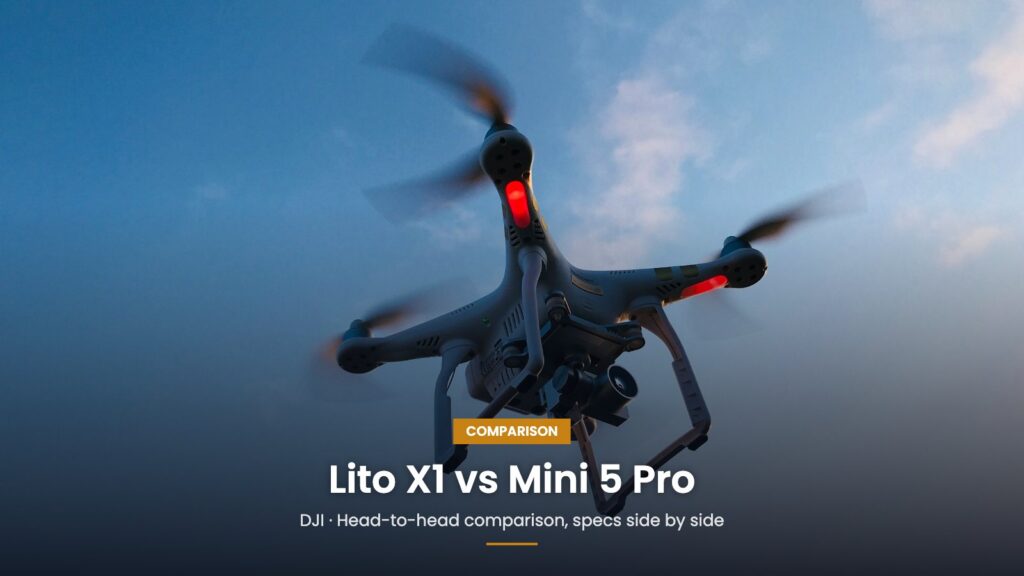
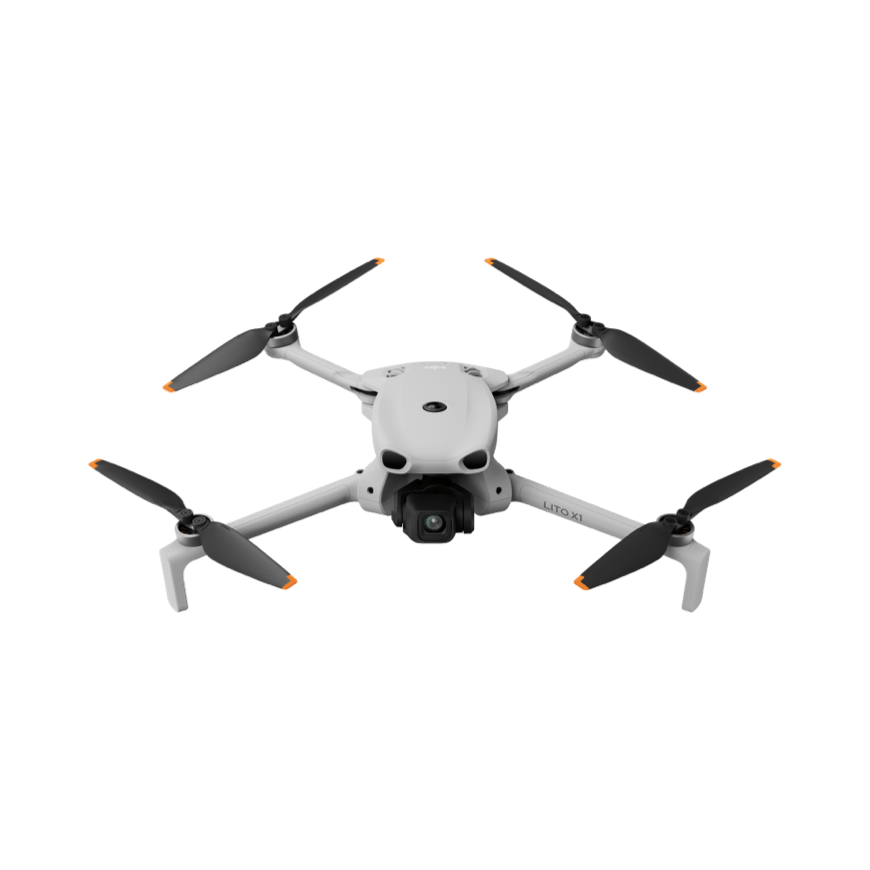
DJI Lito X1
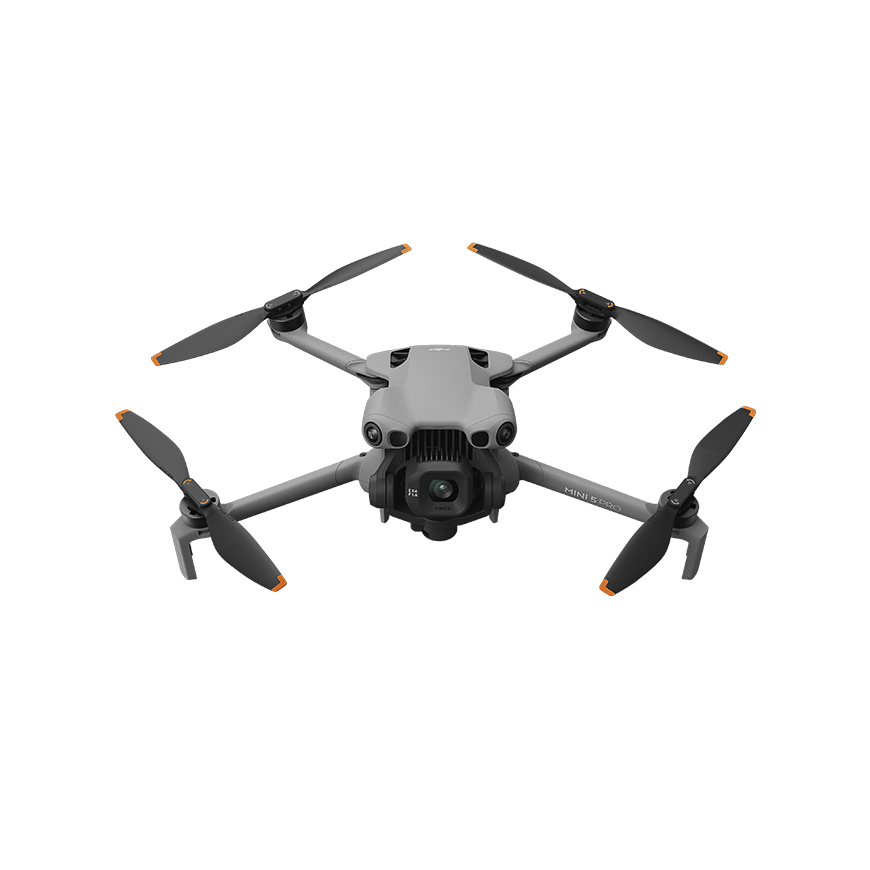
DJI Mini 5 Pro
Technical Specifications
Last updated: Oct 2026| Feature | DJI Lito X1 | DJI Mini 5 Pro |
|---|---|---|
| Weight | Under 249 g with standard battery; Plus battery raises takeoff weight above 249 g | 249 g with standard configuration; Plus configuration raises weight and can change EU class |
| Dimensions | Not used as a confirmed headline metric in this update | Compact palm-sized foldable Mini-class airframe |
| Volume | Not calculated because a matching current global dimension table was not used | Not used as a headline comparison metric |
| Max Speed | Not used as a confirmed headline metric in this update | Not used as a headline comparison metric in this update |
| Max Flight Distance | Not used as a headline metric; battery endurance and transmission are reported separately | Not used as a headline metric; battery endurance and transmission are reported separately |
| Sensor Size | 1/1.3-inch CMOS | 1-inch CMOS |
| Megapixels | 48 MP | 50 MP |
| Max ISO | Mode-dependent; not used as a headline comparison metric | Mode-dependent; not used as a headline comparison metric |
| Flight Time | 36 minutes standard; 52 minutes Plus (manufacturer-stated) | 36 minutes standard; 52 minutes Plus (manufacturer-stated) |
| Max Resolution | 4K/60fps HDR; 4K/100fps slow motion | 4K/60fps HDR; 4K/120fps slow motion |
| Movie Bitrate | Not used as a confirmed headline metric in this update | High-bitrate 10-bit creator workflow; exact bitrate not required to decide this comparison |
| Field of View | Not used as a confirmed headline metric in this update | Wide-angle main camera with 225° flexible gimbal rotation |
| Transmission Range | DJI O4: up to 15 km under IC standard; 8 km CE/SRRC/MIC | DJI O4+: 20 km FCC; 10 km CE/SRRC/MIC |
| Wind Resistance | Not used as a confirmed headline metric in this update | Designed for advanced outdoor Mini-class operation; exact wind figure is not used as a headline winner here |
| Obstacle Avoidance | Omnidirectional vision sensing with forward-facing LiDAR | Nightscape omnidirectional obstacle sensing with forward-facing LiDAR and multiple vision sensors |
| Battery Power | 2788 mAh, 19.52 Wh standard; 4680 mAh, 33.51 Wh Plus | 2788 mAh, 19.52 Wh standard; 4680 mAh, 33.51 Wh Plus |
| Charge Time | Approx. 45 minutes for one standard battery or 56 minutes for one Plus battery in the charging hub with DJI 65W Portable Charger | Approx. 46 minutes for standard battery in charging hub with supported 65W charger |
| Internal Storage | 42 GB | 42 GB plus microSD expansion |
| GPS | Yes | Yes |
| Obstacle Detection | Yes, omnidirectional vision sensing with forward-facing LiDAR | Yes, Nightscape omnidirectional sensing with forward-facing LiDAR |
| Return to Home | Yes, including route-memory assistance under supported conditions | Yes, next-generation Smart RTH with route-memory support under suitable conditions |
| Removable Battery | Yes | Yes |
| Shoots RAW | Yes | Yes |
| HDR Mode | Yes, 4K/60fps HDR | Yes, 4K/60fps HDR |
| Weather Sealed | No official IP rating used in this comparison | No official IP rating; not waterproof |
| Best For | First-time buyers who want good tracking, solid sensing and built-in storage | Travel filmmakers and low-light shooters who want the best Mini-class camera |
| Product Status | Officially released and sold by DJI | Officially released and sold by DJI |
| DJI Product Positioning | Entry-Level – Beginner-Friendly Premium Camera Drone | Advanced – All-In-One 1-Inch Large CMOS Mini Camera Drone |
| Camera Generation | 1/1.3-inch premium beginner camera platform | 1-inch advanced Mini camera platform |
| Camera Sensor | 1/1.3-inch CMOS | 1-inch CMOS |
| Maximum Photo Resolution | 48 MP | 50 MP |
| Lens Aperture | f/1.7 | f/1.8 |
| HDR Video | 4K/60fps HDR | 4K/60fps HDR |
| Maximum 4K Slow Motion | 4K/100fps | 4K/120fps |
| Dynamic Range | DJI states up to 14 stops in supported recording | Advanced 1-inch imaging platform; exact stop figure is not required to establish the sensor-generation advantage |
| D-Log M | 10-bit D-Log M | 10-bit creator workflow with D-Log M support |
| True Vertical Shooting | Not a headline confirmed feature in current Lito X1 global marketing | Yes |
| Gimbal Flexibility | Conventional compact camera-drone gimbal workflow | 225° roll rotation plus True Vertical Shooting |
| Obstacle Sensing | Omnidirectional vision + forward-facing LiDAR | Nightscape omnidirectional vision + forward-facing LiDAR |
| Tracking | ActiveTrack | Upgraded ActiveTrack 360° |
| Standard Flight Time | 36 minutes | 36 minutes |
| Plus Flight Time | 52 minutes | 52 minutes |
| Standard Battery Capacity | 2788 mAh, 19.52 Wh | 2788 mAh, 19.52 Wh |
| Plus Battery Capacity | 4680 mAh, 33.51 Wh | 4680 mAh, 33.51 Wh |
| Transmission System | DJI O4 | DJI O4+ |
| Headline Transmission | 15 km under IC standard | 20 km under FCC standard |
| CE Transmission Range | 8 km | 10 km |
| Internal Storage | 42 GB | 42 GB |
| EU Standard Configuration | Under 249 g; regional rules still apply | C0-certified standard configuration |
| Plus Configuration Status | Raises weight above 249 g; regional availability/rules apply | Raises weight and can move EU configuration to C1 |
Two DJI tiers, both on sale
Both drones are released and listed on official regional DJI Store pages, so this is no longer a rumor-versus-product comparison. Prices and bundles vary a lot by region, which is why no single price appears here. Check the US drone ban checker if you are buying in the US.
The sensor is the main difference
The Lito X1 uses a 1/1.3-inch 48 MP sensor at f/1.7. DJI lists 4K/60fps HDR, 4K/100fps slow motion, up to 14 stops of dynamic range and 10-bit D-Log M. That's a capable camera for an entry-tier drone.
The Mini 5 Pro steps up to a 1-inch 50 MP sensor at f/1.8 and raises slow motion to 4K/120fps. The extra frame rate helps with action footage, but the sensor size is the real change, and it is the reason the Mini 5 Pro sits in DJI's Advanced range rather than being a faster Lito X1.
Vertical video and gimbal movement
The Mini 5 Pro adds True Vertical Shooting and 225° gimbal roll, which DJI uses for rotating and angled camera moves. The Lito X1's marketing focuses on easy cinematic smart modes and doesn't present an equivalent feature. For creators who post mostly in portrait, the Mini 5 Pro is the safer pick.
Sensing and tracking: LiDAR on both, Nightscape on the Mini 5 Pro
The Lito X1 pairs omnidirectional vision sensing with a forward LiDAR, which is far beyond basic entry-level sensing. The Mini 5 Pro also has forward LiDAR but combines it with multiple vision sensors in DJI's Nightscape omnidirectional system, giving it the stronger low-light sensing on paper. Neither is collision-proof: transparent or reflective surfaces, wires, thin branches and moving objects can still be missed.
On tracking, the Lito X1 has ActiveTrack to reduce the piloting and camera work when following a subject. The Mini 5 Pro has ActiveTrack 360°, which DJI says can recognize sports scenarios and pick suitable tracking behavior automatically.
Same flight time, same battery capacities
DJI rates both at 36 minutes with the standard battery and 52 with the Plus. Its battery documentation lists the same capacities for both: 2788 mAh (19.52 Wh) standard and 4680 mAh (33.51 Wh) Plus. Matching numbers don't prove the batteries are interchangeable, so rely on DJI's official compatibility list before buying spares for both. Either drone's Plus battery can change its weight class; the registration-by-weight guide explains what that means.
Range: compare CE with CE
The Lito X1 uses O4 and is marketed at 15 km under the IC standard and 8 km under CE, SRRC and MIC. The Mini 5 Pro uses O4+ at 20 km FCC and 10 km CE, SRRC and MIC. Because the headline figures come from different standards (IC against FCC), the cleaner comparison is CE to CE: 8 km against 10 km.
Storage is a tie too
Both have 42 GB of internal storage, which is unusual for an entry-tier model like the Lito X1. The Mini 5 Pro also takes microSD cards for bigger shoots. More detail is in the Lito X1 specs analysis and the Mini 5 Pro analysis.
DJI Lito X1
Strengths
- 1/1.3-inch 48 MP sensor with f/1.7 lens
- Omnidirectional vision plus forward LiDAR
- 36 minutes standard, 52 with the Plus battery
- 4K/60fps HDR, 4K/100fps and 10-bit D-Log M
- 42 GB internal storage
- ActiveTrack for automated subject filming
Drawbacks
- Smaller sensor than the Mini 5 Pro's 1-inch
- 4K slow motion tops out at 100fps
- 8 km CE range on O4 against 10 km on O4+
- No True Vertical Shooting or 225° gimbal roll highlighted by DJI
- Plus battery takes it over the sub-250 g class
DJI Mini 5 Pro
Strengths
- 1-inch 50 MP sensor
- 4K/60fps HDR and 4K/120fps slow motion
- True Vertical Shooting and 225° gimbal roll
- Nightscape omnidirectional sensing with forward LiDAR
- ActiveTrack 360°
- O4+ at 20 km FCC and 10 km CE
Drawbacks
- Priced in a higher tier than the Lito X1
- No flight-time advantage: same 36 and 52 minutes
- Plus battery can change weight class and rules
- Some buyers won't use enough of the extras to justify the cost
Pay for the Mini 5 Pro for the camera, not the battery
Buy the DJI Mini 5 Pro if image quality and low light are what you care about: its 1-inch 50 MP sensor, 4K/120fps, True Vertical Shooting and stronger O4+ link put it a generation ahead of the Lito X1. Buy the Lito X1 if you want a cheaper DJI tier that still has LiDAR-assisted omnidirectional sensing, ActiveTrack and 42 GB of storage.
What surprises most buyers is that flight time is a tie. DJI rates both at 36 minutes on the standard battery and 52 with the Plus battery, and both carry 42 GB of internal storage. So the upgrade has to be justified by the camera, the sensing and the creator features.
DJI places the Lito X1 in its Entry-Level range as a beginner-friendly premium camera drone, and the Mini 5 Pro in its Advanced range. For a first serious drone, the Lito X1 is good value. If you already know you'll grade footage or shoot at dusk, go straight to the Mini 5 Pro.
Check DJI Mini 5 Pro price on Amazon →Affiliate link. We may earn a commission at no extra cost to you.
Context and limitations
This comparison helps buyers choose between DJI Lito X1 and DJI Mini 5 Pro by translating the specification table into camera, flight, safety, workflow and value decisions. Recommendations are matched to user needs rather than based on a single headline number.
Limitations
The Friday Brief
One email a week on what changed in drones
FCC and FAA rule changes, DJI leaks checked against filings, and the week’s new comparisons. Every Friday, nothing else.
Free. Unsubscribe in one click. Sent with Kit; see our privacy policy.
Follow us on Google too: add Drone Ranker as a preferred source →

Alihan Demirdaş is the founder and editor of Drone Ranker. A software developer by profession, he researches drones the way he reads code: from the primary documents. Every review, comparison and news story on the site is written by him from manufacturer specification sheets, FCC and EU certification filings, aviation-authority rules and dated press releases, with the source linked. Unless a page is labelled hands-on, the analysis is documentary; when an aircraft is in his hands, the page says so and carries his own photographs and flight notes. He covers consumer, professional and agricultural drones and is based in Türkiye.