New York Drone Law: The 500-Foot Ban, the Part 107 Exemption and the 249.5 g Hobby Line

The New York drone law now makes it a crime to fly within 500 feet of schools, police and fire stations, airports, prisons, critical infrastructure and any event with 500 or more people. The offense, unlawful use of a drone, arrived with the 2026–27 state budget as Penal Law Article 280 and has been in force since 25 August 2026. It is a class A misdemeanor, punishable by up to 364 days in jail and a $1,000 fine.
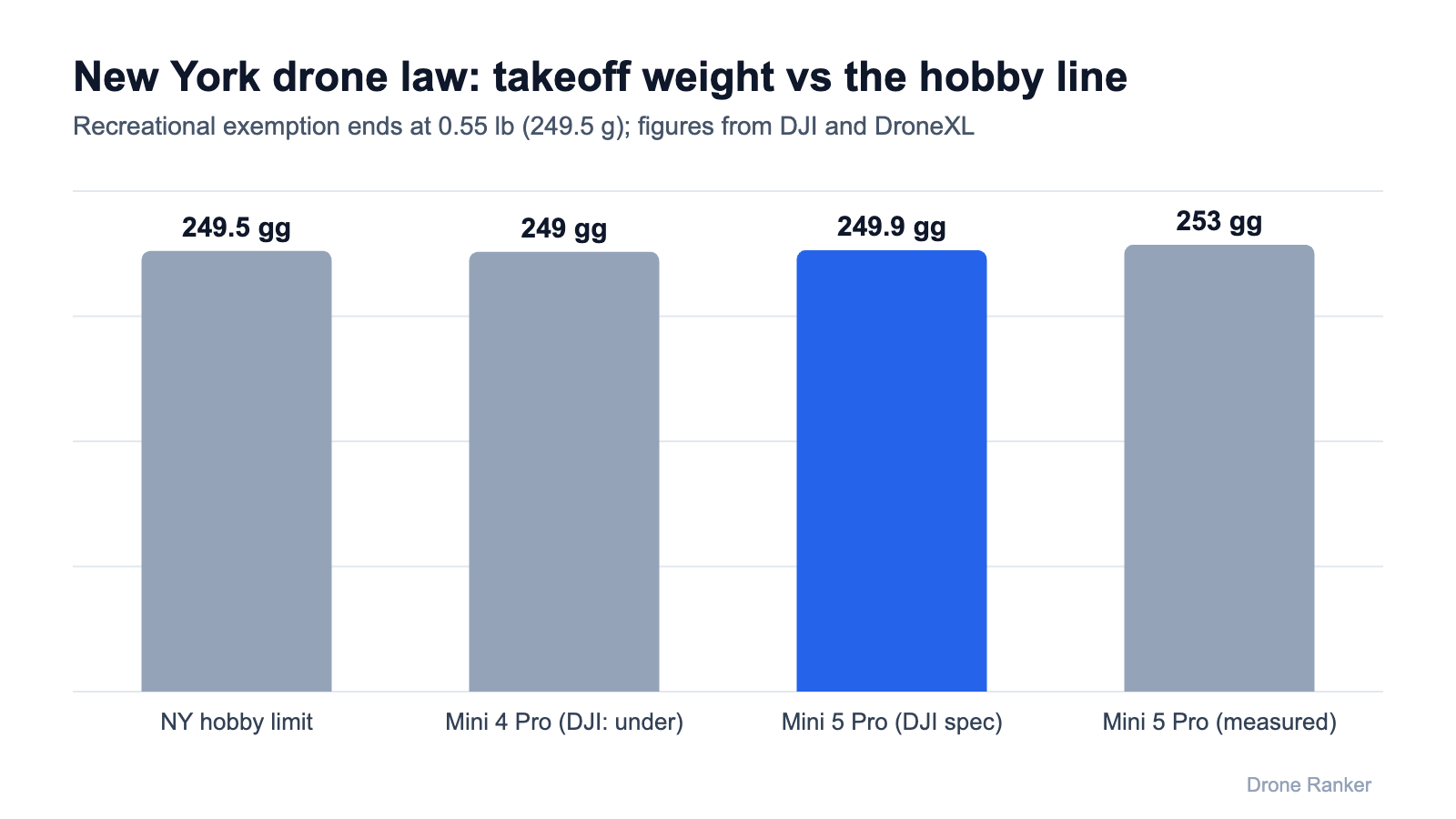
Most commercial pilots are covered by an exemption. Hobbyists are in a tighter spot, and the line is drawn at a weight that a popular DJI drone misses by less than half a gram, DroneXL reported on 23 October.
Table of Contents
What the New York drone law prohibits
Section 280.00 defines “prohibited space” as the area within 500 feet of a listed site’s boundary and up to 400 feet high, or higher without FAA authorization. The list covers schools, police and fire stations, airports, correctional facilities, critical infrastructure and events drawing 500 or more people. The critical infrastructure category borrows a definition from the state’s Freedom of Information Law that covers anything “so vital to the state” that losing it would endanger the public, and it names no specific sites.
Section 280.05 bans flying over prohibited space without “express prior approval from someone the person reasonably believes has the authority” to grant it. A separate offense covers flying in a nefarious manner anywhere.
Part 107 pilots: the lawful-purpose exemption
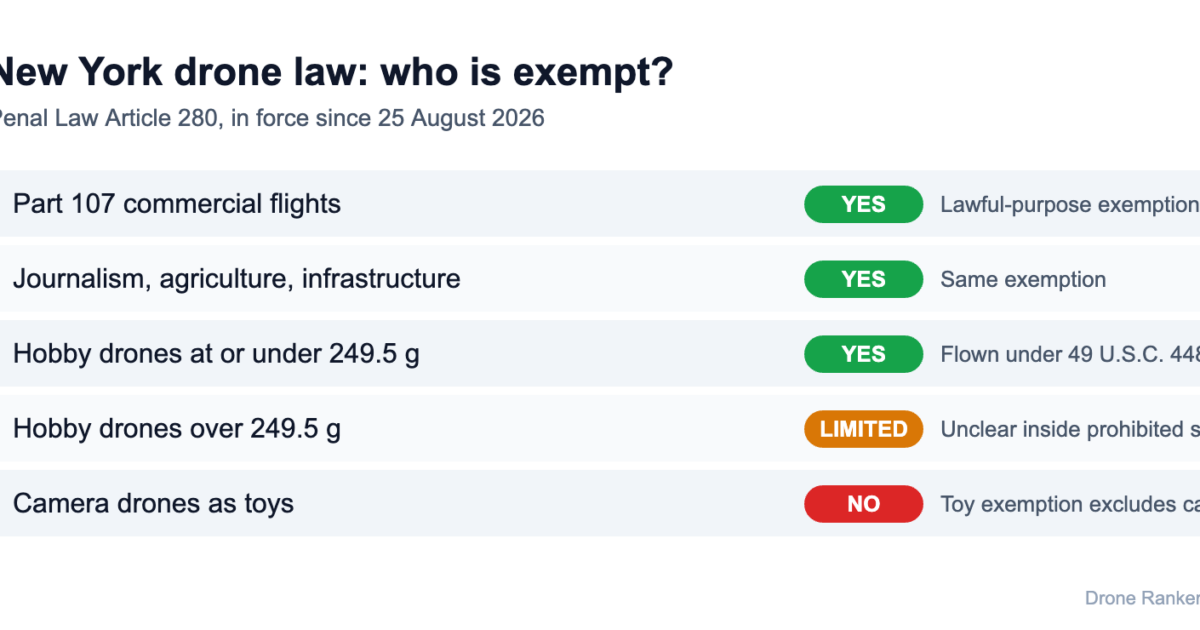
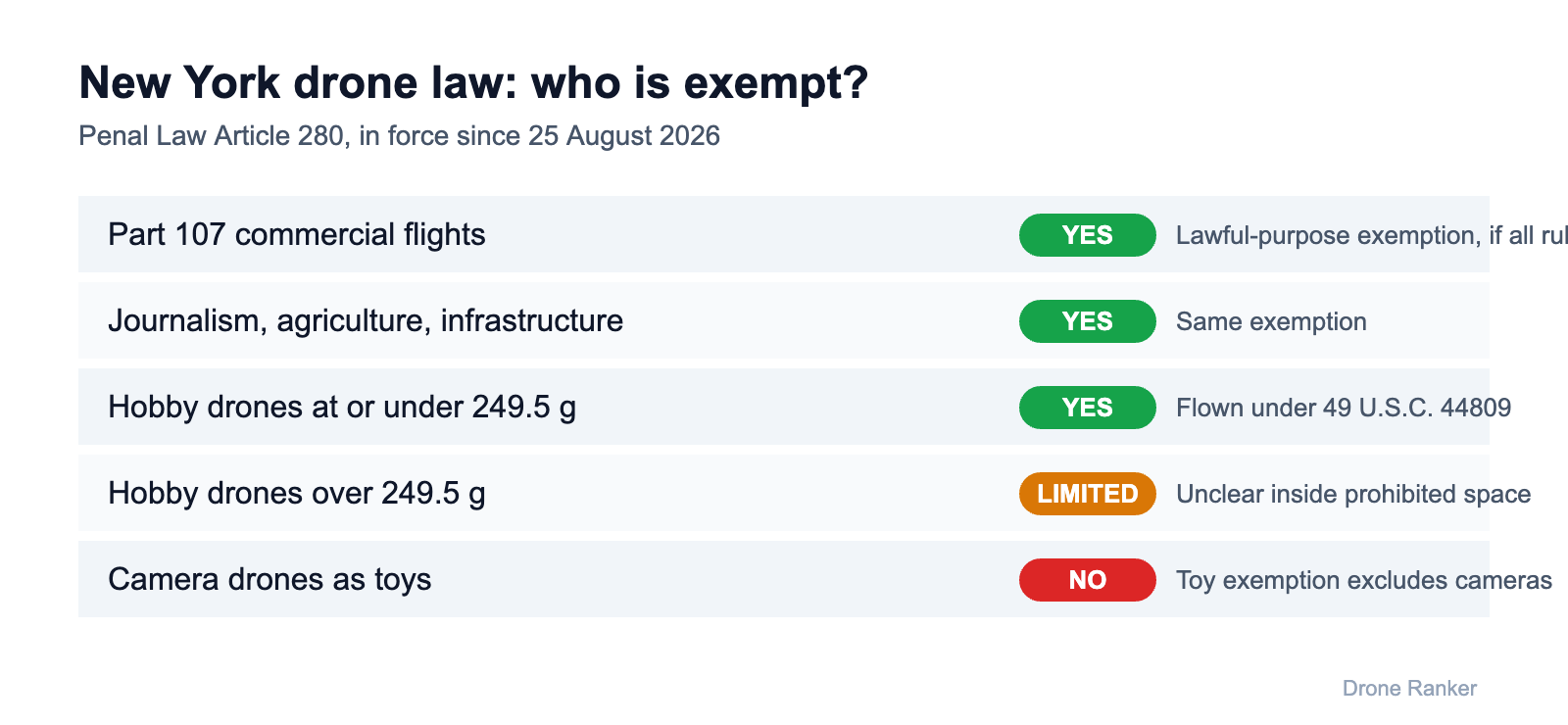
Section 280.10(3) exempts drones flown for commercial, educational, agricultural, journalistic, infrastructure or other lawful purposes, as long as the flight complies with every applicable federal, state and local rule. It covers both the prohibited-space ban and the nefarious-use ban, and it only falls away if the pilot recklessly risks injury or property damage. For a certified operator flying under Part 107, that is the firmest footing. Our guide to starting a drone business covers the Part 107 basics.
Vic Moss of the Drone Service Providers Alliance has also argued that a pilot flying legally under federal rules would reasonably believe they have approval, because federal law gives the FAA control of US airspace. Near an airport, a LAANC authorization may well count as that express approval. In uncontrolled airspace a Part 107 flight needs no authorization at all, which is why the exemption is the stronger argument. Moss labeled his walkthrough as not legal advice, and so do we.
Hobby pilots and the 0.55-pound line
The recreational exemption is narrower. It covers drones weighing 0.55 pounds or less at takeoff, flown only under the recreational exception in 49 U.S.C. 44809. Converted, 0.55 pounds is 249.5 grams, and the weight counts everything on board at takeoff. A drone loses its recreational status if it carries a payload beyond its own flight equipment and sensors.
Here is where it gets awkward. DJI’s own spec sheet lists the Mini 5 Pro at 249.9 grams, 0.4 grams over the line, with a stated tolerance of plus or minus 4 grams, and DroneXL has reported units weighing 252 to 253 grams. A Mini 4 Pro on its standard battery, which DJI rates under 249 grams, fits. A 724-gram Air 3S is nearly three times the limit. The law’s toy drone exemption does not help either, because it excludes any drone with a camera.
What the New York drone law means for hobbyists in practice
Outside prohibited space, a hobbyist with a heavier drone commits no crime under Article 280 unless they fly in a nefarious manner. Inside it, the only possible shelter is the “other lawful purposes” wording, and the text does not say whether recreation counts. Until a court or the state clarifies that, the safe reading for a hobbyist with anything heavier than a sub-249 g drone is simple: keep at least 500 feet from the listed sites and large events, or get permission from the site.
If you are choosing a drone partly for this reason, our best mini drones guide lists the sub-250 g models, and the Mini 5 Pro analysis covers its weight in detail. The weight limit also matters for FAA registration, explained in our Remote ID guide.
Police now have takedown powers
The same budget bill added Executive Law Section 236, which lets trained police act against drones flying in prohibited space or in a nefarious manner. Kinetic measures need probable cause and federally approved equipment, and only come into play when non-kinetic measures have failed or would be expected to. Officers need State Police training plus any federal certification, which ties the power to the federal law that let the NYPD set up its counter-drone unit in May. The State Police have six months to write the mitigation rules, and every use must be reported to them within 48 hours. Our explainer on who can take down a drone in the US has the federal background.
The Friday Brief
One email a week on what changed in drones
FCC and FAA rule changes, DJI leaks checked against filings, and the week’s new comparisons. Every Friday, nothing else.
Free. Unsubscribe in one click. Sent with Kit; see our privacy policy.
Follow us on Google too: add Drone Ranker as a preferred source →
Continue Reading
All News