DJI Mavic 4 Pro Weight: 1,063 g (2.34 lb), Size, Battery and the Rules That Follow

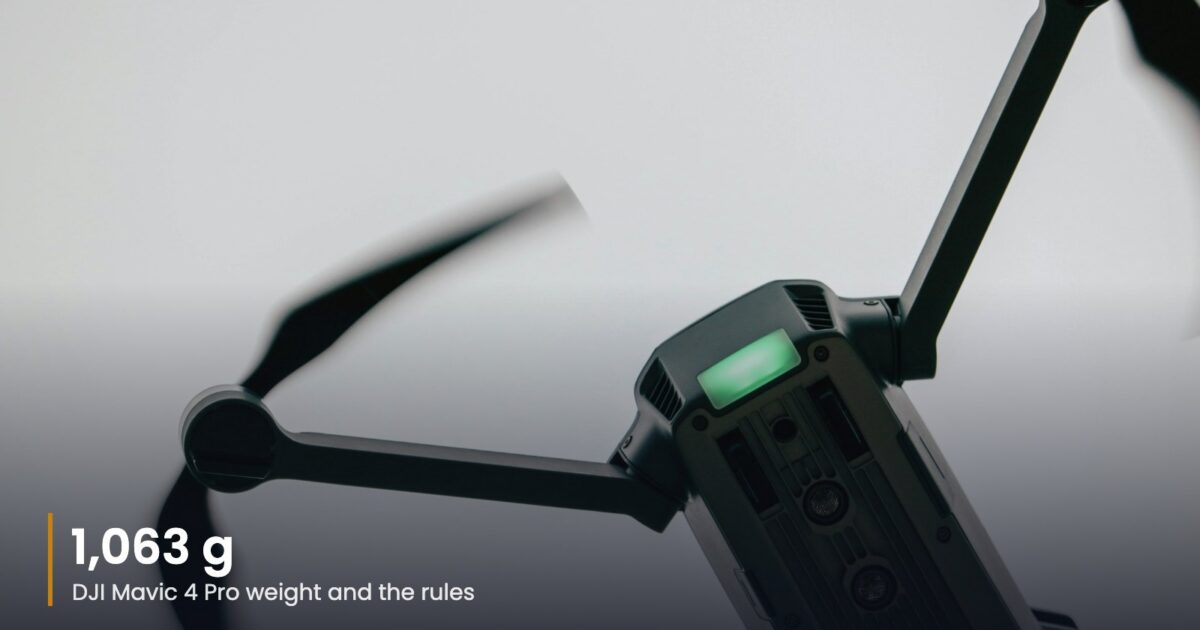
The DJI Mavic 4 Pro weight is 1,063 g (2.34 lb) ready to fly, with the battery and propellers fitted. That is more than four times the 250 g line that decides a lot of drone rules in the US and Europe, so the number affects registration, travel and where you can fly, not only how heavy your bag feels.
DJI lists the aircraft at approximately 1,063 g. The word “approximately” matters a little: manufacturing tolerances and whatever you bolt on can move it by a few grams. For the legal questions below, that never changes the answer.
| Unit | Drone, ready to fly | Battery alone |
|---|---|---|
| Grams | 1,063 g | 332 g |
| Kilograms | 1.06 kg | 0.33 kg |
| Pounds | 2.34 lb | 0.73 lb |
| Ounces | 37.5 oz | 11.7 oz |
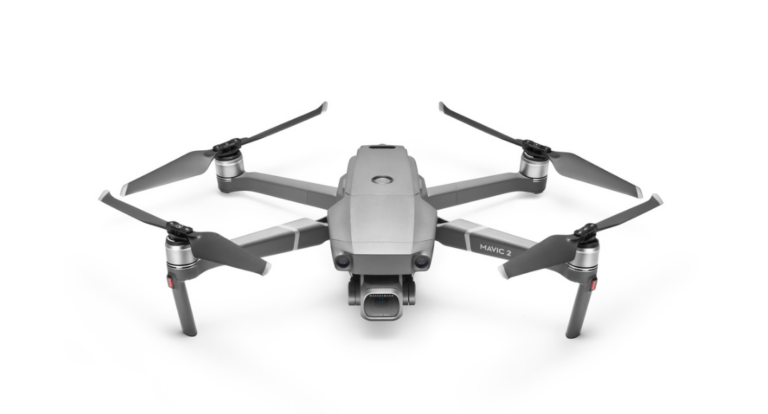
The battery is a big part of that total. It is a 6,654 mAh, 95.3 Wh pack of about 332 g, and there is only one battery option, so the weight is the same whether you buy the Standard, Fly More or Creator Combo. The bundles differ in storage (64 GB versus 512 GB), not in mass. Add the triple-camera head and the 360-degree Infinity Gimbal and the jump over the Mini line makes sense.
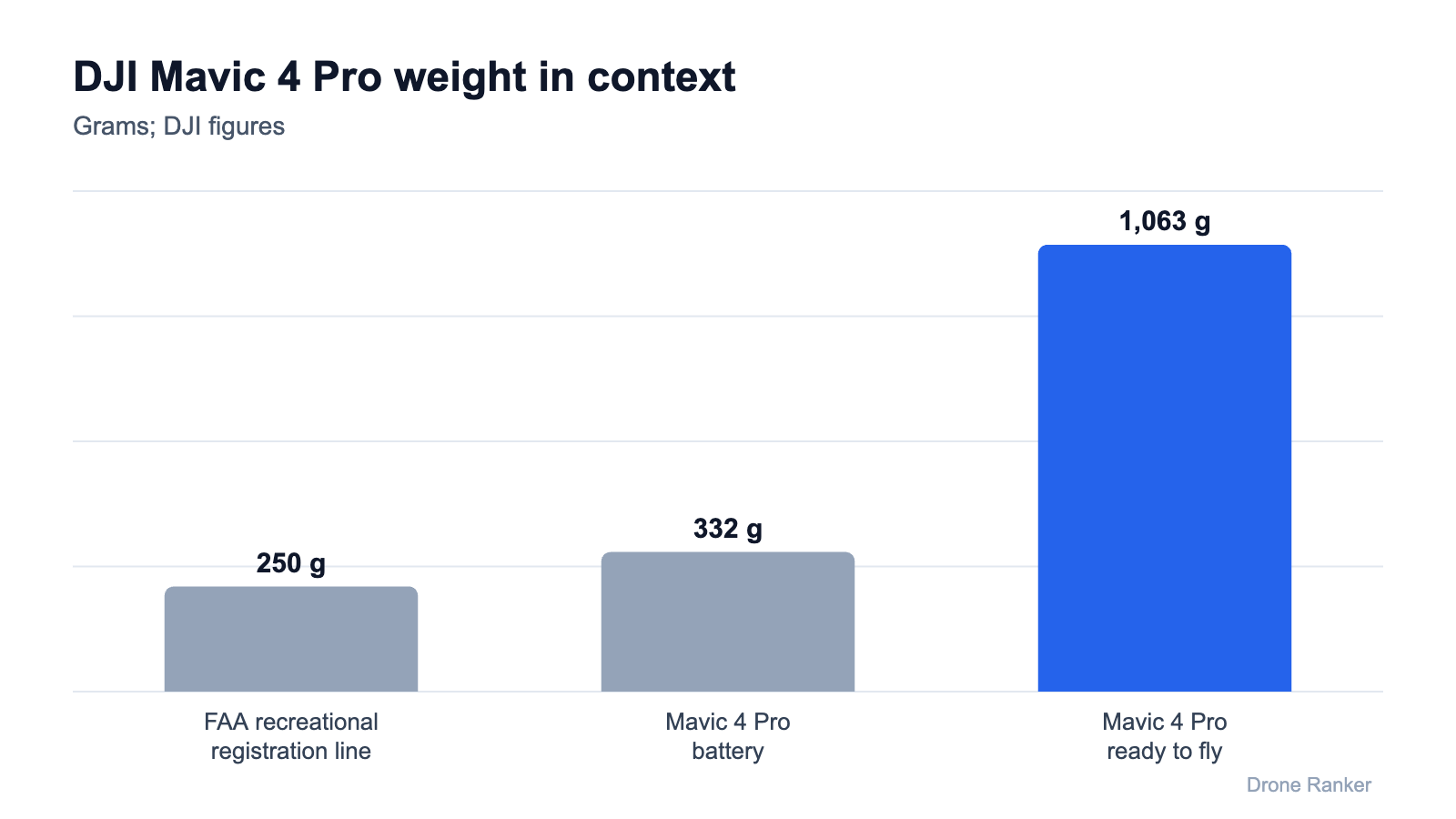
Table of Contents
How big is the Mavic 4 Pro when folded?
| State | Length × width × height |
|---|---|
| Folded, with propellers | 257.6 × 124.8 × 106.6 mm (10.1 × 4.9 × 4.2 in) |
| Folded, without propellers | 257.6 × 124.8 × 103.4 mm |
| Unfolded | 328.7 × 390.5 × 135.2 mm (12.9 × 15.4 × 5.3 in) |
Folded, it is roughly a one-litre water bottle lying on its side. It fits a normal camera backpack, but the drone is never the whole load. With the DJI RC 2 or RC Pro 2, three batteries and the charging hub, a Fly More kit goes well past 3 kg. If you hike or fly with carry-on only, that kit weight is the number to plan around.
For the cameras, sensing and flight specs behind the weight, see the DJI Mavic 4 Pro specs and analysis.
What the DJI Mavic 4 Pro weight means in the US: registration and Remote ID
The FAA’s recreational exception only covers drones at or under 0.55 lb (250 g), so the Mavic 4 Pro has to be registered. The FAA registration rules also cover every drone flown under Part 107, whatever its weight, so the answer is the same for hobby and work flights.
Registration is not a pilot licence. Recreational pilots still need the free TRUST test and have to follow the recreational rules. Flying for work or pay generally falls under Part 107, which needs a Remote Pilot Certificate.
Because it has to be registered, the drone also has to meet the Remote ID rule, unless you fly inside an FAA-Recognized Identification Area. Check the firmware and Remote ID status in the DJI app before you count on the broadcast working. And none of this gives you permission for controlled airspace, flights over people or beyond visual line of sight. Those are separate approvals.
Not sure what the weight means where you live? The drone registration checker lists the registration, ID and Remote ID rules for the US, UK, EU, Canada, Australia and Japan.
Europe: what the C2 label means for a 1,063 g drone
DJI sells the Mavic 4 Pro in Europe as a C2-class drone. Under the EASA open category, a C2 drone can fly in subcategory A2 if you hold the A2 competency and keep your distance from uninvolved people: 30 m as standard, or 5 m with the certified low-speed mode on and the conditions right. Flying over uninvolved people is not allowed.
If you cannot meet the A2 conditions, you are in A3, which means a much emptier area, away from homes, shops, industrial sites and parks. The usual 120 m height limit applies, and so do operator registration, training and each country’s geographic zones. The C2 mark is not a pass to fly anywhere in Europe.
This is the biggest practical gap between the Mavic and a C0 travel drone. You get far more camera, but you have to plan distances and paperwork more carefully.
Taking it on a plane
At airport security, the batteries matter more than the airframe. Each one is rated at 95.3 Wh, just under the 100 Wh point where many airlines start asking for approval. The FAA’s PackSafe drone guidance says spare lithium batteries go in the cabin, with the terminals protected against short circuits, never in checked bags. Airlines and destination countries can be stricter, so check both before you pack.
- Spare batteries in your carry-on, terminals covered.
- Check the airline’s limit on battery count and watt-hours.
- Leave damaged, swollen or recalled batteries at home.
- Look up the destination’s registration and airspace rules.
The drone itself, powered off and protected, may be allowed in checked luggage, but a carry-on case keeps it in your hands. Being under 100 Wh does not mean every airline will say yes.
Next to other DJI drones
| Drone | Approx. takeoff weight | Difference vs Mavic 4 Pro |
|---|---|---|
| DJI Mavic 4 Pro | 1,063 g | — |
| DJI Mavic 3 Pro | 958 g | 105 g lighter |
| DJI Air 3S | 724 g | 339 g lighter |
| Typical DJI Mini model | Under 250 g | More than 800 g lighter |
On paper, 105 g over the Mavic 3 Pro is not much. It adds up once you carry three batteries and accessories. The Mavic 4 Pro vs Mavic 3 Pro comparison goes through what the extra mass pays for in camera, flight time and sensing, and the Mavic 3 Pro, Cine and Mavic 4 Pro comparison covers the storage and camera trade-offs between all three.
Accessories add weight too. Filters, propeller guards, lights or any other payload make the flight-ready drone heavier than DJI’s published figure. For the Mavic this never changes the US registration answer, since it is already far over 250 g, but it does affect balance and battery life. If a permit or waiver depends on an exact mass, weigh the drone as you will actually fly it.
Who should worry about the extra grams?
Hikers and travel creators feel it first, because every spare battery makes the bag heavier. Commercial users usually care more about the image quality and having three focal lengths in one drone than about a few hundred grams.
New pilots should pay attention for a different reason. A 1 kg drone carries far more energy than a palm-sized one, so pick open takeoff spots, keep a wide margin around people and run proper preflight checks, even with obstacle sensing on.
If portability is the reason you are hesitating, the weight is a real cost and worth taking seriously. A Mini-series drone wins that argument by a wide margin. If you need the Mavic’s cameras, the weight is simply the price of them. Compare it with the lighter options in the best DJI drones guide before deciding.
The Friday Brief
One email a week on what changed in drones
FCC and FAA rule changes, DJI leaks checked against filings, and the week’s new comparisons. Every Friday, nothing else.
Free. Unsubscribe in one click. Sent with Kit; see our privacy policy.
Follow us on Google too: add Drone Ranker as a preferred source →
Continue Reading
All News