DJI Neo 3 Weighs 192.7 g. Compared Properly, the Gain Is About 33 g

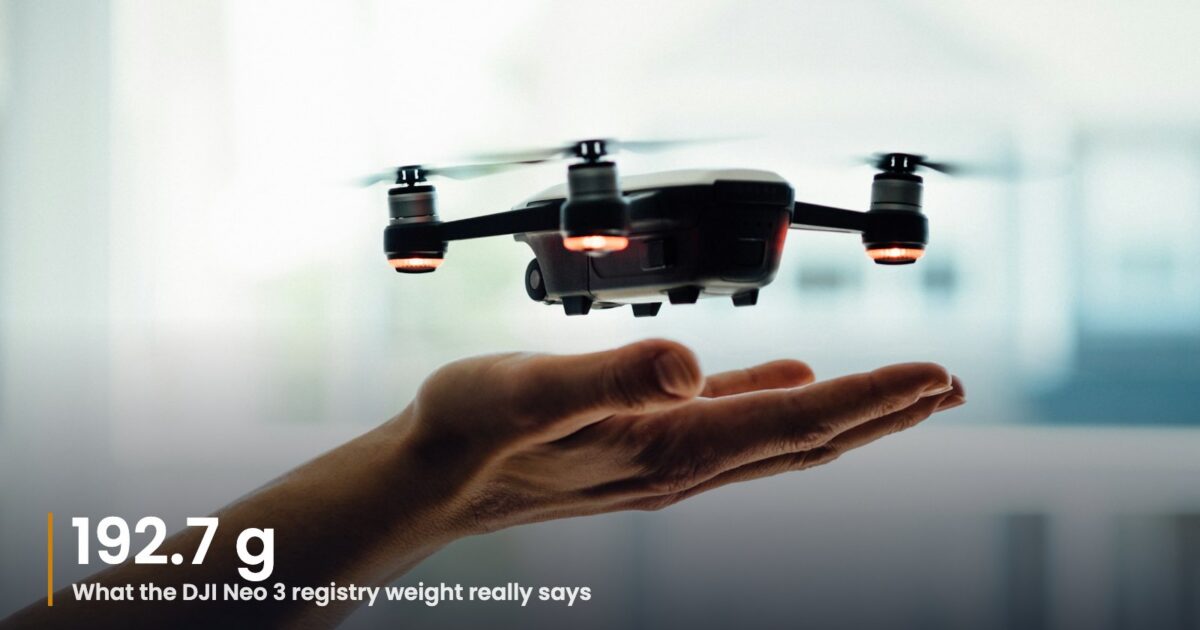
A line in China’s drone registry has given the DJI Neo 3 its first hard number. The aircraft, listed under model code DEN326 with a production date of 21 September 2026, has a take-off weight of 192.7 grams.
Most coverage has run that figure against the Neo 2’s headline 151 grams and reported a 42 gram, 28% jump. The arithmetic is right. The comparison is not quite like for like, and once it is lined up properly the DJI Neo 3 weight story becomes smaller, more interesting, and consistent with something we spotted on the Neo 3’s retail box two weeks ago.
Table of Contents
Can you buy it in the US? Not the Neo 3, but our US drone ban checker shows which DJI drones you still can.
DJI Neo 3 weight: what the registry entry says
The source is China’s unique product identification system for civil drones, the database every aircraft sold there has to be entered into. Drone leaker Igor Bogdanov posted a screenshot of the Neo 3 entry on 22 September. It gives three fields that matter here:
- Model code: DEN326
- Take-off weight: 192.7 g
- Production date: 21 September 2026
It does not give flight time, battery capacity, sensor size, price or a launch date. A registry form records what the regulator asks for, and nothing else. Everything below that goes beyond those three lines is labelled as inference.
28% heavier, or 20%? It depends which Neo 2 you weigh
DJI publishes two take-off weights for the Neo 2, and the difference is a radio. The Neo 2 can be flown from a phone over Wi-Fi. To fly it with a DJI controller or goggles, you clip on the separate DJI Neo 2 Digital Transceiver, which adds 9 grams.
| Configuration | Take-off weight | Neo 3 difference |
|---|---|---|
| Neo 2, phone control (no transceiver) | 151 g | +41.7 g (+27.6%) |
| Neo 2 with Digital Transceiver fitted | 160 g | +32.7 g (+20.4%) |
| Neo 3 (China registry, DEN326) | 192.7 g | — |
Which row is the fair comparison depends on what is inside the Neo 3. And that is where the box comes in.
The box already told us the radio moved inside
When the Neo 3’s retail packaging leaked in mid-September, the printed contents list had nine items. It included the DJI RC Mini controller and did not include a Digital Transceiver. We wrote at the time, in our Neo 3 vs Neo 2 box analysis, that the two facts only fit together one way: a controller needs a radio on the aircraft side, so if the add-on module is gone and the controller is in the box, the O4 radio has probably been built into the airframe.
If that is right, then the 160 gram Neo 2 is the one to compare against, because it is the Neo 2 carrying the same capability. On that basis the Neo 3 has gained 32.7 grams, about a fifth, not 42 grams.
We should be clear about the limits. The box shot was later shown to be a marketing render rather than a photograph of hardware, so details of the drawing are not evidence. The printed parts list is a different kind of evidence, and it is the part our inference rests on. It is still an inference until DJI publishes a spec sheet.
There is also a definitional caveat. DJI’s 151 g and 160 g figures are its own take-off weights. We cannot confirm that the registry form defines take-off weight identically, for example with or without a microSD card or propeller guards. A few grams either way would not change the conclusion, but it is a reason not to quote the difference to one decimal place as fact.
Where 32.7 grams could go
Nothing official breaks the number down, so this is a list of candidates rather than an answer.
- A bigger battery. The Neo 2’s battery is 1606 mAh and weighs 46 g, and DJI rates the aircraft at about 19 minutes, or 17 with propeller guards. Battery mass is the most common reason a small DJI drone gets heavier between generations, and a battery 25 to 35% heavier would account for a large share of the gap on its own. We have no capacity figure for the Neo 3, so we are not estimating a flight time.
- Integrating the radio is not free. Moving the transceiver inside saves the clip-on housing, but the antennas and board still have to go somewhere, and they are already counted in the 160 g comparison.
- Structure and sensing. A stiffer frame, larger motors to carry the extra mass, or more obstacle sensing would all add grams. None of these is confirmed.
The useful conclusion is narrower than a parts list: the Neo 3 is heavier mainly in ways that suggest DJI is trading some of the Neo line’s ultralight positioning for endurance and controller-first flying. That is a guess about intent, and we label it as one.
Does 192.7 g change the rules you fly under?
For most pilots, no. Every major threshold sits either below the Neo 2 or above the Neo 3, so the two aircraft land in the same box almost everywhere.
| Jurisdiction | Threshold | Neo 2 (151–160 g) | Neo 3 (192.7 g) |
|---|---|---|---|
| EU | C0 class: under 250 g | C0 | Stays under 250 g |
| United Kingdom | Flyer ID from 100 g; Operator ID for 100–250 g with a camera (since 1 Jan 2026) | Both IDs required | Both IDs required |
| United States | FAA registration for recreational flying above 250 g | Not required for recreation | Not required for recreation |
| Japan | Registration and Remote ID from 100 g (since 20 Jun 2022) | Required | Required |
| China | Real-name registration with no sub-250 g exemption | Required | Required |
Two footnotes. In the UK, Remote ID becomes mandatory for UK0-class and legacy drones of 100 g or more with a camera from 1 January 2028, which will catch both aircraft. And in the US, the weight is academic for now, which is the next point.
The US question has nothing to do with weight
The Neo 3 has no FCC authorization. Since 22 December 2025, foreign-produced drones and DJI by name sit on the FCC’s Covered List, which means a new DJI aircraft cannot get the equipment authorization it needs to be marketed in the United States. Staying under 250 g does not help with that. We explain the mechanics in our guide to which drones are banned in the US and what still reaches US shelves in can you buy DJI in the US.
If you are in the US and want a palm-sized DJI now, the DJI Neo 2 is the model with an existing authorization (FCC ID SS3-DEN225, filed in 2025), although DJI does not sell it through its own US store. The naming is worth noticing too: the Neo 2 is DEN225 in the FCC database and the Neo 3 is DEN326 in China’s registry. Its practical limits, including the Neo 2’s maximum altitude, are covered separately.
What the production date says about release
A production date of 21 September means units were being built for the domestic market before the end of September. Rumour trackers including DJI Rumors and The New Camera read that, alongside the Neo 2’s rollout pattern, as pointing to an October to November 2026 launch, China first. That is a reasonable reading, but it is a projection from timing, not an announcement. Our running DJI Neo 3 release date and leak tracker will carry the date when DJI confirms it.
When the official spec sheet appears, we will update this page with the confirmed weight, battery and flight time, and mark each inference above as right or wrong.
Frequently asked questions
How much does the DJI Neo 3 weigh?
The DJI Neo 3 weight in China’s civil drone registry is 192.7 g take-off weight, listed under model code DEN326. DJI has not published an official spec sheet yet.
Is the DJI Neo 3 under 250 g?
Yes. At 192.7 g it stays under the 250 g line used for the EU C0 class and US recreational registration.
How much heavier is the Neo 3 than the Neo 2?
41.7 g heavier than the Neo 2’s 151 g phone-control weight, or 32.7 g heavier than the 160 g Neo 2 with its Digital Transceiver fitted. If the Neo 3 has the radio built in, the second comparison is the fair one.
Why is the DJI Neo 3 heavier?
DJI has not said. The retail box lists the RC Mini but no clip-on transceiver, which suggests an integrated O4 radio. A larger battery is the other likely contributor. Both are inferences until DJI confirms the specs.
Do I need to register the DJI Neo 3?
In the UK you need a Flyer ID and Operator ID, as with the Neo 2. In Japan and China, registration is required. In the US, recreational flyers do not register drones under 250 g, but the Neo 3 is not authorized for US sale.
When is the DJI Neo 3 release date?
Not announced. A 21 September 2026 production date has led rumour trackers to expect an October to November 2026 launch, starting in China.
Can you buy the DJI Neo 3 in the US?
Not through official channels. It has no FCC authorization, and new DJI aircraft cannot receive one while DJI is on the FCC Covered List.
What is DEN326?
DEN326 is the model code under which the Neo 3 appears in China’s civil drone registry.
Sources
Sources
Primary references used for factual claims in this article.
Continue Reading
All News