DJI Neo 3 vs Neo 2: The Box Says the Transceiver Is Gone

Five days after the front of the DJI Neo 3 retail box leaked, the back of it has surfaced, and the parts list on it is more informative than the product shot on the front. Nine items are printed there. One that appears on the Neo 2 Fly More Combo is missing, and its absence points at a hardware change DJI has not announced.
Any DJI Neo 3 vs Neo 2 comparison written today rests on that panel and nothing else. Nothing below is confirmed by DJI: the Neo 3 has not been announced, no specification sheet exists, and the images are packaging photographs of unknown provenance. What follows is what the printed panel shows and what can reasonably be read from it, kept separate from each other.
Table of Contents
Update, 2 October 2026: A registry entry now gives the Neo 3 a take-off weight of 192.7 g. That is 32.7 g more than the 160 g Neo 2 with its Digital Transceiver fitted, which is the fair comparison if, as the parts list on the box suggests, the radio is now built in. Our full analysis of the Neo 3’s weight.
The nine items on the panel
The box is a Fly More Combo. DroneXL lists the printed contents as: the aircraft, three flight batteries, a charging hub, the DJI RC Mini controller, an RC Mini expansion cover, an RC Mini anti-loosening pad, spare propellers, a screwdriver and a USB-C cable.
Three of those nine entries are accessories for the controller rather than the drone, which is itself a signal: the RC Mini is being treated as a first-class part of the package rather than an upsell. On the Neo 2 the controller was the thing you bought separately.
What is not on the list
The Digital Transceiver is absent.
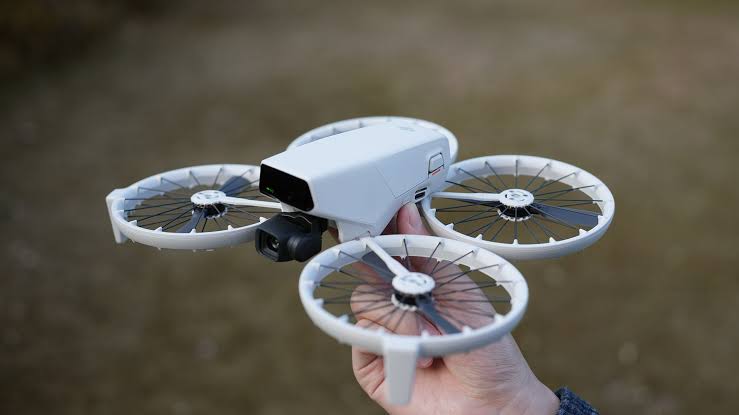
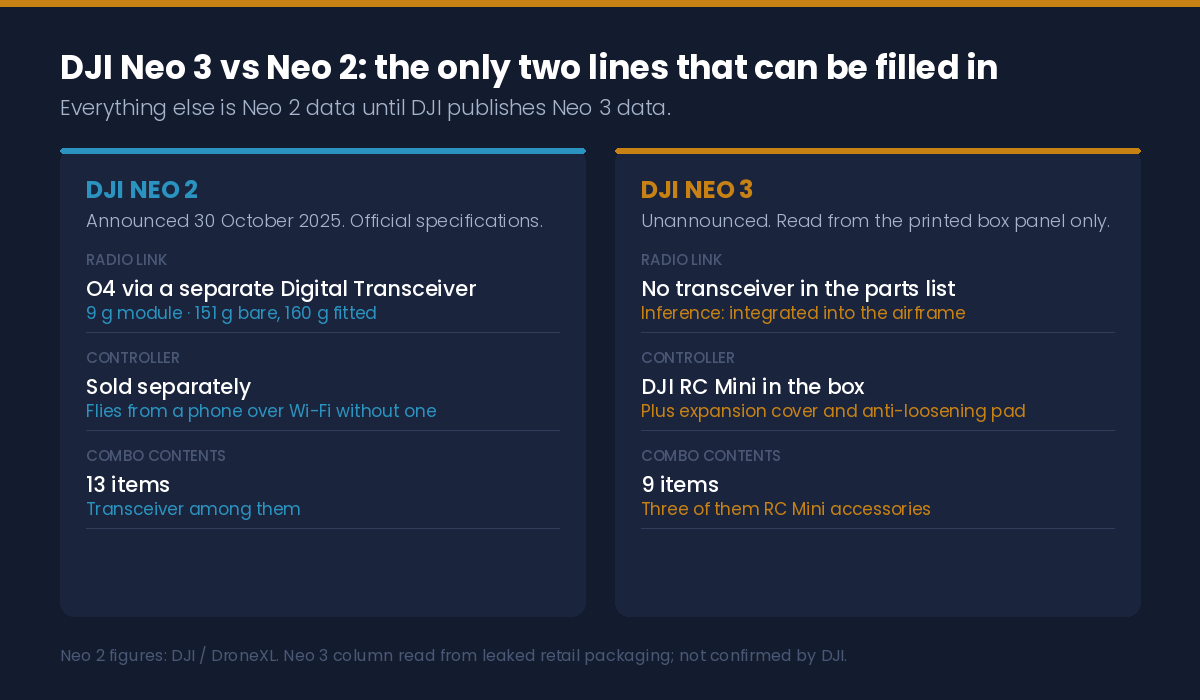
On the DJI Neo 2 that module is not optional garnish. The aircraft weighs 151 grams on its own and 160 grams with the module fitted — a 9-gram part that carries the O4 video link. Without it the Neo 2 flies from a phone over Wi-Fi. With it, the drone can talk to a controller or to goggles. DroneXL counts thirteen items in the Neo 2 Fly More Combo, the transceiver among them.
So the Neo 3 panel presents a combination that does not work on the Neo 2’s architecture: an RC Mini controller in the box, and no transceiver to talk to it. A controller needs a radio link at the aircraft end. If the parts list is accurate and complete, the most economical explanation is that the O4 radio has moved inside the airframe.
That is an inference, not a disclosure. Two other readings are possible: the transceiver could be pre-installed at the factory and therefore not itemised as a separate accessory, or the panel photographed could be an early or regional variant. Either of those would still mean the same thing in practice for a buyer — the module is no longer something you fit yourself — but only the first implies a redesigned airframe.
Why a 9-gram part is worth this much attention
Because on this class of aircraft, nine grams is a design decision rather than a rounding error.
The Neo line exists to sit far under the 250-gram threshold that most Western regulators use as the dividing line for registration and pilot requirements. The Neo 2 at 151 grams has around 99 grams of headroom; a built-in radio spends some of that permanently rather than only when the owner chooses to fit it. DJI’s engineers traded that flexibility for weight on the Neo 2 deliberately. If the Neo 3 reverses the trade, it means the company decided controller and goggles support is now the default use case rather than the enthusiast one.
It also removes the Neo 2’s single most confusing purchase decision, which was working out whether you needed the module at all.
The three certification marks say which market this box was printed for
The same panel carries three Chinese national standard numbers, and they are the reason this is not simply a specification leak.
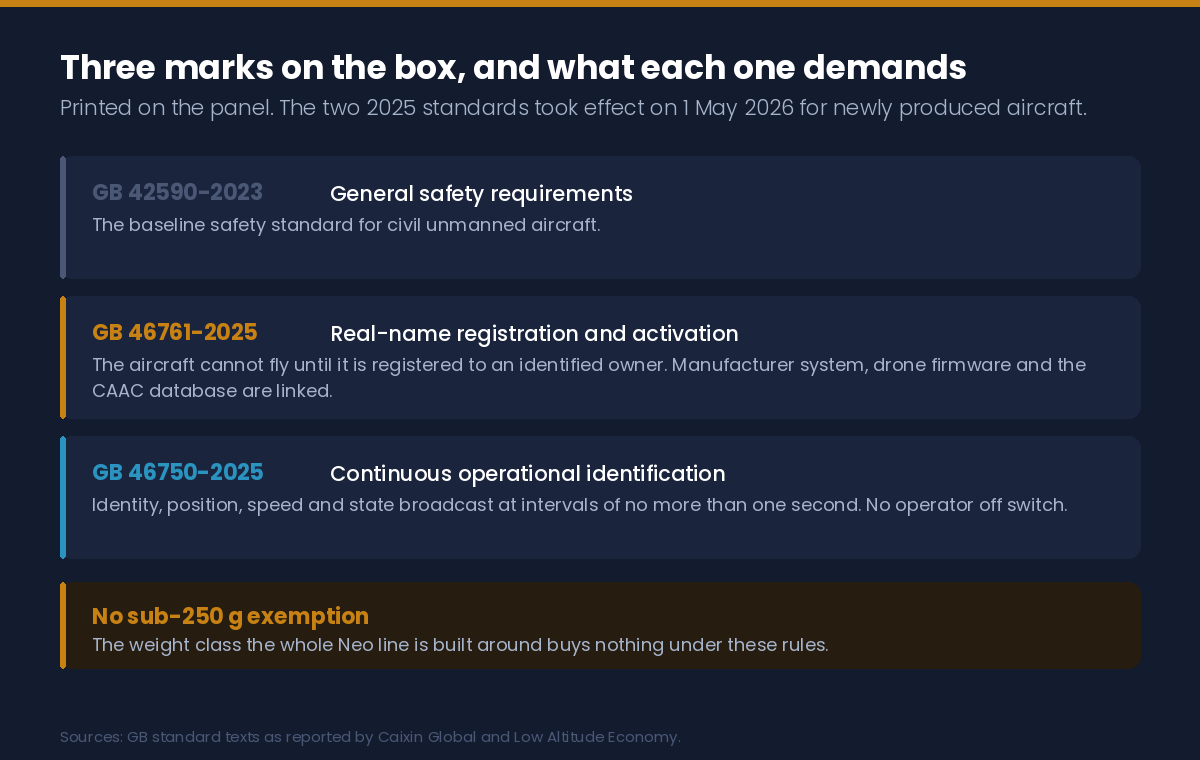
- GB 42590-2023 — the general safety requirements standard for civil unmanned aircraft.
- GB 46761-2025 — real-name registration and activation. Effective 1 May 2026 for newly produced aircraft. It requires that a drone be incapable of flight before activation, with the manufacturer’s system, the aircraft’s firmware and the CAAC’s registration database linked together. Registration records the owner’s identity along with the product name, model, serial number and intended use.
- GB 46750-2025 — operational identification. Also effective 1 May 2026. The aircraft must broadcast identity, position, speed and state continuously, at intervals of no more than one second, over both broadcast and network modes. The module cannot be switched off by the operator, and if identification fails in flight the aircraft must hover, return to home or land.
Alongside those marks the box shows a mainland Chinese service hotline. This is a China-market unit, and it was built for a regime in which a drone does not take off until it has been tied to a named person.
One detail in that framework matters more than the rest for a drone like this one: China’s rules carry no sub-250-gram exemption. The weight class that the entire Neo line is engineered around — the thing that lets a Neo 2 owner in most Western countries skip registration entirely — buys nothing at home. Consumer toys are in scope if they meet the functional parameters of a civil UAV.
That produces a split worth holding in view. In the United States, DJI’s problem is that its equipment cannot get new authorizations at all, which is why its US catalogue is freezing product by product. In China, the product is welcome but the aircraft has to identify itself and its owner by design. Two regulators, opposite instruments, and a 150-gram camera drone caught between them.
How much of this should you trust
Less than a specification sheet, more than a rendering. A few things are worth stating plainly.
- The photographs show the box next to a Neo 2 display model in what appears to be a retail environment. That is consistent with production packaging rather than a mock-up, and it suggests a China launch that is close rather than distant.
- Commentary on the earlier front-of-box images raised authenticity questions — inconsistent motor orientation, small branding errors, and an unexplained upward-facing component on the top of the aircraft. Those doubts have not been resolved by the new photographs.
- Printed regulatory marks are harder to fake convincingly than a product render, because the standard numbers and their effective dates have to be internally consistent. These are. That raises the floor on credibility without proving anything.
The honest position is that the parts list is the strongest evidence in the leak and the rest is context.
What the box does not tell us
No weight. No flight time. No camera specification. No price. No release date, in China or anywhere else. The panel is a parts list and a compliance block, not a spec sheet, and anyone publishing Neo 3 numbers today is either quoting the Neo 2 or making them up.
The one date in the record that is firm belongs to the controller, not the drone: the RC Mini’s FCC authorization, ID SS3-TKMI2507, was granted on 19 December 2025 — three days before the US Covered List cutoff. We went through what that timing does and does not mean in our coverage of the original Neo 3 box leak.
DJI Neo 3 vs Neo 2: what can actually be compared today
Only two lines of a comparison table can be filled in honestly right now, and both come from packaging rather than from DJI.
- Radio link. Neo 2: O4 via a separate 9-gram Digital Transceiver, 151 g bare and 160 g with it fitted. Neo 3: no transceiver in the parts list, RC Mini included — so, on the evidence, integrated.
- Controller. Neo 2: sold separately, and the aircraft flies from a phone without one. Neo 3: DJI RC Mini in the combo box, with an expansion cover and anti-loosening pad alongside it.
Everything else — sensor, flight time, obstacle sensing, wind resistance, price — is Neo 2 data until DJI publishes Neo 3 data. For reference, the Neo 2 launched on 30 October 2025 with a 12 MP 1/2-inch sensor, 4K/60 video, a claimed 19 minutes of flight time and omnidirectional obstacle sensing, and it remains the drone to measure the line’s progress against.
We will update this page when DJI announces the aircraft, and not before.
Frequently asked questions
Does the DJI Neo 3 need a separate transceiver like the Neo 2?
On the evidence of the retail box, no. The nine-item parts list includes the DJI RC Mini controller but no Digital Transceiver, which points to the O4 radio being built into the aircraft. DJI has not confirmed this.
What was the Digital Transceiver on the DJI Neo 2?
A 9-gram add-on module carrying the O4 video link. Fitted, it took the Neo 2 from 151 grams to 160 grams and allowed the drone to connect to a controller or goggles; without it the Neo 2 flies from a phone over Wi-Fi.
How much will the DJI Neo 3 weigh?
Unknown. The box lists no weight. If the radio has moved inside the airframe the figure would reasonably sit above the Neo 2’s 151 grams, but DJI has published nothing and any specific number in circulation today is a guess.
When is the DJI Neo 3 release date?
Not announced. The packaging was photographed in what looks like a Chinese retail setting beside a Neo 2 display unit, which suggests a China launch is near, but no date has been given for any market.
What is in the DJI Neo 3 Fly More Combo?
Per the printed panel: the aircraft, three flight batteries, a charging hub, the DJI RC Mini, an RC Mini expansion cover, an RC Mini anti-loosening pad, spare propellers, a screwdriver and a USB-C cable.
What do GB 46761-2025 and GB 46750-2025 require?
GB 46761-2025 requires real-name registration and activation — a drone cannot fly until it is registered to an identified owner through a link between the manufacturer, the aircraft firmware and the CAAC database. GB 46750-2025 requires continuous broadcast of identity, position, speed and state at intervals of no more than one second, with no operator off switch. Both took effect on 1 May 2026 for newly produced aircraft.
Does China exempt drones under 250 grams?
No. Unlike the registration thresholds used in the United States and much of Europe, the Chinese standards apply without a sub-250-gram carve-out, and extend to products sold as toys where they meet the functional parameters of a civil UAV.
Will the DJI Neo 3 be sold in the United States?
There is no path for the aircraft under the rules as they stand, because DJI equipment on the FCC Covered List cannot receive new authorizations. The RC Mini controller is the exception: its grant predates the 22 December 2025 cutoff.
Is this leak trustworthy?
Partly. The parts list and the regulatory marks are internally consistent and hard to fabricate casually. Commentary on the earlier images of the same box flagged motor orientation inconsistencies, small branding errors and an unexplained component on the top of the aircraft, and those questions remain open.
Sources
- DroneXL — DJI Neo 3 box lists nine items; the Neo 2’s transceiver isn’t one
- DroneXL — DJI Neo 2 specifications
- Caixin Global — China mandates real-name registration for drones
- Low Altitude Economy — China’s drone identification standards for 2026
- Geeky Gadgets — questions raised about the original box leak
Sources
Primary references used for factual claims in this article.
Continue Reading
All News