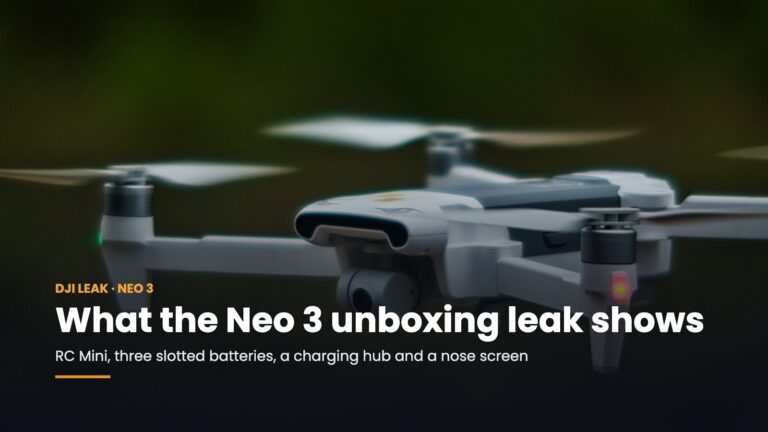
DJI Neo 3 Release Date: What the Retail Box Reveals


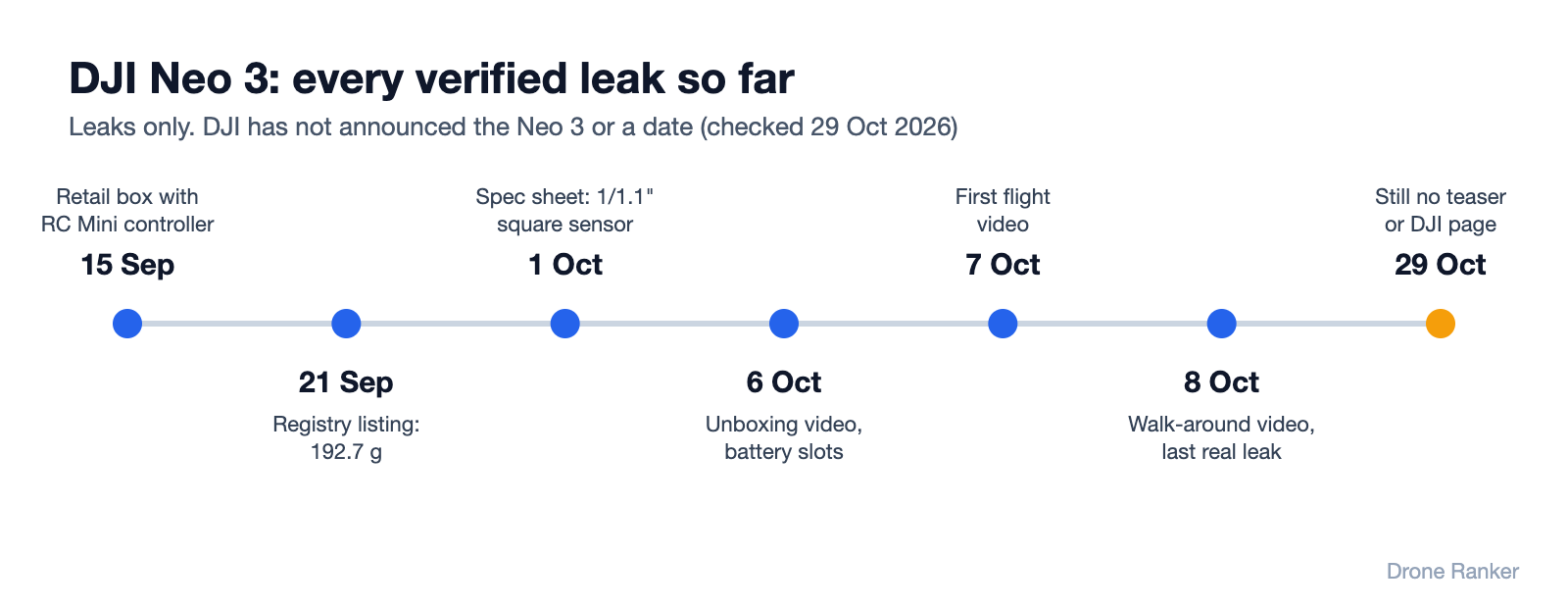
DJI still has not announced the DJI Neo 3 or a release date (checked 29 October 2026), and its store has no preorder page. The last verified leak, a walk-around video, appeared on 8 October, three weeks ago. Leaks point to an October to November 2026 launch: China’s drone registry lists a production date of 21 September, a spec sheet surfaced on 1 October and an unboxing video on 6 October. The DJI launch set for 14 October was a DJI Enterprise product, a battery-swapping drone dock, not the Neo 3 (details).
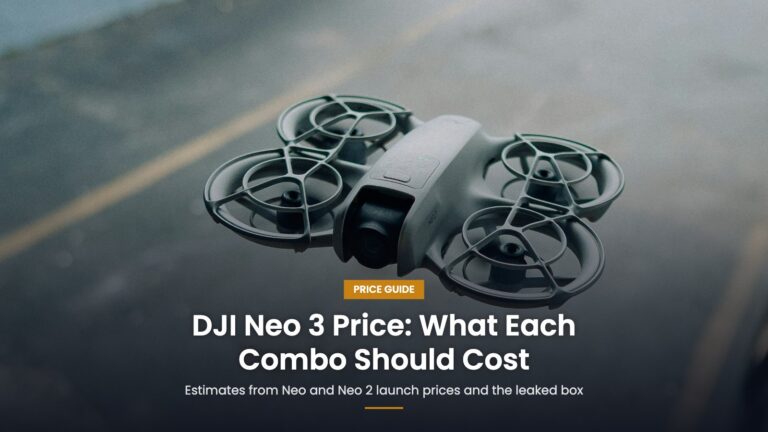
Leaker Jasper Ellens guessed “about six weeks” on 7 October, which would mean mid-to-late November, but he called it a guess. That window is still open: as of 29 October nothing newer had surfaced, and DroneXL’s Neo 3 leak guide, last updated 20 October, still lists the drone as unannounced. A quiet stretch like this before a DJI launch is normal; it is not evidence of a delay. Price, flight time and launch date are still not on record; our price estimate covers the likely range, and our DJI release tracker shows how the Neo 3 compares with every other unreleased DJI drone.
If you don’t want to wait, the original Neo is still sold in the US, and the Neo 2 is available there from third-party sellers; see the best drones under $500.
Table of Contents
What has leaked so far
- 15 September: photos of retail packaging, first reported by DroneXL and also covered by Notebookcheck and Gizmochina. The bundle includes the DJI RC Mini with a screen, three batteries and a charging hub.
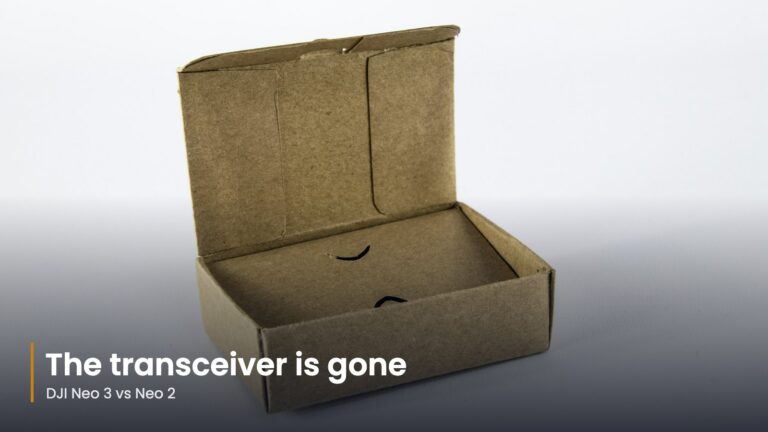
- 20 September: the back of the box. Its nine-item parts list includes the RC Mini but not the Neo 2’s 9-gram Digital Transceiver, which points to the O4 radio moving inside the airframe. The panel also carries three Chinese national standard marks, including the real-name registration rule that came into force on 1 May 2026. More in DJI Neo 3 vs Neo 2: what the retail box already shows.
- Late September: China’s civil drone registry lists the Neo 3 under model code DEN326 at 192.7 g take-off weight. Against a Neo 2 fitted with its transceiver (160 g), that is a 32.7 g gain; we break down the weight here.
- 1 October: a box feature panel lists a 1/1.1-inch square sensor (up from 1/2-inch on the Neo 2), 2x lossless zoom, high-speed ActiveTrack and omnidirectional obstacle sensing. We go through it in the spec sheet leak and DJI Neo 3 specs.
- 7 October: a label shows a three-cell, 18.9 Wh battery that does not fit the Neo 2, and the first flight video appeared (details).
None of this is confirmed by DJI. A DJI product page, aircraft filing or user manual would be a stronger launch signal than packaging.
The RC Mini is the most revealing part
The Neo 2 ships with the RC-N3, a controller with no display of its own that needs a phone clipped to it. The leaked box instead shows a compact controller with two sticks, a record button, four status LEDs and a small color screen: DJI’s RC Mini, the first Neo-class remote with its own display.
Reporting gives that controller FCC ID SS3-TKMI2507, with an equipment authorization dated 19 December 2025. It appears to be a rebranded version of the RC Mini AG, which DJI introduced in November 2025 alongside its agricultural line. If the two are identical inside (an assumption, not a confirmed fact), the published RC Mini AG figures would apply: a 1.97-inch screen at 410 × 494 pixels, up to 800 nits, OcuSync 4 with a claimed maximum range of 10 km, and roughly three hours of battery per charge.
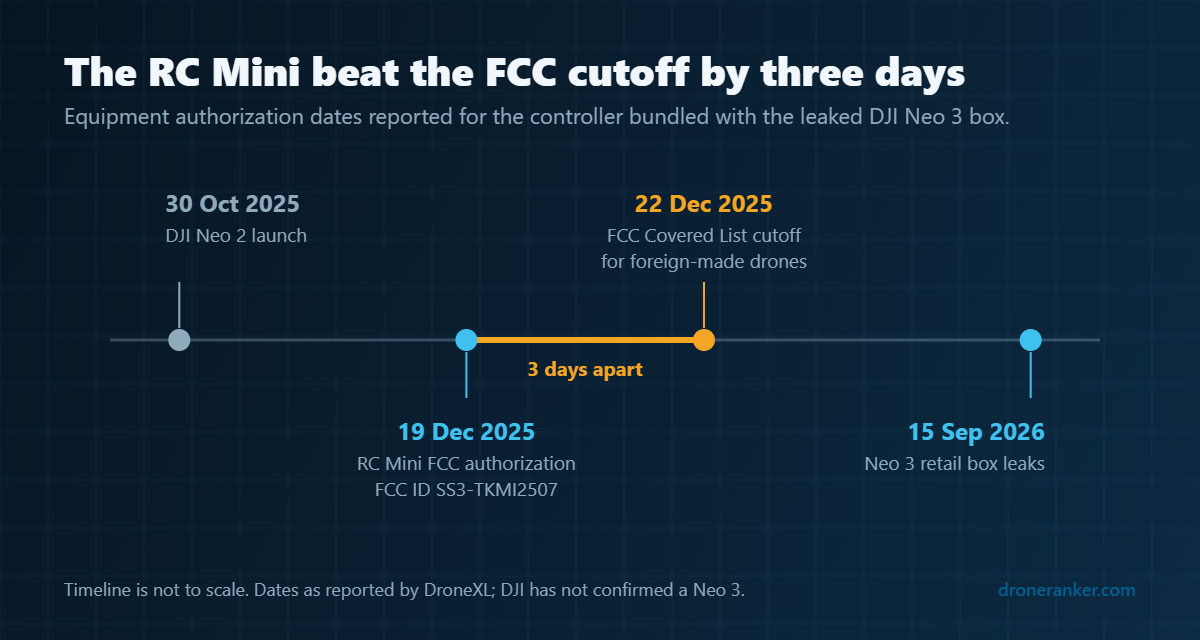
That authorization date carries more weight than anything printed on the box. It falls three days before the 22 December 2025 FCC Covered List cutoff for foreign-made drones, so the controller and the drone sit in very different regulatory positions.
For a drone that has always been sold on flying without a controller at all, putting a screened remote in the combo is a real positioning change. It moves the Neo line closer to a conventional camera drone and further from a selfie flyer.
Design changes visible on the box
Three differences from the Neo 2 show up in the packaging images, and all three are structural:
- Propeller guards. The Neo 2’s closed rings give way to a hub-and-spoke pattern that several outlets compared to bicycle wheels. Spoked guards are usually a weight-and-airflow trade against a solid ring.
- Extra rear venting. More venting normally signals either a warmer processor or a denser internal layout.
- A new dome on top. A sensor dome sits on the upper fuselage. DJI has disclosed nothing about its coverage or purpose.
The camera position has not changed: the gimbal still sits in the nose, as on the Neo 2. That suggests an iteration of the existing platform rather than a redesign.
Neo 3 vs Neo 2: what is known
The Neo 2 column below is DJI’s official specification. The Neo 3 column is only what the box, the registry and the leaked panel show.
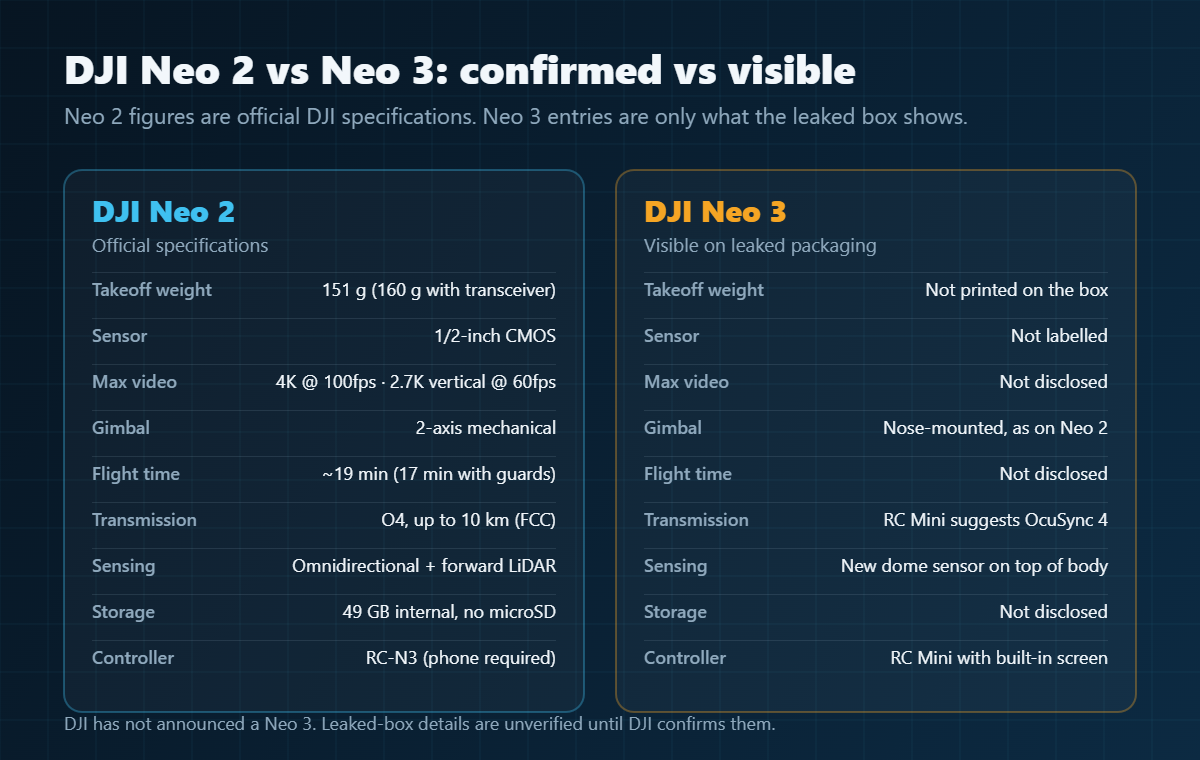
| Specification | DJI Neo 2 (official) | DJI Neo 3 (leaked) |
|---|---|---|
| Takeoff weight | 151 g / 160 g with transceiver | 192.7 g (China registry), transceiver built in |
| Image sensor | 1/2-inch CMOS | 1/1.1-inch square (box panel) |
| Max video | 4K @ 100fps, 2.7K vertical @ 60fps | Not disclosed |
| Gimbal | 2-axis mechanical | Nose-mounted, position unchanged |
| Max flight time | ~19 min (17 min with guards) | Not disclosed |
| Transmission | O4, up to 10 km (FCC) | RC Mini implies OcuSync 4 |
| Sensing | Omnidirectional vision + forward LiDAR | Additional top-mounted dome sensor |
| Internal storage | 49 GB, no microSD | Not disclosed |
| Bundled controller | RC-N3 (phone required) | RC Mini with built-in screen |
At 192.7 g the Neo 3 stays well under 250 g, so US recreational pilots would not need to register it. The Neo 2 sits inside the EU C0 class.
Flight time is the big gap. A “16-minute” Neo 3 figure is circulating in some roundups, but we could not trace it to any leak, filing or retail listing; one widely shared version links to a Neo 2 page as its source. Spoked guards, extra venting and a heavier airframe could push the number either way, so treat it as unknown until DJI or a certification filing gives one. The leaked 18.9 Wh, three-cell battery is covered here.
Will the Neo 3 be sold in the US?
Unlikely. The RC Mini’s authorization predates the Covered List cutoff, but no equivalent authorization is publicly known for a Neo 3 airframe, so a normal US retail launch looks improbable on current information.
That sits inside a broader picture we have been tracking: the 2026 FCC proposals affecting previously approved DJI models and the public comment record on the proposed drone rule. Neither has produced a final order, and neither stops anyone flying a drone they already own. The same constraint shapes expectations for the DJI Air 4 and the DJI Mini 6 Pro.
What the timing suggests
Retail packaging is one of the last things to exist before a launch, and a “Not for sale” sample box circulating outside DJI usually means production materials are already moving. The Neo 2 arrived on 30 October 2025, so a roughly annual cycle would put a successor in late 2026. The leaks are consistent with that, but they don’t prove it: DJI has never committed to a fixed Neo cycle and usually stays silent until days before an announcement.
Buy a Neo 2 now or wait?
If you want a Neo today, buy the Neo 2. It is a finished, documented product at around $299, while the Neo 3 is still a box with no price, no flight time and no confirmed US path. Waiting for it is a bet with no settlement date, and in the US it may never pay out.
The case for waiting is narrower: if a screened controller in the standard bundle or the larger sensor matters to you, and you live where DJI can sell it. If you mostly fly the Neo hand-launched and phone-free, the controller changes very little.
If you are choosing between models rather than generations, our Neo 2 vs Neo comparison, Neo 2 vs Flip and HOVERAir VERSA vs Neo 2 cover the current field. Beginners may also want the Ryze Tello vs Neo 2 breakdown. For the official Neo 2 numbers, see DJI’s Neo 2 specifications.
The Friday Brief
One email a week on what changed in drones
FCC and FAA rule changes, DJI leaks checked against filings, and the week’s new comparisons. Every Friday, nothing else.
Free. Unsubscribe in one click. Sent with Kit; see our privacy policy.
Follow us on Google too: add Drone Ranker as a preferred source →
Continue Reading
All News