Ryze Tello vs DJI Neo 2
Most beginners should buy the DJI Neo 2. It shoots 4K, follows you with ActiveTrack, launches from your palm and senses obstacles in every direction, so it stays useful long after the first few weeks. Buy the Ryze Tello only if you want cheap indoor…
Ryze Tello

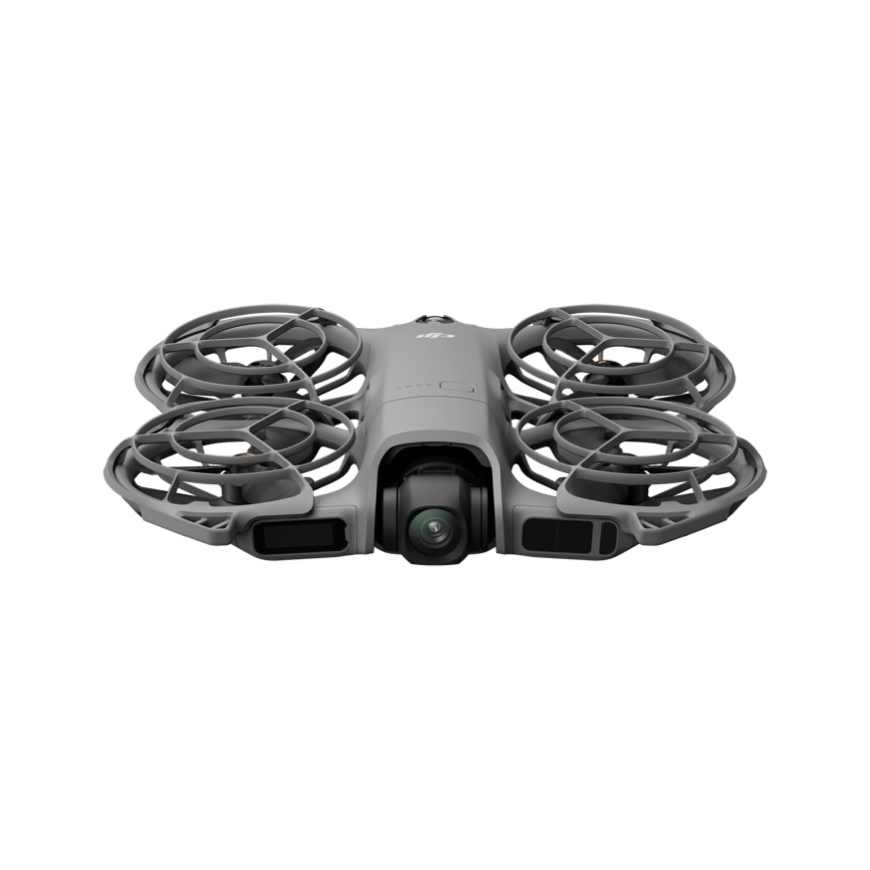
DJI Neo 2
Technical Specifications
Last updated: Oct 2026| Feature | Ryze Tello | DJI Neo 2 |
|---|---|---|
| Weight | Approx. 80 g with propellers and battery | 151 g without digital transceiver; approximately 160 g with digital transceiver |
| Dimensions | 98×92.5×41 mm | 147×171×41 mm |
| Volume | Approx. 372 cm³ bounding-box volume | Approx. 1031 cm³ bounding-box volume |
| Max Speed | 8 m/s | Up to 12 m/s maximum tracking speed in open areas |
| Max Flight Distance | 100 m | Control and transmission capability depends on operating method; O4 video transmission reaches up to 10 km under supported conditions |
| Sensor Size | Not specified by Ryze | 1/2-inch CMOS |
| Megapixels | 5 MP | 12 MP |
| Max ISO | Not specified | Mode-dependent; not used as a headline comparison metric |
| Flight Time | 13 minutes (manufacturer-stated) | Up to 19 minutes (manufacturer-stated) |
| Max Resolution | 720p at 30fps | 4K up to 60fps; 4K/100fps slow motion with remote or motion controller; 2.7K vertical video |
| Movie Bitrate | Not specified | Not used as a headline metric without a directly verified global specification value |
| Field of View | 82.6° | Wide-angle camera designed for personal follow-me and action-oriented framing |
| Transmission Range | Approx. 100 m over 2.4 GHz Wi-Fi | Wi-Fi: up to 500 m; O4: up to 10 km with compatible transmission setup |
| Wind Resistance | No official wind-resistance rating published | Level 5 wind resistance |
| Obstacle Avoidance | No obstacle avoidance; vision positioning and range-finding assist hovering | Omnidirectional monocular vision with forward-facing LiDAR and downward infrared sensing |
| Battery Power | 1100 mAh, 3.8 V detachable battery | 1606 mAh, 7.16 V, 11.5 Wh |
| Charge Time | Not specified on the official specification page | Approx. 70 minutes in the aircraft; approximately 68 minutes for three batteries simultaneously with a sufficiently powered Two-Way Charging Hub |
| Internal Storage | None; photos and video are handled through the connected device | 49 GB; no microSD expansion |
| GPS | No | Yes, GNSS-assisted flight |
| Obstacle Detection | No | Yes, omnidirectional vision with forward LiDAR and downward infrared sensing |
| Return to Home | No GPS-based Return to Home; connection-loss protection can trigger landing | Yes, with supported control modes |
| Removable Battery | Yes | Yes |
| Shoots RAW | No, JPEG photos | No |
| HDR Mode | No | No dedicated HDR mode used as a headline feature |
| Weather Sealed | No official IP rating | No official IP rating; DJI advises against flying in rain |
| Best For | Indoor practice, supervised kids, and Scratch or SDK coding projects | Beginners who want outdoor flying, family videos and follow-me shots |
| Beginner Learning Curve | Very simple phone-based flight with basic automated tricks | Very beginner-friendly with palm, gesture, app and controller options |
| Primary Beginner Strength | Low-cost flight practice and programming | Safer filming, automated tracking and outdoor versatility |
| Camera Resolution | 5 MP photos, 720p/30fps video | 12 MP photos, 4K/60fps video |
| Slow Motion | No high-resolution slow-motion mode | 4K/100fps with compatible remote or motion controller |
| Video Stabilization | Electronic Image Stabilization | 2-axis mechanical gimbal plus electronic stabilization |
| Obstacle Avoidance | None | Omnidirectional vision + forward LiDAR + downward infrared |
| Vision Positioning | Yes | Yes, with enhanced omnidirectional sensing |
| GNSS / GPS | No | Yes |
| Return to Home | No GPS-based RTH | Yes in supported control modes |
| Palm Takeoff | Throw & Go launch, not DJI-style palm takeoff | Yes |
| Return to Palm | No | Yes |
| Gesture Control | No | Yes |
| Subject Tracking | No ActiveTrack | ActiveTrack with cycling option, Spotlight and Point of Interest |
| Phone Control | Yes, Tello app over Wi-Fi | Yes, DJI Fly over Wi-Fi |
| Remote Controller Options | Selected third-party Bluetooth controllers | Compatible DJI remote controllers plus motion-control options |
| FPV Goggles | Basic smartphone VR-headset style support | Compatible with DJI Goggles N3 / Goggles 3 and motion control |
| Programming | Scratch and Tello SDK | Not positioned as a programming-learning platform |
| Indoor Use | Very good for basic practice in suitable indoor spaces; no obstacle avoidance | Excellent beginner features with protected propellers and obstacle sensing, subject to vision-system limitations |
| Outdoor Use | Best in calm conditions due to 80 g weight, Wi-Fi control and lack of GPS | Much stronger with GNSS, Level 5 wind resistance, obstacle sensing and longer-range control |
| Maximum Flight Time | 13 minutes | 19 minutes |
| Direct Wi-Fi Control Range | Approx. 100 m maximum flight range | Up to 500 m |
| Long-Range Transmission | No dedicated long-range digital transmission system | O4 up to 10 km with compatible setup |
| Internal Storage | None | 49 GB |
Two different ideas of a beginner drone
The Tello keeps things simple: your phone is the controller over 2.4 GHz Wi-Fi, takeoff and landing are automatic, and modes like Throw & Go and 8D Flips make early flights fun. That suits someone who mainly wants to learn movement and orientation.
The Neo 2 takes the opposite approach and reduces how much piloting you need. Palm takeoff, Return to Palm, gestures, voice control, SelfieShot and ActiveTrack let you get usable footage before you are comfortable with sticks. Later you can add a DJI remote, goggles or the motion controller for FPV.
720p against 4K
The Tello records 720p at 30fps and takes 5 MP photos, with electronic stabilization. It is fine for learning and casual sharing, not for aerial footage you want to keep. The Neo 2 uses a 12 MP 1/2-inch sensor, records 4K at up to 60fps and offers 2.7K vertical video for social posts. Its 4K/100fps slow-motion mode only works with a compatible remote or motion controller.
Safety: hovering aids versus real obstacle sensing
The Tello has vision positioning, a range finder, low-battery protection and failsafe landing on connection loss. That helps it hover and handle basic failures, but it does not detect obstacles. The Neo 2 combines omnidirectional monocular vision, forward LiDAR, downward infrared sensing and full propeller guards. DJI warns that wires, thin branches, glass, water, moving objects and poor light can still beat the sensors.
Indoors, both work; outdoors, the Neo 2 is far ahead
Indoors, the Tello's small size and vision hovering make it an easy room trainer. The Neo 2 is better equipped indoors thanks to its sensing and guards, and DJI highlights improved navigation inside and near buildings. Both need decent light and surface texture to hold position.
Ryze shows the Tello in parks too, so it is not indoor-only. But with about 80 g, no GPS, no obstacle avoidance and a roughly 100 m Wi-Fi range, it needs calm air and short distances. The Neo 2 adds GNSS positioning, Level 5 wind resistance, Return to Home and tracking. Its Wi-Fi control reaches up to 500 m, and a compatible O4 setup is rated for video up to 10 km. Flight time is 19 minutes against 13. All of these are manufacturer figures.
Coding is the Tello's one clear win
Ryze officially supports Scratch programming and the Tello SDK, so students can write commands and build flight experiments. The Neo 2 is a content-creation drone with no comparable coding angle. For a STEM class or a kid who wants to program, the Tello is the better choice, with supervision.
Ryze Tello
Strengths
- About 80 g
- Scratch programming and the Tello SDK
- Simple smartphone controls
- Vision positioning for indoor hovering without GPS
- Throw & Go, 8D Flips and Bounce Mode
Drawbacks
- 720p/30fps video and 5 MP photos
- No GPS and no GPS-based Return to Home
- No obstacle avoidance
- About 100 m maximum flight distance
- 13-minute rated flight time
DJI Neo 2
Strengths
- Omnidirectional vision sensing plus forward LiDAR
- Palm takeoff, Return to Palm and gesture control
- 4K/60fps video, with 4K/100fps slow motion on a compatible controller
- ActiveTrack, SelfieShot and QuickShots
- 49 GB internal storage
- GNSS and Level 5 wind resistance
Drawbacks
- Substantially more expensive and complex than the Tello
- 19-minute rated flight time
- No RAW photos
- Storage cannot be expanded with microSD
- No official IP rating; not for rain
Neo 2 for flying and filming, Tello for learning to code
Most beginners should buy the DJI Neo 2. It shoots 4K, follows you with ActiveTrack, launches from your palm and senses obstacles in every direction, so it stays useful long after the first few weeks. Buy the Ryze Tello only if you want cheap indoor practice or a drone for learning to code.
The Tello is a learning toy in the good sense: about 80 g, simple phone controls, Throw & Go and flips, and Scratch and SDK support that make it interesting for kids and students. Its 720p camera, 100 m range, no GPS and no obstacle avoidance make it a weak outdoor camera.
The Neo 2 costs substantially more and has more to learn. If you only want basic indoor practice, that extra cost is hard to justify.
Check DJI Neo 2 price on Amazon →Affiliate link. We may earn a commission at no extra cost to you.
Context and limitations
This comparison helps buyers choose between Ryze Tello and DJI Neo 2 by translating the specification table into camera, flight, safety, workflow and value decisions. Recommendations are matched to user needs rather than based on a single headline number.
Limitations
The Friday Brief
One email a week on what changed in drones
FCC and FAA rule changes, DJI leaks checked against filings, and the week’s new comparisons. Every Friday, nothing else.
Free. Unsubscribe in one click. Sent with Kit; see our privacy policy.
Follow us on Google too: add Drone Ranker as a preferred source →

Alihan Demirdaş is the founder and editor of Drone Ranker. A software developer by profession, he researches drones the way he reads code: from the primary documents. Every review, comparison and news story on the site is written by him from manufacturer specification sheets, FCC and EU certification filings, aviation-authority rules and dated press releases, with the source linked. Unless a page is labelled hands-on, the analysis is documentary; when an aircraft is in his hands, the page says so and carries his own photographs and flight notes. He covers consumer, professional and agricultural drones and is based in Türkiye.