Can You Still Buy DJI in the US? Here’s What’s Left in September 2026

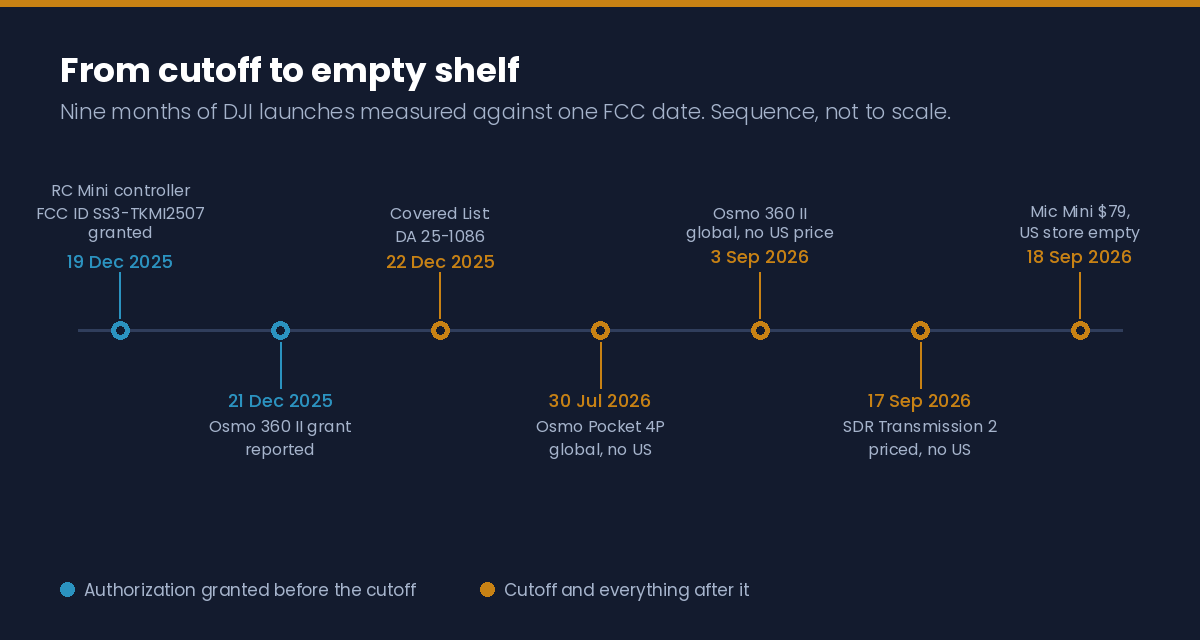
If you are trying to buy DJI in the US this month, three things happened in the space of sixteen days that say more about where the company stands than any single announcement has all year. On 3 September DJI launched the Osmo 360 II at IFA in Berlin without a US price. On 17 September it priced the SDR Transmission 2 for Europe and the UK, again with no US listing. On 18 September the original Mic Mini appeared on Amazon at $79, below its $99 kit price, while every configuration of it sat out of stock on DJI’s own US storefront.
The convenient explanation is that the FCC banned DJI and that is the end of it. The filings do not support that reading. One of the products above is cleared to be sold in the United States and is not being sold anyway. That distinction — between what DJI cannot put on a US shelf and what it has chosen not to — is the part almost nobody is separating out, and it decides whether a future rule change would actually bring anything back.
Table of Contents
Quick answer for one product: pick it in our US drone ban checker, which separates “cannot be sold” from “legal, but DJI isn’t selling it”.
What the December 2025 rule actually does
On 22 December 2025 the FCC released Public Notice DA 25-1086, adding foreign-made unmanned aircraft systems, UAS critical components, and DJI communications and video surveillance equipment to its Covered List. The mechanism is narrow and worth stating precisely, because most coverage of it is not precise.
- It blocks new equipment authorizations. Anything on the Covered List cannot receive a fresh FCC grant, and without a grant it cannot legally be imported or marketed in the US.
- It does not retroactively cancel existing grants. Hardware that already held an authorization before the cutoff kept it.
- It does not touch the drone in your bag. Equipment already sold to consumers stays legal to own and fly.
DJI is only part of this story. The same rule reaches every foreign manufacturer, which is why swapping brands does not solve it — see which drones are banned in the US for the market-wide picture.
The rules kept moving after this was written. From 13 October an American-built drone cannot be newly authorized with a DJI board inside it either, which is a separate FCC order about components rather than aircraft.
For the mirror image of this story — a market where DJI products are welcome but every aircraft must be registered to a named owner before it will start — see what the Chinese standards printed on the DJI Neo 3 box require.
So the rule does not empty a shelf. It freezes one. Existing inventory sells down and nothing new gets added behind it — which is exactly the pattern the Mic Mini listings show, six configurations out of stock with no successor model carrying a US page.
Bucket one: products the rule blocks
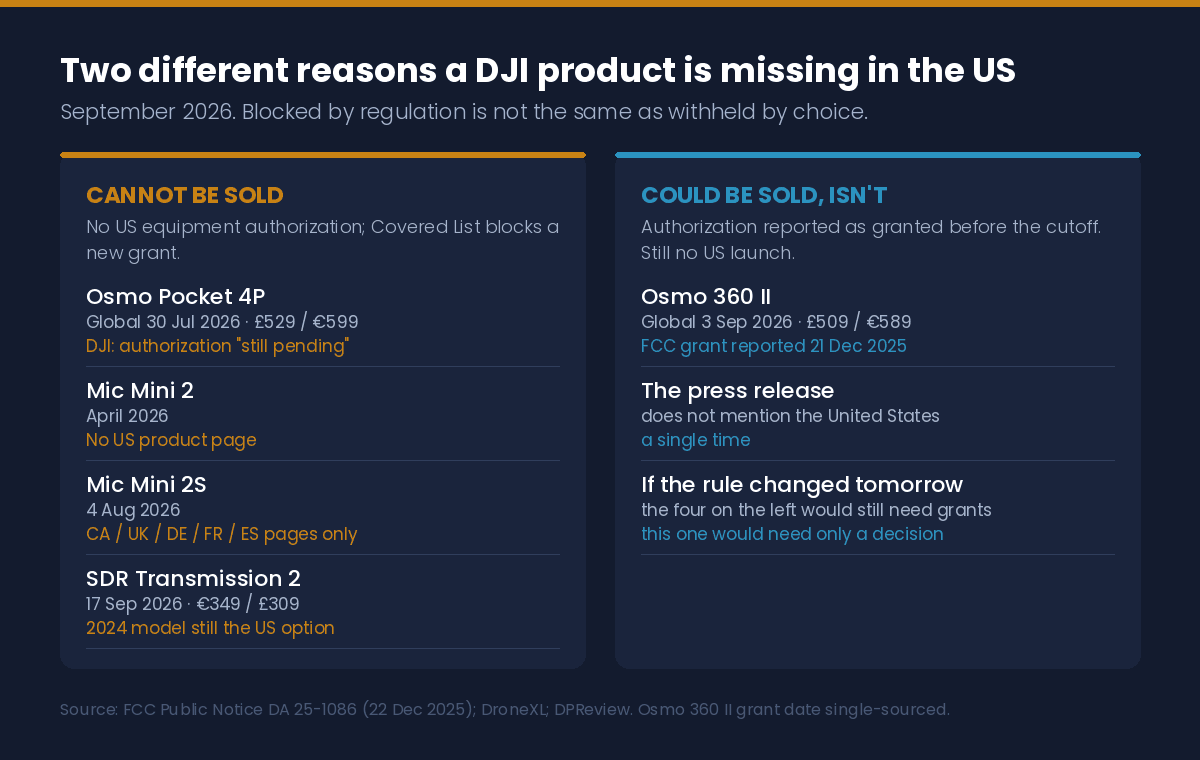
Four 2026 DJI releases fall cleanly into this category. None of them launched in the US, and in each case the missing piece is an equipment authorization DJI can no longer obtain.
- Osmo Pocket 4P — global launch 30 July 2026 at £529 / €599 for the base kit. Asked about the US, DJI’s stated position was that “the application for authorization is still pending,” per DPReview.
- Mic Mini 2 (April 2026) and Mic Mini 2S (4 August 2026) — product pages exist for Canada, the UK, Germany, France and Spain. Not for the United States. DroneXL reports an FCC filing for the Mic Mini 2S surfaced on 31 January and then disappeared.
- SDR Transmission 2 — announced at IBC Amsterdam, priced 17 September at €349 / £309 for a single transceiver and €629 / £559 for the two-unit combo, after a 1 September China launch at ¥1,999. For US crews the 2024 SDR Transmission, at $549, remains the newest legal option.
It is worth pausing on the last two. A wireless microphone with no camera, no GPS and no flight capability is now caught by a rule written around unmanned aircraft, because the Covered List entry reaches DJI’s communications equipment as a class rather than drones as a product category. Whatever one thinks of the national-security case for the drones, the microphone is a reminder that the scope is broader than the headline suggests.
Bucket two: cleared, and still not sold
The Osmo 360 II does not belong in the list above, and this is the detail that changes the story.
DJI announced the camera on 3 September 2026 from IFA in Berlin, with European availability from 15 September at £509 / €589 for the Standard Combo and £639 / €739 for the Adventure Combo. Native 8K60 panoramic video, a 1-inch square HDR sensor rated at 14.5 stops, user-replaceable lenses, 105 GB of internal storage, 183 grams. No US price was given, and DroneXL notes the press release does not mention the United States once.
According to the same report, the Osmo 360 II holds an FCC equipment authorization granted on 21 December 2025 — one day before the Covered List cutoff. This is a single-source claim and DJI has not commented on it, so treat it as reported rather than confirmed. But if it holds, the camera is legally sellable in the United States and DJI is declining to sell it. That is a commercial decision, not a regulatory outcome.
The practical consequence is straightforward. If the FCC softened its position tomorrow, the Pocket 4P and the SDR Transmission 2 would still need authorizations they do not have. The Osmo 360 II would need nothing at all — it would need DJI to want the US market. Those are different problems with different timelines, and lumping them under “the DJI ban” hides that.
Where that leaves the drones
The same split runs through the aircraft. The DJI Mini 5 Pro was never listed on DJI’s US store at launch; DJI cited market conditions. It reached American buyers anyway through third-party retailers, with Amazon bundles running from roughly $1,397 to $1,929. That is not a loophole in the Covered List — units authorized before the cutoff can still be imported and sold by whoever holds them. It is the same freeze working in the buyer’s favour for as long as stock lasts.
The timing detail matters more than it looks. When the DJI Neo 3 retail box leaked on 15 September, the RC Mini controller shown with it carried FCC ID SS3-TKMI2507, granted 19 December 2025 — three days before the cutoff. A controller cleared in that window is one of the few pieces of an unannounced DJI product that could, in principle, still be sold in the United States. The aircraft it pairs with could not, on current rules, get its own grant.
For the two aircraft this site tracks most closely, the arithmetic is unchanged: neither the DJI Air 4 nor the DJI Mini 6 Pro has a US path under the rule as written, which we covered in more detail in our look at whether either will be sold in the US.
The part that is still open: previously authorized gear
The freeze described above depends on one thing staying true — that old authorizations keep working. The FCC has proposed changing that.
- DA 26-742, released 17 July 2026, sought comment on limiting continued importation and marketing of previously authorized foreign-made UAS, UAS critical components, and DJI communications and video surveillance equipment. Comments closed 31 August 2026.
- DA 26-758, released 21 July 2026, went further for equipment the Bureaus characterise as “military grade,” proposing to prohibit importation and marketing of items that already hold authorizations. Comments closed 2 September 2026.
DJI filed a 26-page response in early September. Its central objection is that the seven “military-grade” categories are, in its words, “an entirely post-hoc creation of the Bureaus,” and that features like thermal cameras, LiDAR and docking stations are ordinary commercial technology. The filing puts DJI’s own exposure above $1.5 billion and names the Mini 5 Pro, Air 3S and Avata 360 as products the proposal would reach — the LiDAR-sensor question we went through in the 2026 FCC LiDAR update. The public comment round is the procedural step before any order.
As of 19 September 2026 no order has issued on either notice. Until one does, the retroactive step is a proposal, not a rule — and the existing-stock channel that is currently supplying American buyers stays open.
What this means if you are buying now
A few things follow from the structure rather than from speculation:
- The practical way to buy DJI in the US right now is third-party stock, and that stock is legal to own and fly. That is not in dispute under the current rule.
- Warranty and service routing is the real friction. A product DJI does not sell in the US is a product DJI does not support through a US channel, and grey-market units frequently carry regional warranty terms rather than American ones. Check the seller’s terms before assuming coverage.
- Prices on remaining inventory move in both directions — liquidation pricing on discontinued lines, scarcity pricing on desirable ones. The Mic Mini at $79 and the Mini 5 Pro near $1,900 are the same market, seen from opposite ends. Tariffs sit on top of this; we covered that separately in the 2026 US tariff price analysis.
- If you need guaranteed US support and a clean supply chain, the procurement shift already visible in American public safety is instructive — Boston’s drone-as-first-responder programme flies BRINC hardware, not DJI, as we covered in the BRINC Responder crash report.
The short version
DJI is not banned from the United States in the sense most people mean. Its 2026 releases are largely unable to enter, its existing catalogue is selling down without replacement, and at least one cleared product is being withheld by choice. The first of those is a regulatory fact, the second is its consequence, and the third is a business decision that no FCC ruling will reverse. Anyone forecasting where you will be able to buy DJI in the US next year needs to keep the three apart.
Frequently asked questions
Can you still buy DJI drones in the US in September 2026?
Yes. You can still buy DJI in the US from third-party retailers holding stock that was authorized before 22 December 2025. DJI’s own US storefront no longer carries its newest models, and several 2026 products were never listed there at all.
Is it illegal to fly a DJI drone in the US now?
No. The Covered List governs equipment authorization — import and marketing — not personal use. Aircraft already sold remain legal to own and operate under the usual FAA rules.
Why is the Osmo 360 II not sold in the US if it has FCC clearance?
DJI has not said. The authorization reported for it predates the Covered List cutoff by one day, which would leave the US launch a commercial decision rather than a regulatory block. DJI’s press material for the camera does not mention the United States.
What is the FCC Covered List and when did DJI go on it?
It is the FCC’s list of equipment deemed an unacceptable national-security risk; listed equipment cannot receive new authorizations. Public Notice DA 25-1086, released 22 December 2025, added foreign-made UAS, UAS critical components, and DJI communications and video surveillance equipment.
Could the FCC ban DJI products that were already approved?
It has proposed doing so, in DA 26-742 and DA 26-758. Both comment periods closed in late summer 2026 and no order had issued as of 19 September 2026. Until one does, previously authorized equipment can still be imported and sold.
Will the DJI Mini 6 Pro or Air 4 be sold in the US?
Not under the current rule. Neither aircraft has a US equipment authorization, and as Covered List entries they cannot obtain one while the listing stands.
Does buying from Amazon or another retailer void the warranty?
Not automatically, but coverage depends on the seller and on which regional warranty the unit carries. Products DJI does not sell in the US are not supported through a US channel, so read the listing’s warranty terms before purchase.
What happened to the DJI Mic Mini in the US?
All six configurations are out of stock on DJI’s US store with no successor listed there. The original kit appeared on Amazon at $79 against a $99 list price on 18 September 2026 — pricing consistent with clearing remaining inventory rather than a promotional discount.
Are DJI products cheaper or more expensive in the US because of this?
Both, depending on the product. Discontinued lines clear at a discount; in-demand aircraft with no resupply drift upward. US tariffs apply on top of whatever the retailer charges.
What is the difference between the Covered List and a tariff?
A tariff raises the cost of importing a product. The Covered List determines whether the product can be authorized for import and sale at all. A tariff makes a drone more expensive; a Covered List entry stops the next model arriving.
Sources
- FCC, Public Notice DA 25-1086 (22 December 2025)
- DroneXL — Osmo 360 II global launch at IFA
- DroneXL — SDR Transmission 2 pricing
- DroneXL — Mic Mini at $79, US store empty
- DPReview — Osmo Pocket 4P launches outside the US
- Engadget — SDR Transmission II specifications
- DroneDJ — DJI’s filing on the “military grade” proposal
Sources
Primary references used for factual claims in this article.
Continue Reading
All News