From 13 October, a US-Built Drone Cannot Have DJI Parts Inside

Three weeks from now the American drone rules stop asking only who built the aircraft and start asking who built the parts inside it. From 13 October 2026, a radio device cannot receive a new FCC equipment authorization if it contains logic-bearing hardware made by a company on the Covered List — and that applies even when the device itself was designed and assembled in the United States.
The FCC component rule is the part of this year’s regulation that does not care about your flag. A drone built in Ohio by an American company, sold to an American police department, cannot be newly authorized after that date if a DJI or Autel circuit is doing the thinking inside it.
Table of Contents
Correction, 2 October 2026: the Blue UAS and Buy American exemptions now run to 1 January 2028, not 1 January 2027; the FCC extended them on 21 July 2026.
Update, 2 October 2026: For how this rule lands on US-assembled agricultural spray drones, and why “built in America” does not settle the question on its own, see our agricultural drone ban guide.
Update, 1 October 2026. The rule reaches forward as well as back. DJI’s next inspection aircraft, the Matrice 5TD named in a Chinese registry filing on 21 September, is aimed at power line and pipeline work whose biggest market cannot lawfully buy it.
What actually changes on 13 October
The instrument is the FCC’s Third Report and Order, FCC 26-50, in ET Docket No. 21-232. It was published in the Federal Register on 11 September 2026 at 91 FR 57798 and takes effect thirty days later, on 13 October.
What it closes is usually called the component loophole. Until now the Covered List stopped a listed company from getting its own device authorized; it did not stop somebody else’s device from being built around that company’s chips. After 13 October, a device containing logic-bearing hardware produced by a covered entity is prohibited from authorization where the device would have been prohibited had that entity made the whole thing.
Two limits are worth stating immediately, because they decide how much of the market this touches:
- It is prospective. Equipment already authorized is untouched, and nothing you own changes.
- It applies to new applications for authorization. It is a rule about paperwork that has not been filed yet, not a recall.
What a logic-bearing component is
The definition in the order is long and worth reading once in full, because the boundary it draws is not the intuitive one:
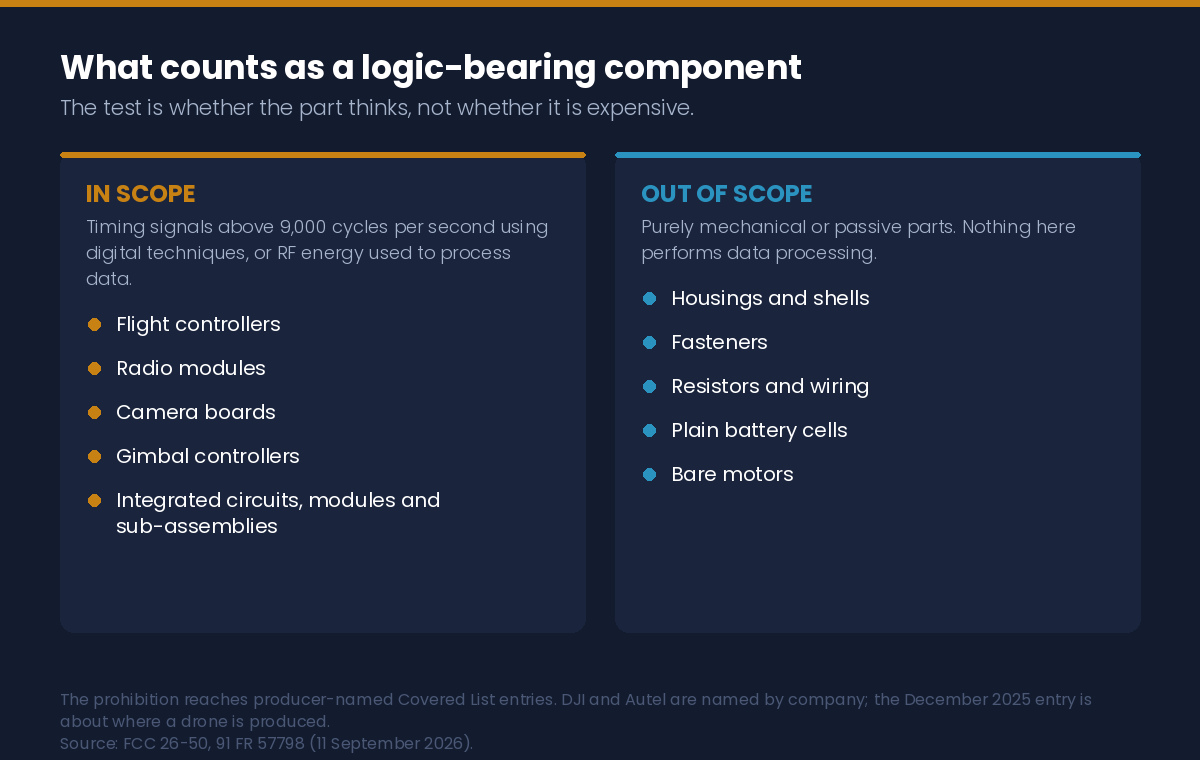
“Any device, system, module, sub-assembly, integrated circuit, or other physical component that generates and uses timing signals or pulses at a rate in excess of 9,000 pulses (cycles) per second and uses digital techniques … or any device, system, module, sub-assembly, integrated circuit, or other physical component that generates and uses radio frequency energy for the purpose of performing data processing functions.”
In plain terms: the test is whether the part thinks. On a drone that pulls in the flight controller, the radio module, the camera board and the gimbal controller. It leaves out the housing, the fasteners, the resistors, the wiring, plain battery cells and bare motors.
One consequence follows directly from that line. The 65 per cent Buy American content threshold does not rescue a design: a drone can be overwhelmingly American by value and still fail this test on one board.
The one place the Covered List really is a brand list
We argued yesterday that the December 2025 listing is a category rather than a list of companies, and that swapping badges does not help you. That remains true of the listing. The component rule is the exception that makes the distinction matter.
The Covered List carries two different kinds of entry. Some are producer-based: a named company, such as Huawei, ZTE, Hikvision, Dahua — and, for drones, DJI and Autel Robotics. Others are production-location-based: the December 2025 entry covering all unmanned aircraft produced in foreign countries, whoever made them.
Practitioner analysis of the order reads the component prohibition as reaching the producer-based entries rather than the location-based ones. If that is right, the effect is specific: a US-built drone fails because DJI and Autel are named companies, not because their chips were made abroad. A logic-bearing part from a foreign manufacturer that is caught only by the category entry would not trip the same wire.
So the honest summary across the two rules is this. For finished aircraft, the question is where it was produced. For the components inside somebody else’s aircraft, the question is who produced them. Yesterday’s advice and today’s are not in conflict; they answer different questions.
Who this actually hits
Not DJI. DJI already cannot obtain new authorizations for its own aircraft, which is the position we traced through its shrinking catalogue in what is left of DJI in the US. This rule costs DJI a component business it was quietly still running.
The people it lands on are the American and allied manufacturers who were supposed to be the answer. Building a drone in the United States has never meant building every board in the United States, and Shenzhen has been the default supplier of exactly the parts this rule names. A manufacturer serving public safety buyers — the procurement shift we described around Boston’s BRINC programme — now has to be able to answer, in writing, where each thinking part came from.
That is a supply-chain audit, not a form. It is also the point of the rule.
The grandfather clause and the trap inside it
Applications already pending on 13 October are exempt from the new prohibition. That exemption is not permanent, and the condition attached to it is the detail most worth knowing:
“Applications pending as of the effective date are exempt from the new prohibition unless later amended to add, substitute, or change a logic-bearing hardware component.”
So a manufacturer that files before the deadline buys protection for that design as filed. Change the flight controller afterwards — for a supply problem, a cost saving, a revision — and the protection goes with it. In an industry where board revisions are routine, that is a narrow ledge to stand on.
The half of this order that reaches you directly
The same order does something else that has had almost no coverage, and it is the part a buyer will actually notice. Online marketplaces will have to show the FCC ID at the point of sale for the radio devices they list.
- 1 March 2027 — marketplaces with physical access to, or title over, the devices they list must display a valid and accurate FCC ID.
- 1 June 2027 — listings from third-party sellers follow, with the platform verifying against the FCC database and obtaining the seller’s certification that the identifier is accurate.
There are real carve-outs. Used devices are exempt. So are sellers below the INFORM Consumers Act threshold, which is 200 sales or $5,000 in revenue over a rolling 24 months. Existing listings are exempt until they are amended or republished. And enforcement is aimed at willful violations and a platform’s own inventory rather than at platforms doing reasonable diligence.
Even with those gaps, the direction is clear. The advice we gave yesterday — find the FCC ID and check the grant date before you buy — becomes, from March 2027, something the platform is obliged to put in front of you. The listing with no identifier and a suspiciously good price gets harder to run.
The dates ahead
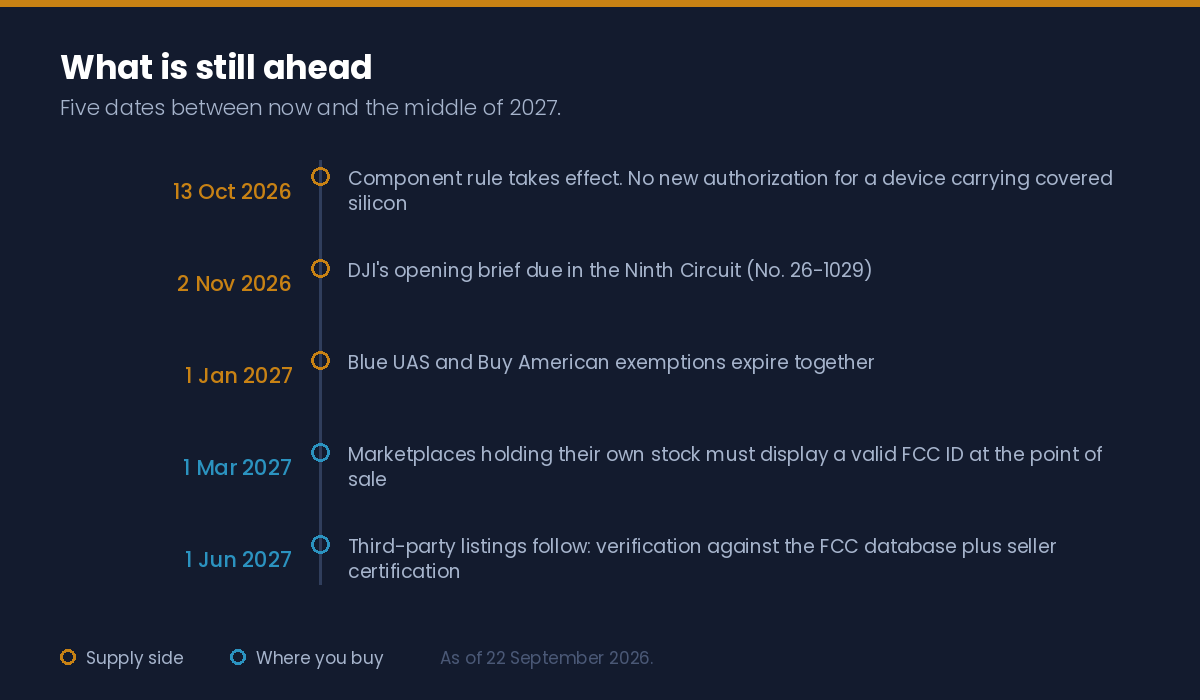
Put beside the proceedings we have been tracking, the next nine months are unusually crowded. The component rule lands on 13 October. DJI’s opening brief in the Ninth Circuit is due on 2 November. The Blue UAS and Buy American exemptions expire on 1 January 2028 (extended on 21 July 2026 from 1 January 2027). Then the two marketplace deadlines arrive in March and June.
Still unresolved underneath all of that: the full Commission has not decided the DJI and Autel challenges, and no order has issued on the July proposals that would reach previously authorized equipment, which we covered in the public comment round and the “military grade” update.
What it means if you are just buying a drone
Almost nothing, this month. Nothing on a shelf today is affected, nothing you own is affected, and the aircraft you were comparing last week are the same aircraft.
What changes is the shape of the choice in a year or two. The market was already not being restocked with foreign-made models; this narrows the path for the domestic alternatives that were supposed to fill the gap, because their bill of materials has to change first. Fewer new models, later, and probably dearer.
The one thing worth doing now is the same thing as before. Check the FCC ID and its grant date on anything you buy, and treat a listing without one as what it is.
Frequently asked questions
What is the FCC component rule?
A prohibition, effective 13 October 2026, on granting equipment authorization to a radio device that contains logic-bearing hardware produced by a company on the FCC’s Covered List, where that device would have been prohibited had the covered company built the whole thing. It comes from the Third Report and Order, FCC 26-50, in ET Docket No. 21-232.
Does the FCC component rule affect the drone I already own?
No. It applies prospectively to new applications for equipment authorization. Equipment already authorized keeps its authorization, and nothing already sold is recalled or grounded.
Which drone parts count as logic-bearing components?
Parts that process data: flight controllers, radio modules, camera boards, gimbal controllers, and the integrated circuits, modules and sub-assemblies inside them. Housings, fasteners, resistors, wiring, plain battery cells and bare motors are outside the definition.
Can an American-made drone use DJI parts after 13 October?
It can be built, but it cannot obtain a new FCC equipment authorization, which in practice means it cannot be lawfully marketed or imported as a new model. DJI and Autel are named companies on the Covered List, so their logic-bearing components trigger the prohibition regardless of where the aircraft is assembled.
Does meeting Buy American requirements avoid the problem?
No. The 65 per cent domestic content threshold is a separate test. A design can satisfy it by value and still fail the component rule because of a single covered board.
What happens to applications already filed?
Applications pending on the effective date are exempt — unless they are later amended to add, substitute or change a logic-bearing hardware component, at which point the exemption is lost.
Will Amazon have to show an FCC ID on drone listings?
Yes, on the timeline in the same order. Marketplaces with physical access to or title over the devices must display a valid FCC ID from 1 March 2027; listings from third-party sellers follow on 1 June 2027, with database verification and a seller certification.
Are there exemptions to the marketplace requirement?
Used devices are exempt, as are sellers below the INFORM Consumers Act threshold of 200 sales or $5,000 in revenue over 24 months. Existing listings are exempt until amended or republished.
Does this mean drone prices will rise?
It points that way for new models rather than for current stock. Redesigning around a different supplier costs money and time, and the manufacturers affected are mostly the smaller domestic ones. Tariffs sit on top of that as a separate layer.
How does this fit with the December 2025 Covered List entry?
The December 2025 entry is about where a finished aircraft is produced. The component rule is about who produced the thinking parts inside somebody else’s device, and it reaches the companies named on the list rather than the location-based category.
Sources
- Federal Register, Protecting Against National Security Threats to the Communications Supply Chain Through the Equipment Authorization Program, 91 FR 57798 (11 September 2026)
- DroneXL — FCC bars DJI chips from new US-built drones on October 13
- Pillsbury — FCC to close another equipment authorization loophole and expand e-commerce platform obligations
- Mondaq — The FCC looks inside the box: new rules for components and online marketplaces
- FCC, Public Notice DA 25-1086 (22 December 2025)
Sources
Primary references used for factual claims in this article.
Continue Reading
All News