A Chinese Filing Named the DJI Matrice 5TD. Its Payload Nearly Doubled.


On 21 September a line appeared in China’s national drone registry. Manufacturer: SZ DJI Technology. Model code: M5TD. Name: DJI Matrice 5TD. Intended use: power line patrol and oil pipeline inspection. The production date field was left blank.
The entry carries two weights, and almost all of the coverage since has quoted the first one: the aircraft is 750 grams heavier than the Matrice 4TD it replaces. That is true, and on its own it reads like bad news, because a heavier airframe usually means shorter flights.
The second number says something different. Put the two side by side and the DJI Matrice 5TD has not simply gained weight. It has gained roughly twice as much room to carry something.
Table of Contents
What the filing actually says
The registry is the CAAC’s UOM platform, China’s national drone registration system, and the entry is an administrative record rather than a product announcement. That distinction is worth holding on to. It gives us a model designation, a manufacturer and two mass figures because those are the fields the form has. It tells us nothing about flight time, sensors, price or a launch date, because the form does not ask.
- Manufacturer: SZ DJI Technology Co.
- Model code: M5TD, listed as DJI Matrice 5TD
- Empty weight: 2,600 g
- Maximum take-off weight: 3,050 g
- Intended use: power line patrol and oil pipeline inspection
- Production date: blank
The screenshots came from Igor Bogdanov, who has a track record on DJI enterprise hardware — he was accurate on the Matrice 400A and on the Matrice 4 series before this.
The two numbers, and the one nobody worked out
The Matrice 4TD’s official figures are public: 1,850 g empty and 2,090 g maximum take-off. So the deltas are +750 g empty and +960 g on take-off.
That second delta is larger than the first, and the gap between them is the whole story. Subtract one from the other on each aircraft and you get the margin the airframe has left for whatever it is carrying.
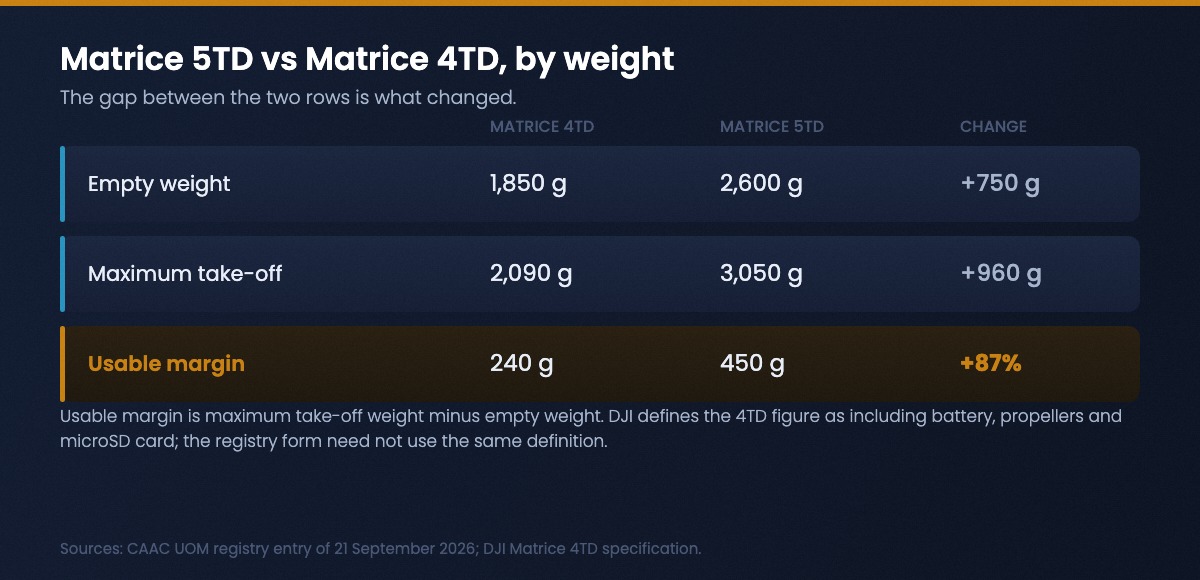
The usable margin rises by 87 per cent. The aircraft got heavier, but its permitted take-off weight got heavier faster, and that is a deliberate engineering decision rather than a side effect of one.
One caveat, and it matters. DJI’s 1,850 g for the 4TD is defined on its own specification sheet as including the battery, propellers and microSD card, with no third-party payload. A registry form does not have to use that definition. If the CAAC field counts the airframe without its battery, the comparison above breaks and the margin means something else entirely. Nobody outside DJI can resolve that today, so the honest version is this: on a like-for-like reading the margin nearly doubles, and the reading is like-for-like only if the two documents define “empty” the same way.
Where 750 grams could go
The explanation in circulation is that the weight is LiDAR and RTK moving from accessories into the airframe. Half of that is wrong, and it is easy to check.
RTK was already aboard the 4TD. DJI’s own specification lists the RTK module as integrated on the aircraft. It cannot be part of a weight increase, because it was never outside the aircraft to begin with.
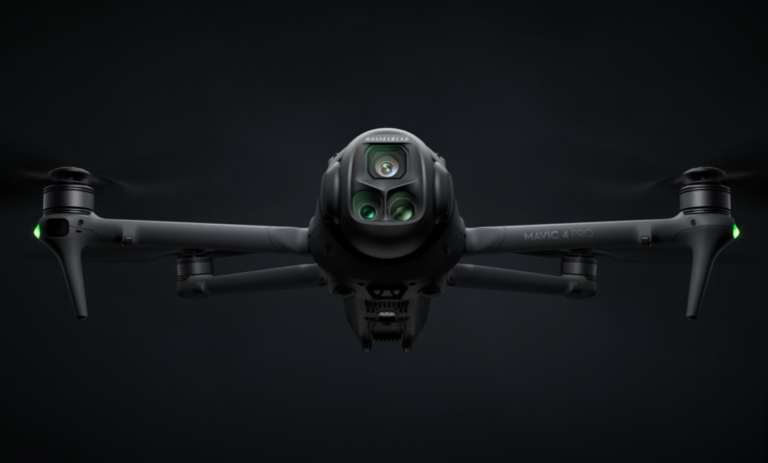
LiDAR is the real candidate. The Matrice 4TD does not include it; laser scanning is bought as a separate Zenmuse L2 or L3 payload. The prototype photographed in July carried a dome on top of the fuselage in exactly the position an integrated scanner would sit, along with a five-window gimbal arranged in two rows and what appears to be a laser rangefinder lens. A scanner, its window, its mount and the structure to carry it is a plausible few hundred grams. The rest would be the larger gimbal assembly and, if the margin figure holds, a bigger battery.
That is an inference from a photograph and a weight, and it is labelled as one here. What sits behind those five windows has not been confirmed by anybody.
What integration costs the buyer
If the scanner moves inside, the purchasing decision changes shape.
Today a Matrice 4 operator who wants laser scanning buys the payload separately, an add-on in the region of $2,075. The ones who do not need it do not pay for it. Integration removes the choice in both directions: nobody has to specify it, and nobody can decline it. The base aircraft becomes more capable and almost certainly more expensive, and the fleet buyer who only wanted thermal inspection is now carrying a scanner on every flight whether the job needs one or not.

For the jobs named in the filing — power lines and pipelines — that is probably the right trade. Those are exactly the surveys where a scanner earns its weight. It is a narrower aircraft than the 4TD, aimed harder.
The class thresholds do not move
Weight increases matter most when they cross a regulatory line. This one crosses none.
In China the aircraft stays in the light category, which runs from 250 g to 4 kg; at 3,050 g it has room to spare. In Europe the C2 class marking is capped at 4 kg maximum take-off mass, so both the 4TD and the 5TD sit inside it and an operator’s certificate requirements do not change. In the United States, weight is not the binding constraint on an aircraft this size at all. Something else is.
The American problem
The filing names power line patrol and oil pipeline inspection. The largest market in the world for exactly that work is the United States, and as the rules stand the DJI Matrice 5TD has no lawful route into it.
Since the FCC added foreign-made unmanned aircraft and critical components to its Covered List on 22 December 2025, no new DJI aircraft can receive a new equipment authorization. An aircraft that has never been authorized cannot be marketed or imported for sale. From 13 October 2026 the position tightens further: a drone designed and assembled in the United States cannot receive an authorization either if it carries logic-bearing hardware from a named covered producer. And on 1 January 2028 the Blue UAS and Buy American exemptions expire together.
So DJI is defining its next inspection aircraft around a job whose biggest customers — American utilities, pipeline operators and public safety agencies — cannot currently buy it. Whatever the Matrice 5TD turns out to be, for a US operator it is a specification sheet rather than a purchase option. The Matrice 400, the heavier flagship above this line, sits in the same position.
What is not confirmed
Four things are circulating that this filing does not support, and they are worth separating out.
A launch on 14 October. One Italian outlet reports that DJI has teased an Enterprise announcement for 14 October 2026, and reads a battery-shaped module in the teaser as automatic battery swapping in a new dock. DJI’s own enterprise newsroom carries no such announcement, and DroneXL’s rumour tracker does not mention the date. Treat it as a single-source report until DJI posts it.
Dock 4. Bogdanov said on 25 September that a Dock 4 exists and will reach stores. No source was given, and no dock photographs, dealer listings or specifications have surfaced.
The labelled product image. A picture captioned “DJI Matrice 5TD” appeared on 25 September. One outlet describes it as a finished product shot; another calls it a leaked render. Both cannot be right, and after the DJI Neo 3 episode in September — where a widely shared “photo” turned out to be artwork printed on the retail box — the distinction is not academic.
Everything about performance. Flight time, sensor configuration, ingress protection, charge time and price are all unknown. The 4TD flies up to 54 minutes and hovers for 47. Whether the 5TD matches that with more mass and a bigger battery is the single most useful number still missing.
Frequently asked questions
How much does the DJI Matrice 5TD weigh?
The Chinese registry filing lists 2,600 g empty and a maximum take-off weight of 3,050 g. That is 750 g heavier empty than the Matrice 4TD and 960 g heavier at take-off.
Is the Matrice 5TD more capable than the 4TD?
On the filing’s own figures the margin between empty weight and maximum take-off weight rises from 240 g to 450 g, which points to meaningfully more carrying capacity. No performance figures have been published.
Does the DJI Matrice 5TD have built-in LiDAR?
Not confirmed. A prototype photographed in July 2026 carries a dome on the fuselage in the position an integrated scanner would occupy, and the weight increase is consistent with one. DJI has said nothing.
Did the Matrice 4TD have RTK?
Yes. RTK is integrated on the aircraft according to DJI’s own specification, which is why it cannot explain the Matrice 5TD’s extra weight.
When is the DJI Matrice 5TD release date?
Not announced. The registry entry’s production date field is blank. One outlet reports a DJI Enterprise teaser pointing at 14 October 2026, but DJI’s own newsroom does not list it.
What will the Matrice 5TD be used for?
The filing names power line patrol and oil pipeline inspection.
Can I buy the DJI Matrice 5TD in the United States?
Not as the rules stand. New DJI aircraft cannot receive new FCC equipment authorizations following the December 2025 Covered List update, and a device without authorization cannot lawfully be marketed or imported for sale in the US.
Does the extra weight change its drone class?
No. It stays in China’s light category, which runs to 4 kg, and within Europe’s C2 class marking, also capped at 4 kg maximum take-off mass.
Is there a DJI Dock 4?
A leaker said so on 25 September without citing a source. No photographs, listings or specifications have appeared.
How reliable is this leak?
The registry entry is an administrative record with specific figures, which is a stronger class of evidence than a photograph. The prototype images come from a leaker with a good record. The performance claims and the dock do not have that backing.
Sources
- DroneXL — DJI Matrice 5TD surfaces in a Chinese registration filing, 27 September 2026
- DroneXL — Matrice 5 prototype photographs: integrated LiDAR and five-window gimbal, 27 July 2026
- DJI Matrice 4TD official specifications
- Quadricottero — report of a DJI Enterprise teaser dated 14 October 2026
- EU C-class drone categories and mass limits
Sources
Primary references used for factual claims in this article.
Continue Reading
All News