DJI Matrice 400 Weight: An Honest Breakdown of 9.74 kg Ready to Fly and 15.8 kg Max Takeoff

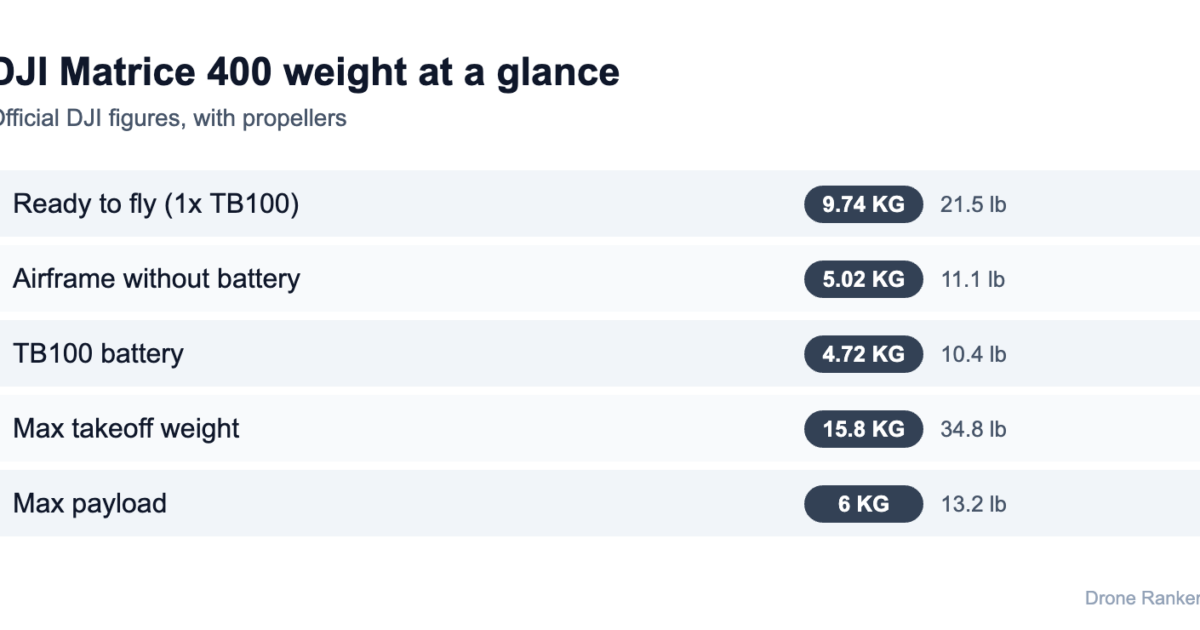
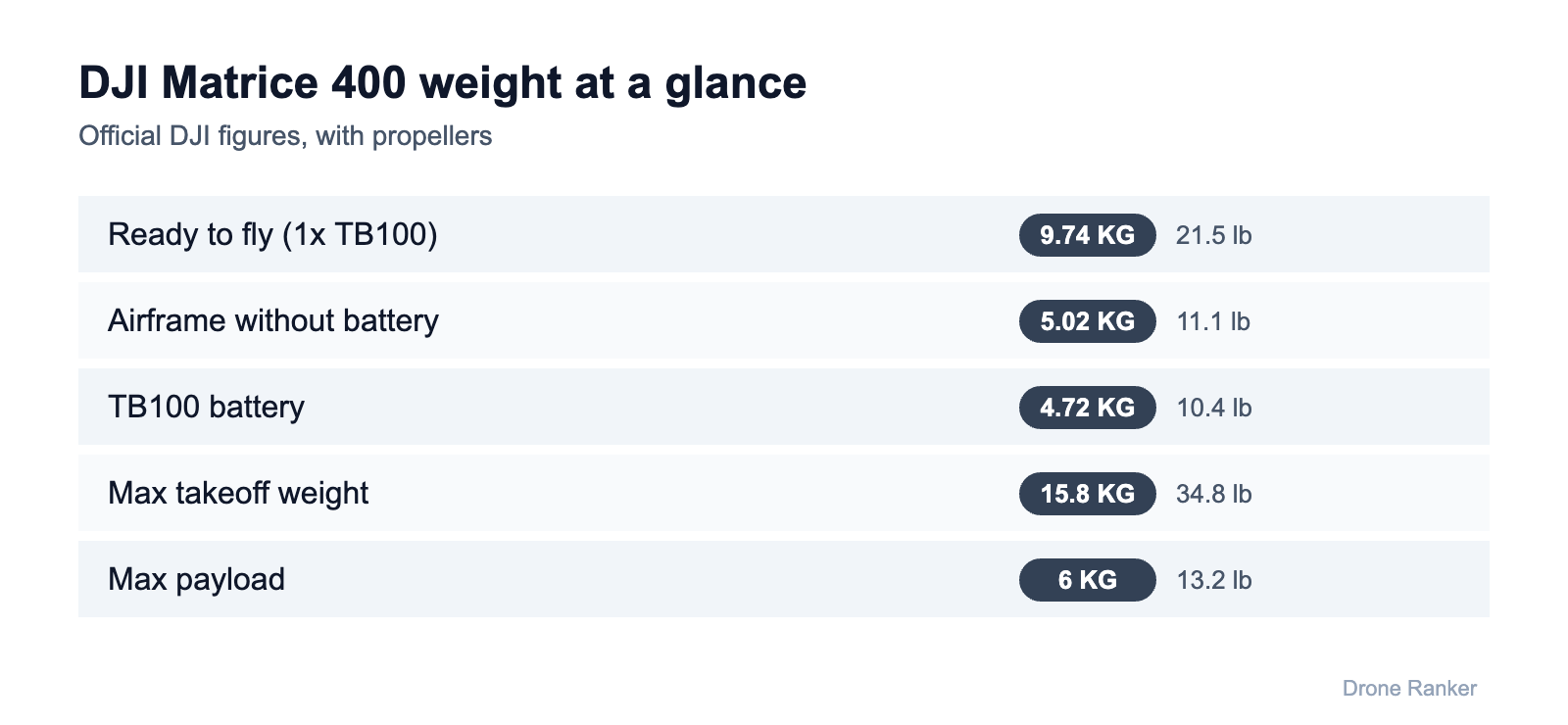
The DJI Matrice 400 weight is 9.74 kg (21.5 lb) ready to fly with its single TB100 battery and propellers fitted, according to DJI’s official Matrice 400 specs. Strip the battery off and the airframe alone is 5.02 kg (11.1 lb). Load it up to the limit and it can leave the ground at a maximum takeoff weight of 15.8 kg (34.8 lb).
Those three numbers answer different questions about the DJI Matrice 400 weight. The first tells you what you will be lifting out of the case on every job, the second what the drone weighs in a shipping manifest, and the third what the aircraft is legally and physically allowed to carry. Here is how each one plays out in the field.
In this guide
Where the DJI Matrice 400 weight comes from
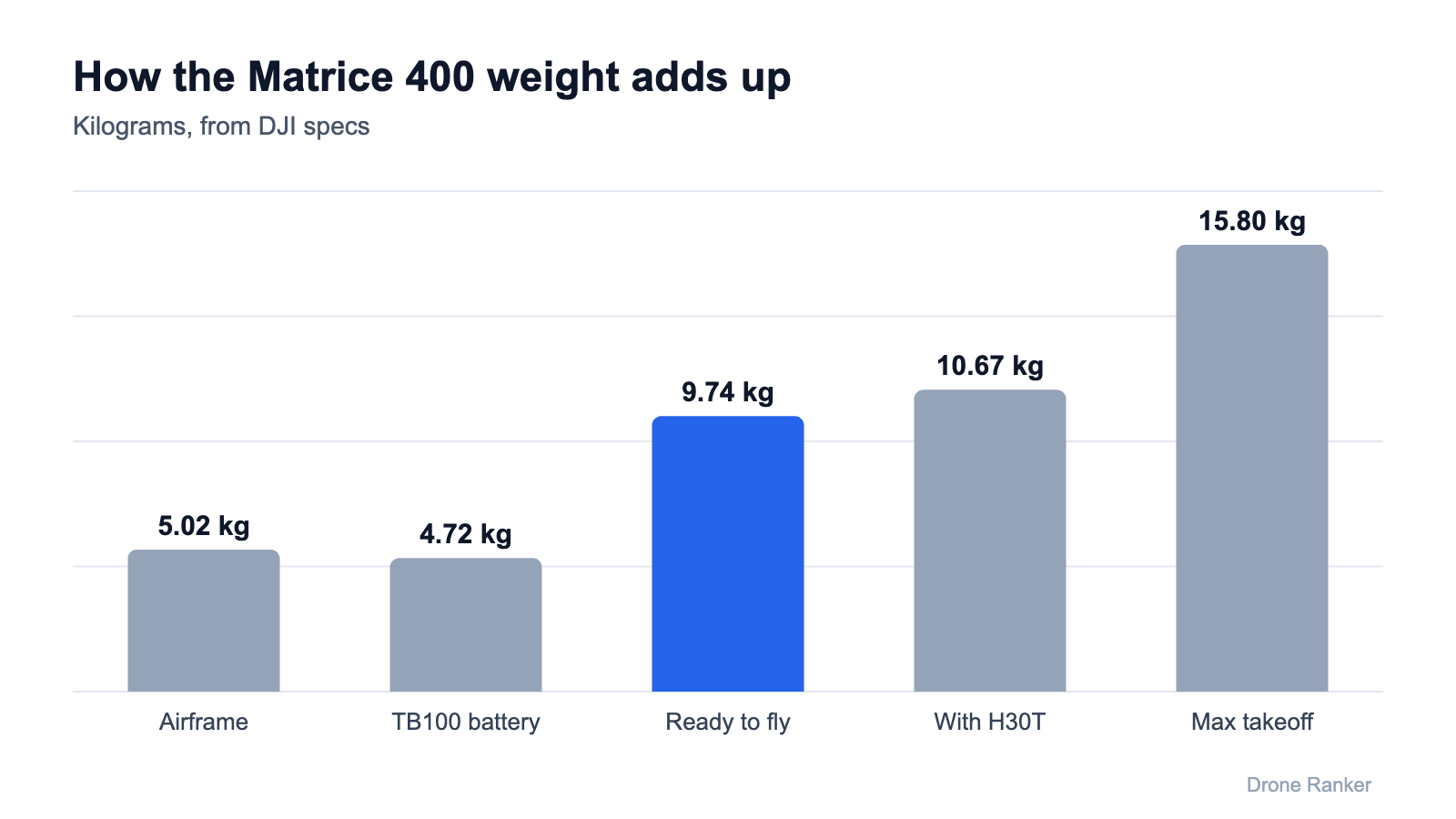
Almost half of the DJI Matrice 400 weight is battery. DJI lists the TB100 at 4,720 g, plus or minus 20 g, which is the exact gap between the 5,020 g airframe and the 9,740 g figure with battery. Unlike the Matrice 350 RTK, which hot-swaps two smaller packs, the Matrice 400 runs on one large 977 Wh battery.
DJI also notes that the actual DJI Matrice 400 weight can vary slightly between production batches, so treat the published numbers as plus or minus a few tens of grams. For planning payload margins that tolerance does not matter. For an airline or freight booking it is worth weighing your own aircraft.
| Item | Weight | Note |
|---|---|---|
| Airframe, no battery | 5.02 kg (11.1 lb) | With propellers |
| TB100 battery | 4.72 kg (10.4 lb) | 977 Wh, Li-ion 13S |
| Ready to fly | 9.74 kg (21.5 lb) | One TB100 fitted |
| With Zenmuse H30T | 10.67 kg (23.5 lb) | DJI’s flight-time test setup |
| Max takeoff weight | 15.8 kg (34.8 lb) | Sea level |
| DJI RC Plus 2 Enterprise Enhanced | 1.15 kg (2.5 lb) | Without external battery |
| BS100 battery station | 11.8 kg (26 lb) | Charges three TB100 packs |
How much the Matrice 400 can carry
DJI rates the Matrice 400 for a 6 kg maximum payload, but that figure comes with conditions. It is measured on the third gimbal connector with the screw-lock fastening, at sea level. With the quick-release port on that connector the limit drops to 3 kg, and payload capacity falls further as altitude rises.
The standard gimbal mounts are far lighter. A single gimbal connector takes up to 1,400 g, and DJI warns that anything above 950 g cuts the damper’s rated lifespan from 1,000 hours to 400 hours. Run two gimbals and each mount is limited to 950 g. The Zenmuse L3 LiDAR has its own 2,100 g allowance on a dedicated connector.
In practice that means the big 6 kg number is for heavier custom loads such as drop systems, speakers, spotlights or third-party sensors. If you fly one of DJI’s own cameras, your real limit is set by the gimbal mount long before the aircraft runs out of lift.
DJI Matrice 400 weight versus flight time
DJI’s headline 59-minute flight time was measured with the Zenmuse H30T fitted, for a total of 10.67 kg, flying forward at 10 m/s in still air at sea level until the battery forced a landing. Hovering with the same setup, the figure drops to 53 minutes. Add the AP100 parachute and the total climbs to 11.61 kg, which brings forward flight down to about 53 minutes.
Those numbers are tested at a total weight well below the 15.8 kg ceiling. In other words, the DJI Matrice 400 weight you add in payload comes straight out of your endurance. Expect flight times to shrink noticeably as you approach the full 6 kg payload, and plan missions with a healthy reserve, especially in cold weather or at altitude.
Matrice 400 vs Matrice 350 RTK on the scale
The Matrice 400 is a much heavier aircraft than the drone it replaces at the top of DJI’s enterprise range. The Matrice 350 RTK weighs about 3.77 kg without batteries and about 6.47 kg with two TB65 packs, with a 9.2 kg maximum takeoff weight, according to DJI’s Matrice 350 RTK specs. That leaves roughly 2.7 kg of lift margin against more than 6 kg on the Matrice 400.
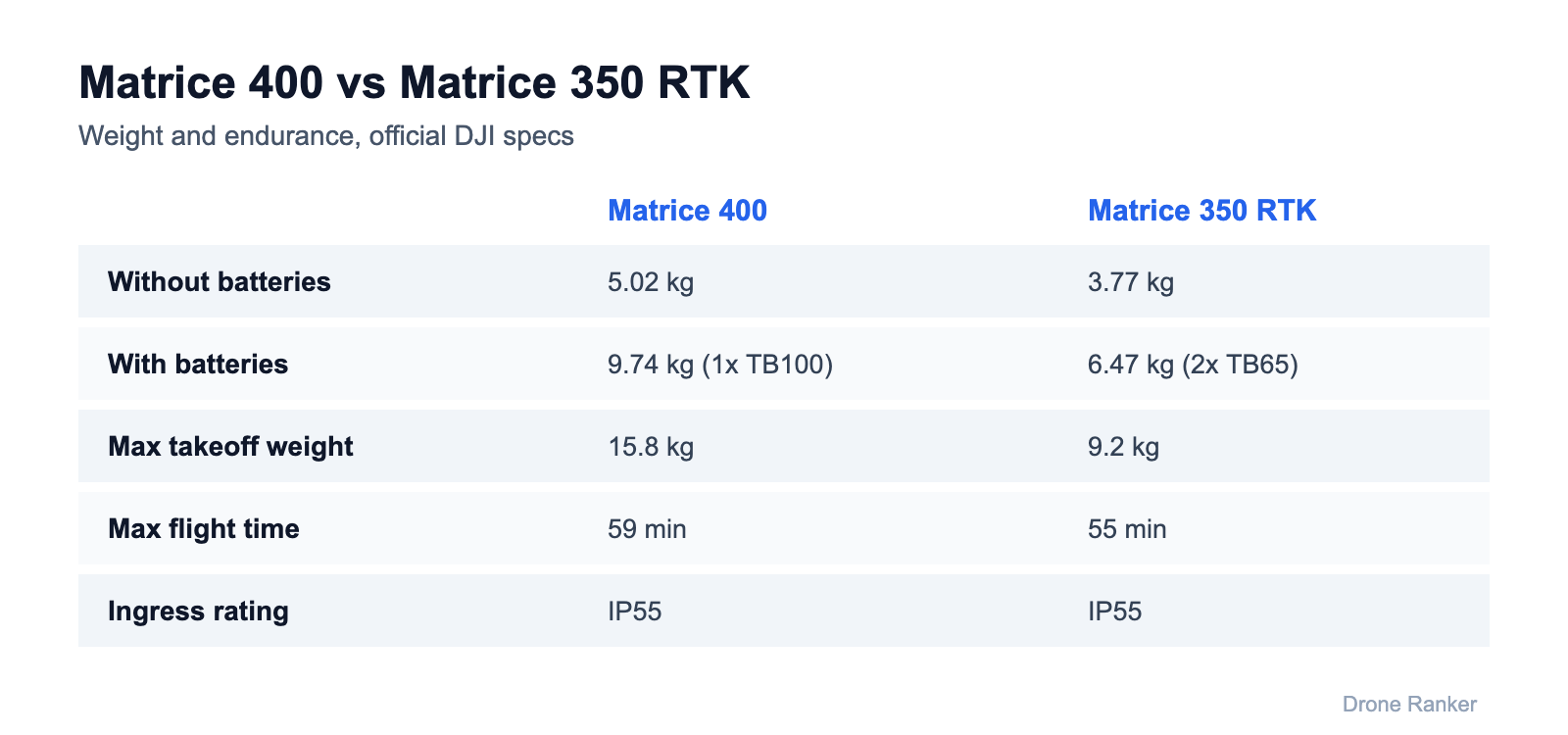
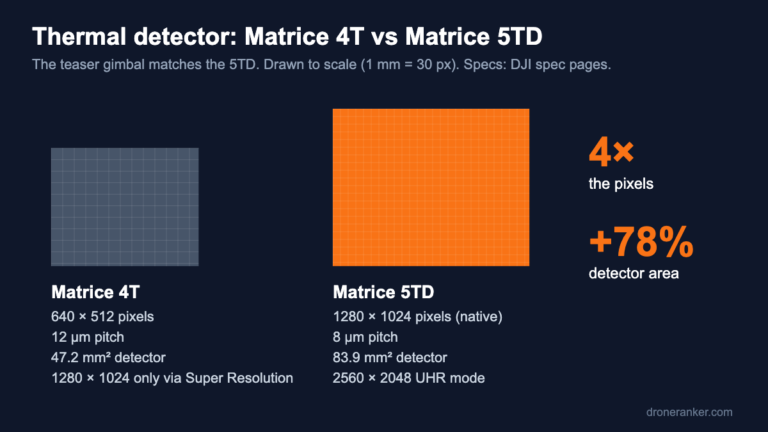
The trade-off is handling, because the DJI Matrice 400 weight is felt on every deployment. At over 3 kg heavier when ready to fly, the Matrice 400 is a two-hand lift in and out of its 779 × 363 × 528 mm case, and it needs the 11.8 kg BS100 station to keep its batteries charged on site. For smaller crews, the newer folding Matrice 5T launched on 5 November is a lighter alternative for thermal work.
What the DJI Matrice 400 weight means for the FAA
At a 15.8 kg (34.8 lb) maximum takeoff weight, the Matrice 400 stays under the 55 lb line, so commercial flights fall under the FAA’s Part 107 small drone rules rather than requiring a separate exemption for heavier aircraft. It must be registered with the FAA, and the pilot needs a Part 107 remote pilot certificate for any commercial job.
The DJI Matrice 400 weight still matters for planning. Heavier payloads mean more energy in a fall, which is one reason DJI offers the AP100 parachute for operations near people. If you are building a services business around a drone of this class, our guide on how to start a drone business in 2026 covers insurance and waivers in more detail.
Shipping and travelling with the TB100
The TB100 is the part of the kit that causes the most logistics headaches. At 977 Wh it is far above the 160 Wh ceiling that airlines allow for lithium-ion batteries carried by passengers, so it cannot travel in carry-on or checked bags. Teams that need to move a Matrice 400 by air have to ship the batteries as dangerous goods cargo, or source batteries at the destination.
A realistic field kit adds up quickly once you go beyond the DJI Matrice 400 weight on its own. The aircraft, two spare TB100 packs, the BS100 station and the remote controller come to more than 32 kg before you count the case, the payload or any accessories. That is worth knowing before you plan a job that involves a long walk from the vehicle.
Is the Matrice 400 the right weight for your work?
If your work involves heavy LiDAR, long corridor inspections or custom payloads, the extra DJI Matrice 400 weight buys you real capability: more lift, nearly an hour in the air and a 40 km FCC transmission range. If you mostly fly a thermal camera on short missions, a lighter platform will be quicker to deploy and easier to carry.
US buyers should also check where DJI enterprise hardware stands under the FCC rules before committing to a fleet. Our explainer on whether the DJI ban will be lifted covers the current position, and our Dock 4 and Matrice 5TD coverage shows where DJI’s automated enterprise line is heading.
The Friday Brief
One email a week on what changed in drones
FCC and FAA rule changes, DJI leaks checked against filings, and the week’s new comparisons. Every Friday, nothing else.
Free. Unsubscribe in one click. Sent with Kit; see our privacy policy.
Follow us on Google too: add Drone Ranker as a preferred source →
Continue Reading
All News