Pentagon Drone Dominance Program Explained: $450M Phase III, Gauntlet 2.5 in November, and Who Is Winning

The Pentagon’s Drone Dominance Program is a $1 billion-plus effort to buy more than 200,000 cheap one-way attack drones by 2027, picking suppliers through fly-off competitions called Gauntlets. Phase III opened on 28 September 2026 with at least $450 million for about 60,000 drones, and a separate Gauntlet 2.5 for heavy “bomber” drones has slipped from October to early November.
Here is how the program works, who has won so far, what the drones cost, and what comes next, with every figure sourced to the Defense Department’s announcements or defence trade reporting.
Quick answer
| Drone Dominance Program | |
|---|---|
| Started by | Defense Secretary Pete Hegseth’s memo of 10 July 2025, following Executive Order 14307 |
| Run by | Defense Innovation Unit (DIU) with the Test Resource Management Center; orders placed through NSWC Crane |
| Budget | More than $1 billion across four phases (reported as $1.1 billion) |
| Goal | 200,000+ low-cost drones by 2027 |
| Phase I | About 30,000 drones for about $150M (March 2026) |
| Phase II | About 60,000 drones from the Gauntlet II leaderboard (September 2026) |
| Phase III | $450M+ for about 60,000 drones, option for 40,000 more |
| Next event | Gauntlet 2.5 bomber-drone qualifier, early November 2026 |
Why the Pentagon wants hundreds of thousands of drones
The war in Ukraine changed the maths of small drones. First-person-view (FPV) attack drones costing a few thousand dollars now destroy armoured vehicles worth millions, and both sides use them by the hundreds of thousands. Hegseth’s July 2025 memo, titled “Unleashing U.S. Military Drone Dominance”, told the services to treat small drones as consumables rather than aircraft. It set deadlines: every squad was to have low-cost, expendable drones by the end of 2026, with units in the Indo-Pacific first, and the US was to reach dominance in small drones by the end of 2027, DefenseScoop reported.
The memo also moved management of the Blue UAS list, the Pentagon’s roster of approved drones and parts, from DIU to the Defense Contract Management Agency on 1 January 2026.
How the Gauntlets work
Instead of a years-long programme of record, the Drone Dominance Program runs short competitions. Military operators fly each vendor’s drone and score it on performance, production capacity, cost, ease of use and supply-chain resilience. Orders go to the leaderboard, and the competition is not winner-take-all: firms that miss out can enter later rounds. In Gauntlet I, about 100 operators each received roughly two hours of training before flying, according to IDGA’s program explainer. The program director is Travis Metz.
Phase I: about 30,000 drones, Skycutter first
On 3 February 2026 the Pentagon named 25 vendors for Gauntlet I, including Ukrainian companies, and testing began at Fort Benning, Georgia, on 18 February. Results were posted on 6 March. The UK’s Skycutter placed first with 99.3 points and Neros second. Orders worth about $150 million for roughly 30,000 one-way attack drones went to about 11 firms, including Napatree, ModalAI, Auterion, UDD, Griffon, Nokturnal AI, Halo, Ascent AeroSystems and Farage Precision. That works out at around $5,000 a drone, delivered over five months.
Deliveries have lagged. By 25 August, 13,440 of the 22,320 drones in the first tranche, about 60%, had been delivered, DroneXL reported. Shortfalls were linked to NDAA-compliant motors, batteries, sensors and chips.
Phase II: Neros and Perennial Autonomy lead
A Phase II qualifier at Camp Grayling, Michigan, from 8 to 19 June drew 49 companies with about 79 designs; 19 advanced. Gauntlet II then ran at Fort Carson, Colorado, with 1,858 sorties across 23 platforms. Range improved sharply: all 11 long-range platforms reached 15 km, compared with just 24% reaching 10 km in Gauntlet I, DefenseScoop reported on 18 September.
| Rank | Deep Strike | Close Quarters Battle |
|---|---|---|
| 1 | Perennial Autonomy (80.1 points) | Neros |
| 2 | Hyperscale | ORQA US |
| 3 | Neros | XTEND |
| 4 | Skycutter | Vector |
| 5 | Swarm Defense | ModalAI |
About 60,000 drones are planned from this pool. Neros announced the largest order on 30 September: more than 14,000 drones for about $100 million, plus 800 bonus units, The Defense Post reported. Tectonic Defense reported further orders for Swarm Defense (4,000 Kiwi drones, at least $25 million including munitions), Skycutter (at least 5,000) and Vector (5,000); those last figures are reported rather than officially confirmed.
Phase III: $450 million for 60,000 drones
Phase III opened on 28 September 2026 with at least $450 million for about 60,000 drones and an option for 40,000 more, Defense Daily reported. The missions stay the same, Deep Strike and Close Quarters Battle, with tougher scenarios and a faster pace. Price caps move in opposite directions: about $5,000 per Deep Strike drone before weaponisation, up from $4,500, and $3,000 per CQB drone, down from $3,500.
The entry bar is higher too. Each entrant must deliver 400 drones before Gauntlet III, against 120 for Gauntlet II. Ten firms from the Gauntlet II leaderboard advance directly, a November “Pitch & Fly” adds about eight more, and Gauntlet III is reported to be capped at 14 firms. DefenseScoop puts Gauntlet III about six months after Gauntlet II, with Gauntlet IV, the last, about six months after that.
Gauntlet 2.5: bomber drones, now in November
Gauntlet 2.5, also called Mission C, is a separate competition for heavy gravity-bomber drones. Inside Unmanned Systems reported the requirements: $32 million for 1,200 night-capable drones, split roughly 600, 400 and 200 among the top three vendors; a cap of $20,000 per drone plus a $5,000 logistics package; 15–30 km range; at least 8 kg of payload, enough for 60mm and 81mm mortar rounds; more than one warhead per sortie; resistance to electronic warfare; and at least 30 missions before loss.
Seventeen companies were invited to the Camp Grayling qualifier, Defense Daily reported on 22 September, including Skycutter, Swarm Defense, UDD Tech, Halo Aeronautics, AIRO and several Ukrainian-linked firms. On 9 October the program moved the start from October to early November, and DroneLife’s 14 October report confirms the shift. Final dates have not been published.
No Chinese parts: the supply-chain rules
Phase II barred motors and batteries from covered countries, mainly China. Restrictions on GPS modules begin in February 2027, and full domestic traceability is required by August 2027, according to IDGA. That is hard: China dominates drone motors, batteries and cameras, and on 5 August 2026 Beijing put drone-related dual-use exports to the US under case-by-case licensing, Global Trade Alert reported. It is not a ban, but it slows shipments.
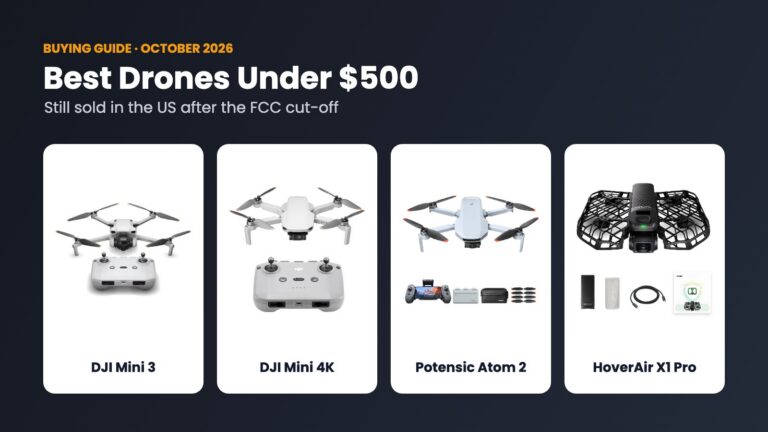
The same pressure shapes the civilian market. The FCC added foreign-made drones and components to its Covered List in December 2025; see which drones are banned in the US and the FCC component rule.
Related moves: a drone command and Army factories
- Autonomous Warfare Command. On 30 September Hegseth ordered a four-star combatant command for drones and robotics, targeted for 1 October 2027. It needs legislation, and no commander or budget has been named. An interim effort, Project Agincourt, owes the Joint Chiefs a plan within 30 days, DroneXL reported.
- Army SkyFoundry. The Army originally planned depot capacity for 10,000 drones a month. In April 2026 an Army Materiel Command official said it had become a fully commercial partnership; Hadrian Automation won an advanced manufacturing facility at Red River Army Depot.
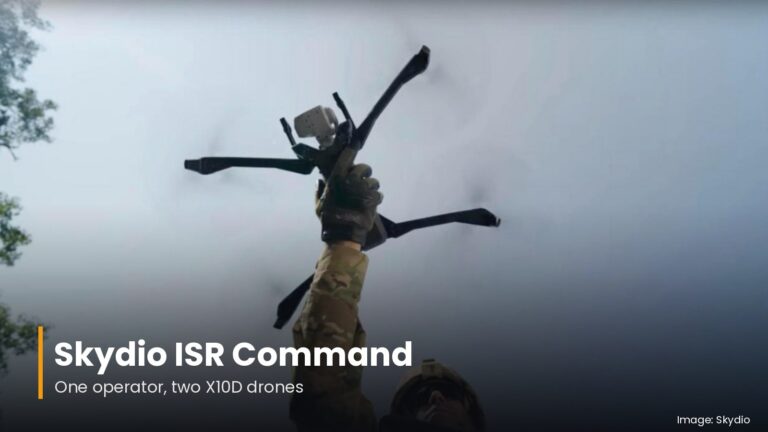
- Skydio X10D. Separately, the Army ordered more than 2,500 Skydio X10Ds for over $52 million in March 2026. Skydio has since added ISR Command, letting one soldier fly two X10Ds.
Timeline
| Date | Event |
|---|---|
| 6 June 2025 | Executive Order 14307 |
| 10 July 2025 | Hegseth “Drone Dominance” memo |
| 1 January 2026 | Blue UAS list moves to DCMA |
| 3 February 2026 | 25 Gauntlet I vendors named |
| 6 March 2026 | Gauntlet I results; ~30,000 drones, ~$150M |
| 8–19 June 2026 | Phase II qualifier, Camp Grayling |
| 18 September 2026 | Gauntlet II results |
| 28 September 2026 | Phase III opens ($450M+) |
| 30 September 2026 | Autonomous Warfare Command ordered; Neros $100M order |
| Early November 2026 | Gauntlet 2.5 and Pitch & Fly |
| 2027 | Gauntlets III and IV; 200,000+ drone goal |
What is still unknown
- Exact dates for Gauntlet 2.5 and the reason for the delay.
- How many Phase I and II drones have actually reached units.
- Whether Congress funds the Autonomous Warfare Command.
Thinking about a drone career?
FAA Airman Knowledge Testing Supplement
The official figure book for the Part 107 exam, which adds chart questions on 26 October.
ASA Remote Pilot Test Prep 2027-2028
Widely used Part 107 study guide with practice questions.
As an Amazon Associate, Drone Ranker earns from qualifying purchases. We do not quote prices because Amazon’s change by the hour.
Frequently asked questions
What is the Drone Dominance Program?
A Pentagon program run by the Defense Innovation Unit, worth more than $1 billion over four phases, to buy over 200,000 low-cost one-way attack drones by 2027 through fly-off competitions called Gauntlets.
How much does each Drone Dominance drone cost?
Phase III caps are about $5,000 per Deep Strike drone before weaponisation and $3,000 per Close Quarters Battle drone. Gauntlet 2.5 bomber drones can cost up to $20,000.
Who won Gauntlet I?
Skycutter, with 99.3 points, ahead of Neros. About 11 firms shared roughly $150 million in orders for about 30,000 drones.
Who won Gauntlet II?
Perennial Autonomy topped Deep Strike and Neros topped Close Quarters Battle. Neros received the largest order: more than 14,000 drones for about $100 million.
What is Gauntlet 2.5?
A competition for heavy bomber drones carrying at least 8 kg over 15–30 km: $32 million for 1,200 drones, moved to early November 2026 at Camp Grayling, Michigan.
Can Drone Dominance drones use Chinese parts?
No. Motors and batteries from covered countries were barred from Phase II, GPS-module limits start in February 2027 and full traceability is required by August 2027.
What is the Autonomous Warfare Command?
A planned four-star combatant command for drones and robotics, targeted for 1 October 2027 and dependent on Congress.
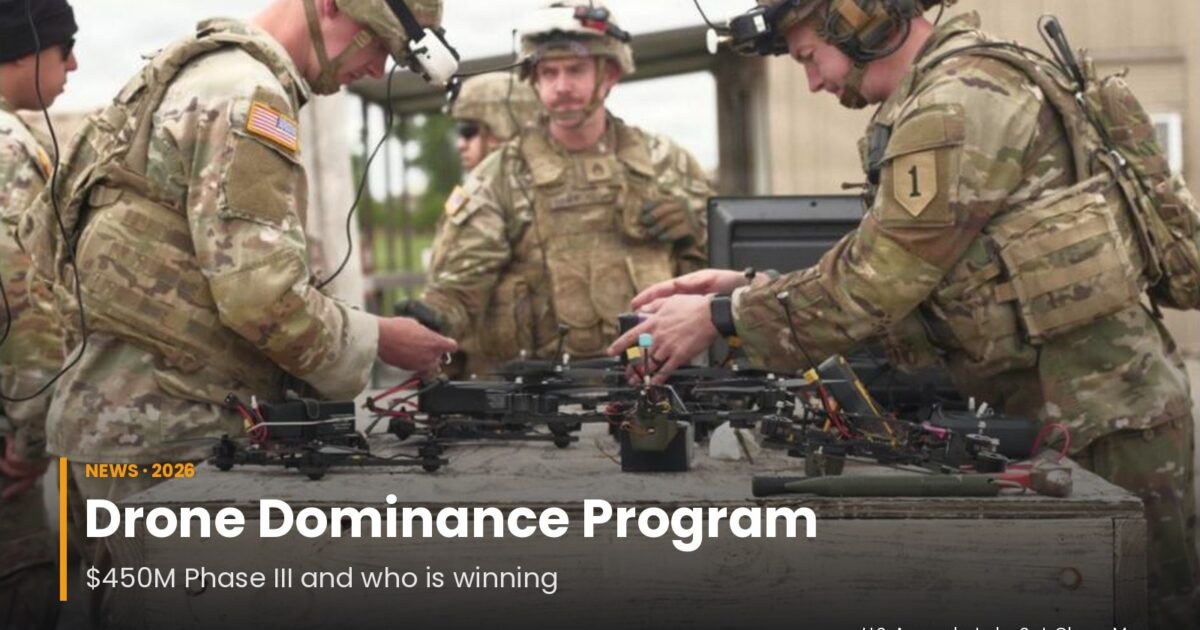
Cover photo: Soldiers of the 1st Infantry Division during one-way strike drone experimentation at Fort Riley, Kansas, 28 April 2026. U.S. Army photo by Sgt. Chase Murray.
Product links on this page are Amazon affiliate links. If you buy through them, Drone Ranker may earn a commission at no cost to you. We compare drones from manufacturer specifications and filings, not hands-on flight tests.
Sources
- DefenseScoop: Hegseth memo on drone dominance (10 July 2025)
- DefenseScoop: Gauntlet I results (9 March 2026)
- DefenseScoop: Gauntlet II results (18 September 2026)
- Defense Daily: $450 million Phase III (29 September 2026)
- Defense Daily: 17 companies for bomber qualifier (22 September 2026)
- DroneLife: Phase III details as Gauntlet 2.5 moves to November (14 October 2026)
- The Defense Post: Neros Pentagon order (1 October 2026)
- DroneXL: Hegseth orders four-star drone command (1 October 2026)
- IDGA: Drone Dominance Program explained
- Inside Unmanned Systems: Gauntlet Mission C requirements
Sources
Primary references used for factual claims in this article.
The Friday Brief
One email a week on what changed in drones
FCC and FAA rule changes, DJI leaks checked against filings, and the week’s new comparisons. Every Friday, nothing else.
Free. Unsubscribe in one click. Sent with Kit; see our privacy policy.
Follow us on Google too: add Drone Ranker as a preferred source →
Continue Reading
All News