Skydio Ascend 26: What Was Expected, and the 4 Things Skydio Actually Announced

Skydio Ascend 26 took place on 23 September 2026, with a public livestream scheduled for 15:20–17:00 GMT. Skydio calls it its biggest launch event of the year and says CEO Adam Bry will unveil new flying robots, software and mission capabilities for autonomous operations.
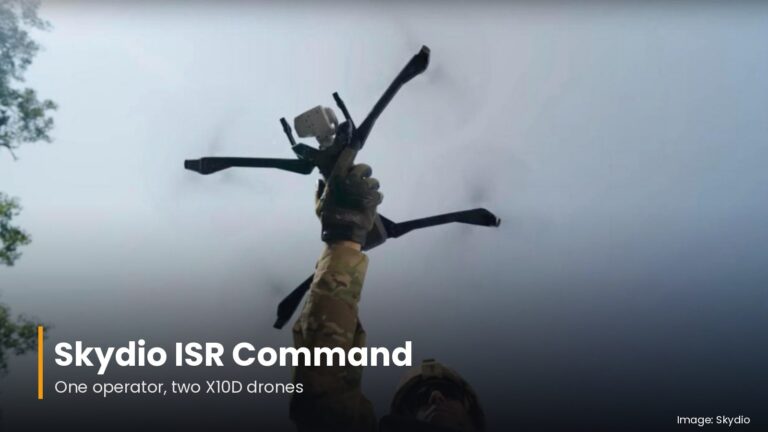
Update (15 October 2026): Skydio followed Ascend with ISR Command, which lets one soldier fly two X10D drones.
Update (5 October 2026): a DHS laboratory has published its comparative test of five Blue UAS drones flown against DJI Matrice aircraft in Manhattan. Three of the Blue aircraft could not hold position, and the DJI scores were withheld from the public report. Our breakdown covers the scores, the prices and what it means for agencies.
Table of Contents
What Skydio actually announced at Skydio Ascend 26
The Skydio Ascend 26 keynote delivered four main products, all aimed at public safety and infrastructure customers rather than consumers. Skydio’s own summary lists them as follows.
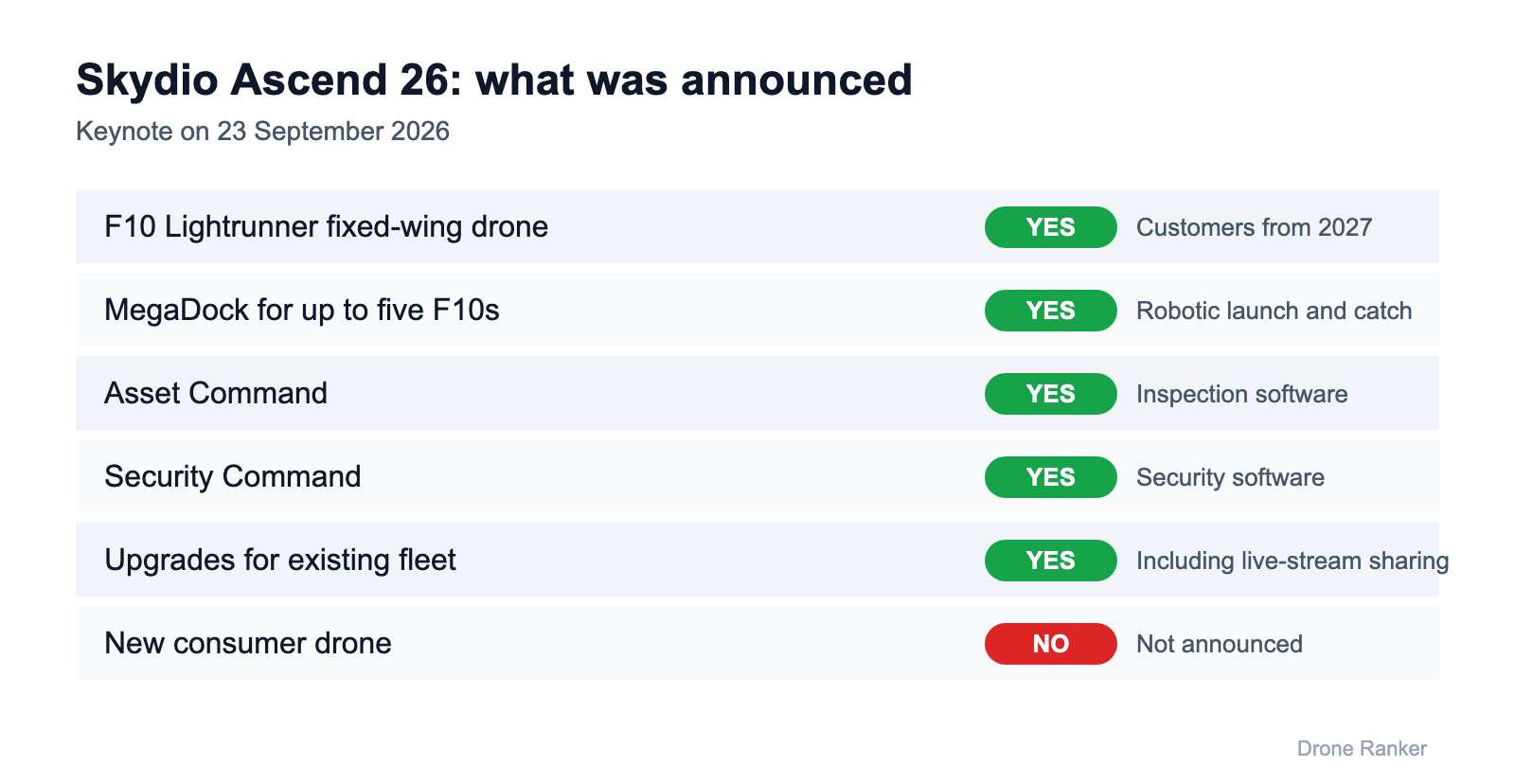
- F10 Lightrunner, Skydio’s first fixed-wing aircraft, rated up to 100 mph and due to reach customers in 2027. Our F10 Lightrunner specs analysis covers it in detail.
- MegaDock, a dock that houses up to five F10s and launches and catches them with a robotic gripper.
- Asset Command and Security Command, two new software products for inspection and security teams.
- Fleet-wide upgrades for existing Skydio aircraft, including easier and more secure live-stream sharing.
The section below is the preview we published before the keynote. We have kept it so readers can compare what was expected with what arrived.
The official language before the keynote is deliberately broad. Skydio has not published a product list, prices or shipping dates, so this preview separates what the company has confirmed from what is still open.
Skydio Ascend 26 livestream time and where to watch
The official Skydio Live event page lists the stream for Wednesday, 23 September, from 15:20 to 17:00 GMT. Skydio’s events calendar gives the Pacific equivalent as 08:20–10:00 PT. Registration may be required to enter the live event page.
| Region | Local start time | Date |
|---|---|---|
| GMT / UTC | 15:20 | 23 September |
| US Pacific | 08:20 | 23 September |
| US Eastern | 11:20 | 23 September |
| London | 16:20 | 23 September |
| Istanbul | 18:20 | 23 September |
The wider Ascend 26 conference runs on 23–24 September in Summerlin, Nevada. The physical conference is described as invitation-only; the keynote stream is promoted publicly.
What Skydio has confirmed
Skydio’s event pages establish that this is a product announcement, not a general webinar, and that the keynote will cover both aircraft and software. The named markets are public safety, national security, energy, utilities and critical infrastructure, with emergency response, physical security and infrastructure inspection as use cases. Skydio talks about “new flying robots” in the plural without naming them, and says its autonomous systems are coming together on one platform.
That supports expecting a multi-product event. It does not confirm a consumer drone, a camera specification, a price or a delivery date.
Last year’s announcements set the baseline
Skydio’s official Ascend 2025 recap is the best guide to the starting point. That event introduced the R10 indoor drone, previewed the F10 fixed-wing platform, demonstrated one operator controlling multiple drones through a browser and showed the Shadow autonomous tracking capability. Alongside the existing X10, that gives Skydio three aircraft for three different jobs.
| Platform | Public status before Ascend 26 | Role | What to verify today |
|---|---|---|---|
| X10 | Documented current product | Portable outdoor response and inspection | New software, autonomy, attachments or dock workflows |
| R10 | Introduced at Ascend 2025 | Compact indoor response | Availability, communications, training and supported missions |
| F10 | Previewed at Ascend 2025 | Long-range fixed-wing coverage | Final specifications, price, ordering and delivery schedule |
Skydio’s X10 page shows the level of documentation buyers should expect from anything presented as ready to order: up to 40 minutes of flight time, a 45 mph top speed, IP55 protection and modular visual and thermal sensor packages. Its technical specifications also describe the navigation cameras, onboard processing and communications options. Paired with Dock for X10, Skydio says it can launch in 20 seconds under supported conditions.
That sets a high bar. A new aircraft should either reach a mission X10 cannot, cut the people and time an existing mission needs, or make several aircraft and docks work better together.
The questions to watch
Does F10 get a price and shipping date?
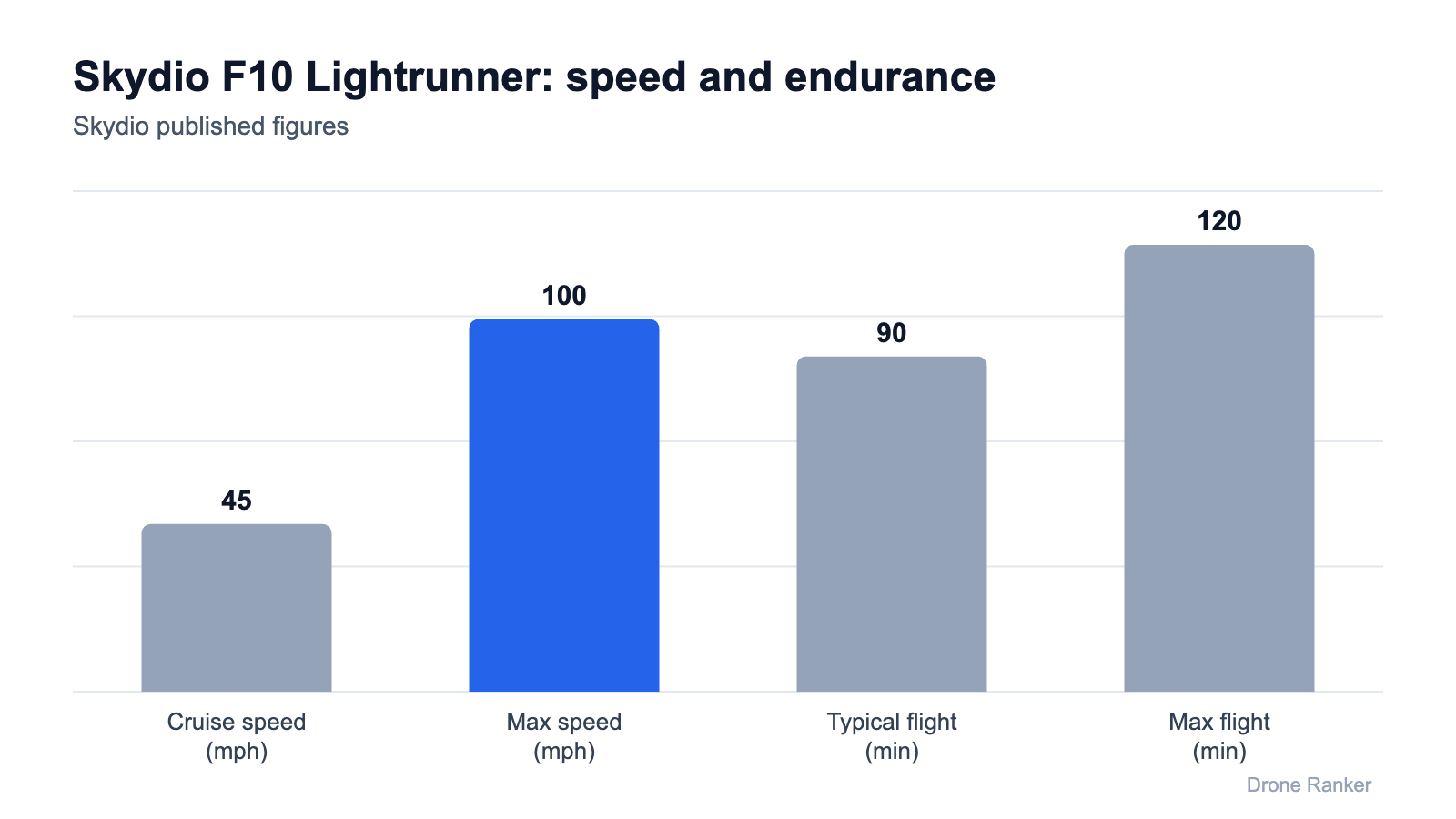
F10 was the clearest unfinished story from 2025. Skydio described it as a vertical-takeoff fixed-wing aircraft meant to cover dozens of miles, support longer incidents and reach scenes quickly. That description does not establish endurance, payload, communications range or regulatory permissions. It becomes actionable only with a product page, datasheet, ordering path, support plan and a firm delivery window. A stage demo alone doesn’t get there.
How far has R10 moved?
Indoors there is no GPS and little open space, which makes autonomy, lighting, communications and durability more important than range. The questions are whether R10 is broadly available or limited to a selected group, how video and control hold up through walls, what happens when a connection drops and how departments train operators for tight spaces. For Drone as First Responder programs, an indoor aircraft could extend awareness past the doorway, if communications, policy and training are in place.
How many drones can one operator really supervise?
“One operator, multiple drones” needs an operational definition. Does the person assign missions while each aircraft navigates on its own, or watch several video feeds at once? Which alerts demand attention, how are conflicts resolved, and what happens when communications degrade? The useful number is how many routine missions one trained operator can supervise safely, including lost-link events, and it should come with written limits, not a stage count.
Is the real launch a software platform?
The event wording points beyond individual drones. A common system tying together remote operations, dispatch, live video, mapping, evidence management and fleet health could be more consequential than any single airframe. Hardware decides where a drone can fly; software decides how consistently an organization can run thousands of missions. Look for documented integrations and APIs, permissions, retention controls, export formats and audit logs, and separate demonstrated features from roadmap items.
What will it actually cost?
Skydio sells to organizations, so a retail-style price may not appear. The aircraft is only one line anyway: docks, connectivity, software subscriptions, batteries, spares, training and maintenance can change the total significantly. The keynote should at least make clear which capabilities are included and which need recurring software.
The software and multi-drone story is the one that will decide whether Ascend 26 matters to agencies. A new airframe is easy to show on stage; a documented operating model with clear limits on where a human must step in is much harder, and much more useful.
Not a consumer event
Ascend 26 is aimed at organizations, not hobby pilots. Skydio ended its consumer offering in 2023 to focus on enterprise and public-sector customers, and nothing in the event description signals a return to retail camera drones. Obstacle avoidance and autonomy work often filters into the wider industry, but a new Skydio aircraft should not be treated as an alternative to a DJI Mini or Air. Purchasing channels, support and training are very different.
For the US market context, see our analysis of which drones are actually restricted in the US and the FCC drone-ban public comments. Our report on the Boston police drone crash shows why deployment policy and incident reporting count as much as hardware.
Want to fly one yourself?
DJI Neo
135 g, palm takeoff, no controller needed. Under 250 g: recreational flyers skip FAA registration but still need TRUST.
Under 249 g, 3-axis gimbal, 4K/30. The cheapest DJI camera drone with a real gimbal.
As an Amazon Associate, Drone Ranker earns from qualifying purchases. We do not quote prices because Amazon’s change by the hour.
We will update this article after the keynote where official product pages or technical material support a change, and keep unverified claims labeled as such. Until then, a stage statement is an announcement, a published specification is a measurable claim, and only an available product with documented support is a buying option.
This preview uses Skydio’s official Ascend 26 conference page, livestream listing, events calendar, 2025 keynote recap and consumer-business announcement. Time-zone conversions are calculated from the official 15:20 GMT start. Source status checked 23 September 2026.
The Friday Brief
One email a week on what changed in drones
FCC and FAA rule changes, DJI leaks checked against filings, and the week’s new comparisons. Every Friday, nothing else.
Free. Unsubscribe in one click. Sent with Kit; see our privacy policy.
Follow us on Google too: add Drone Ranker as a preferred source →
Continue Reading
All News