Matternet M3: 9 Critical Facts About the New Delivery Drone

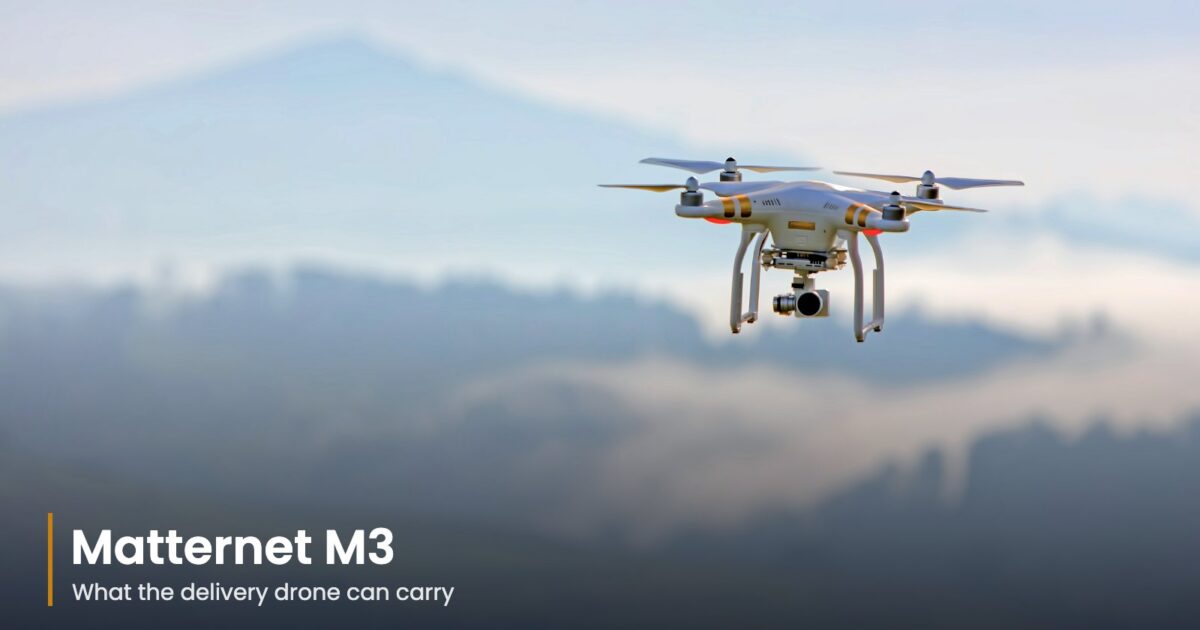
Matternet M3 is the company’s next-generation autonomous delivery platform, unveiled on September 28, 2026, with a targeted 11-pound payload, a 10-mile service radius and commercial service planned for the second half of 2027. The announcement matters because M3 is not just a larger aircraft. Matternet is pairing the drone with a compact charging dock and an off-grid package portal designed to let restaurants, retailers and hospitals operate small delivery hubs without an on-site drone crew.
Those are ambitious targets rather than certified operating specifications. Matternet still has to complete flight testing, customer pilots and regulatory approvals before M3 can enter routine service. This report separates what the company has announced from what remains to be proven.
Matternet M3: quick facts
| Announced | September 28, 2026 |
| Target payload | Up to 11 lb / approximately 5 kg |
| Target service radius | 10 miles / approximately 16 km |
| System components | M3 Aircraft, M3 Dock and M3 Portal |
| Initial U.S. launch partner | Dave’s Hot Chicken |
| Initial U.K. launch partner | Apian |
| Commercial service target | Second half of 2027 |
| Important limitation | M3 remains in development and requires testing and regulatory approval |
Table of contents
- What is the Matternet M3?
- Payload and range targets
- How the three-part system works
- Launch partners and use cases
- M3 versus M2
- Launch timeline and regulatory hurdles
- Why the announcement matters
- Frequently asked questions
What is the Matternet M3?
The Matternet M3 is an autonomous package-delivery system being developed for food, retail, healthcare and industrial logistics. Matternet describes it as an end-to-end platform rather than a standalone drone. A merchant places an order in the M3 Portal; the system is intended to manage collection, flight and delivery without staff handling the aircraft or waiting for an operator to arrive.
That design shifts the operating model away from a large centralized drone hub. Matternet wants a restaurant, store or hospital to host a small micro-hub on a rooftop, at ground level or on another underused part of the property. Locating the aircraft near the point where orders originate could reduce empty repositioning flights and shorten the time between an order being packed and dispatched.
The idea is particularly relevant to instant delivery. A conventional courier may need to travel to a restaurant, wait for a package and then drive through traffic to the customer. An aircraft already stationed at the merchant can leave as soon as the order is ready, although weather, airspace restrictions, approved delivery zones and battery state will still determine whether a flight can occur.
Matternet M3 payload and range targets
Matternet is targeting a maximum payload of approximately 5 kg, or 11 lb, and a 10-mile service radius for M3. The company says the cargo bay will accept ordinary merchant packaging, including restaurant bags and retail boxes, as well as specialized healthcare and industrial payload containers.
An 11-pound payload is a significant step for small urban delivery drones. It is large enough for multi-item meals, a modest grocery order, medical materials or certain industrial parts. It does not mean every 11-pound package can travel 10 miles in all conditions. Payload, wind, temperature, route design, reserve requirements and applicable operating approvals can all reduce practical performance.
The 10-mile figure is a service radius, not necessarily a 20-mile guaranteed round-trip range under every condition. Matternet’s September announcement presents both payload and radius as design targets. The final certified operating envelope may be narrower or may include additional conditions.
Matternet has not yet published a complete M3 aircraft specification sheet covering maximum speed, flight time, aircraft weight, noise level, battery capacity or delivery mechanism. Those omissions make it too early to compare M3’s real-world economics with Wing, Amazon Prime Air, Zipline or other delivery systems using a single headline number.
How the Matternet M3 system works
1. M3 Aircraft
The aircraft carries the package between a merchant-side hub and an approved delivery point. Matternet says M3 is being designed for autonomous operation, but “autonomous” does not mean unregulated or unsupervised. Commercial delivery networks still require an approved operator, operational procedures, maintenance, flight monitoring and authorization for beyond-visual-line-of-sight routes.
2. M3 Dock
The M3 Dock stores and charges the aircraft between flights. Matternet lists the dock as a 1.2-meter cube, or approximately 48 inches on each side, weighing about 90 kg with the aircraft. It can be installed on a rooftop or at ground level and requires a 200–240 V, 50 A circuit; two docks can share a 60 A circuit.
A compact dock is central to the micro-hub concept. It protects the aircraft, keeps the battery charged and places the drone close to outgoing orders. A real installation will still need structural, electrical, fire-safety, access-control and local planning review, especially when a dock is placed on a roof.
3. M3 Portal
The M3 Portal is the package interface. Staff can deposit as many as three packages and return to their normal work instead of waiting beside the aircraft. The portal is approximately 1.6 meters tall, has a 0.4-meter-square footprint and weighs about 31 kg. It can run on solar power without trenching, network wiring or a permanent electrical connection, or use a 110 V supply.
Asynchronous loading may be M3’s most important operational change. Drone delivery demonstrations often focus on the aircraft, yet labor at the origin can determine whether the service saves money. A portal that queues several ordinary bags reduces special handling and allows flights to collect orders as capacity becomes available.
Dave’s Hot Chicken and Apian are initial launch partners
Matternet named Dave’s Hot Chicken as an initial U.S. launch partner. The two companies previously ran an M2 delivery pilot in Northridge, California, giving them experience with restaurant packaging, order timing and neighborhood delivery before the M3 rollout.
In the United Kingdom, healthcare-logistics company Apian is the initial launch partner. Apian and Matternet already operate a network serving the National Health Service in central London. Healthcare logistics offers a different test from food delivery: payload integrity, chain of custody and predictable turnaround can matter more than consumer convenience.
Using both partners suggests Matternet wants one platform to serve high-frequency commercial orders and time-sensitive medical logistics. That breadth is commercially attractive, but each use case brings different packaging, landing-site, regulatory and customer-experience requirements.
Matternet M3 versus M2
M3 builds on the Matternet M2, which the company says is the first drone-delivery system to receive standard FAA Type Certification and Production Certification. M2 is rated for a maximum payload of 2 kg, or 4.4 lb, and an approximately 20 km, or 12.4-mile, maximum range.
| Capability | Matternet M2 | Matternet M3 target |
|---|---|---|
| Payload | 2 kg / 4.4 lb | Approximately 5 kg / 11 lb |
| Coverage metric | Approx. 20 km maximum range | 10-mile service radius |
| Merchant packaging | Dedicated payload boxes | Ordinary bags and boxes plus specialized containers |
| Origin infrastructure | Existing station architecture | Compact M3 Dock and multi-package Portal |
| Certification status | FAA type and production certified | Not yet certified; in development |
The payload increase is about 2.5 times the M2 rating. Matternet also estimates that a 10-mile-radius M3 hub could cover approximately 314 square miles, around four times the area associated with its current platform. Coverage geometry is not the same as an approved service map: airports, restricted airspace, terrain, weather and community agreements can remove substantial portions of the theoretical circle.
M2’s certification history gives Matternet practical experience that many early-stage drone-delivery companies do not have. It does not automatically transfer certification to M3. A heavier payload, new aircraft, different ground equipment and expanded operating concept all require evidence and regulatory review.
When will Matternet M3 launch?
Matternet is targeting commercial service in the second half of 2027. Its earlier SEC filings described prototype testing and the start of regulatory approval activity in the second half of 2026, followed by flight testing and customer pilots in the first half of 2027.
That schedule should be treated as a target, not a confirmed launch date. The company’s own forward-looking-statement notice identifies development, testing, certification, site approvals, manufacturing scale, customer contracts and financing as risks that could change the timing or performance of the program.
Matternet plans to build M3 manufacturing capacity in the United States and says its April 2026 strategic partnership with SoftBank Robotics America will help expand deployment. More launch partners are expected to be announced, but the September 28 release did not specify cities, fleet sizes, delivery prices or the number of planned docks.
Why the Matternet M3 announcement matters
The most interesting part of M3 is not simply its larger payload. It is the attempt to make autonomous delivery infrastructure fit into ordinary commercial property and ordinary staff workflows. If a rooftop dock and solar-powered portal can be installed without a specialized launch crew, a merchant could treat drone delivery more like a utility than a one-off aviation project.
The platform also highlights a divide in the delivery market. Some operators use large hubs serving wide areas; others place aircraft and support equipment close to merchants. Matternet is committing to the second model. Co-location can improve response time and reduce empty travel, but it multiplies the number of sites that need approval, maintenance, power, security and community acceptance.
For consumers, the questions will be simpler: which products qualify, how much delivery costs, how quickly an order arrives, where the package is released and what happens in poor weather. None of those details was fully answered in the launch announcement.
M3 also arrives while the United States is expanding pathways for more complex drone operations. Readers following that regulatory shift can see our Aerosonde long-range vertiport flight report and the latest Drone Ranker news coverage. The aircraft and missions are different, but both illustrate how drones are moving from isolated demonstrations toward repeatable networks built around permanent ground infrastructure.
Frequently asked questions
How much can the Matternet M3 carry?
Matternet is targeting a payload of up to 11 lb, or approximately 5 kg. This remains a development target and may be subject to route, weather and regulatory limitations.
How far can the M3 fly?
The announced target is a 10-mile service radius. Matternet has not yet published a full specification sheet explaining the certified round-trip range under different payload and weather conditions.
When will Matternet M3 deliveries begin?
The company targets the second half of 2027 for commercial service. Testing, certification, manufacturing and local site approvals could change that schedule.
Is the Matternet M3 FAA certified?
No. Matternet’s M2 holds FAA Type Certification and Production Certification, but M3 is a new platform still in development. The M2 approvals should not be read as approval of M3.
Who will use the M3 first?
Dave’s Hot Chicken is the initial U.S. launch partner, while Apian is the initial U.K. partner. Matternet says it will announce additional partnerships focused on high-volume delivery.
Sources and editorial method
This report uses Matternet’s September 28 announcement, official M3 Dock and Portal product pages, and company filings with the U.S. Securities and Exchange Commission. Manufacturer specifications and timelines are identified as targets where they have not been independently certified. Drone Ranker has not flight-tested the M3.
Sources
Primary references used for factual claims in this article.
Continue Reading
All News