DoorDash Built Its Own Delivery Drone and Published No Numbers

DoorDash showed its own delivery drone on 30 September, at a company product event called Dash Forward. It has six slow-spinning propellers on two cross booms, lowers food on a winch, is assembled in San Francisco, and will start flying in the East Bay with Chipotle, Popeyes and a local restaurant called Momo N Curry.
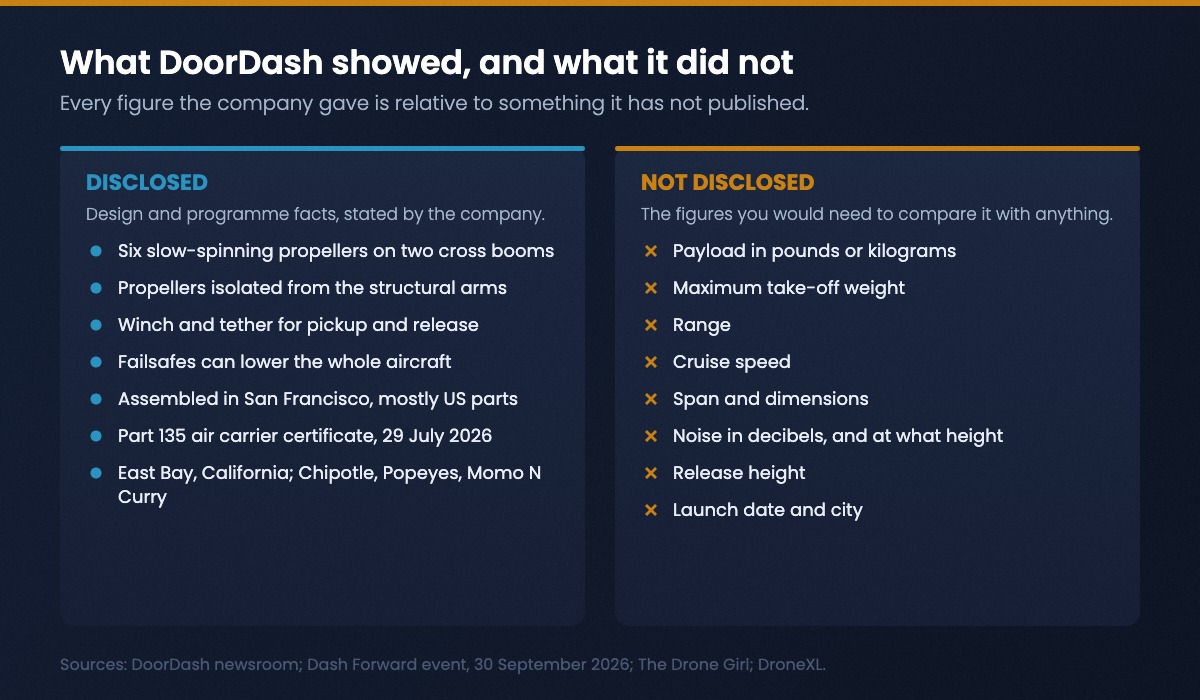
What the DoorDash Air drone does not have, anywhere in the announcement or the briefings around it, is a number. Not a payload in pounds. Not a range, a cruise speed, a span, a take-off weight, a decibel figure or a release height. Not a launch date, and not a city.
That is unusual enough to be the story. Every delivery operator this site has covered this year — Amazon, Wing, Zipline, Matternet — publishes a spec sheet, because the specs are how a town, a regulator and a customer work out what is about to fly over them. DoorDash gave three figures instead, and each one is measured against something it has not published.
Table of Contents
What was actually unveiled
Start with what is solid, because a fair amount is.
The aircraft is DoorDash’s own design, built in-house and assembled in San Francisco from what the company describes as a vast majority of domestic parts. Six propellers turn slowly on two crossed booms, and they are deliberately isolated from the structural arms — a design choice aimed at vibration and noise rather than performance. Delivery is by winch and tether, like Wing’s, rather than a free drop. If something fails, the stated behaviour is to lower the entire aircraft to the ground rather than release the load.
It does not live on a restaurant roof. Aircraft sit at nearby “drone nests” on standby, and the dispatch is tied into the restaurant’s own equipment: DoorDash says tablets and smart scales tell the system when the bag is actually packed, so the drone arrives as the food does rather than idling in a car park.
Behind it sits what DoorDash calls its Autonomous Delivery Platform, which decides per order whether a human Dasher, a sidewalk robot or an aircraft collects it. That matters for the competitive reading: Wing and Flytrex, which have been flying DoorDash orders for years, are not being replaced. DoorDash says both keep flying, and its own aircraft becomes a third option in the same dispatcher.
The three numbers, and what each one avoids
DoorDash did give figures. They are worth taking one at a time, because the pattern is consistent.
“Roughly 80 per cent of typical restaurant orders.” This is the payload claim, and it is not a payload. It is a statement about the distribution of DoorDash’s own order book, which nobody outside the company can see. A rival aircraft rated at five pounds and this one may cover the same share of orders or a very different one; without the mass there is no way to tell, and no way for a competitor to be measured against it.
“Under five minutes from load to door.” An average from early testing, with no sample size, no distance and no idea whether those flights were the convenient ones. Five minutes over half a mile and five minutes over three miles describe different aircraft.
“About as loud as a passing car.” The most quoted line, and the least checkable. A passing car is anywhere from the high fifties to the mid seventies in decibels depending on speed and how far away you are standing, and the comparison omits the altitude the drone is at when the comparison holds. Noise is the single thing residents object to in every delivery hearing in the country, and it is the one figure a company would publish if the figure helped.
None of this means the aircraft is bad. It means nobody outside DoorDash can yet say whether it is, and that is a choice the company made rather than a gap it has not got round to filling.
The certificate, and the date next to it
DoorDash holds an FAA Part 135 air carrier certificate, issued on 29 July 2026 after a process the company says took ten months. That is a real achievement and a real constraint, and it is routinely described as both more and less than it is.
Part 135 makes DoorDash an air carrier. It is the certificate that lets a company carry someone else’s property for hire, and it covers airworthiness, maintenance and operating procedures. It is not permission to fly beyond visual line of sight. Routine, scaled, pilot-light delivery over a metropolitan area still depends on the FAA’s long-delayed Part 108 rule, which cleared its final review stage in September and which the agency has said it hopes to publish by the end of this year. When a DoorDash executive talks about reaching “millions a day”, that number is gated on a rule that does not exist yet.
The date is the other half. The certificate issued on 29 July — one day after the FAA signed the nationwide environmental clearance that now covers commercial drone package delivery across the whole country. DoorDash is therefore among the first operators to scale entirely inside that document rather than negotiating a market-by-market environmental review, which is a meaningful head start.
It is also a head start with a lawsuit attached. Fifteen state attorneys general and Harris County, Texas asked a federal appeals court on 28 September to vacate that clearance. California, where the East Bay pilot is planned, is one of them. The same document carries a ceiling of 1,150 deliveries a day from a single hub, above which site-specific noise analysis is required — a threshold that becomes interesting the moment anyone starts talking about millions.
How it compares with the two aircraft DoorDash already uses
DoorDash’s own framing is the clearest guide to where it thinks the gap was.
Against Wing, the claim is capacity: Wing’s narrow fuselage suits a coffee and a sandwich, and DoorDash says its aircraft is built for the family-sized order Wing cannot take. Against Flytrex, the claim is installation: Flytrex works from a dock, and a dock means a restaurant has to modify its building. A winch needs nothing but clear ground.
Both are plausible, and both are unverifiable in exactly the same way. “Larger than Wing” is a comparison to an aircraft whose payload is published, which makes the omission on DoorDash’s side more conspicuous rather than less.
What is striking is that none of this is framed as a replacement. Wing has flown DoorDash orders for about four years and Flytrex since at least mid-2025, and the company says both continue. The vision an executive described was Wing aircraft and DoorDash aircraft working the same metropolitan market at once, with the software choosing between them order by order. That is a different strategy from Amazon’s, which flies its own aircraft exclusively and absorbs the regulatory fights that come with it.
What to watch before the first flight
There is no launch date and no named city, so the honest position is that nothing has been flown for a customer yet. Four things would change the picture, roughly in the order they are likely to arrive.
- A payload figure in pounds, which is the moment the aircraft becomes comparable to anything else in the air.
- A named city and a start date in the East Bay — and with it, the first local hearing, where the noise question gets asked by people who live under the route.
- Part 108, the beyond-visual-line-of-sight rule. Until it publishes, scale is a projection rather than a plan.
- The Second Circuit, which now has the environmental clearance in front of it. A vacatur would not ground anything overnight, but it would put the market-by-market review back in the path of every operator expanding into new ground, DoorDash included.
The aircraft itself looks sensibly conceived — slow propellers, isolated arms, a winch instead of a drop, and a failure mode that brings the whole machine down rather than letting go of it. Those are the decisions of people who have thought about what happens in somebody’s garden. It would simply be easier to say so with the numbers in hand.
Frequently asked questions
What is the DoorDash Air drone?
A six-rotor delivery aircraft designed and built by DoorDash itself and assembled in San Francisco. It lowers orders on a winch and tether, operates from standby sites called drone nests rather than restaurant roofs, and was shown publicly on 30 September 2026.
How much can the DoorDash Air drone carry?
DoorDash has not published a payload in pounds or kilograms. The only capacity statement is that the aircraft fits roughly 80 per cent of typical DoorDash restaurant orders, which describes the company’s order mix rather than the aircraft.
How fast is it and how far can it fly?
Neither figure has been released. The company has said early testing averaged under five minutes from loading to delivery, without giving the distances those flights covered.
How loud is the DoorDash Air drone?
DoorDash compares it to a passing car during hover and delivery. No decibel figure and no measurement height have been published, so the comparison cannot be checked.
Where will DoorDash drone delivery launch first?
Northern California’s East Bay, in the coming months. No city and no start date have been named. The launch restaurant partners are Chipotle, Popeyes Louisiana Kitchen and Momo N Curry.
Does DoorDash still work with Wing and Flytrex?
Yes. DoorDash says both partnerships continue and its own aircraft becomes a third option in the same dispatch system, which decides per order whether a Dasher, a sidewalk robot or a drone collects it.
What does DoorDash’s Part 135 certificate allow?
It makes DoorDash an FAA air carrier, covering airworthiness, maintenance and operating procedures for carrying property for hire. It was issued on 29 July 2026. It is not authorisation to fly beyond visual line of sight.
Can DoorDash fly beyond visual line of sight?
Not on the strength of Part 135 alone. Routine BVLOS delivery at scale depends on the FAA’s Part 108 rule, which has cleared its final review stage and which the agency has said it hopes to publish by the end of 2026.
Is DoorDash Air affected by the states’ lawsuit against the FAA?
Potentially. DoorDash scales under the FAA’s nationwide environmental clearance for drone package delivery, which fifteen states and Harris County asked the Second Circuit to vacate on 28 September 2026. California, the planned launch state, is among the petitioners.
When will DoorDash publish the specifications?
The company has said it will share more about the aircraft later this year. Nothing more specific has been committed to.
Sources
- DoorDash newsroom — DoorDash Air announcement
- The Drone Girl — DoorDash Air aircraft details and interview, 30 September 2026
- The Drone Girl — DoorDash Air receives its Part 135 certificate, 29 July 2026
- DroneXL — what the unveiling disclosed and what it left out
- DroneLife — DoorDash unveils purpose-built drone and end-to-end delivery system
Sources
Primary references used for factual claims in this article.
Continue Reading
All News