Amazon’s Drones Let Go at 13 Feet. Ten States Have a Law About That


An Amazon delivery drone does not land. It flies to the address, descends vertically over the garden, holds a hover for about six seconds, opens the cargo bay and lets the parcel go from roughly thirteen feet up. That is the designed behaviour, described in the FAA’s own environmental assessments, and customers have filmed it from underneath.
Ten states have statutes about releasing objects from an aircraft in flight. Most of them were written decades before anyone ordered toothpaste by drone, and on their face they describe exactly this.
Nobody has been prosecuted. Amazon drone delivery has expanded anyway, and the reason the conflict has not come to a head yet is a genuinely unsettled question of federal preemption. But the collision is not hypothetical: Amazon already flies in two of those states and has said it is heading for a third.
Table of Contents
How the MK30 actually delivers
The aircraft is not small. The MK30 weighs 78 pounds empty and 83.2 pounds at take-off, carries a five-pound payload, cruises between 205 and 370 feet, and tops out at 73 mph.
The delivery sequence is the part that matters here. The drone descends over the drop zone, hovers for around six seconds while it checks the ground, and releases. Amazon’s stated reason for not landing is safety: hovering keeps spinning rotors away from people, pets and obstacles, and it avoids the complexity of putting an 83-pound aircraft down on an unknown surface. The company says the drone uses cameras, radar and other sensors to pick a clear drop zone.
That reasoning is sound on its own terms. It also produces a parcel in free fall, which is the fact the statutes care about.
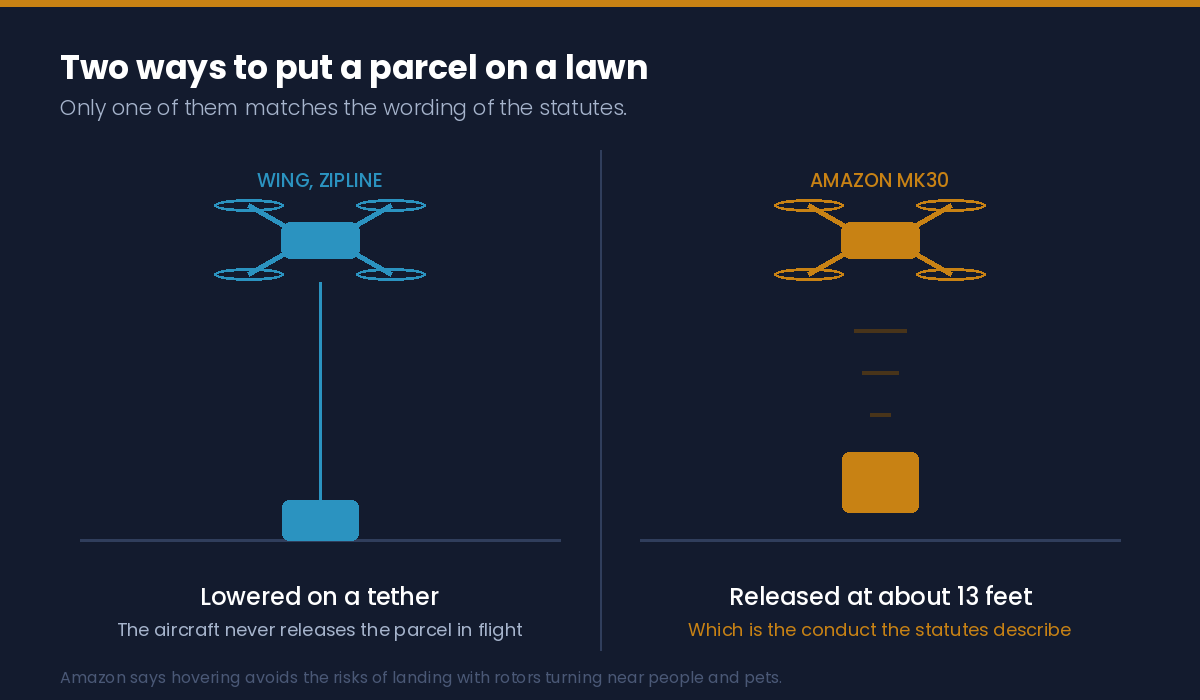
This is where Amazon’s engineering choice separates it from its competitors. Wing and Zipline lower packages on a tether: the aircraft stays up, the parcel comes down on a line, and nothing is released in flight. Amazon drops. Two companies doing the same job end up on opposite sides of a sentence in a statute book.
The ten states, and what they actually require
The laws fall into two groups, and the distinction is the practical one: whether there is a door you can knock on.
Four states offer a permit. Illinois requires one filed fourteen days ahead, naming the date, the time and the location. Minnesota requires written approval from both the state transportation commissioner and the municipality. Oregon requires a permit from its aviation director. Michigan requires written municipal permission before any object is released from an aircraft in flight.
Six states simply prohibit it over populated areas, with no permit to apply for. Arizona treats it as a Class 1 misdemeanour. North Carolina, Hawaii, Delaware, New Jersey and Missouri also treat it as a misdemeanour.
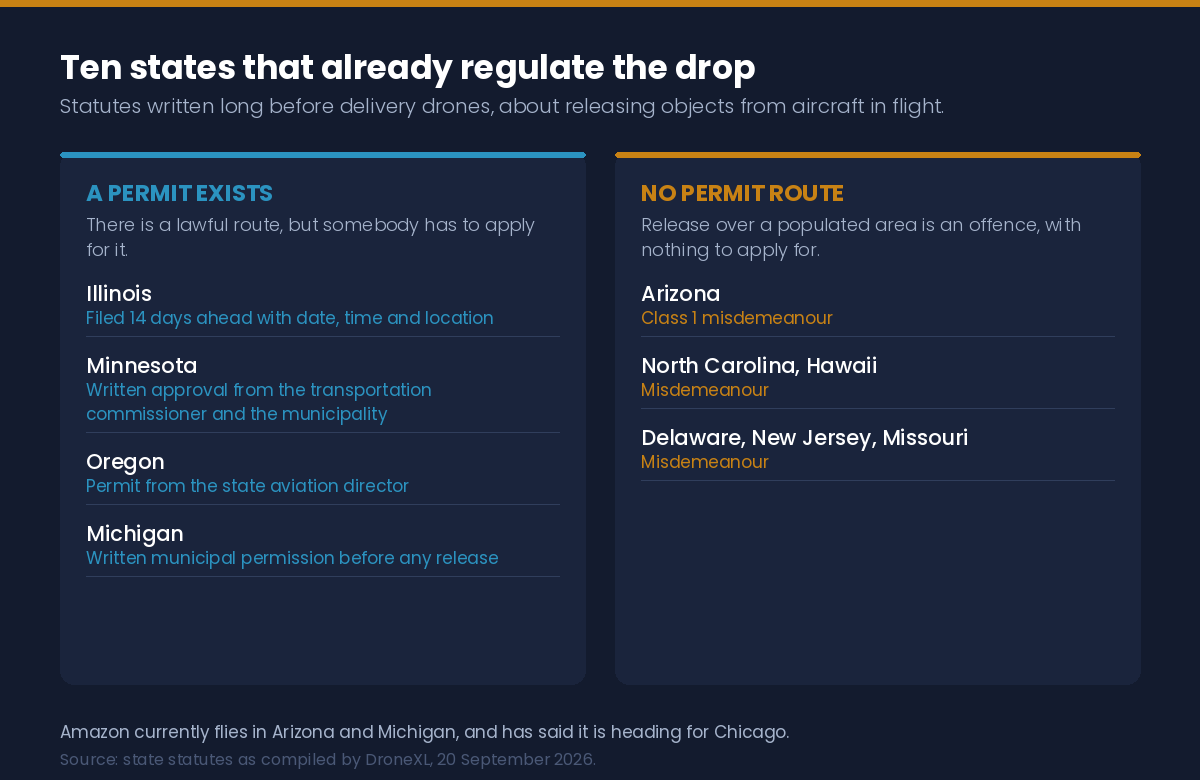
Read the second group carefully and the difficulty becomes obvious. In a state where the conduct is an offence over populated areas and no permitting mechanism exists, compliance is not a paperwork exercise. There is nothing to file.
Why nobody has been charged
The answer is federal preemption, and it is genuinely unresolved rather than merely inconvenient.
The FAA controls the navigable airspace. Its 2023 guidance suggests federal authority is likely to preempt state rules that affect commercial delivery routes. The same guidance acknowledges that states keep their traditional land-use powers, and draws a line that sounds clean until you try to use it: states may regulate how an aircraft operates in some respects, but not where it may fly.
Now apply that to a permit to release cargo over a city. Is that a rule about how the aircraft operates, which would survive, or a rule that effectively decides where it can fly, which would not? It reads as either depending on who is doing the reading, and no court has settled it for delivery drones.
Update, 30 September 2026. It is no longer untested. On 28 September fifteen state attorneys general and Harris County, Texas asked the Second Circuit to vacate the FAA’s nationwide environmental clearance for drone delivery — not the airspace rules, the paperwork behind them. We have broken down what they filed, and the one number the clearance turns on.
So the position today is a standoff. The statutes are on the books and unrepealed. The operations continue. No state has tested it, and until one does, nobody can tell you with confidence which way it goes. It is a familiar shape in US drone policy this year: the question of which drones are banned in the US is being decided the same way, by rules written for one purpose and applied to another.
Where the map and the statute book overlap
This would be an academic problem if the flights were somewhere else. They are not.
Amazon currently operates from eleven sites across seven states, with hundreds of thousands of deliveries completed. Two of those states — Arizona and Michigan — are on the list above, and Arizona is one of the six with no permit route. Chicago is among the announced expansion targets, which puts Illinois and its fourteen-day filing requirement on the map as well.
And the scale is about to change sharply. Amazon has said it intends to reach nearly 500 US cities and towns by the end of 2026, roughly a sixfold expansion. A programme one analyst still describes as being in “test and learn mode” is about to touch a lot more statute books. Scale is also when the edge cases arrive: Boston’s police drone programme hit a parked car six days into its pilot, and that was one aircraft, not a thousand flights a day.
The Connecticut filing, and a deadline this week
The clearest picture of what expansion looks like sits in a current application. Amazon has asked the FAA to authorise up to 1,000 MK30 flights a day from its warehouse in North Haven, Connecticut. That is about 365,000 flights a year, inside a 7.5-mile radius covering roughly 174 square miles — taking in Hamden, Wallingford and parts of New Haven.
- Operating hours of 6:00 a.m. to 10:30 p.m., with up to 100 flights permitted in the first and last half-hour.
- Delivery priced at $5 for Prime members and $10 for everyone else.
- North Haven’s commissioners approved the ground facility back in May, while noting that flight patterns are the FAA’s jurisdiction alone.
Connecticut’s Department of Energy and Environmental Protection opened a fifteen-day public comment window on the state’s coastal zone consistency review, and it closes on 1 October 2026. Worth noting for anyone following the paperwork: as of 20 September the FAA’s environmental review page carried no Connecticut documentation at all.
What thirteen feet does to a parcel
There is a more mundane complaint running underneath the legal one, and it has been running for a year.
Customers have reported Amazon drone delivery parcels released from around ten feet arriving cracked, leaking or visibly damaged — the sort of outcome that follows fairly predictably from dropping a five-pound box onto grass, or onto something harder. In September 2025 Amazon said it would keep refining how its drones select and handle drop zones. Reports gathered seven months later suggested the behaviour had not noticeably changed.
The safety record around the programme is thinner than the delivery count implies, too. Federal reports document test crashes that started brush fires, hardware failures that brought aircraft down from over 100 feet, two drones striking a crane in Arizona, and an MK30 hitting an apartment building in Texas before it crashed.
None of that is unusual for a young aviation programme, and the deliveries that go wrong are a small fraction of the ones that do not. But it is the context in which a state legislature, reading its own statute, might decide to find out what it means.
What would actually settle this
Three things could, and only one of them is quick.
- Amazon changes the method. A tether would take the company out of the statutes entirely, at the cost of a slower, more complex delivery.
- A state tests it. One prosecution, or one cease-and-desist, and the preemption question stops being theoretical.
- The FAA settles it in rulemaking. Part 108 is the obvious vehicle, and it has been slipping for years.
Until one of those happens, the honest description of Amazon drone delivery in those ten states is that it operates in a gap between a federal authority that has not spoken precisely and state laws that nobody has tried to enforce. Which is a strange place to run 365,000 flights a year from a single warehouse.
Frequently asked questions
How does Amazon drone delivery actually drop the package?
The MK30 descends vertically over the delivery point, hovers for roughly six seconds while it checks the drop zone, then opens its cargo bay and releases the parcel from about thirteen feet. The aircraft does not land.
Is it illegal to drop a package from a drone?
It depends which state you are standing in, and the question has not been tested. Ten states have statutes on releasing objects from aircraft in flight: four offer a permit, six treat it as a misdemeanour over populated areas. Whether federal authority over the airspace overrides those laws for Amazon drone delivery and other commercial operators is unresolved.
Which states have laws about releasing objects from aircraft?
Illinois, Minnesota, Oregon and Michigan have permit or written-permission requirements. Arizona, North Carolina, Hawaii, Delaware, New Jersey and Missouri treat release over a populated area as a misdemeanour, with Arizona classing it as a Class 1 misdemeanour.
Why does Amazon drop instead of landing?
Amazon’s stated reason is safety. Hovering keeps turning rotors clear of people, pets and obstacles, and avoids the difficulty of landing an 83-pound aircraft on an unfamiliar surface. The company says the drone uses cameras, radar and other sensors to choose a clear drop zone.
Do Wing and Zipline have the same problem?
No, because they lower packages on a tether rather than releasing them. The aircraft never lets go of the parcel while airborne, so the conduct the statutes describe does not occur.
Has any state prosecuted Amazon over this?
Not that has been reported. The statutes remain on the books and the flights continue, with the preemption question untested in court for delivery drones.
Where does Amazon fly drones today?
From eleven sites across seven states, including Arizona and Michigan, with hundreds of thousands of deliveries completed. Amazon has said it intends to reach nearly 500 US cities and towns by the end of 2026, with Chicago, Atlanta, Cleveland, Syracuse and Boise among the named targets.
What is Amazon proposing in Connecticut?
Up to 1,000 MK30 flights a day from its North Haven warehouse — about 365,000 a year — within a 7.5-mile radius covering some 174 square miles, operating from 6:00 a.m. to 10:30 p.m. The state’s public comment window on its coastal zone consistency review closes on 1 October 2026.
Do packages get damaged?
Customers have reported items arriving cracked, leaking or visibly damaged after being released from around ten feet. Amazon said in September 2025 that it would keep refining drop-zone selection; reports seven months later suggested little had changed.
What would resolve the conflict?
Amazon switching to a tether, a state testing its statute in court, or the FAA settling the point in rulemaking. The Part 108 BVLOS rule is the obvious vehicle for the third, and it has been delayed repeatedly.
Sources
Sources
Primary references used for factual claims in this article.
Continue Reading
All News