Drone Delivery by Lowe’s: 7 Amazing Facts You Need to Know

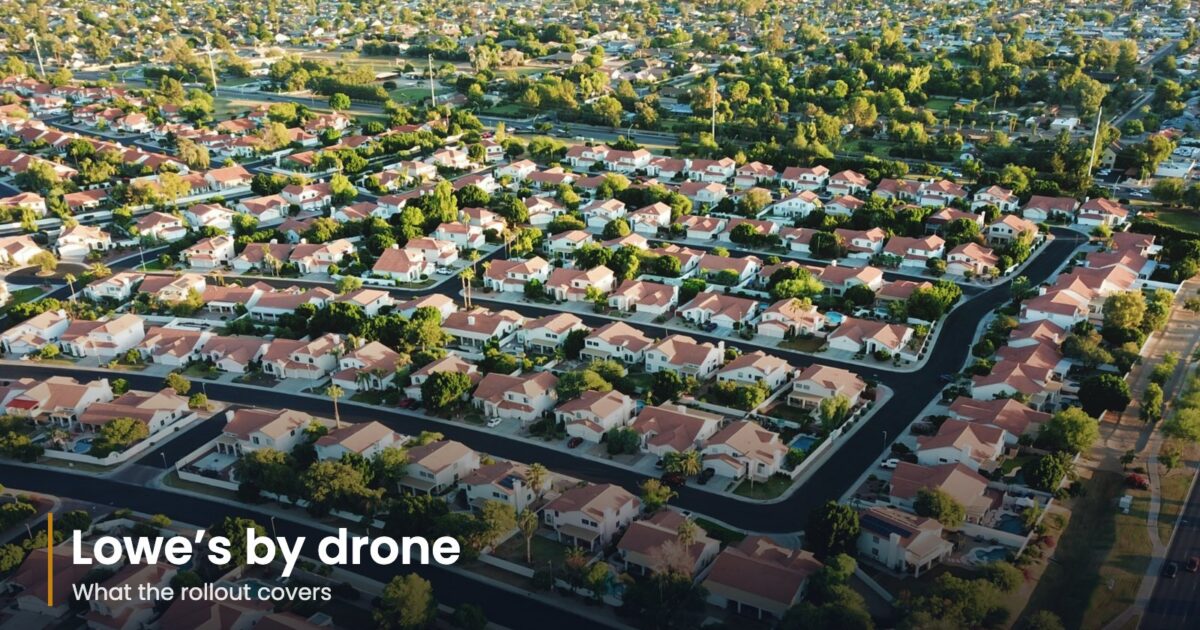
Updated September 25, 2026: Lowe’s drone delivery is now live at one store in Matthews, North Carolina, through a pilot with Wing and DoorDash. The service promises eligible local customers selected home-improvement essentials in as fast as 20 minutes. It is a limited launch, not a nationwide rollout, but it may be one of the clearest tests yet of whether delivery drones can solve a practical retail problem rather than simply create a faster way to order lunch.
Update, 1 October 2026. DoorDash has since gone further than a partnership: it built its own delivery drone and showed it on 30 September, without publishing a payload figure.
Lowe’s drone delivery quick answer
Lowe’s drone delivery lets eligible customers near the Matthews store order from a dedicated “Lowe’s by Drone” storefront in the DoorDash app. Wing operates the aircraft. Lowe’s says the initial catalog includes more than 100 eligible products, such as hand tools, paint supplies, tape, cleaner, batteries and other lightweight project essentials. Wing drones currently carry orders weighing about 2.5 pounds per flight, and Lowe’s says deliveries can arrive in as fast as 20 minutes.
Important limitation: Availability depends on the delivery address, item eligibility, weather and operating conditions. A customer who can see a nearby Lowe’s store in DoorDash will not necessarily see the drone option.
Key facts at a glance
| Question | Confirmed answer |
|---|---|
| Where is the pilot? | Lowe’s store in Matthews, North Carolina, in the Charlotte area |
| When did it launch? | September 24, 2026 |
| Who are the partners? | Lowe’s, Wing and DoorDash |
| How do customers order? | Through the dedicated “Lowe’s by Drone” storefront in the DoorDash app |
| How fast is it? | Lowe’s advertises delivery in as fast as 20 minutes |
| What is the payload? | Approximately 2.5 pounds per flight at launch |
| Is it nationwide? | No. It is a local pilot with address-based eligibility |
Table of contents
- What launched
- How it works
- Why it matters
- Limits and unanswered questions
- What it means for retail drones
- Frequently asked questions
1. Lowe’s drone delivery is a real service, but only a pilot
Lowe’s announced the service on September 24, calling itself the first home-improvement retailer to offer drone delivery. The pilot is operating from the company’s Matthews store in its home market near Charlotte. It adds a new option beside store pickup, curbside pickup and conventional same-day delivery.
That distinction matters. The announcement does not say that every Lowe’s customer in Charlotte can order by drone, and it does not provide a national expansion schedule. Eligibility appears automatically in DoorDash when an address falls inside the supported service area and the operational conditions allow a flight.
The launch builds on an existing Wing and DoorDash delivery network in the Charlotte area. Lowe’s is therefore joining operating infrastructure rather than attempting to build its own aircraft, flight software, dispatch system and consumer ordering app from scratch. For a retailer, that platform approach can lower the cost and complexity of testing a new fulfillment method.
2. How Lowe’s drone delivery works
The customer journey is deliberately familiar. Users open DoorDash and check whether the “Lowe’s by Drone” storefront is available for their address. They choose from the eligible catalog, complete checkout and receive the order through Wing’s delivery operation.
Lowe’s says the curated launch assortment includes more than 100 products. Examples in the official announcement include hand tools, paint products, soap, tape, all-purpose cleaner and batteries. These are not random choices: they are lightweight items that can stop a repair or weekend project when they are missing.
Wing aircraft do not need to land in a customer’s yard. The delivery system lowers a package on a tether while the aircraft remains above the ground, then releases it in a suitable open area. That reduces the need for a landing pad and keeps spinning components away from people, pets and ground obstacles.
The approximately 2.5-pound payload figure is the most important constraint. It rules out paint cans, large power tools, lumber, bags of soil and most other products people associate with a home-improvement warehouse. The pilot is focused on small rescue items, not replacing a pickup truck or a scheduled contractor delivery.
3. The strongest use case is an interrupted project
Many delivery-drone pilots begin with food, medicine or convenience products. Lowe’s drone delivery tests a different kind of urgency: the inexpensive component that is worth far more than its price when a job cannot continue without it.
A missing roll of painter’s tape, a pack of batteries, a small brush or a basic hand tool can force someone to clean up, leave home, drive to a store and return. A 20-minute aerial delivery could be valuable even when the item itself costs only a few dollars. The customer is buying back time and avoiding interruption.
This use case also provides a useful measure of demand. If customers repeatedly order a narrow group of forgotten products, Lowe’s can refine the catalog around real project behavior. If most users try the service once because it is novel and never return, the economics will be less persuasive.
4. Why the Lowe’s, Wing and DoorDash structure matters
Three companies each control a different part of the experience. Lowe’s supplies inventory and retail knowledge. DoorDash provides the ordering marketplace, payments and a consumer base already accustomed to on-demand delivery. Wing supplies the aircraft, automation and operational system.
This separation is significant because drone delivery is not just an aircraft problem. A viable service needs accurate local inventory, fast picking, packaging that works with the aircraft, airspace operations, customer notifications and a safe handoff at the destination. Integrating with an established app may also be easier than convincing customers to install another single-purpose application.
For Wing, a national retailer offers a path toward higher aircraft utilization and more varied demand throughout the day. For DoorDash, drones can become another delivery mode within the same marketplace. For Lowe’s, the partnership creates a way to test aerial fulfillment without becoming an aviation company.
The broader industry has been moving toward this shared-infrastructure model. Drone operators need enough order density to keep aircraft productive, while retailers want coverage without funding a proprietary fleet in every market. The Charlotte pilot will show whether home-improvement orders can add meaningful volume to a network that already serves other merchants.
5. Speed is attractive, but reliability will decide the result
“As fast as 20 minutes” is the headline number, not a guarantee for every order. Actual delivery times can depend on picking speed, launch queues, flight distance, weather, temporary airspace restrictions and whether the customer has an acceptable delivery area.
For this category, predictability may matter more than the best-case time. A customer who pauses a repair needs confidence that the missing item will arrive when promised. A consistently reliable 25-minute service can be more useful than a service that occasionally arrives in ten minutes but is frequently unavailable.
Weather resilience will be another important test. Charlotte experiences rain, thunderstorms, wind and hot summer conditions. Lowe’s did not publish operating thresholds in its retail announcement. Customers should expect the drone option to disappear when flight conditions or local restrictions make delivery unsuitable.
6. What the announcement does not tell us
The official release confirms the launch mechanics but leaves several commercial details unanswered. Lowe’s did not disclose the exact delivery radius, the drone-delivery fee, daily operating hours, expected order volume or a timeline for expansion to other stores.
It also does not state whether the assortment will remain above 100 products, how orders with multiple items are handled when they exceed the payload, or whether a conventional courier option is offered automatically when a drone cannot fly.
Those gaps are normal for an early pilot, but they prevent confident claims about scale. A technically successful flight does not by itself prove that the service saves money. Retailers must account for store labor, packaging, operator costs, infrastructure, maintenance and the number of completed deliveries per aircraft.
Noise and neighborhood acceptance also deserve attention. Wing’s aircraft are designed for delivery networks, yet repeated operations will be judged by residents who did not place an order as well as customers who did. Transparent operating hours and predictable routes can be as important to public acceptance as speed.
7. Lowe’s drone delivery could expand the definition of “urgent” retail
Urgency is usually associated with meals or medical products. This pilot suggests that urgency can also mean avoiding a 45-minute interruption during a two-hour household task. That is a more specific and potentially more defensible value proposition than delivering any lightweight item simply because a drone can carry it.
If the Matthews trial produces repeat orders, Lowe’s could identify other stores where suburban density, suitable yards and customer demand align with Wing’s network. The first expansion targets would likely be markets where Wing and DoorDash already have operations or can add multiple merchants to the same infrastructure.
However, the 2.5-pound limit will continue to shape the catalog. Drone delivery is likely to complement stores and road vehicles rather than replace them. It can handle the small, time-sensitive edge of the order mix while vans and cars carry heavy, bulky or multi-item purchases.
What this means for the delivery-drone market
The most encouraging feature of the announcement is not a new aircraft specification. It is the integration of a real retailer into a consumer app and an existing local flight network. That is the operational layer the industry must solve before delivery drones become routine.
The pilot also creates a measurable commercial experiment. Lowe’s can compare drone orders with curbside pickup and conventional delivery, study which products are most valuable in urgent situations and evaluate whether faster fulfillment improves customer retention.
Competitors will watch closely. If a lightweight replacement part or project essential generates repeat demand, hardware, automotive and general-merchandise retailers may have similar opportunities. If demand is mostly promotional, the sector will need to find categories with stronger frequency or higher margins.
For consumers, the near-term lesson is simple: drone delivery will arrive neighborhood by neighborhood and retailer by retailer, not everywhere at once. The presence of an aircraft network in a city does not guarantee eligibility, and service areas can be smaller than a metropolitan market.
Confirmed facts versus analysis
Confirmed: the Matthews pilot is live; orders are placed through DoorDash; Wing provides the drone service; the launch catalog has more than 100 eligible products; current orders weigh approximately 2.5 pounds per flight; and Lowe’s advertises delivery in as fast as 20 minutes.
DroneRanker analysis: the interrupted-project use case may produce stronger practical value than novelty-driven delivery, and the three-company structure may make expansion easier. Lowe’s has not confirmed new markets, pricing, order volume or a rollout schedule, so any national expansion remains speculative.
What to watch next
- Whether Lowe’s publishes additional eligible stores or cities
- Changes to the payload limit or product assortment
- Delivery pricing and whether subscription benefits apply
- Operating hours and weather-related availability
- Evidence of repeat use after the launch period
- New retailers joining the same Wing and DoorDash network
The Charlotte area has become an important proving ground for consumer drone logistics. Readers tracking the wider market can also see our coverage of the latest autonomous-drone launches and our ongoing reporting on U.S. drone regulation and commercial operations.
Frequently asked questions
Is Lowe’s drone delivery available everywhere?
No. It launched as a pilot from the Matthews, North Carolina store. DoorDash displays the option only for eligible addresses.
How fast is Lowe’s drone delivery?
Lowe’s says eligible orders can arrive in as fast as 20 minutes. That is a best-case service claim, and actual availability or timing can vary.
How much can the drone carry?
Wing drones currently transport orders weighing approximately 2.5 pounds per flight for this service.
What products can be delivered?
The initial catalog includes more than 100 lightweight products, including selected hand tools, paint supplies, tape, cleaner, soap and batteries.
Do customers need a Wing app?
The announced process uses DoorDash. Eligible customers select the dedicated “Lowe’s by Drone” storefront inside the DoorDash app.
Does the drone land at the house?
Wing’s delivery system generally lowers the package to the ground on a tether while the aircraft remains above the delivery area.
Will Lowe’s expand the service?
Lowe’s has not announced a national rollout schedule. Results from the Matthews pilot will likely influence any future expansion.
Sources and editorial method
This report is based primarily on Lowe’s official September 24 announcement, cross-checked against public information about Wing’s delivery method. DroneRanker separates confirmed launch details from analysis and does not treat an advertised best-case delivery time as a universal guarantee.
Last checked: September 25, 2026.
Lowe’s drone delivery remains a limited pilot. DroneRanker will update this Lowe’s drone delivery report when Lowe’s, Wing or
DoorDash confirms new stores, pricing or operating limits.
Table of Contents
Sources
Primary references used for factual claims in this article.
Continue Reading
All News