Fifteen States Sued the FAA Over Drone Delivery. The Fight Is One Document.

On 28 September fifteen state attorneys general and one Texas county asked a federal appeals court to throw out a document most people have never heard of. It is not a rule about where drones may fly, or how loud they are allowed to be. It is an environmental review — written once, and applied to every commercial drone delivery hub in the United States.
Four days earlier, a federal judge in New Jersey had struck down a borough’s drone ordinance as preempted by federal law, and then refused to give the pilot who challenged it anything at all.
Read together, the two filings explain why the FAA drone delivery lawsuit went after the paperwork rather than the flights. On the question of who controls the airspace, they would lose. On the question of whether the FAA did its homework before opening that airspace to delivery drones nationwide, they might not.
Table of Contents
Update, 1 October 2026. The first operator to scale entirely inside that clearance is already here: DoorDash received its Part 135 air carrier certificate on 29 July, the day after the FAA signed the document, and unveiled its own delivery drone on 30 September — with California, its planned launch state, among the petitioners.
What the fifteen states actually filed
The petition was lodged on 28 September in the United States Court of Appeals for the Second Circuit. New York Attorney General Letitia James is counsel for the group. Joining her: California, Arizona, Colorado, Delaware, Illinois, Maine, Maryland, Massachusetts, Michigan, New Mexico, Oregon, Rhode Island, Washington and Wisconsin, together with Harris County, Texas.
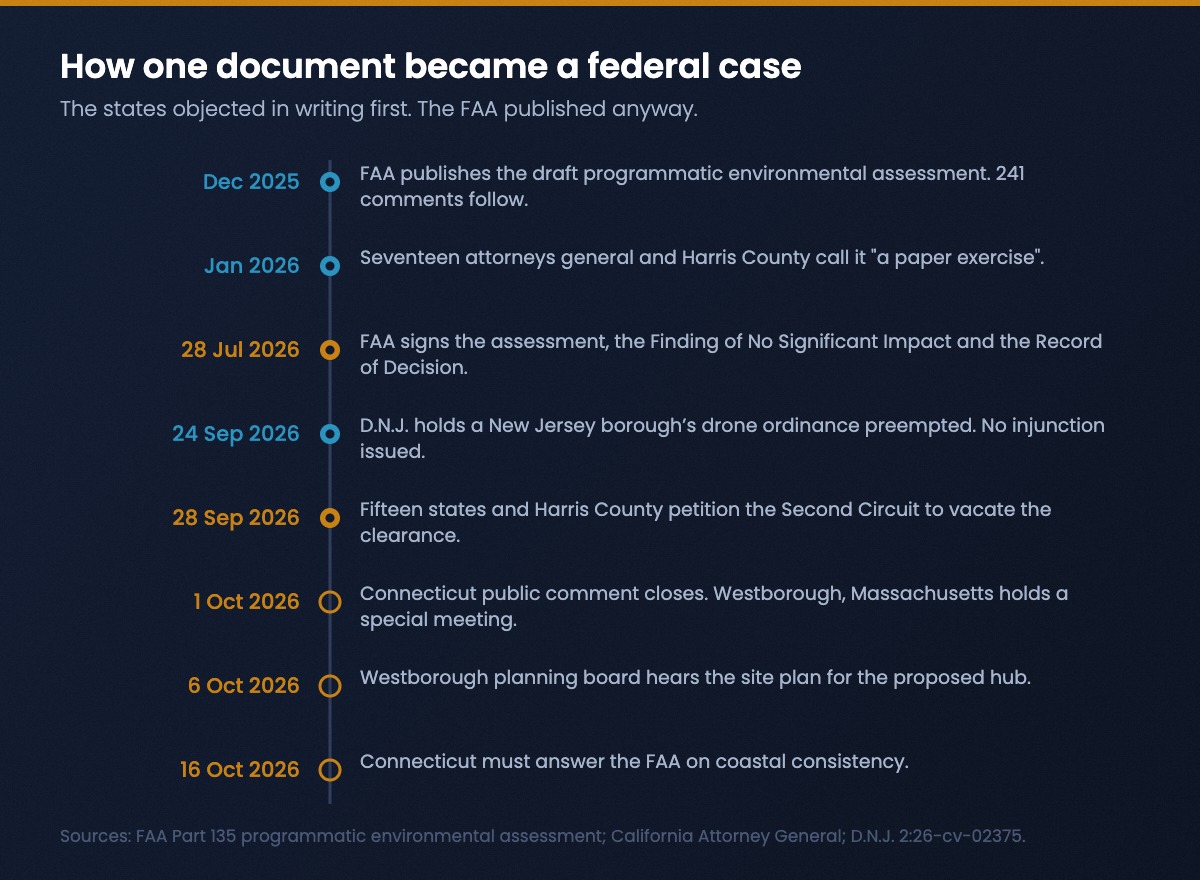
What they want set aside is a set of three linked documents signed on 28 July 2026: the FAA’s final Programmatic Environmental Assessment for commercial drone package delivery, the Finding of No Significant Impact that followed from it, and the Record of Decision. The legal ground is the National Environmental Policy Act. The remedy asked for is vacatur — not a pause, but the removal of the document.
California Attorney General Rob Bonta’s office put the complaint plainly: the assessment “does not adequately address the potential safety risks or other environmental impacts” of the expansion it contemplates, and says too little about the communities underneath it.
One procedural detail is worth noting because it tells you this was not a spur-of-the-moment filing. The window to challenge the July decision closed on Saturday 26 September. Under the Federal Rules of Appellate Procedure a deadline falling on a weekend moves to the next business day, which is how a challenge to a July decision came to be filed on the last possible Monday.
The number the whole clearance rests on
Before 28 July, a company that wanted to start delivering by drone in a new city generally needed an environmental assessment for that city. The programmatic assessment replaced that arrangement with a single national document. It covers commercial package delivery under Part 135 — all operators, from hubs anywhere in the United States including Alaska and Hawaii, to delivery locations anywhere in the United States.
It is not unlimited. The scope is set by one figure, and it is the figure the entire arrangement turns on.
“The proposed action includes a UCT of 1,150 AAD deliveries from a single hub.” — FAA, Final Programmatic Environmental Assessment
UCT is the unit capacity threshold. AAD is average annual day: the year’s total deliveries divided by 365. Stay under 1,150 a day from one hub and the operation sits inside the national document, with no site-specific environmental analysis required. Go above it and, in the FAA’s words, “a more detailed analysis specific to the proposed activity would be required to evaluate the potential for noise impacts” — unless the operator can show its aircraft would not be louder than the noise profile the threshold was built on.
The rest of the envelope is similarly specific. Hubs must sit at least 183 metres (600 feet) from noise-sensitive land uses, a setback the final version made binding rather than merely recommended. Cruise runs between 46 and 114 metres (150 to 375 feet), under a 122-metre (400-foot) ceiling. Aircraft plus package may not exceed 50 kilograms (110 pounds).
Hold that 1,150 next to the largest single request now pending. Amazon has asked to fly up to 1,000 MK30 flights a day out of a warehouse in North Haven, Connecticut, over a 7.5-mile radius, from 6 a.m. to 10:30 p.m. The two numbers are not measured the same way — the FAA’s is an annual average, Amazon’s is a daily maximum — so they cannot be compared cleanly.
But they are close enough that the threshold has stopped being a theoretical ceiling. It is the line a real filing is being drawn up against. And those flights end the way every Amazon delivery ends, by releasing the parcel in mid-air from about thirteen feet — conduct that ten states already have statutes about.
They said all of this in writing, and the FAA published anyway
The petition is not a new argument. It is an old argument moved to a courtroom.
The FAA put the draft assessment out in December 2025 and took 241 comments, with the window extended into late January at the public’s request. Seventeen attorneys general and Harris County filed against it then. Their description of the draft was not diplomatic: “a paper exercise, largely devoid of reliable qualitative or quantitative analyses.”
Two specific objections sit underneath that phrase. The first is about noise: the model measured delivery drones against aviation baselines alone, which leaves out the road and rail noise a suburban street already lives with, and therefore flatters the result. The second is about fire. The states pointed at an incident in Tolleson, Arizona in October 2025 in which an Amazon MK30’s battery was ejected in a collision and burned, and argued the lithium-battery analysis did not take that class of risk seriously.
The FAA answered commenters in an appendix and kept its numbers. One thing did change between draft and final: the hub setbacks stopped being a request and became a condition. Everything else, including the 1,150 threshold, survived intact. That is the decision now in front of the Second Circuit.
Two of the seventeen did not sign
Compare the two lists and a gap appears. Seventeen states objected during the comment round. Fifteen signed the petition. The two that did not are Connecticut and Vermont.
Connecticut is the more conspicuous absence, because Connecticut is where the biggest pending hub request in the country sits. It is also the one state running a parallel process of its own. The Department of Energy and Environmental Protection is conducting a coastal consistency review of the North Haven proposal: public comment closes on 1 October and DEEP must give the FAA its answer by 16 October. That review can produce a concurrence or an objection. It cannot set altitudes, hours or noise limits — it asks only whether the federal action is consistent with the state’s coastal policies.
Whether those two facts are connected is not something anyone has said publicly, and it would be careless to assume it. What can be said is narrower and still worth saying: the state with the most immediate exposure to this clearance is currently arguing about it through a state permit process rather than a federal court.
Why nobody is arguing about authority any more
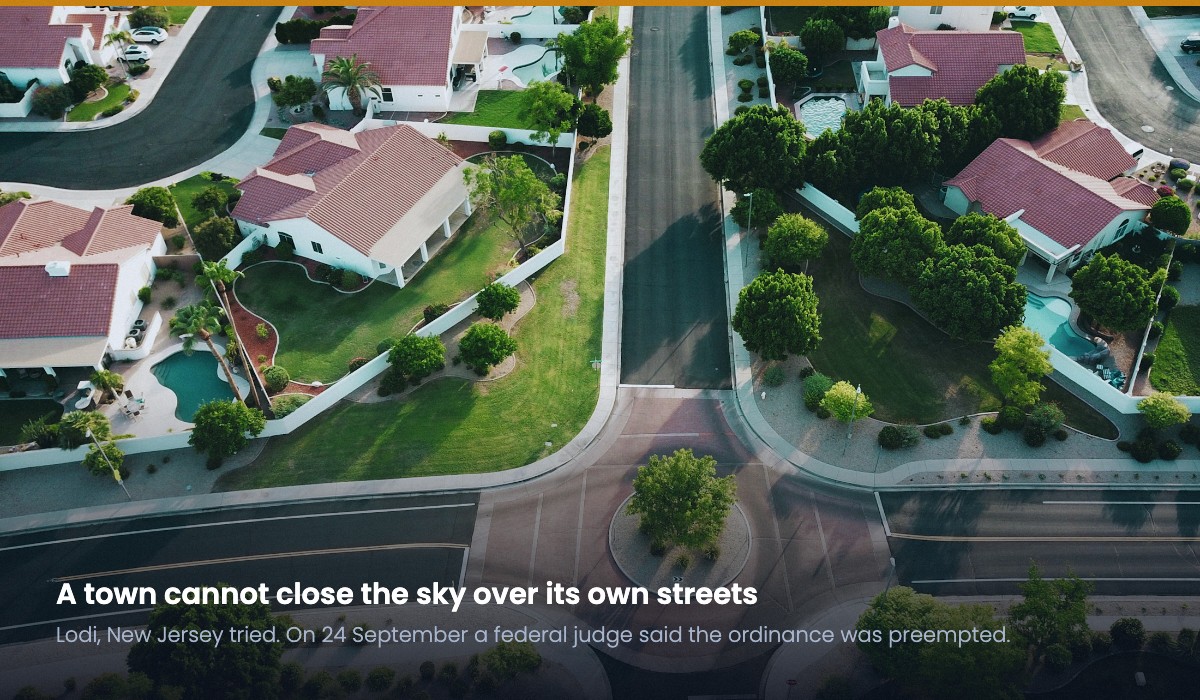
On 24 September, in a letter opinion in Palange v. Borough of Lodi (2:26-cv-02375, District of New Jersey), Judge Susan D. Wigenton explained why a case like this one gets filed the way it does.
Lodi had adopted Chapter 217 in June 2025. It banned camera-carrying drones below 400 feet anywhere in the borough, and sensor-free aircraft below 400 feet over residential and commercial zones, roads and public buildings. A third offence carried up to $2,000 and 90 days. Paul Palange, who represented himself, flew a camera-free drone from his own yard and collected three summonses in July 2025.
The court found the ordinance both field preempted and conflict preempted. The reasoning is short and hard to argue with: the FAA caps most small drone flight at 400 feet, and Lodi prohibited flight below 400 feet, so the two together left, in the judge’s words, “no meaningful altitude band in which a UAS may lawfully operate.” The ordinance stood as “an obstacle to the FAA and Congress’s objectives to integrate UAS into the national airspace.”
And then Palange got nothing. The borough told the court that his FAA-compliant flights were already permitted and that it was not enforcing the ordinance against him, which made his injury speculative rather than imminent, and the restraining order was denied. He won the point and left without a remedy.
That is the backdrop to the state petition. A local government writing its own airspace rule loses on the law. Fifteen attorneys general did not file a preemption case, and the Lodi opinion is a fair illustration of why not. What is left is procedure: not whether the FAA may open the airspace, but whether it followed the statute on the way.
The fortnight that follows
The court case will take months. The decisions that actually place drones over particular streets are being made in the next two weeks.
- 1 October — Connecticut DEEP’s public comment window on the North Haven proposal closes. Comments are weighed against coastal policy, so the ones that count address coastal resources rather than noise preferences.
- 1 October — Westborough, Massachusetts holds a Select Board special meeting on the hub proposed at 64 Otis Street: roughly six MK30s, a 7.5-mile radius, several hundred deliveries a day, possibly flying by the end of October.
- 6 October — the Westborough planning board hears the site plan application.
- 16 October — Connecticut must return its consistency answer to the FAA.
Massachusetts is doing both things at once. It signed the federal petition on 28 September, and on 29 September three of its state legislators — Senator Michael Moore, Representative Kate Donaghue and Representative Hannah Kane — asked Amazon to pause the Westborough launch until it answered on operating hours, flight paths, service range and daily flight counts. A local survey circulated in the town put opposition at 92 per cent; that is a community survey rather than a scientific poll, and it should be read as a measure of who turned up, not of the town.
None of this has slowed the programme down elsewhere: the company opened in Cleveland this month and is still working towards nearly 500 US cities and towns. Amazon’s position has not moved. A spokesman said the company is working with local officials to bring the service to the area, and the company has said that fewer than one per cent of customer contacts mention noise.
What this changes if you just fly a drone
Directly, nothing. The FAA drone delivery lawsuit concerns commercial package delivery under Part 135. It has no bearing on Part 107 work or on recreational flying, and no drone becomes more or less legal to own because of it.
The Lodi opinion is the half that reaches ordinary pilots, and it is worth keeping the weight right. It is a district court ruling on a request for a temporary restraining order. It binds nobody outside that case. But it is one more reasoned holding that a municipal ban on flight below 400 feet cannot stand, which is useful to know if your own town is drafting one.
As for the lawsuit: if the Second Circuit vacates the assessment, the FAA has to do the analysis again. That would slow expansion into new markets. It would not make delivery drones illegal, and what happens to approvals already granted under the document would be for the court and the agency to sort out rather than something anyone can promise now.
The honest summary is that a week ago the question of whether states could do anything about drone delivery was open. It is still open — but it has been narrowed to a single question about a single document, and it now has a court, a docket and a calendar attached to it.
Frequently asked questions
Which states sued the FAA over drone delivery?
New York, California, Arizona, Colorado, Delaware, Illinois, Maine, Maryland, Massachusetts, Michigan, New Mexico, Oregon, Rhode Island, Washington and Wisconsin, plus Harris County, Texas. New York Attorney General Letitia James is counsel for the group.
What exactly are they challenging?
The FAA’s final Programmatic Environmental Assessment for commercial drone package delivery, together with the Finding of No Significant Impact and the Record of Decision that accompany it, all signed on 28 July 2026. The claim is brought under the National Environmental Policy Act and asks the court to vacate them.
What is a programmatic environmental assessment?
An environmental review written once for a whole class of future actions, so that individual projects falling inside its parameters do not each need their own. Here it replaced market-by-market reviews for drone delivery with one national document.
What is the 1,150 figure in the FAA document?
The unit capacity threshold: 1,150 average annual day deliveries from a single hub, where average annual day means the year’s deliveries divided by 365. Operations below it sit inside the national assessment. Above it, the FAA says a more detailed noise analysis specific to the proposal would be required.
Does the lawsuit stop Amazon drone deliveries?
No. The FAA drone delivery lawsuit is a petition for review, and filing one does not suspend the decision being challenged. Deliveries continue while the case proceeds unless a court orders otherwise.
Why are Connecticut and Vermont not on the petition?
Neither has said. Both objected during the comment round in January and neither signed in September. Connecticut is separately running a state coastal consistency review of the North Haven hub, with its answer due to the FAA by 16 October.
What did the New Jersey ruling decide?
That Lodi’s drone ordinance was field and conflict preempted by federal law, because banning flight below 400 feet leaves no altitude at which a drone could lawfully fly under the FAA’s own 400-foot ceiling. The pilot was still denied a restraining order, because the borough told the court it was not enforcing the ordinance against him.
Can my town ban drones?
A town can regulate what happens on the ground it owns — take-off and landing from municipal parks, for example. An ordinance that sets altitude rules for the airspace itself runs into federal preemption, which is what happened in Lodi. Local rules vary and this is not legal advice.
When is the Connecticut comment deadline?
1 October 2026 for public comments to the Department of Energy and Environmental Protection. DEEP must respond to the FAA by 16 October 2026.
Does any of this affect recreational flying?
The petition does not. It concerns commercial Part 135 package delivery only.
Sources
- California Attorney General — announcement of the challenge to the FAA environmental assessment, 28 September 2026
- FAA — Final Programmatic Environmental Assessment, FONSI and Record of Decision for Part 135 package delivery (PDF)
- govinfo — Palange v. Borough of Lodi, 2:26-cv-02375, letter opinion of 24 September 2026
- DroneXL — fifteen states petition the Second Circuit over the delivery clearance
- DroneXL — the Lodi ordinance is preempted, but the pilot gets no order
- DroneXL — Massachusetts lawmakers ask Amazon to pause the Westborough hub
- DroneXL — the North Haven proposal and the CT DEEP consistency review
Sources
Primary references used for factual claims in this article.
Continue Reading
All News