Amazon Prime Air Drone Delivery Expands to Nearly 500 U.S. Cities

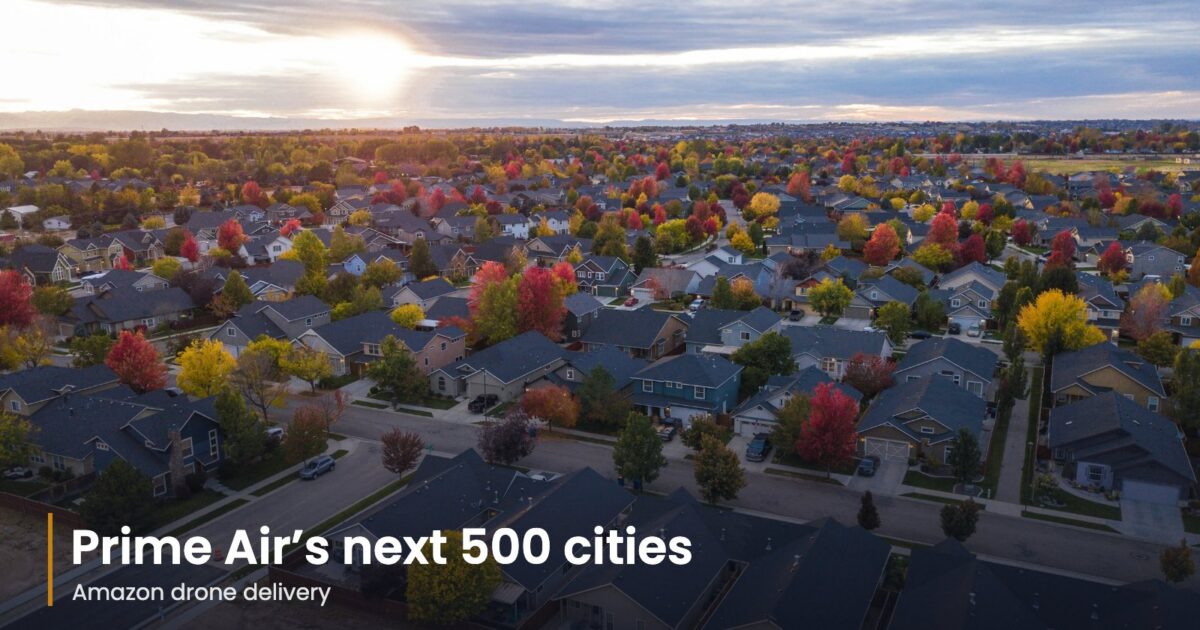
Amazon says its Prime Air drone delivery network is expected to reach nearly 500 cities and towns across the United States by the end of 2026, potentially putting the service within reach of tens of millions of customers. Eligible orders weighing up to 5 pounds can arrive in as little as 30 minutes.
Living in one of those places won’t automatically mean your home qualifies. Eligibility still depends on the address, local airspace, distance from a launch site, package size and whether the property has a suitable drop area.
Update, 30 September 2026. Fifteen states and Harris County, Texas have petitioned a federal court to vacate the FAA environmental clearance the whole program runs on, which puts every US drone delivery hub on uncertain legal ground.
Update, 22 October 2026: Prime Air is next aiming at Tallahassee, Florida. Amazon told a public MK30 showing on 20 October that it plans to start there by mid-November, flying items up to 5 pounds from the Mahan Drive fulfillment center to homes within 7.5 miles for a $4.99 fee, with a fleet of up to 21 drones. The building that will house the drones is still under permit review, DroneXL reports, so the date could slip.
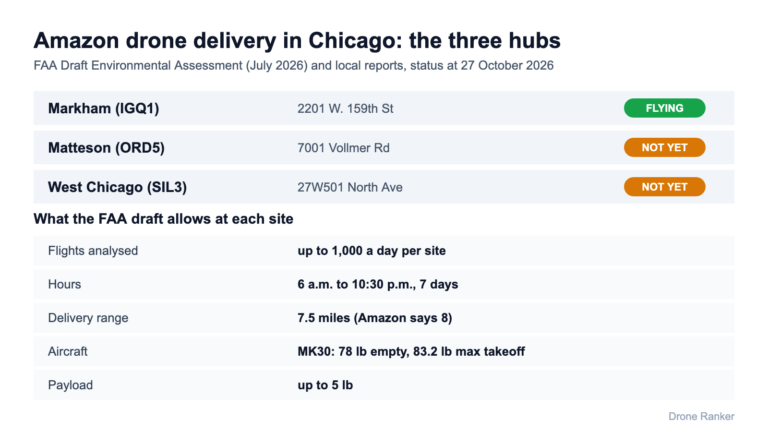
Update, 27 October 2026: Chicago is now flying. Amazon says about 21 MK30 drones are based at its Markham fulfillment center, and residents in nearby Homewood have filmed deliveries since mid-October, although Amazon has not announced a formal launch. The FAA’s Chicago assessment for Markham, Matteson and West Chicago is still a draft. Details in our Amazon drone delivery Chicago guide.
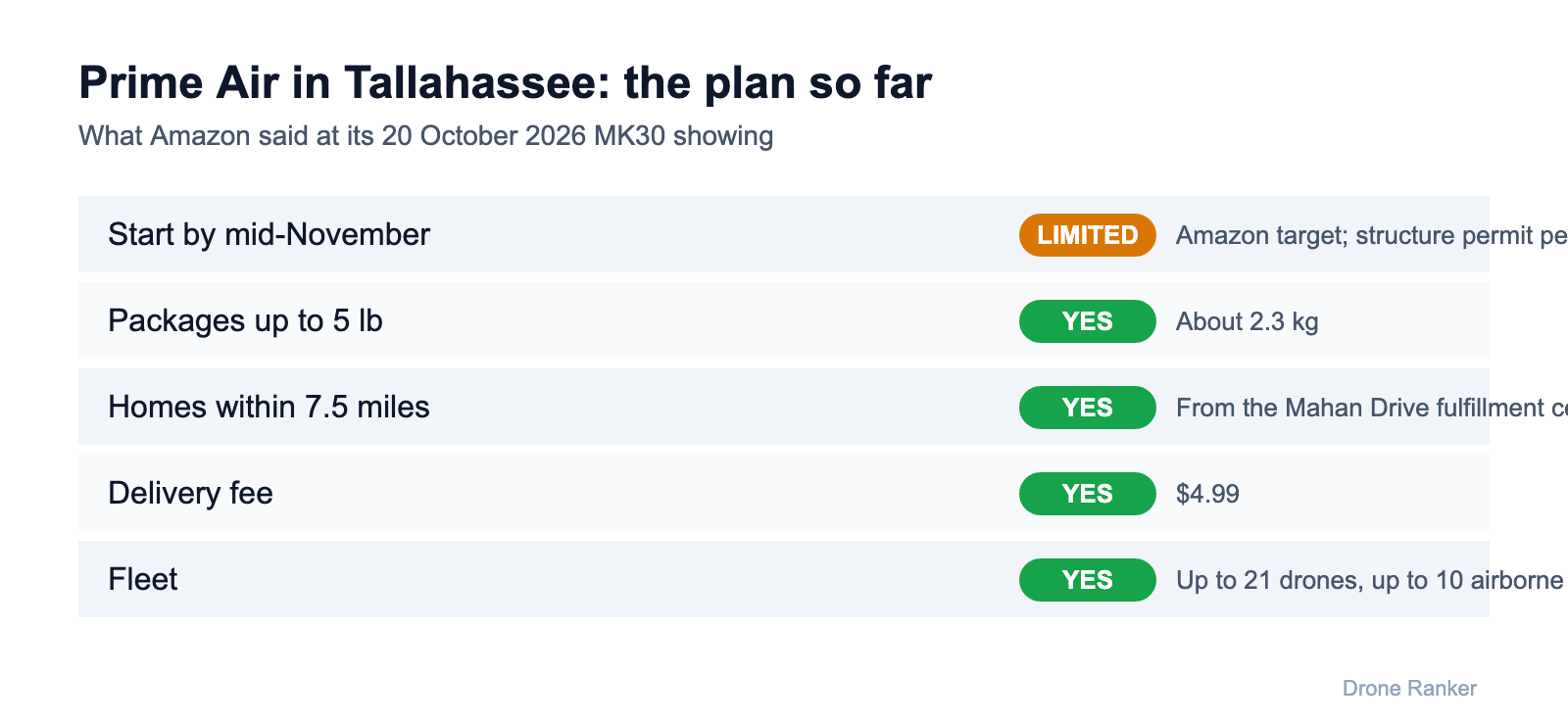
Table of Contents
Where Prime Air flies now, and where it’s going
Amazon says Prime Air currently operates from 11 locations across 10 US metro areas, in Arizona, Florida, Kansas, Louisiana, Michigan, Nebraska and Texas. Current markets include areas around Phoenix, Tampa, Kansas City, Baton Rouge, Detroit, Omaha, Houston, Dallas, San Antonio and Waco. The company also says it has already completed hundreds of thousands of drone deliveries in 2026.
The Associated Press has identified planned expansion around Chicago, Atlanta, Cleveland and Boise, and Amazon says new locations are coming to Georgia, Ohio, Illinois, Idaho and New York. Our Cleveland report covers one of those launches. Amazon has not published a single list of all the nearly 500 cities.
The jump from 11 sites to 500 cities is less dramatic than it sounds. One launch site can serve several surrounding communities, so the count of covered towns can grow much faster than the count of facilities. That also means the city number is a soft measure. The one that counts is how many customers actually see Prime Air at checkout.
How to tell if it’s available to you
There is no nationwide map of eligible addresses. If your address and order qualify, Prime Air appears as a delivery option while you shop or at checkout.
Two neighbors in the same town can get different answers. Each site serves a limited radius, and dense trees, power lines, swimming pools, restricted airspace or other obstacles near the drop spot can rule a home out. Weather plays a part too: strong winds and storms affect drones more than delivery vans.
What it carries and what it costs
Prime Air handles packages up to 5 pounds (about 2.27 kg). That leaves out furniture, TVs and bulk orders, but covers the kind of small items where speed counts: medicine, chargers, cosmetics, household essentials, some groceries and small electronics. Whether a given product qualifies is shown per item at your address.
According to current reporting, qualifying Prime members get free drone delivery on eligible orders over $50, smaller eligible Prime orders carry a $2.99 fee, and non-Prime customers pay about $4.99. Amazon could change that as it expands. Keeping drone delivery cheap is the right call if Amazon wants people to use it routinely rather than once as a novelty.
How the MK30 delivers
Amazon uses its newer MK30 drone, which flies autonomously between Amazon facilities and customers’ delivery spots with a Detect-and-Avoid system to recognize and respond to obstacles and other aircraft. It doesn’t land at your home. It positions itself above an approved drop area and releases the parcel from roughly thirteen feet, then returns.
That release detail is less trivial than it sounds: ten states have statutes that describe exactly that act, a conflict no court has tested yet.
Autonomy is also what makes the scale possible. A network across hundreds of towns could not rely on one pilot watching every aircraft, and Amazon has worked with the FAA on approvals for flights beyond visual line of sight in approved circumstances. Jeff Bezos first talked publicly about delivery drones in 2013; the company has since spoken of delivering hundreds of millions of packages by drone before the end of the decade.
Noise, privacy and local pushback
Residents in some test areas have raised concerns about noise, privacy and frequent autonomous flights over neighborhoods. Amazon says the drones’ cameras and sensors are for navigation and safe operation, not surveillance, and that the MK30 was designed to reduce perceived noise compared with earlier models.
Aviation approval is one hurdle. Persuading hundreds of communities that regular overflights are a fair trade for faster deliveries is a harder one, and local governments can influence where Amazon builds and operates. Some towns are already pushing back on proposed hubs.
Amazon vs Walmart
Walmart is expanding drone delivery too, mostly through Alphabet-owned Wing, using its huge network of stores as launch points close to where many households already live. Amazon instead combines its own logistics sites with purpose-built drones like the MK30. Our guide to Walmart drone delivery cities covers that side.
The 500-city target is a ceiling, not a promise for 31 December, and local approvals, construction and now the court challenge could all delay individual sites. Prime Air is still a tiny share of Amazon’s deliveries. The test for 2026 is whether 30-minute delivery at a few dollars becomes an ordinary checkout choice in the places it reaches, not how many town names end up inside a service area.
Want to fly one yourself?
DJI Neo
135 g, palm takeoff, no controller needed. Under 250 g: recreational flyers skip FAA registration but still need TRUST.
Under 249 g, 3-axis gimbal, 4K/30. The cheapest DJI camera drone with a real gimbal.
As an Amazon Associate, Drone Ranker earns from qualifying purchases. We do not quote prices because Amazon’s change by the hour.
Last updated 21 August 2026. Prime Air locations, pricing and address eligibility may change as Amazon expands its US drone delivery network.
The Friday Brief
One email a week on what changed in drones
FCC and FAA rule changes, DJI leaks checked against filings, and the week’s new comparisons. Every Friday, nothing else.
Free. Unsubscribe in one click. Sent with Kit; see our privacy policy.
Follow us on Google too: add Drone Ranker as a preferred source →
Continue Reading
All News