Skydio F10 Lightrunner: 7 Critical Facts Explained

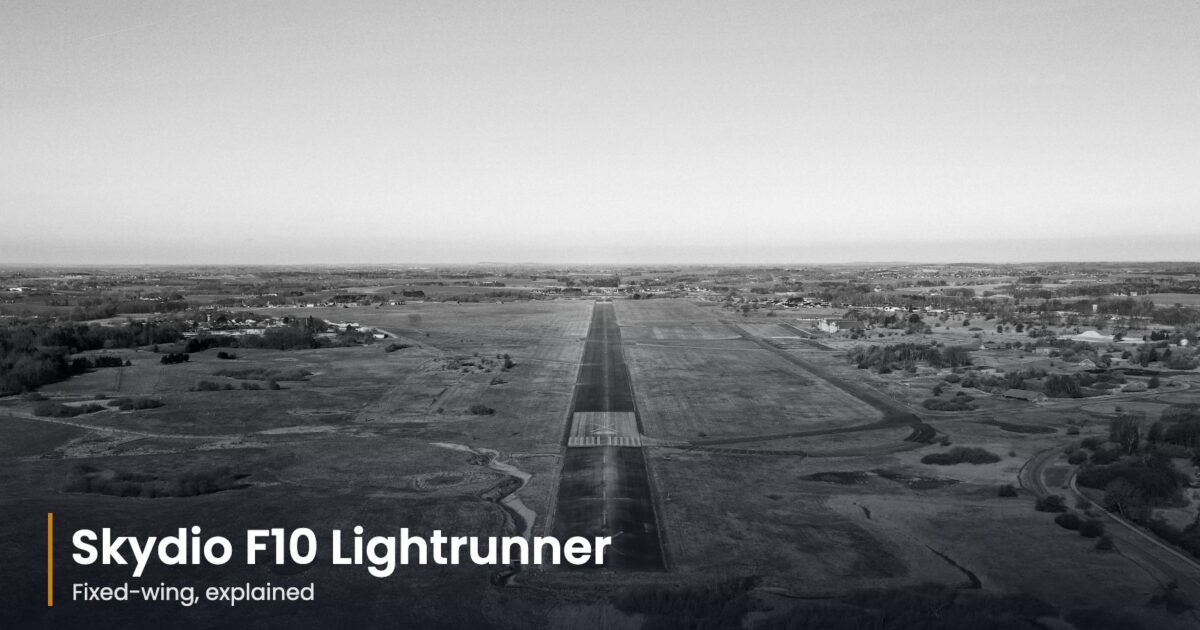
The Skydio F10 Lightrunner is now an announced product rather than the unnamed long-range aircraft viewers saw before Skydio Ascend 2026. Skydio says its first fixed-wing drone can reach 100 mph, operate within a 30-mile radius and remain airborne for up to 120 minutes under its published maximum specification.
Those numbers put F10 in a different category from Skydio X10 and most docked multirotors. The aircraft is intended for rural emergency response, high-speed pursuits, search operations and long infrastructure corridors. It is not a consumer camera drone, and Skydio has not published a retail price.
The most important qualification is timing. Skydio says F10 will deploy to customers in 2027. The announcement and technical pages provide substantial detail, but they do not establish that every agency can order a fully operational system today or that regulators have approved every proposed mission.
Quick answer: Skydio F10 Lightrunner is a 7 kg autonomous fixed-wing drone designed to launch from MegaDock without a runway or ground crew. Official specifications list a 100 mph maximum speed, 120-minute maximum flight time, 30-mile operating radius, IP55 protection, visual and thermal cameras, dual-cellular connectivity and an integrated parachute. Customer deployments are planned for 2027; pricing and a broad delivery schedule have not been published.
Skydio F10 Lightrunner quick facts
| Item | Officially published detail | Important context |
|---|---|---|
| Aircraft type | Autonomous fixed-wing VTOL | Uses robotic launch and recovery rather than a runway |
| Maximum speed | 100 mph / 44 m/s | Skydio also lists a 45 mph cruise speed in its FAQ |
| Maximum flight time | 120 minutes | Another official FAQ describes about 90 minutes of flight plus a 30-minute charge cycle |
| Operating radius | 30 miles | Requires cellular coverage across the operating area |
| Claimed coverage | About 2,800 square miles | A geographic coverage claim, not blanket regulatory authorization |
| Weight | 15.43 lb / 7 kg including batteries | Far outside consumer sub-250 g categories |
| Weather rating | IP55 | Skydio lists launch/landing wind limits of 27 mph |
| Dock | MegaDock, up to five aircraft | Large fixed site with robotic takeoff and landing |
| Cameras | 64 MP narrow, 48 MP telephoto, FLIR Boson+ thermal | Detailed imaging performance still needs independent field testing |
| Availability | Deploying to customers in 2027 | No public price or universal shipping date announced |
Table of Contents
- [What Skydio actually announced](#what-skydio-actually-announced)
- [Seven critical facts about Skydio F10 Lightrunner](#seven-critical-facts-about-skydio-f10-lightrunner)
- [F10 versus Skydio X10](#skydio-f10-lightrunner-versus-skydio-x10)
- [What MegaDock changes](#what-megadock-changes)
- [Camera and sensor package](#camera-and-sensor-package)
- [Autonomy, connectivity and airspace safety](#autonomy-connectivity-and-airspace-safety)
- [What remains unconfirmed](#what-remains-unconfirmed)
- [Industry impact](#what-the-skydio-f10-lightrunner-could-change)
- [Questions buyers should ask](#questions-buyers-should-ask)
- [Frequently asked questions](#frequently-asked-questions)
What Skydio actually announced
Skydio introduced F10 Lightrunner and MegaDock at Ascend 2026 on September 24. The company also announced Controller 2, Asset Command, Security Command and fleet-wide software and camera updates.
This is the follow-up to the aircraft previewed at Ascend 2025. Our earlier Skydio Ascend 26 preview identified F10 availability, endurance, communications and launch infrastructure as the major unanswered questions. The new product and technical pages now answer many of them.
Skydio describes F10 as a dock-based fixed-wing aircraft for missions measured in miles rather than city blocks. A remote pilot chooses the mission and remains responsible for it, while the system automates launch, navigation, obstacle response, camera tracking and recovery.
The company is positioning the aircraft for public safety and critical infrastructure, not hobby flying. Named use cases include rural and suburban incident response, search and rescue, long-duration overwatch, high-speed vehicle pursuits, storm-damage assessment and inspection of roads, power lines and other linear assets.
The announcement does not make F10 a generally available consumer product. Skydio directs interested organizations to its sales team and says deployments begin in 2027.
Seven critical facts about Skydio F10 Lightrunner
1. Skydio F10 Lightrunner is a 100 mph fixed-wing drone
Skydio’s technical specifications list a maximum horizontal speed of 100 mph, or 44 m/s, at sea level. Its FAQ separately lists a 45 mph cruise speed. The distinction matters: maximum speed describes the upper performance limit, while cruise speed is more relevant to routine range and energy use.
At 100 mph, F10 could reach a scene 10 miles away in roughly six minutes before accounting for launch, routing, airspace restrictions and wind. That is the operational argument behind the product: a docked aircraft may arrive before a ground unit traveling through rural roads.
High speed also raises the consequence of planning and perception errors. A fixed-wing aircraft cannot stop and hover when it sees an obstacle. Skydio says its Foresight system looks ahead and replans while enough distance remains to maneuver. Six navigation cameras provide daytime 360-degree environmental coverage, with published sensing distances of 100 meters forward and 20 meters above and below.
Those are manufacturer specifications. Independent testing will be needed to show how the system performs around wires, towers, trees, terrain, rain and changing light at operational speed.
2. The published maximum flight time is 120 minutes
The formal technical page lists a maximum flight time of 120 minutes. Skydio’s F10 FAQ uses different operational language, describing “about 90 minutes of flight paired with a 30-minute charge cycle” as a two-hour mission cycle.
These statements should not be treated as identical. The first appears to be an aircraft maximum; the second appears to describe a repeatable deployment cycle. Payload, wind, speed, temperature, reserve policy, cellular route and time spent maneuvering will affect usable endurance.
The technical page also lists a 45-minute charge from 10% to 90%. Procurement teams should therefore ask for the exact test profiles behind the 120-minute maximum, the 90-minute operational example and the 45-minute partial-charge figure.
For a public-safety program, time on scene is more useful than maximum endurance. A mission 25 miles from the dock consumes substantial energy traveling out and back. F10’s value will depend on how much useful observation time remains after reserves and routing constraints are applied.
3. The 30-mile radius depends on cellular coverage
Skydio gives F10 a 30-mile operational radius and promotes coverage of about 2,800 square miles. A circle with a 30-mile radius is approximately 2,827 square miles, so the headline coverage figure is geographically consistent.
It is not a promise that one dock can legally or reliably fly everywhere inside that circle. Terrain, controlled airspace, temporary flight restrictions, local policy, weather and cellular availability can remove substantial portions of the theoretical footprint.
F10 uses Connect Fusion+, which combines two integrated cellular connections for command, control and live video. Connect SL provides the local link used for launch and recovery at MegaDock. Skydio says it evaluates cellular coverage with customers before deployment.
The FAQ also describes lost-link behavior: the aircraft can continue briefly to clear a gap, orbit at the last reliable connection point and return to MegaDock if it cannot reconnect. Agencies will need written thresholds, configurable policies and evidence from the exact operating region before relying on that sequence.
4. MegaDock launches and catches up to five F10 aircraft
F10 does not need a runway. MegaDock uses a suction-based Robotic Takeoff and Landing system to launch and recover the aircraft. Skydio says the enclosure can house, charge and protect up to five F10s, enabling concurrent missions or aircraft handoffs.
This is not a compact box comparable with Dock for X10. The official MegaDock FAQ lists a 14.5 by 20.75 foot total footprint and a height of 9.5 feet. It combines a container with a protected launch and landing area.
That size changes deployment planning. A site needs power, networking, physical security, drainage, maintenance access and a clear launch volume. Planning, zoning, property permission and neighborhood acceptance may be as important as aircraft performance.
The benefit is persistent readiness. A remote pilot can select a mission without sending a launch crew to the site. If the robotic system proves reliable in wind, rain and repeated cycles, one fixed installation could cover missions that currently require several multirotor docks or a vehicle-based aviation team.
5. The sensor package combines visible zoom and radiometric thermal imaging
Skydio lists three mission cameras: a 64 MP narrow camera, a 48 MP telephoto camera and a Teledyne FLIR Boson+ radiometric thermal imager.
The narrow camera uses a 1/1.7-inch sensor, 46 mm-equivalent focal length and f/1.8 aperture. The telephoto camera uses a 0.5-inch sensor, 190 mm-equivalent focal length and f/2.8 aperture. Both list maximum video resolution of 3840 by 2880.
The thermal camera records 640 by 512 imagery, has a published sensitivity below 30 mK and supports spot and area temperature measurement. Thermal accuracy is listed as the larger of ±5°C or 5%, which is important for inspection teams expecting quantitative measurements rather than detection alone.
F10’s SideEye layout moves the gimbal to the wingtip so the wing and propeller do not repeatedly block the subject during turns. Skydio says the continuous-roll gimbal and electronic stabilization keep the horizon level through extended orbits.
The concept is compelling, but resolution does not establish identification range. Users should ask for validated target-recognition distances, stabilization performance at speed, low-light samples, thermal calibration procedure and exported metadata.
6. Weather protection and parachute capability have defined limits
The aircraft carries an IP55 rating and an operating-temperature range of -20°C to 55°C measured at MegaDock. Skydio publishes a 27 mph launch and landing wind limit and says the aircraft can operate in light or moderate rain.
IP55 does not mean waterproof under every condition. It describes a defined level of protection against dust and water jets. Mission planning still needs limits for precipitation, icing, lightning, visibility and gusts along the complete route.
F10 includes a parachute that can deploy automatically after a flight failure or be triggered manually from a controller or Skydio software. The technical page lists a minimum deployment altitude of 150 feet AGL and a maximum deployment speed of 100 mph.
Skydio says the configuration is eligible for Part 107 Category 3 operations while in forward flight, but not Category 3 compliant while hovering. That qualification is essential. The presence of a parachute does not itself authorize every operation over people, and the remote pilot remains responsible for meeting FAA requirements.
7. Deployment begins in 2027, but price is still private
Skydio’s launch article says F10 will deploy to customers in 2027. Asset Command and Security Command are available to purchase now with general availability early next year, but the company has not posted a public F10 price, MegaDock price or standard subscription schedule.
Enterprise drone costs extend beyond the aircraft. A realistic budget must include MegaDock site work, communications, command software, batteries, maintenance, spares, training, regulatory approvals, data storage and integration with dispatch or asset systems.
“Talk to sales” is a valid enterprise route, but it prevents a public total-cost comparison. Buyers should request separate line items and multi-year renewal terms before judging F10 against several X10 docks, crewed aviation, vehicle deployment or competing fixed-wing systems.
Skydio F10 Lightrunner versus Skydio X10
F10 is not a direct X10 replacement. Skydio says X10 suits dense operating areas that require close maneuvering, concurrency and high availability. F10 is intended for longer reach, faster transit and extended endurance.
| Capability | F10 Lightrunner | Skydio X10 |
|---|---|---|
| Airframe | Fixed-wing with robotic VTOL launch/recovery | Multirotor |
| Maximum speed | 100 mph | 45 mph published maximum |
| Published maximum flight time | 120 minutes | Up to 40 minutes |
| Close inspection | Limited by fixed-wing flight profile | Designed for low, close maneuvering |
| Dock | MegaDock, up to five F10s | Dock for X10, one aircraft |
| Best fit | Rural response, pursuit, corridor inspection | Dense urban response, site inspection |
X10 can hover, maneuver near structures and fly as low as two feet under supported conditions. F10 operates at a higher, more consistent altitude. A mature fleet could use F10 to reach or follow a distant event and X10 for close observation after coverage moves into a dense area.
That combined model is central to Skydio’s platform strategy. X10, R10 and F10 use a common autonomy foundation and are coordinated through the company’s command software. The operational question is whether the interfaces make multi-aircraft handoffs simpler or introduce another layer of subscription and integration cost.
What MegaDock changes
MegaDock may be as consequential as the aircraft. Long-range fixed-wing drones traditionally need a runway, catapult, recovery net or trained crew. Skydio’s robotic gripper is designed to remove those requirements.
If it works consistently, an organization could place one site near the center of a county or linear asset network and launch without local staff. Five aircraft in one enclosure create options for overlapping incidents, relief flights and maintenance rotation.
The system also creates a concentrated failure point. Power loss, communications failure, mechanical damage or site access problems could ground the entire local fleet. Buyers should ask about backup power, remote diagnostics, manual recovery, spare robotic components, service response times and the procedure for an aircraft that cannot return to the dock.
Camera and sensor package
The published sensor set is built for observation from farther away than a typical inspection quadcopter. The 190 mm-equivalent telephoto view can keep an aircraft at distance while the narrow camera provides broader context. Thermal imaging adds search, fire and infrastructure use cases.
The wingtip position solves one fixed-wing problem: the airframe can enter the camera view during banks and circles. SideEye attempts to keep the subject continuously visible, while the aircraft changes its path around it.
Skydio has not yet provided enough public field material to judge fine-detail performance at the edge of the 30-mile operating radius or in difficult low light. Published sensor dimensions are useful, but agencies should request original files and run acceptance tests against their real mission targets.
Autonomy, connectivity and airspace safety
Pathfinder plans a route before launch using terrain, structures, agency boundaries, geofences and airspace restrictions. Foresight then adapts the path in flight using aircraft state, obstacle information and environmental conditions.
Skydio Airspace Assurance System combines live airspace data, local policy settings and onboard perception. The company says the system can maneuver away from nearby crewed aircraft if a pilot does not respond in time.
That claim is important and should be tested carefully. Automated avoidance must account for detection range, closure speed, blind areas, false alerts and what happens when airspace data and onboard perception disagree. Public documentation should ultimately define the conditions under which the system acts automatically.
F10 uses an NVIDIA Jetson Orin and Qualcomm Snapdragon 865, according to the technical page. Security features include secure boot, signed updates, encrypted internal storage and NDAA compliance. The page says removable SD cards are unencrypted, a detail agencies should include in evidence-handling policy.
What remains unconfirmed
Skydio has published more detail than a typical early preview, but several purchasing questions remain open:
- Public aircraft and MegaDock pricing
- Standard software and cellular subscription costs
- A precise 2027 delivery schedule by customer and region
- Independent endurance and range tests with operational reserves
- Required site power, backup power and network specifications
- Maintenance intervals and expected component life beyond the listed 1,000-hour propeller life
- Regulatory assumptions for routine 30-mile BVLOS missions
- Demonstrated detection and avoidance performance around crewed aircraft
- Camera identification ranges in day, night and thermal conditions
- Service-level commitments after a dock or robotic-recovery failure
None of these omissions makes the product unreal. They determine when an announced platform becomes a repeatable operational system.
What the Skydio F10 Lightrunner could change
The clearest potential impact is geographic consolidation. Multirotor DFR programs often add docks to extend coverage. A 30-mile-radius fixed-wing system could cover a much larger area from one site, particularly in rural counties where calls are dispersed.
Utilities face a similar problem along transmission lines, pipelines and roads. Long endurance and high transit speed can reduce time spent repositioning crews, but only when BVLOS permission, connectivity and automated inspection workflows are in place.
F10 also pushes drone programs toward mixed fleets. Rather than finding one aircraft for every mission, an organization could dispatch a fast fixed-wing platform for reach, a multirotor for close exterior work and R10 for indoor spaces. Software, permissions and evidence management then become the shared infrastructure.
The risk is that impressive geographic coverage encourages organizations to move faster than policy and public accountability. A 2,800-square-mile technical footprint can cross many communities. Transparent flight records, retention rules, complaint processes and mission limits should scale with the aircraft.
Questions buyers should ask
- Which published endurance figure applies to our real mission profile?
- How much time remains on scene at 10, 20 and 30 miles?
- Which cellular carriers are combined, and what coverage threshold is required?
- What happens after complete dual-network loss?
- Which BVLOS and operations-over-people approvals are required?
- What are the aircraft, MegaDock, software and connectivity costs over five years?
- How is video encrypted, stored, exported and audited?
- What original imagery can we test before purchase?
- How often does the robotic recovery system require service?
- What is the fallback when MegaDock is unavailable?
- Which capabilities are shipping in 2027 and which remain roadmap items?
- Can the organization publish meaningful flight and policy data for the public?
What to watch next
Skydio has scheduled a dedicated F10 webinar for October 7, 2026. That session may add operational demonstrations or clarify the relationship between the technical maximums and field mission cycles.
The most valuable next documents would be a complete MegaDock site-readiness guide, a regulatory concept of operations, sample imagery and a public commercial model. Early customer deployments in 2027 will then show whether the system can reproduce its launch-event performance through weather, network gaps and repeated robotic recoveries.
Frequently asked questions
What is the Skydio F10 Lightrunner?
It is Skydio’s first announced fixed-wing drone, designed for autonomous long-range response and infrastructure missions from a robotic dock. It is an enterprise and public-sector system, not a consumer camera drone.
How fast is Skydio F10 Lightrunner?
Skydio lists a maximum speed of 100 mph and a 45 mph cruise speed. Actual mission speed will depend on routing, wind, airspace and operating policy.
How long can F10 fly?
The technical page lists a 120-minute maximum flight time. An official FAQ separately describes about 90 minutes of flight plus a 30-minute charge cycle. Buyers should ask which profile applies to their missions.
What is the Skydio F10 range?
Skydio advertises a 30-mile operating radius. Long-range operation requires cellular coverage and appropriate regulatory authorization; the radius is not guaranteed usable in every direction.
Does F10 need a runway?
No. MegaDock uses a robotic gripper to launch and catch the aircraft. Skydio says no launch-site ground crew is required.
How many drones fit in MegaDock?
Skydio says MegaDock can hold, charge and protect up to five F10 aircraft.
Does F10 have thermal imaging?
Yes. The published package includes a FLIR Boson+ 640 × 512 radiometric thermal camera alongside narrow and telephoto visible cameras.
Can F10 fly in rain?
The aircraft is IP55 rated, and Skydio describes operation in light or moderate rain. Operators must still follow published weather, visibility, wind and icing limits.
Can F10 fly over people?
Skydio says the integrated parachute configuration is eligible for Part 107 Category 3 during forward flight, but not Category 3 compliant while hovering. Eligibility is not automatic permission for every mission.
When will Skydio F10 be available?
Skydio says customer deployments begin in 2027. It has not published a universal shipping date or public price.
Sources and Editorial Method
This article relies primarily on Skydio’s launch announcement, F10 product page, F10 technical specifications, F10 FAQ, MegaDock FAQ and Ascend 2026 replay page. Manufacturer specifications and performance statements are identified as Skydio claims unless independently established. Where official pages use different operational descriptions—particularly the 120-minute maximum flight time and the 90-minute flight plus 30-minute charge example—both are presented rather than silently reconciled.
Primary references:
- Skydio Ascend 2026 announcement
- Skydio F10 Lightrunner product page
- Skydio F10 technical specifications
- Skydio F10 frequently asked questions
- Skydio MegaDock frequently asked questions
- Skydio Ascend 2026 keynote replay
Last checked: September 25, 2026. Pricing, delivery timing and operational approvals may change as 2027 deployments approach.
Sources
Primary references used for factual claims in this article.
Continue Reading
All News