Cleaning Drones in 2026: Do They Work, What They Cost, and Who Makes Them

Cleaning drones work: tethered to a hose and a ground pump, they soft-wash and pressure-wash building facades, windows, roofs and tanks, and some now spray paint. A Lucid Bots Sherpa starts at about $45,750 or $2,950 a month on subscription; Apellix’s B2 lists at $47,000 and its NDAA-compliant Blue at $60,000. Most performance figures still come from the manufacturers, and every job needs an FAA Part 107 pilot keeping the drone in sight.
Lucid Bots, which raised $20 million in March, has just expanded its platform into painting, and Apellix is promoting before-and-after results from 15 jobs. Here is how cleaning drones work, what they cost, which companies make them and where the limits are.
Quick answer
| Cleaning drones, October 2026 | |
|---|---|
| Main jobs | Facades, windows, roofs (soft wash), tanks, solar panels; painting and coating |
| How they get water | Through a tethered hose from a ground pump; some add a power tether |
| Lucid Bots Sherpa | From about $45,750 to buy, or $2,950/month; up to 180 ft working height (company figure) |
| Apellix | B2 about $47,000; Blue (NDAA-compliant) about $60,000 |
| Pilot licence | FAA Part 107; visual line of sight |
| Weight limit | Part 107 covers aircraft under 55 lb; heavier rigs need an exemption |
How cleaning drones work
A cleaning drone is a heavy-lift multicopter carrying a spray lance, connected by a hose to a pump, water tank and chemical system on the ground. The drone does not carry the water; it carries the nozzle. Operators usually soft-wash first, spraying a cleaning solution at low pressure and letting it dwell, then rinse. For tougher grime, high-pressure modes reach thousands of PSI.
Battery life is the main constraint. Lucid Bots rates the Sherpa at up to 19 minutes per battery; Apellix quotes up to 32 minutes for the B2. Power tethers, which feed electricity up the line from a generator, remove battery swaps altogether: Lucid says it flew for more than eight hours continuously at its headquarters and ran a live job for 1 hour 53 minutes at 3,500 PSI and 8 gallons per minute.
The main makers
Lucid Bots (Sherpa)
Charlotte, North Carolina-based Lucid Bots was founded in 2018 by Andrew Ashur, who got the idea as a Davidson College student watching window washers, DroneLife reported. In March 2026 it raised a $20 million Series B co-led by Cubit Capital and Idea Fund Partners, taking total funding to $34 million, TechCrunch reported; it said it was nearing 1,000 units sold and operates a 25,000 sq ft factory in Charlotte.
Lucid’s specifications for the Sherpa 1.5, all manufacturer figures:
- Soft wash up to 12 gallons per minute at 300 PSI; high-pressure mode up to 4,500 PSI and 10 GPM.
- Up to 19 minutes per battery; optional 200 ft power tether that needs a 10,000 W generator.
- Maximum working height of 180 ft; on the tether, Lucid’s tested stable height is about 140 ft in wind under 10 mph with a quarter-inch hose.
- Up to 300 sq ft per minute of spray time, which excludes setup, dwell, repositioning and cleanup.
- Not autonomous: a pilot flies it within line of sight. An NDAA-compliant configuration is offered.
On 8 October DroneLife reported Lucid’s expansion into painting. The company claims its Sherpa painting module works up to 160 ft, uses standard airless sprayers and covers more than 12,000 sq ft per hour with one operator. Lucid also sells Lavo, a ground pressure-washing robot.
Apellix (B2 and Blue)
Jacksonville, Florida-based Apellix, led by CEO Robert Dahlstrom, builds tethered drones for power washing, soft washing and spray painting and says it operates in more than 20 countries. DroneLife reported up to 4,000 PSI at 8–10 GPM, a design that stays under the 55 lb limit, standard pumps and nozzles, and distance-hold and collision avoidance. In sponsored comparisons, Apellix lists the B2 at $47,000 and its NDAA-compliant Blue at $60,000, with the B2 weighing 31.5 lb, flying up to 32 minutes and working up to 195 ft. Pressure claims vary between sources, from 4,000 PSI to 6,300 PSI at 6 GPM.
Apellix launched a spray-painting beta in September 2025 for AMPP QP1-certified coatings contractors, claiming more than 1,000 sq ft per hour and validation with two-part industrial coatings. Its 9 October DroneLife feature with 15 before-and-after jobs is labelled sponsored content.
Others
- KTV Working Drone (Norway) runs a franchise model, with up to 200 bar of pressure and a roof-anchored system rather than a ground tether.
- Aquiline AD Endure is a US-built NDAA-compliant cleaning drone rated up to 3,600 PSI; price not published.
- Aerones (Latvia) cleans and de-ices wind turbines, but with ground-operated robots that climb the tower, not drones; it moved away from drones in 2020.
- DJI Matrice conversions with spray kits were common, but new DJI enterprise drones are no longer available in the US.
What cleaning drones cost to buy and run
| System | Price | Notes |
|---|---|---|
| Lucid Bots Sherpa | From about $45,750; full packages listed up to about $75,000 | Includes drone, controller, training, batteries |
| Lucid Refresh subscription | From $2,950 a month | Robotics-as-a-service |
| Apellix B2 | About $47,000 | Sponsored comparison figure |
| Apellix Blue | About $60,000 | NDAA-compliant |
| DJI-based conversion | About $8,000–$10,000 for the aircraft plus spray kit | No longer available new in the US |
Add a pump, tank, generator, hoses, chemicals, a trailer, insurance and training. Sponsored industry guides put a complete startup at roughly $75,000–$105,000. For the savings, Lucid’s own example for an eight-storey building is $4,000–$6,000 with a two-person drone crew against $8,000–$12,000 for a four-person crew over three days. Treat these as manufacturer claims; we have not found independent per-square-foot comparisons with rope access or lifts.
Rules: Part 107, the 55 lb line and the FCC
- Part 107. Cleaning for pay requires an FAA remote pilot certificate and a registered drone with Remote ID. Flights stay within visual line of sight, and fully autonomous cleaning is not approved. Near airports you need LAANC authorisation. See how to start a drone business.
- 55 lb. Part 107 covers aircraft under 55 lb total. A loaded hose adds weight, which is one reason makers design around the limit. Heavier systems need an FAA exemption.
- Part 137. The agricultural aircraft rule applies to dispensing pesticides and other substances affecting agriculture, horticulture or forests (14 CFR 137.3). Washing a building with water and detergent is not an agricultural operation, but spraying biocides on vegetation could be; check with the FAA if unsure.
- People below. Work near sidewalks raises the rules on flying over people; operators typically close off the area under the drone. Local permits for sidewalk or road closures may apply.
- FCC Covered List. New foreign-made drones cannot be authorised for US sale, and federal or some state jobs require NDAA-compliant hardware; see our FCC exemptions list.
Limits and safety
Wind and height are the practical limits. Lucid’s tested tether height of about 140 ft applies only in wind under 10 mph, and heavier hoses reduce reach. High-rise towers above roughly 150–200 ft remain rope-access or building-maintenance-unit territory. The safety case for drones is that they keep workers off ropes and lifts; falls are among the leading causes of construction deaths in the US. We found no published reports of cleaning-drone accidents, but the field is young and most data comes from vendors.
Is a cleaning drone business worth it?
It can be, for operators who already have washing customers. The drone replaces lifts and ropes on mid-rise jobs, and Lucid says its operator network has generated more than $75 million in cleaning revenue. The barriers are the upfront cost, insurance, and the need to master both pressure-washing chemistry and flying. Revenue claims such as “up to $2,500 an hour” come from manufacturer case studies and should be checked against local prices.
Get certified first
FAA Airman Knowledge Testing Supplement
Official figure book for the Part 107 exam; new chart questions start 26 October.
ASA Remote Pilot Test Prep 2027-2028
Widely used Part 107 study guide.
As an Amazon Associate, Drone Ranker earns from qualifying purchases. We do not quote prices because Amazon’s change by the hour.
Frequently asked questions
Do cleaning drones actually work?
Yes, for soft washing and pressure washing facades, windows, roofs and tanks. They are flown by a pilot on a hose fed from a ground pump. Most results data still comes from manufacturers.
How much does a cleaning drone cost?
A Lucid Bots Sherpa starts at about $45,750 or $2,950 a month on subscription. Apellix lists the B2 at about $47,000 and the Blue at about $60,000.
How high can a cleaning drone clean?
About 140–195 ft depending on the model, hose and wind. Lucid quotes 180 ft maximum and tested 140 ft on its tether in wind under 10 mph.
How do cleaning drones get water?
Through a tethered hose from a pump and tank on the ground. A separate power tether can remove the need for battery swaps.
Do you need a licence to fly a cleaning drone?
Yes, an FAA Part 107 remote pilot certificate. Systems over 55 lb need an FAA exemption.
Do cleaning drones need Part 137 certification?
Generally not for building or window washing. Part 137 applies to agricultural dispensing such as pesticides.
Can drones paint buildings?
Yes. Apellix and Lucid Bots both offer spray-painting systems, with manufacturer-claimed rates from about 1,000 to more than 12,000 sq ft per hour.
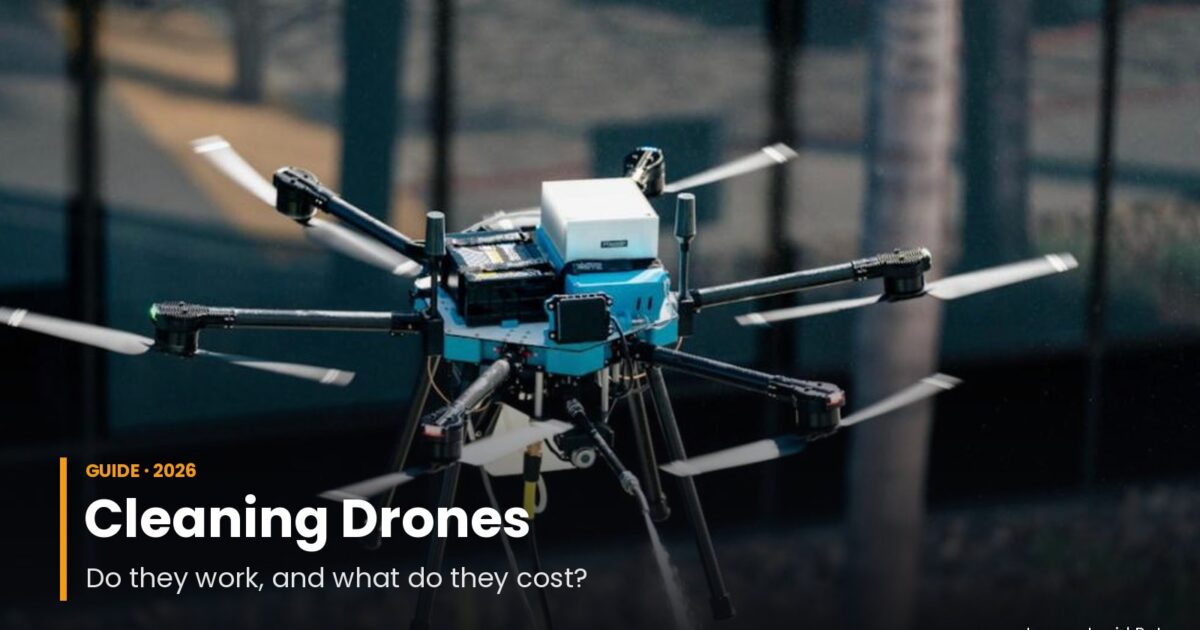
Cover image: Lucid Bots Sherpa with power tether. Image: Lucid Bots.
Product links on this page are Amazon affiliate links. If you buy through them, Drone Ranker may earn a commission at no cost to you. We compare drones from manufacturer specifications and filings, not hands-on flight tests.
Sources
- DroneLife: Lucid Bots expands its drone platform (8 October 2026)
- DroneLife (sponsored): 15 Apellix before-and-after jobs (9 October 2026)
- TechCrunch: Lucid Bots raises $20M (25 March 2026)
- DroneLife: Lucid Bots Series B (25 March 2026)
- Lucid Bots: Sherpa drone specifications
- Lucid Bots: Power Tether
- Lucid Bots: Over 1 hour of continuous drone cleaning (December 2025)
- DroneLife: Apellix names UK distributor (16 March 2026)
- DroneLife: Apellix spray-painting beta (16 September 2025)
- DroneLife (sponsored by Apellix): Commercial cleaning drone comparison (17 August 2026)
- 14 CFR 137.3: Definitions (eCFR)
Sources
Primary references used for factual claims in this article.
The Friday Brief
One email a week on what changed in drones
FCC and FAA rule changes, DJI leaks checked against filings, and the week’s new comparisons. Every Friday, nothing else.
Free. Unsubscribe in one click. Sent with Kit; see our privacy policy.
Follow us on Google too: add Drone Ranker as a preferred source →
Continue Reading
All News