Skyrover S1 FCC Ban: Can You Still Buy or Fly It?

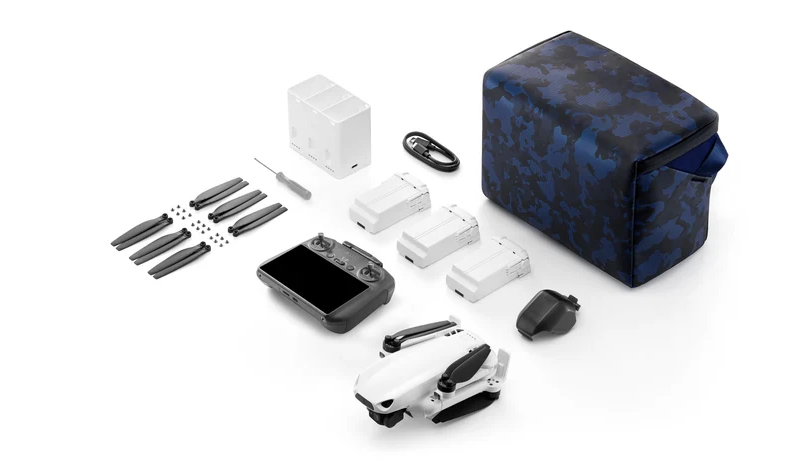
Despite talk of a Skyrover S1 FCC ban, the drone is not banned in the United States. You can still fly one, and on August 31, 2026 you could still buy one. But an FCC proceeding whose public comment period closed that day names the S1’s own FCC authorization, and if the agency adopts its proposal, new sales could stop.
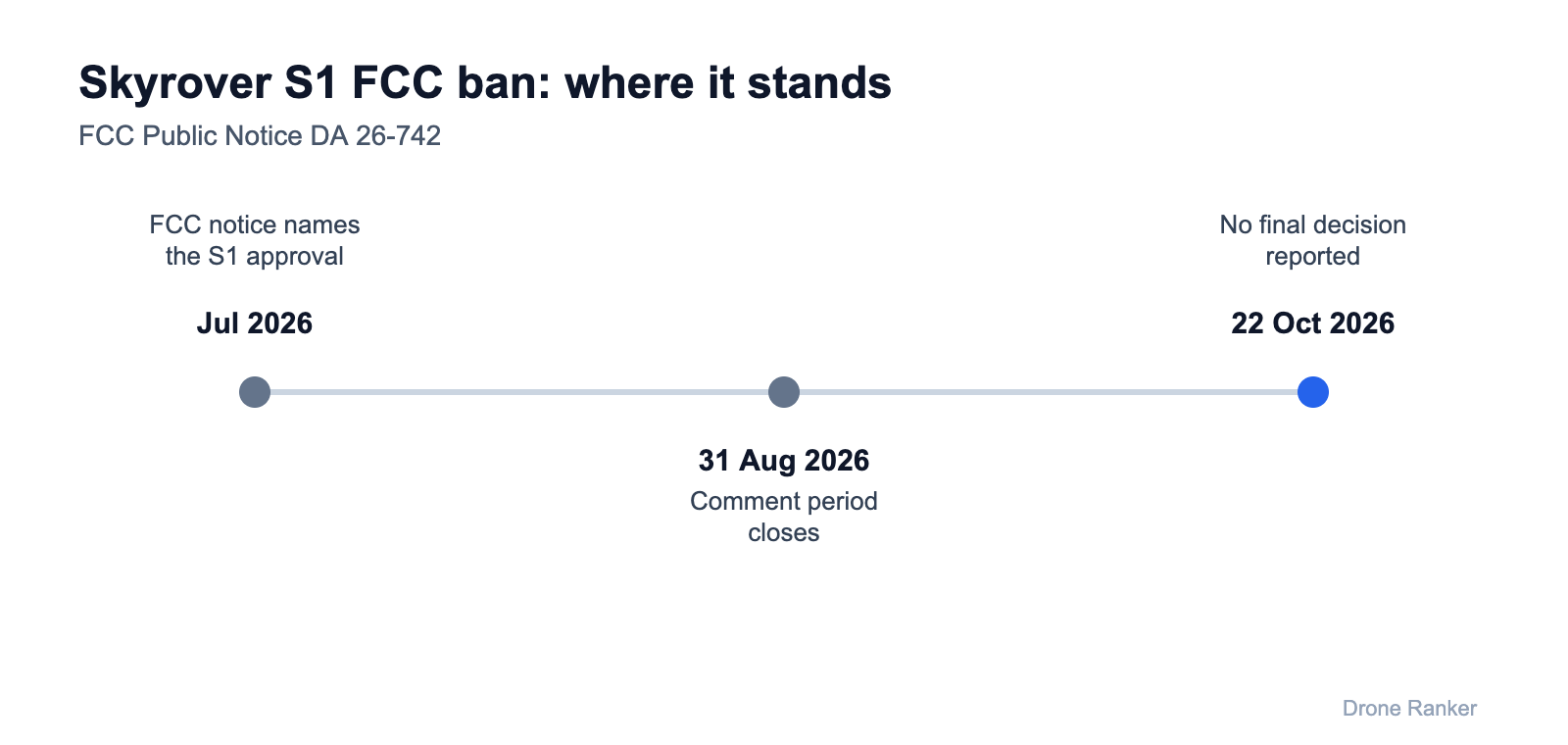
Update, 22 October 2026: the comment period on the Skyrover S1 proceeding closed on 31 August. We have found no report of a final FCC decision since, so the S1’s authorization remains under review rather than revoked.
Update (18 October 2026): Jovistar, another brand the FCC suspected of being a DJI front, has now given up its own FCC drone approval. Read what that means for DJI front companies.
Table of Contents
Skyrover S1 FCC ban: why the S1 is caught up in this
The issue comes from FCC Public Notice DA 26-742, released on July 17, which opened PS Docket No. 26-184. The FCC is considering restrictions on previously authorized foreign-produced drones and drone components tied to nine companies, including WaveGo Tech LLC and SZ Knowact Robot Technology Co., Ltd.
WaveGo is the one that matters for Skyrover. The FCC’s list includes FCC ID 2BPFE-DD001 for the aircraft and 2BPFE-RC001 for its controller. FCC equipment records show DD001 as an unmanned aircraft authorization granted to WaveGo Tech in July 2025.
The proposal goes further than blocking new approvals. It would apply to equipment that was already authorized before being classed as covered, and it would restrict importation and marketing, which FCC rules define broadly enough to include advertising, distribution and sale.
The S1 is not an isolated case. The December 2025 listing covers foreign-made drones as a category rather than a set of companies, which is why brands almost nobody has heard of hit the same wall. We lay out the full picture in which drones are banned in the US.
Is it banned yet?
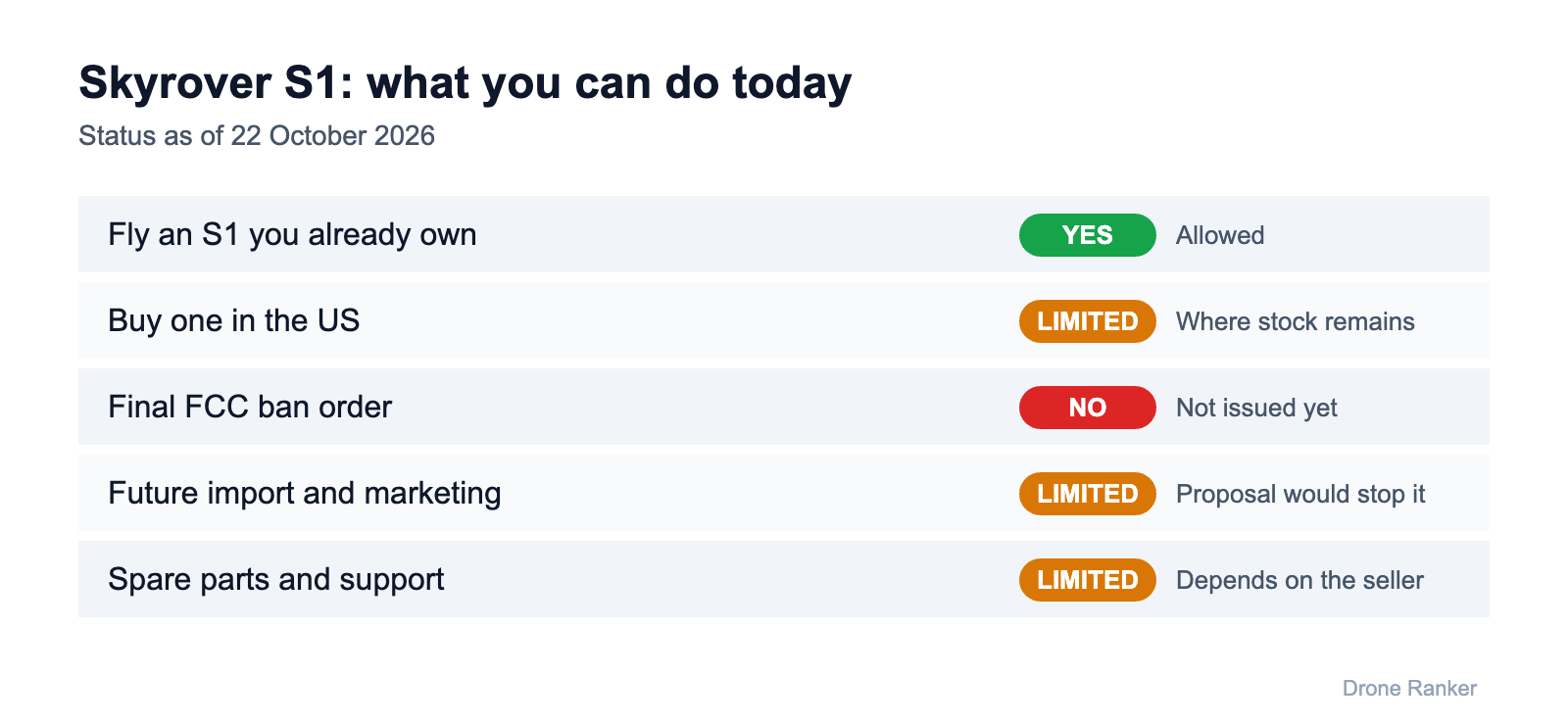
No. August 31 was the deadline for public comments on PS Docket No. 26-184, not a ban date. As of 22 October 2026 there is still no final order on the Skyrover S1 FCC ban, and no published date for one.
The risk is real, though. The FCC has already tentatively concluded that the listed equipment should be treated as covered, and it proposes stopping its continued import and marketing.
Can owners keep flying?
Yes. The FCC says the restrictions would not prevent continued use or operation of equipment already purchased by consumers, and repeats that in the implementation section: equipment already in users’ hands would stay authorized. The target is the supply side, not drones already in the air.
Normal FAA rules still apply. Skyrover lists the S1 at under 249 g, so recreational pilots generally do not need to register it with the FAA. Part 107 operators must register any drone regardless of weight, and registered drones are generally subject to Remote ID. Our registration-by-weight guide covers the details.
Can you still buy one?
For now, yes. Skyrover’s US store listed the S1 on August 31 at $236, down from a stated regular price of $349, with US warehouse shipping, a 30-day return period and a 12-month warranty. DroneXL reported on August 30 that it was also on Amazon, including stock sold by Skyrover Direct and fulfilled by Amazon.
Because the proposal covers marketing and sale, a final order could eventually reach units already sitting in retail stock, depending on its terms. As proposed, affected parties would have 30 days after Federal Register publication of an adopted prohibition to stop importing and marketing. August 31 does not make the S1 disappear from Amazon; it starts the stage of the process that could.
Batteries and parts are the bigger long-term risk
A drone can stay legal to fly and still become hard to maintain. The proceeding covers not only complete drones but also UAS critical components, so if the rules are finalized broadly, importing and selling replacement hardware for covered products could get harder.
Skyrover currently sells a $59 S1 protection plan and says eligible customers can get replacement aircraft, gimbal cameras, propellers, batteries and remote controllers under it. There is no sign today that it has ended those services. The question is what happens if those parts can no longer move normally through the US supply chain.
Why the S1 is still tempting
On paper it is a lot of drone for the price. Skyrover advertises a sub-249 g body, a 1/2-inch Sony sensor, 48 MP photos, 4K at up to 60 fps on a three-axis gimbal, up to 40 minutes of flight time and an FCC transmission range of about 12 km (7.45 miles). It also has forward and downward sensing, and forward obstacle detection is unusual at this price.
Skyrover S1 vs DJI Mini 4K
The DJI Mini 4K is the obvious alternative. On specs, the S1 wins on several counts: 4K/60 against the Mini 4K’s 4K/30, a rated 40 minutes of flight time against 31, and forward obstacle detection where DJI lists only downward vision and infrared sensing. DJI counters with a much more established accessory, software and support ecosystem and its widely used O2 transmission.
The irony is that DJI itself sits at the center of US restrictions, so the Mini 4K is not regulation-proof either. Still, against a cheap S1 with an uncertain supply chain, its existing support base is an advantage that does not show up on a spec sheet.
WaveGo was already under FCC scrutiny
On July 10, the FCC Enforcement Bureau proposed a $25,000 penalty against WaveGo Tech LLC for allegedly failing to respond to a formal Letter of Inquiry. The FCC said the inquiry asked whether WaveGo had marketed radio-frequency equipment connected to equipment on the Covered List. A similar $25,000 proposed penalty was issued against SZ Knowact. These enforcement actions are about the alleged failure to respond, and are separate from the proceeding that could restrict sales.
Should you buy one now?
After the comment period, the FCC will weigh arguments on national security, consumer costs, supply-chain effects and alternatives; it has specifically asked whether the named companies are only a small share of the market and whether other equipment could fill the gap. If it adopts the proposal, the S1 faces something more serious than the rules on new approvals: an end to marketing a drone that is already authorized.
If you want a drone to keep for several years, the S1’s price does not make up for the risk to batteries, parts and warranty replacements, and the Mini 4K or another established model is the safer buy. If you accept that a cheap drone may become hard to service, the S1 is still one of the more interesting budget options, and buying one will not make it illegal to fly. What to watch now is the FCC’s decision, not the comment deadline.
Small drones still sold in the US
135 g, palm takeoff, no controller needed. Under 250 g: recreational flyers skip FAA registration but still need TRUST.
151 g, 4K/60 and omnidirectional sensing. The current Neo you can buy in the US.
As an Amazon Associate, Drone Ranker earns from qualifying purchases. We do not quote prices because Amazon’s change by the hour.
The Friday Brief
One email a week on what changed in drones
FCC and FAA rule changes, DJI leaks checked against filings, and the week’s new comparisons. Every Friday, nothing else.
Free. Unsubscribe in one click. Sent with Kit; see our privacy policy.
Follow us on Google too: add Drone Ranker as a preferred source →
Continue Reading
All News